Roman "wanted poster" for Jesus?

  • Thread starter Thread starter Langdell
  • Start date Start date
Status
Not open for further replies.
L

Langdell

Guest
I’ve been reading, purely for its entertainment value, The Mammoth Book of Unexplained Mysteries, by Colin Wilson. Last night, I read his chapter on the Shroud of Turin.

In this chapter, Wilson claims there is a Roman “wanted poster” for Jesus that describes Him as short and hunchbacked. Wilson does not provide any source for this claim.

I’ve never heard of such a thing before and was unable to find anything solid on the Internet. Does anyone know what the source of this claim might be?
 
I’ve been reading, purely for its entertainment value, The Mammoth Book of Unexplained Mysteries, by Colin Wilson. Last night, I read his chapter on the Shroud of Turin.

In this chapter, Wilson claims there is a Roman “wanted poster” for Jesus that describes Him as short and hunchbacked. Wilson does not provide any source for this claim.

I’ve never heard of such a thing before and was unable to find anything solid on the Internet. Does anyone know what the source of this claim might be?
His overactive imagination?

Sorry. I don’t mean to be snarky, but why on earth would there be a wanted poster for Jesus at all, much less one put out by the Romans, who were perfectly content to ignore Jesus until Judas betrayed Him?

Sounds pretty silly to me…
 
I’ve heard all sorts of claims to refute either Jesus’ divinity or existence. This is a new one for me. If it really existed, you’d think it would be a common atheist Facebook meme and continuously mentioned in the comments section of news sites whenever religion is even tangentially discussed. It could be an attempt to start a lie and hope it’s repeated often enough that it enters the public consciousness.
 
Thanks, all. It certainly sounded bizarre to me, but I wanted to make sure I wasn’t missing some big discovery.
 
I’ve been reading, purely for its entertainment value, The Mammoth Book of Unexplained Mysteries, by Colin Wilson. Last night, I read his chapter on the Shroud of Turin.

In this chapter, Wilson claims there is a Roman “wanted poster” for Jesus that describes Him as short and hunchbacked. Wilson does not provide any source for this claim.

I’ve never heard of such a thing before and was unable to find anything solid on the Internet. Does anyone know what the source of this claim might be?
I think he may be referring to the urban legend of a supposed quote from Josephus which claims that Jesus an ugly hunchback. There is a quote attributed to St. Andrew of Crete which goes: “But moreover the Jew Josephus in like manner narrates that the Lord was seen having meeting eyebrows, goodly eyes, long-faced, crooked (epikyphos), well-grown.” Despite his attribution, however, all the surviving manuscripts of Josephus never give a description of Jesus’ appearance, nor would Josephus - who almost never gives physical descriptions of people, only doing so when the information is essential to his story - have plausibly made such a remark. Moreover, the quote actually fits more the description of St. Paul in the Acts of Paul and Thecla!

That, however, did not stop Robert Eisler, in his work The Messiah Jesus and John the Baptist According to Flavius Josephus, from providing a ‘reconstruction’ of what the passage may have looked like if actually written by Josephus, something which was taken at face value by many people.
 
At the time of Gennadius was withered the hand of a painter who dared to pain the Saviour in the likeness of Zeus. Gennadius healed him by means of a prayer. The author [Theodorus Lector] says that the other form of Christ, viz. the one with short, frizzy hair, is the more authentic.
Theodore the historian of Constantinople, from his History of the Church, about Gennadius, archbishop of Constantinople:
I shall set down other things about him full of amazement. A certain painter, while painting an icon of Christ our Master, found that his hand shriveled up. And it was said that, as the work of the icon had been ordered by a certain pagan, in the adornment of the name of the Savior he had depicted his hair divided on his forehead, so that his eyes were not covered—for in such a way the children of the pagans depict Zeus—so that those who saw it would think that they were assigning veneration to the Savior.
  • Theodorus Lector as quoted by St. John of Damascus, Three Treatises on the Divine Images (720s-30s), Treatise 3, 130
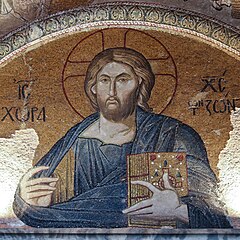
http://img684.imageshack.us/img684/967/6thsinaipantocrator.jpg

As, then, they brought Jesus before [Pilate], he looked at him for a long time, marveling at his beauty and youth. This is his appearance: he is wheat-coloured, his hair is black, coming down to the shoulders like bunches of grapes, his nose is prominent, he has beautiful eyes, his eyebrows are joined together, his cheek are red like roses. He wears a grape-coloured tunic, he has two silver-studded adornments on his side, like a sword, and a linen garment covers him so that he looks like a royal son. Thus they brought him to Pilate, the governor.
  • Pseudo-Cyril of Jerusalem, On the Life and the Passion of Christ (7th-8th century), 114


Of the evangelist and apostle Luke all his contemporaries said that with his own hands he painted both Christ the Incarnated himself and his purest Mother, and their images are preserved in Rome, so it is said, with great honour; and in Jerusalem they are exhibited with meticulous attention. Josephus the Jew, too, says that this was what the Lord looked like when he was seen by the people: with eyebrows that met, fine eyes, a large and prominent face, and great stature, as he was clearly seen when he spoke to the people; and the same can be said as to the reproduction of the Mother of God, which we see also today and somebody calls “the Roman.”
  • Andrew of Crete, On the Veneration of the Holy Images (ca. 700)
He was extremely handsome, six feet tall with blondish hair, not too thick, and lightly waved; the eyebrows black and not very arched, the eyes clear and brilliant; he had beautiful eyes, a long nose, and long, blondish beard, since a razor had never touched his face, nor even any man except for his mother’s when he was an infant. The neck slightly bent, just enough to avoid being rigidly upright, his colour that of wheat; his face was not round, but, like that of his mother, drawn toward the chin, the cheeks lightly coloured, just sufficiently to reveal his pious nature, sage, calm and maintaining always a serene humour without anger.
  • Epiphanius the Monk (ca. 800)
He was beautiful in body, his height seven complete spans, his hair was yellowish, not thick, and at the ends somewhat curled. His eyebrows were black, only a little arched, and without break; his eyes were hazel, of that description called bright-eyed, not dim, in no way misinformed, nor wandering. His nose was prominent, his beard reddish, not profuse, but the hair of the head was abundant, for never had razor or hand of man shorn it. His neck was somewhat bent, so that He did not walk perfectly upright; the colour of his face was a yellow brown, like ripe wheat: his face was not round, nor pointed, but, like his mother’s, a little drooping and slightly blushing. His very countenance indicated a man of intelligence, with manners grave, calm, and removed from anger. In all things was He like His most pure mother.
  • Nicephorus Callistus Xantopulus (ca. 1330s)


Lentulus, the Governor of the Jerusalemites to the Roman Senate and People, greetings. There has appeared in our times, and there still lives, a man of great power, called Jesus Christ. The people call him prophet of truth; his disciples, son of God. He raises the dead, and heals infirmities. He is a man of medium size; he has a venerable aspect, and his beholders can both fear and love him. His hair is of the colour of the ripe hazel-nut, straight down to the ears, but below the ears wavy and curled, with a bluish and bright reflection, flowing over his shoulders. It is parted in two on the top of the head, after the pattern of the Nazarenes. His brow is smooth and vary cheerful with a face without wrinkle or spot, embellished by a slightly reddish complexion. His nose and mouth are faultless. His beard is abundant, of the colour of his hair, not long, but divided at the chin. His aspect is simple and mature, his eyes are changeable and bright. He is terrible in his reprimands, sweet and amiable in his admonitions, cheerful without loss of gravity. He was never known to laugh, but often to weep. His stature is straight, his hands and arms beautiful to behold. His conversation is grave, infrequent, and modest. He is the most beautiful among the children of men.
 
The thing about Robert Eisler is that he advocated the theory that the version of Josephus’ works preserved in Slavonic manuscripts (the so-called Slavonic Josephus) was authentic. In his theory, the Slavonic Josephus was based on the first and now lost Greek editions of The Jewish War, which was originally composed in Aramaic ca. AD 75. The Greek Josephus we all know today is actually a partly rewritten version primarily intended for a Greco-Roman audience. According to Eisler, the Christians who at that time relied on original texts by Josephus in turn tampered with these by adding some bits of text and removing others. Then, in the mid-13th century, a Lithuanian Jew with some sort of Christian background translated Josephus into the Old Russian from Greek texts, thereby producing the Slavonic Josephus. While doing this, he would also have interpolated more materials. Most scholars, however, were not convinced by Eisler’s theory - the Slavonic Josephus is nowadays generally deemed to be a medieval forgery, perhaps written as part of a larger ideological struggle against the Khazars.

Now the extant manuscripts of the Josephus include references to Jesus and the origins of Christianity: the Jewish Antiquities (written in the last decade of the 1st century) includes two references to Jesus in books 18 and 20 and a reference to John the Baptist in book 18. The reference to Jesus in 18.63-64 (the so-called Testimonium Flavianum) is controversial because in its present form, it is blatantly Christian:

At this time there lived one Jesus, a wise man, ((if indeed one should call him a man.)) For he performed surprising deeds, and he was a teacher of men who gladly accept the truth. He won over many Jews and many of the Greeks. ((He was the Christ.)) When Pilate, on hearing him accused by men of the highest standing among us, had condemned him to the cross, those who first loved him did not stop. ((For he appeared to them on the third day, living again, for the divine prophets had foretold these and countless other marvelous things about him.)) And the tribe of the Christians, so called after this (man), has not died out to this day.

The general scholarly view today is that while the Testimonium Flavianum is most likely not authentic in its entirety, it is broadly agreed upon that it originally consisted of an authentic nucleus with a reference to the execution of Jesus by Pilate which was then subject to Christian interpolation, the italicized and parenthesized parts of the quote being the most blatant examples.

Eisler believed that Josephus did write something about Jesus, and theorized that he may have first done so in The Jewish War, which was later removed by Christians, yet have been preserved in a number of later quotes. Josephus could not reasonably have written appreciatively of Jesus and certainly not the Testimonium as it now appears in the Jewish Antiquities – in that case he would not immediately afterwards have written about another sad calamity which befell the Jews. Christians would, on the other hand, not have invented anything about Jesus that could be perceived as negative.

His solution was a simple subtraction: compile everything ever written about Jesus that was likely to come from Josephus, then discard all the bits favorable to Him (and therefore added by Christians) or reverse them. The remainder would then pretty well reflect what Josephus originally wrote. Using the Slavonic Josephus as a base, Eisler reconstructed this supposed reference to Jesus in The Jewish War as he believed it originally appeared by using all the sources he could find, mainly the descriptions of Jesus by Byzantine writers (especially Andrew of Crete’s citation). The result (in part) was this (italicized parts are Eisler’s reconstruction):

At that time, too [during the governorship of Pontius Pilate], there appeared a certain man of magical power, if it is permissible to call him a man, whom (certain) Greeks call a son of God, but his disciples the true prophet, (said to) raise the dead and heal all diseases. His nature and his form were human; a man of simple appearance, mature age, small stature, three cubits high, hunchbacked, with a long face, long nose, and meetng eyebrows, so that they who see him might be affrighted, with scanty hair (but) with a parting in the middle of his head, after the manner of the Nazirites, and with an undeveloped beard. Only in semblance was he superhuman, (for) he gave some astonishing and spectacular exhibitions. But again, if I look at his commonplace physique I (for one) cannot call him an angel. And everything whatsoever he wrought through some invisible power, he wrought through some word and a command. Some said of him, “Our first lawgiver [Moses] is risen again and displays many healings and (magic) arts,” others that “he is sent from God.” Howbeit in many things he disobeyed the law [Torah] and kept not the Sabbath according to (our) fathers’ custom. Yet he himself did nothing shameful or high-handed, but by (his) word he prepared everything. …

 
This, meanwhile, was how Eisler ‘reconstructed’ the Testimonium Flavianum:

Now about this time arose (an occasion for new disturbances) a certain Jesus, a wizard of a man, if indeed he may be called a man (who was the most monstrous of all men, whom his disciples call a son of God, as having done wonders such as no man hath ever yet done). … He was in fact a teacher of astonishing tricks to such men as accept the abnormal with delight. … And he seduced many Jews and many also of the Greek nation, and (was regarded by them) as the Messiah. … And when, on the indictment of the principal men among us, Pilate had sentenced him to the cross, still those who before had admired him did not cease (to rave). For it seemed to them that having been dead for three days, he had appeared to them alive again, as the divinely-inspired prophets had foretold – these and ten thousand other wonderful things – concerning him. And even now the race of those who are called ‘Messianists’ after him is not extinct.

And finally, from the Acts of Paul and Thecla (3.2-3):

And a certain man named Onesiphorus, having heard that Paul was arriving into Iconium, went out to meet him with his children, Simmias and Zenon, and his wife, Lectra, so that he could receive him. For Titus had described to him what sort of image Paul had, for he knew him not by flesh, but only in spirit.
And he was going down by the king’s way, the one from Lystra, and he stood eagerly awaiting him, and he was looking over the ones coming by according to the description passed on by Titus. And he saw Paul coming, a man small of stature, bald headed, a crook in the legs, healthy, a brow meeting in the middle, a small nose, a gracious presence; for some times he appeared as a man, but at other times he had the face of an angel.
 
I’ve been reading, purely for its entertainment value, The Mammoth Book of Unexplained Mysteries, by Colin Wilson. Last night, I read his chapter on the Shroud of Turin.

In this chapter, Wilson claims there is a Roman “wanted poster” for Jesus that describes Him as short and hunchbacked. Wilson does not provide any source for this claim.

I’ve never heard of such a thing before and was unable to find anything solid on the Internet. Does anyone know what the source of this claim might be?
Haha… some people…

I think Colin Wilson is making some far fetches conjecture under influence of drugs.

There is no evidence of such ‘Wanted Poster’ and I have no biblical scholar ever mention it, not even radical ones.
 
This, along with the Shroud of Turin and other such things, always reminds me of the words of the Lord Himself, heard but a short week ago in our very ears:

John 20:29 Jesus said to Thomas: “You believe because you can see me. Blessed are those who have not seen and yet believe.”

Use the eyes of faith, and you will need nothing else.
 
I’ve been reading, purely for its entertainment value, The Mammoth Book of Unexplained Mysteries, by Colin Wilson. Last night, I read his chapter on the Shroud of Turin.

In this chapter, Wilson claims there is a Roman “wanted poster” for Jesus that describes Him as short and hunchbacked. Wilson does not provide any source for this claim.

I’ve never heard of such a thing before and was unable to find anything solid on the Internet. Does anyone know what the source of this claim might be?
Maybe he is confusing Jesus with the Hunchback of Notre Dame.

If you were the Son of God, would anyone chose to look like that?
 
Maybe he is confusing Jesus with the Hunchback of Notre Dame.

If you were the Son of God, would anyone chose to look like that?
Well, some early Christians like Tertullian thought that Jesus was physically unattractive on the basis of Psalm 22 or Isaiah 53.

Let us compare with Scripture the rest of His dispensation. Whatever that poor despised body may be, because it was an object of touch and sight, it shall be my Christ, be He inglorious, be He ignoble, be He dishonoured; for such was it announced that He should be, both in bodily condition and aspect. Isaiah comes to our help again: “We have announced (His way) before Him,” says he; “He is like a servant, like a root in a dry ground; He has no form nor comeliness; we saw Him, and He had neither form nor beauty; but His form was despised, marred above all men.” Similarly the Father addressed the Son just before: “Inasmuch as many will be astonished at You, so also will Your beauty be without glory from men.” (Isaiah 52:14) For although, in David’s words, He is fairer than the children of men, yet it is in that figurative state of spiritual grace, when He is girded with the sword of the Spirit, which is verily His form, and beauty, and glory. According to the same prophet, however, He is in bodily condition “a very worm, and no man; a reproach of men, and an outcast of the people.” But no internal quality of such a kind does He announce as belonging to Him. In Him dwelt the fullness of the Spirit; therefore I acknowledge Him to be “the rod of the stem of Jesse.” His blooming flower shall be my Christ, upon whom has rested, according to Isaiah, “the spirit of wisdom and understanding, the spirit of counsel and might, the spirit of knowledge and of piety, and of the fear of the Lord.” (Isaiah 11:1-2) Now to no man, except Christ, would the diversity of spiritual proofs suitably apply. He is indeed like a flower for the Spirit’s grace, reckoned indeed of the stem of Jesse, but thence to derive His descent through Mary.
 
Ummm, but the Romans did **not **want Jesus. Pilate sent him away to Herod. Herod sent Jesus back, which displeased Pilate. Pilate sought repeatedly to release Jesus (John 19:6, 13). Pilate wanted nothing to do with Jesus, and reluctantly condemned him only because the mob insisted, and threatened that Pilate would be a traitor to Rome if he refused.

A “Not Wanted” poster would have been more appropriate.
 
Status
Not open for further replies.
Back
Top