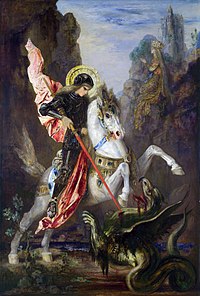
The Legend of St. George and the Dragon
There are many versions of the story of St George slaying the dragon. Most agree on the following:
A town was terrorised by a dragon.
A young princess was offered to the dragon
When George heard about this he rode into the village
George slayed the dragon and rescued the princess
Enjoy the allegory of good triumphing against evil.
This legend originated in the East and was brought to the West by the Crusaders. According to the Golden Legend the story took place in a place called “Silene,” in Libya.
St. George travelled for many months by land and sea until he came to Libya. Here he met a poor hermit who told him that everyone in that land was in great distress, for a dragon had long ravaged the country.
‘Every day,’ said the old man, ‘he demands the sacrifice of a beautiful maiden and now all the young girls have been killed. The king’s daughter alone remains, and unless we can find a knight who can slay the dragon she will be sacrificed tomorrow. The king of Egypt will give his daughter in marriage to the champion who overcomes this terrible monster.’
When St. George heard this story, he was determined to try and save the princess, so he rested that night in the hermit’s hut, and at daybreak set out to the valley where the dragon lived. When he drew near he saw a little procession of women, headed by a beautiful girl dressed in pure Arabian silk. The princess Sabra was being led by her attendants to the place of death. The knight spurred his horse and overtook the ladies. He comforted them with brave words and persuaded the princess to return to the palace. Then he entered the valley.
As soon as the dragon saw him it rushed from its cave, roaring with a sound louder than thunder. Its head was immense and its tail fifty feet long. But St. George was not afraid. He struck the monster with his spear, hoping he would wound it.
The dragon’s scales were so hard that the spear broke into a thousand pieces. and St. George fell from his horse. Fortunately he rolled under an enchanted orange tree against which poison could not prevail, so that the venomous dragon was unable to hurt him. Within a few minutes he had recovered his strength and was able to fight again.
He smote the beast with his sword, but the dragon poured poison on him and his armour split in two. Once more he refreshed himself from the orange tree and then, with his sword in his hand, he rushed at the dragon and pierced it under the wing where there were no scales, so that it fell dead at his feet…
Another version I liked better has Saint George and the Princess in a conversation when the dragon reared out of the lake. Saint George fortified himself with the Sign of the Cross, charged it on horseback with his lance and gave it a grievous wound. Then he called to the princess to throw him her girdle, and he put it around the dragon’s neck. When she did so, the dragon followed the girl like a meek beast on a leash.
She and Saint George led the dragon back to the city of Silene, where it terrified the people at its approach. But Saint George called out to them, saying that if they consented to become Christians and be baptized, he would slay the dragon before them. The king and the people of Silene converted to Christianity, George slew the dragon, and the body was carted out of the city on four ox-carts. “Fifteen thousand men baptized, without women and children.” On the site where the dragon died, the king built a church to the Blessed Virgin Mary and Saint George, and from its altar a spring arose whose waters cured all disease.
Now is isn’t that a befitting end ?

Traditionally, the sword with which St. George slew the dragon was called Ascalon, a name recalling the city of Ashkelon, Israel. From this tradition, the name Ascalon was used by Winston Churchill for his personal aircraft during World War II ( so I understand) since St. George is the Patron Saint of England.

 I’m curious as to any special meaning to the way the other apostles are drawn.