Saint of the day and Feast days-Part 2

  • Thread starter Thread starter odhiambo
  • Start date Start date
Status
Not open for further replies.
From an Easter homily by Saint Melito of Sardis, bishop
*The lamb that was slain has delivered us from death and given us life
*

There was much proclaimed by the prophets about the mystery of the Passover: that mystery is Christ, and to him be glory for ever and ever. Amen.

For the sake of suffering humanity he came down from heaven to earth, clothed himself in that humanity in the Virgin’s womb, and was born a man. Having then a body capable of suffering, he took the pain of fallen man upon himself; he triumphed over the diseases of soul and body that were its cause, and by his Spirit, which was incapable of dying, he dealt man’s destroyer, death, a fatal blow.

He was led forth like a lamb; he was slaughtered like a sheep. He ransomed us from our servitude to the world, as he had ransomed Israel from the land of Egypt; he freed us from our slavery to the devil, as he had freed Israel from the hand of Pharaoh. He sealed our souls with his own Spirit, and the members of our body with his own blood.

He is the One who covered death with shame and cast the devil into mourning, as Moses cast Pharaoh into mourning. He is the One who smote sin and robbed iniquity of offspring. He is the One who brought us out of slavery into freedom, out of darkness into light, out of death into life, out of tyranny into an eternal kingdom; who made us a new priesthood, a people chosen to be his own for ever. He is the Passover that is our salvation.

It is he who endured every kind of suffering in all those who foreshadowed him. In Abel he was slain, in Isaac bound, in Jacob exiled, in Joseph sold, in Moses exposed to die. He was sacrificed in the Passover lamb, persecuted in David, dishonored in the prophets.

It is he who was made man of the Virgin, he who was hung on the tree; it is he who was buried in the earth, raised from the dead, and taken up to the heights of heaven. He is the mute lamb, the slain lamb, the lamb born of Mary, the fair ewe. He was seized from the flock, dragged off to be slaughtered, sacrificed in the evening, and buried at night. On the tree no bone of his was broken; in the earth his body knew no decay. He is the One who rose from the dead, and who raised man from the depths of the tomb.
 
Is there anything in this painting that strikes anyone?
Nothing strikes me Kelvin, but then I do not have an eye for the finer details. I am eager to know what it is that caught your attention 🙂
 
May 22

Today is
**Good Friday
**
On this day we commemorate the passion, the crucifixion and death of Our Lord Jesus Christ on the Cross
 
The LORD says,
“My servant will succeed in his task;
He will be highly honored”
Many people were shocked when they saw him;
He was so disfigured that he hardly looked human.
But now many nations will marvel at him,
And kings will be speechless with amazement.
They will see and understand something they had never known.”

And so I will give him a place of honor,
a place among the great and powerful.
He willingly gave up his life and shared the fate of evil man.
He took the place of many sinners and prayed that they might be forgiven.
Is. 52: 13-15; 53: 12
Good News Bible With DC
 
22 April

Today is also the Feast day of
Saint Adalbert of Praque
Among many other saints.
 
**Saint Adalbert
Bishop of Praque.
**
Adalbert was born in 956 into an illustrious family of Bohemia ( now in the Czech Republic). He descended from the princes of Bohemia. His given name was Voytech or Wojtech).
While still a child, it seems that he became very ill. His parents turned to the Virgin Mother for help, vowing to offer him to the priesthood if he would be cured. Their prayers were answered, and the boy recovered his health.
They sent their son to Magdeburg in Germany, to the Archbishop of Magdeburg, a saintly man. The archbishop saw to his overall education, but most especially his religious education. At his baptism (or confirmation, it is not clear which from my reading), he took the name of his teacher, Adalbert.
In 973 he was ordained priest by the Bishop of Prague.
After the death of his mentor, the Archbishop of Magdeburg, in 981, Adalbert, who was inclined to missionary work and clerical reform, returned to Prague.
In 982, when the Bishop of Prague also died, Adalbert was elected his successor. He was now 27 years old.
He entered Prague barefoot and was joyfully received by the people. The Diocese was in a deplorable situation. Some of its inhabitants were still idolaters, and many Catholics were well entrenched in shameful vices. St. Adalbert tried to correct them and to bring them to religion and piety, but his efforts proved fruitless.
With sadness, he asked permission from the Pope to leave the Episcopate and enter a monastery in Rome. The Pope granted him his wish.
After five years (8 years by other accounts), Pope John XV sent him back to Prague with the provision that he could again leave the Episcopate if the people were still not responsive to his counsel.
For the second time he was received joyfully, and the people promised to correct their wayward ways and leave their heathen practices. These hasty promises, however, were soon forgotten. Saint Adalbert determined to abandon them forever and return to his monastery. On his way back to Rome, he met with a great success in Hungary, where he converted many to Catholicism. After the ministry in Hungary, he went to preach the Good News to people living near the Baltic Sea, the people of Prussia. He converted some of the inhabitants of Danzig.
It was here that he and two companions were martyred by pagan priests in that region. When he received the first blow, he thanked God for giving him the opportunity to suffer for Him. Then the pagan priest leading the idolaters pierced his body with a two-headed lance, saying: “Be joyous, then, since you want nothing more than to suffer with your Christ.” It was April 23, 997.

Adalbert’s body was immediately ransomed and buried in Gniezno cathedral (Poland). In the mid-11th century his body was moved to St. Vitus Cathedral in Prague.
He was canonized in 999.

Saint Adalbert,
Pray for us!
 
It’s just that the disciple “sleeping” looks feminine. I did some digging and it turns out that John is often shown asleep against Jesus shoulder and there have been other male saints who have been rendered with effeminate features such as John the Baptist.

And as you might guess, I first thought it was Mary Magdalene (with red hair).
 
Saint Adalbert
Bishop of Praque.
**
** It was here that he and two companions were martyred by pagan priests in that region. When he received the first blow, he thanked God for giving him the opportunity to suffer for Him. Then the pagan priest leading the idolaters pierced his body with a two-headed lance, saying: “Be joyous, then, since you want nothing more than to suffer with your Christ.” It was April 23, 997.
Must have been Holy Week just like now.
 
It’s just that the disciple “sleeping” looks feminine. I did some digging and it turns out that John is often shown asleep against Jesus shoulder and there have been other male saints who have been rendered with effeminate features such as John the Baptist.

And as you might guess, I first thought it was Mary Magdalene (with red hair).
Well, from the Bible, Mary Magdalene was no where in that Upper Room where the Last Supper was eaten.
I knew it was Saint John reclining against Jesus because the Bible also says as much, He was the disciple " whom Jesus loved".
As for his looking feminine, I am afraid I do not see it.
 
Saint Adalbert determined to abandon them forever and return to his monastery.
Sobering words.

A very blessed Holy Saturday to you odhiambo, and all.
 
May 23

Today is Holy Saturday .
Jesus has been buried and His Body lies in the tomb.
His Soul , however, has gone elsewhere to free the souls of the righteous who had died before Him. We say in the Apostles’ Creed that “He descended into hell”:
after he was buried.
“Hell” here refers to the place of the dead in general, certainly not “Gehenna”, the “Hell of the Lost,” the eternal place of punishment for the damned, the place we usually refer to as simply “Hell” today. The word is used here in the loosest, earliest sense which includes Limbo, Purgatory and Gehena.
This used to worry me when I did not know any better.
Although tomorrow we rejoice in The Lord’s Resurrection, today a great silence engulfs us all. Jesus Christ Our Lord, though innocent, was crucified because of my sins.

We adore you, O Christ and we praise you;
because by your holy cross you have redeemed the world.
 
23 April

Today is also the Feast day of
Saint George
Among many other saints
 
Saint George.

George was born sometime between 275 AD and 285 AD most likely in Cappadocian, modern Turkey.
His father, Gerontius, was a Roman army official from Cappadocia , and his mother, Polychronia, was from Palestine. They were both Christians and from noble rank. George was therefore raised with Christian beliefs. His given name was Georgius (Latin) or Georgios (Greek), meaning “worker of the land”. At the age of 14, his father died.He moved to Palestine with his mother, but a few years later, she too, died. (Other accounts give the names of his parents as Anastasius and Theobaste.).
Now aged about seventeen, and both his parents dead, George decided to go to Nicomedia, the imperial city of that time, and present himself to Emperor Diocletian to apply for a career as a soldier. Diocletian welcomed him with open arms, as he had known his father, Gerontius who had been one of his finest soldiers. By his late 20s, George was promoted to the rank of Tribune and stationed as an imperial guard of the Emperor at Nicomedia.

In the year AD 302, Diocletian issued an edict that every Christian soldier in the army should be arrested and every other soldier should offer a sacrifice to the Pagan gods. But George objected and with the courage of his faith approached the Emperor and objected to the ruling. Diocletian was upset, not wanting to lose his best tribune and the son of his best official, Gerontius. George loudly renounced the Emperor’s edict, and in front of his fellow soldiers and tribunes he claimed himself to be a Christian and declared his worship of Jesus Christ. Diocletian attempted to convert George, even offering gifts of land, money and slaves if he made a sacrifice to the Roman gods. The Emperor made many offers, but George upheld his Faith.
Recognizing the futility of his efforts, Diocletian ordered that George be executed for his refusal to offer sacrifice to the Pagan gods. Before the execution George gave his wealth to the poor and prepared himself for the martyrdom.
He was put through various torture sessions, including laceration on a wheel of swords in which he was resuscitated three times. He was finally executed by decapitation before Nicomedia’s city wall, on April 23, 303. This day is now known as Saint George’s Day.

Witnessing his suffering, Empress Alexandra and Athanasius, a pagan priest, were converted to Christianity. They too, joined George in martyrdom. His body was returned to Lydda (in modern day Palestine) for burial, where Christians soon came to honour him as a martyr.

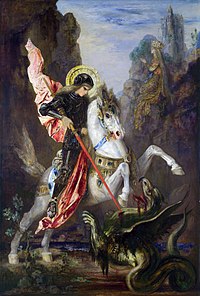
St. George is usually depicted in liturgical art as a soldier on horseback killing a dragon with a lance.

Saint George,
Pray for us!
 
The Legend of St. George and the Dragon

There are many versions of the story of St George slaying the dragon. Most agree on the following:

A town was terrorised by a dragon.
A young princess was offered to the dragon
When George heard about this he rode into the village
George slayed the dragon and rescued the princess
Enjoy the allegory of good triumphing against evil.

This legend originated in the East and was brought to the West by the Crusaders. According to the Golden Legend the story took place in a place called “Silene,” in Libya.
St. George travelled for many months by land and sea until he came to Libya. Here he met a poor hermit who told him that everyone in that land was in great distress, for a dragon had long ravaged the country.
‘Every day,’ said the old man, ‘he demands the sacrifice of a beautiful maiden and now all the young girls have been killed. The king’s daughter alone remains, and unless we can find a knight who can slay the dragon she will be sacrificed tomorrow. The king of Egypt will give his daughter in marriage to the champion who overcomes this terrible monster.’

When St. George heard this story, he was determined to try and save the princess, so he rested that night in the hermit’s hut, and at daybreak set out to the valley where the dragon lived. When he drew near he saw a little procession of women, headed by a beautiful girl dressed in pure Arabian silk. The princess Sabra was being led by her attendants to the place of death. The knight spurred his horse and overtook the ladies. He comforted them with brave words and persuaded the princess to return to the palace. Then he entered the valley.

As soon as the dragon saw him it rushed from its cave, roaring with a sound louder than thunder. Its head was immense and its tail fifty feet long. But St. George was not afraid. He struck the monster with his spear, hoping he would wound it.
The dragon’s scales were so hard that the spear broke into a thousand pieces. and St. George fell from his horse. Fortunately he rolled under an enchanted orange tree against which poison could not prevail, so that the venomous dragon was unable to hurt him. Within a few minutes he had recovered his strength and was able to fight again.

He smote the beast with his sword, but the dragon poured poison on him and his armour split in two. Once more he refreshed himself from the orange tree and then, with his sword in his hand, he rushed at the dragon and pierced it under the wing where there were no scales, so that it fell dead at his feet…

Another version I liked better has Saint George and the Princess in a conversation when the dragon reared out of the lake. Saint George fortified himself with the Sign of the Cross, charged it on horseback with his lance and gave it a grievous wound. Then he called to the princess to throw him her girdle, and he put it around the dragon’s neck. When she did so, the dragon followed the girl like a meek beast on a leash.
She and Saint George led the dragon back to the city of Silene, where it terrified the people at its approach. But Saint George called out to them, saying that if they consented to become Christians and be baptized, he would slay the dragon before them. The king and the people of Silene converted to Christianity, George slew the dragon, and the body was carted out of the city on four ox-carts. “Fifteen thousand men baptized, without women and children.” On the site where the dragon died, the king built a church to the Blessed Virgin Mary and Saint George, and from its altar a spring arose whose waters cured all disease.

Now is isn’t that a befitting end ?🙂

Traditionally, the sword with which St. George slew the dragon was called Ascalon, a name recalling the city of Ashkelon, Israel. From this tradition, the name Ascalon was used by Winston Churchill for his personal aircraft during World War II ( so I understand) since St. George is the Patron Saint of England.

 
Status
Not open for further replies.
Back
Top