
Saint of the day and Feast days-Part 2

  • Thread starter Thread starter odhiambo
  • Start date Start date
Status
Not open for further replies.
Saint William of Roskilde
William was an English priest. He was chaplain to King Canute and as such, used to accompany the King on his travels. While in Denmark one time, he was appalled at the level of ignorance, idolatry, and superstition among the people there. He could see how enormous their missionary needs were and decided there and then, to remain and preach the Gospel to them. He did just that. Eventually William was named bishop of Roskilde on Zeeland Island on the recommendation of Canute. When King Canute died, he was succeeded by King Sweyn Estridsen.
Most of the things related to William have reference to his unwearying efforts to reform the behavior of King Sweyn Estridsen. The new king, despite his many good qualities, was described as headstrong, willful and that several times his actions greatly offended against Christian virtue. One such actions of the King was the stoning to death of a number of men. This was done summarily and without trial, worse, the men were killed within the Church, violating its sanctuary.
William rebuked the king, risking his own life in so doing. He went further and decreed that a person who had shed blood unjustly could not receive the sacraments until he had done public penance.
King Sweyn came to the saint’s cathedral with armed men ready for a showdown.
William stood at the door, armed only with his crozier, and refused the king entry. The armed men drew their swords, at which the saint offered them his neck, ready to give his life for his beliefs. At this point, the King saw reason and came off his high horse, so to speak. He asked for forgiveness. He offered property to the church as a token of his great shame.
There were other instances where William told the King off, about his lifestyle. It is said he marryed his own stepdaughter.
William remonstrated with him constantly for that. He sought and received public as well as the support of the archbishop of Hamburg. Even the Pope and the Emperor, all joined in condemning the King’s action. He was eventually forced to put aside his unlawful wife.
Despite their differences, the two men were friends and usually worked together.
Then King Sweyn Estridsen died. As his body was being carried to Roskilde cathedral, William, who was participating at the funeral and was,on his way to meet
the cortege, dropped down dead!
The bodies of both men were then buried together in Roskilde cathedral.
Saint
William of Roskilde,
Pray for us!
 
Saint William of Roskilde
William was an English priest. He was chaplain to King Canute and as such, used to accompany the King on his travels. While in Denmark one time, he was appalled at the level of ignorance, idolatry, and superstition among the people there. He could see how enormous their missionary needs were and decided there and then, to remain and preach the Gospel to them. He did just that.
Then he said to his disciples,
“The harvest is plentiful but the workers are few.
Ask the Lord of the harvest, therefore, to send out workers into his harvest field.”
Matthew 9: 37-38
 
September 3

Today is the Feast day of
Saint Gregory the Great
Among many other Saints,
 
Saint Gregory the Great
Pope
Doctor of the Church.

Gregory was born in 540 in Rome, Italy. His father was a wealthy senator named Gordianus. His mother was a pious woman named Sylvia. Later she would become Saint Sylvia. (Some accounts name her as Celia).
Gregory was educated by the best of teachers in Rome. He became governor or prefect of Rome while still young. When his father died, Gregory, who had long been attracted to the religious life, abandoned his political career. He converted his estate on the Caelian Hill in Rome into Saint Andrew’s Monastery under Valentius. He then became a monk there. He next founded six monasteries on his estates in Sicily.
After several years of seclusion at Saint Andrews’s, He was ordained priest by Pope Pelagius II. He was also made one of the seven papal deacons in 578. Gregory also served as papal nuncio in Constantinople for several years then returned to Rome to resume his monastic life and became Abbot of Saint Andrews’s.
Gregory cared particularly about the poor and the defenceless. It is said that he once saw some boys being sold as slaves. When he learnt the boys were from England, he set out to go and evangelize England. When plague struck Rome in 589-590, he was brought back by Pope Pelagius. When Pope Pelagius himself died a victim of the plague, Gregory was elected 64th Pope by unanimous acclamation and consecrated on September 3, 590 despite reluctance on his part. Gregory ruled the Church for 14 years and is noted as one of the greatest popes the Church has ever had.
He conducted massive reforms of the clergy and clerical affairs; for instance, he removed unworthy clerics from the office.
He abolished clerical fees for burial and ordination.
He administered papal properties wisely and justly.
Protected Jews from unjust practices.
He ransomed captives of the Lombards.
In 593, he negotiated a peace agreement with the Lombard King to spare Rome from siege and destruction.
Gregory also combated simony, heresy and injustice,
He sent Saint Augustine and 40 monks from his monastery on the Caelian Hill to England, thereby starting the conversion of the English.
He is credited with the form of musical worship known as the Gregorian chant.
Gregory also rebuilt Rome after many natural disasters. He launched charitable programs to feed the hungry people throughout Italy. Helping the poor, feeding the hungry, etc was of deep importance to Saint Gregory who is said to have once wept openly on hearing that someone had starved to death in Rome during his administration.
Gregory was a copious writer and a wonderful preacher.
He is the author of treaties, including his Dialogues and Liber Regulae Pastoralis (on the duties of the bishop) and many others.
Gregory was a deeply holy and sincerely humble pontiff. He took for himself the title, Servus Servorum Dei (Servant of the Servants of God) All the popes since have used this title.
He died of natural causes on 12 March 604 in Rome and was canonized by acclamation immediately after his death.

Saint Gregory,
Pray for us!
 
Last year from the Saint Matthew Bible Study Group here at CAF, I learned that Pope Saint Gregory the Great, in one of his homilies on the Gifts of the Magi said that the treasures represent the gifts that we Christians present to Christ in our daily lives.
Gold is Christ’s Wisdom which shines in us.
Frankincense is the prayer and adoration we give Him.
Myrrh is our daily self sacrifice.
 
September 4
Today is the Feast day of
Saint Rosalia.
Among many other Saints
 
Saint Rosalia.
Also known as La Santuzza or
"The Little Saint"

Rosalia was born at Palermo, Sicily in 1130. She was the daughter of a noble and wealthy family descended from Charlemagne. Her father was Duke Sinibaldo, Lord of the Quisquina and the Roses, who was a cousin of King William II of Sicily. Rosalia grew up
around the royal court in Sicily. As a youth, however, she turned her back on this priviledged life of ease and wealth, choosing to live alone in a cave near her home. According to tradition, she was led to this cave by two angels. On the wall of the cave she wrote the following words:
** “I, Rosalia, daughter of Sinibald, Lord of Roses, and Quisquina, have taken the resolution to live in this cave for the love of my Lord, Jesus Christ.”**
Rosalia remained in this cave entirely cut off from the world, dedicated to prayer and works of penance for the sake of Jesus.
Later, probably around 1159, she moved to a remote cave on Mount Pellegrino, about three miles from Palermo. It was here that Rosalia died alone most likely on 4th of September 1160 of natural causes.
Nothing was heard from her until 1624. This was the year the black plague struck Sicily.
Rosalia appeared in a vision to a hunter lost on Monte Pellegrino. “Don’t worry,” she said “I will protect you and I will protect the city”. She revealed to him the site of the cave in which she had lived as a hermit and told him to go back to Palermo and tell the archbishop and rulers of the city what he has seen and been told. The hunter did as he was instructed, and those leaders found her remains and displayed them through the streets of Palermo. Within three days, the plague ended, and she was proclaimed patron saint of the city.
A sanctuary was built in the cave where her remains were discovered.
I understand that during the first week of June every year in Santo Stefano Quisquina, there is a special celebration to commemorate her miraculous intervention that saved Palermo from the Black Plague.
According to SQPN, her feast day was made a holy day of obligation by Pope Pius XI in 1927.
Saint Rosalia,
Pray for us!
 
Saint Rosalia.
Also known as La Santuzza or
"The Little Saint"

Rosalia was born at Palermo, Sicily in 1130. She was the daughter of a noble and wealthy family descended from Charlemagne. Her father was Duke Sinibaldo, Lord of the Quisquina and the Roses, who was a cousin of King William II of Sicily. Rosalia grew up
around the royal court in Sicily. As a youth, however, she turned her back on this priviledged life of ease and wealth, choosing to live alone in a cave near her home. According to tradition, she was led to this cave by two angels. On the wall of the cave she wrote the following words:
** “I, Rosalia, daughter of Sinibald, Lord of Roses, and Quisquina, have taken the resolution to live in this cave for the love of my Lord, Jesus Christ.”**
Rosalia remained in this cave entirely cut off from the world, dedicated to prayer and works of penance for the sake of Jesus.
Later, probably around 1159, she moved to a remote cave on Mount Pellegrino, about three miles from Palermo. It was here that Rosalia died alone most likely on 4th of September 1160 of natural causes.
Nothing was heard from her until 1624. This was the year the black plague struck Sicily.
Rosalia appeared in a vision to a hunter lost on Monte Pellegrino. “Don’t worry,” she said “I will protect you and I will protect the city”. She revealed to him the site of the cave in which she had lived as a hermit and told him to go back to Palermo and tell the archbishop and rulers of the city what he has seen and been told. The hunter did as he was instructed, and those leaders found her remains and displayed them through the streets of Palermo. Within three days, the plague ended, and she was proclaimed patron saint of the city.
A sanctuary was built in the cave where her remains were discovered.
I understand that during the first week of June every year in Santo Stefano Quisquina, there is a special celebration to commemorate her miraculous intervention that saved Palermo from the Black Plague.
According to SQPN, her feast day was made a holy day of obligation by Pope Pius XI in 1927.
Saint Rosalia,
Pray for us!
This is one of my favorite stories.
 
This is one of my favorite stories.
I always marvel at the holiness of the Saints.
It seems to me that one was more likely to lead a holy life in years past than now.
Just an impression of mine.
 
September 5

Today is the Feast day of
Blessed Teresa of Calcutta
Among many other Blesseds and Saints.

 
Blessed Teresa of Culcutta.

** “By blood, I am Albanian. By citizenship, an Indian. By faith, I am a Catholic nun. As to my calling, I belong to the world. As to my heart, I belong entirely to the Heart of Jesus.”
**
Those are the words of The Blessed Teresa of Calcutta, who is also known as
Mother Teresa, Agnes Gonxha Bojaxhiu, and Saint of the Gutters.
Mother Teresa was born on 26 August 1910 in Skopje, Albania present day Macedonia. She was given the name Agnes Gonxha Bojaxhiu at baptism.
She was the youngest of three children born to her parents Nikolle and Drandafille Bojaxhiu, Her father was a businessman and died when Agnes was just nine years old. After completing her studies at age 18, Agnes joined the Sisters of Loreto, at Loreto Abbey in Ireland on 25 September 1928 and took the name “Teresa”, choosing St Therese of Lisieux as her patron.
It was at Loreto that Agnes learnt English while training for the religious life.
In 1929, Sister Teresa went to Calcutta, and taught for 17 long years at the Order’s school in Calcutta, St Mary’s School at Entally. Here, she learnt and mastered the local language, Bengali.
On 10 September 1946, while traveling by train to Darjeeling for her annual retreat, Sister Teresa experienced a divine call to devote herself to caring for the sick and the poor.
She sought and obtained due permission from her Congregation, from the then Archbishop of Calcutta and from the Vatican. The process took nearly two years before she could embark on the work Jesus had revealed to her.
She abandoned the comfort and security of the Loreto Convent on 16 August 1948 to go out into the world and face the harsh realities of the slums of Calcutta.
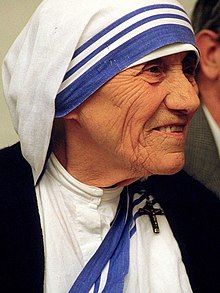
On August 17, 1948, she dressed for the first time in a white, blue bordered sari,
a crucifix pinned at her shoulder, a Bible in hand and with less than five rupees in her pocket, Sister Teresa abandoned the comfort and security of her beloved Loreto Convent. She passed through its gates and entered the world of the poor, the world of the slums of Calcutta.
To equip her for the task ahead, she took a six month intensive training course in nursing, with the Medical Missions Sisters in Patna. After that, she was ready; there was no turning back. She found temporary lodging with the Little Sisters of the Poor. On 21 December she went for the first time to the slums. From then on, she started each day in communion with Jesus in the Eucharist and then went out, rosary in her hand, to find and serve Him in “the unwanted, the unloved, the uncared for.”
Continue at the next post.
 
Blessed Teresa of Culcutta…
She nursed the sick and the dying with the utmost tender care and, lovingly cleansing their maggot-infested wounds, washing their naked bodies. In short, she saw Jesus in every human being she encountered and acted accordingly.
After some months, she was joined, one by one, by some of her former students.
On 21 December 1948, Mother Teresa started her first slum school. In 1949, some of her former pupils joined her in her mission to the dregs of society. In 1950, she adopted Indian nationality and on the Feast of the Hoy Rosary in October that year, she founded the Order of the Missionaries of Charity. She also established “Nirmal Hriday”, a hospice where the poor and the dying destitutes could die in peace and dignity, instead of on the streets of Calcutta as was the case. “Nirmal Hriday” means pure heart. She also opened a home for children, “Shishu Bhavan”. And still more, she founded “Shanthi Nagar”, a colony of peace for lepers. And many more undertakings this Blessed did which cannot all be listed.
In time, the life of this “Saint of the Gutters” as she came to be known, became familiar to the world, particularly through the publication of Malcolm Muggeridge’s portrait of Teresa, Something Beautiful for God.
She received many awards throughout her lifetime including the 1979 Nobel Peace Prize. Due to Mother Teresa’s commitment, the Missionaries of Charity have expanded throughout the world, running hospices, hospitals, caring for abandoned children, the aged and the homeless.
She died of natural causes on 5 September 1997 in Calcutta, West Bengal, India .
Was pronounced venerable on 20 December 2002 by Pope John Paul II , beatified on 19 October 2003 by Pope John Paul II .
Her canonization is pending.
If you have information relevant to the canonization of Mother Teresa’s, contact
Mother Teresa Center
2498 Roll Drive
PMB 733
San Diego, CA 92154, USA
  • or -
    Missionaries of Charity
    54A Acharya Jagadish Ch. Bose Road
    Kolkata WB 700016, INDIA
    Blessed Teresa of Calcutta is the patroness of World Youth Day.
    Blessed Teresa of Calcutta,
    Pray for us!
 
Of my free will, dear Jesus, I shall follow You wherever You shall go in search of souls, at any cost to myself and out of pure love of You. —Mother Teresa

Love, to be real, it must cost—it must hurt—it must empty us of self. —Mother Teresa

To be pure, to remain pure, can only come at a price, the price of knowing God and loving him enough to do his will. He will always give us the strength we need to keep purity as something beautiful for God. Purity is the fruit of prayer. —Mother Teresa
 
Of my free will, dear Jesus, I shall follow You wherever You shall go in search of souls, at any cost to myself and out of pure love of You. —Mother Teresa

Love, to be real, it must cost—it must hurt—it must empty us of self. —Mother Teresa

To be pure, to remain pure, can only come at a price, the price of knowing God and loving him enough to do his will. He will always give us the strength we need to keep purity as something beautiful for God. Purity is the fruit of prayer. —Mother Teresa
Mother Teresa taught us a lot. Everything she did, she did for God,seeing Him in everyone she met and served.
 
Saint Rosalia.
Also known as La Santuzza or
"The Little Saint"

Rosalia was born at Palermo, Sicily in 1130. She was the daughter of a noble and wealthy family descended from Charlemagne. Her father was Duke Sinibaldo, Lord of the Quisquina and the Roses, who was a cousin of King William II of Sicily. Rosalia grew up
around the royal court in Sicily. As a youth, however, she turned her back on this priviledged life of ease and wealth, choosing to live alone in a cave near her home. According to tradition, she was led to this cave by two angels. On the wall of the cave she wrote the following words:
** “I, Rosalia, daughter of Sinibald, Lord of Roses, and Quisquina, have taken the resolution to live in this cave for the love of my Lord, Jesus Christ.”**
Rosalia remained in this cave entirely cut off from the world, dedicated to prayer and works of penance for the sake of Jesus.
Later, probably around 1159, she moved to a remote cave on Mount Pellegrino, about three miles from Palermo. It was here that Rosalia died alone most likely on 4th of September 1160 of natural causes.
Nothing was heard from her until 1624. This was the year the black plague struck Sicily.
Rosalia appeared in a vision to a hunter lost on Monte Pellegrino. “Don’t worry,” she said “I will protect you and I will protect the city”. She revealed to him the site of the cave in which she had lived as a hermit and told him to go back to Palermo and tell the archbishop and rulers of the city what he has seen and been told. The hunter did as he was instructed, and those leaders found her remains and displayed them through the streets of Palermo. Within three days, the plague ended, and she was proclaimed patron saint of the city.
A sanctuary was built in the cave where her remains were discovered.
I understand that during the first week of June every year in Santo Stefano Quisquina, there is a special celebration to commemorate her miraculous intervention that saved Palermo from the Black Plague.
According to SQPN, her feast day was made a holy day of obligation by Pope Pius XI in 1927.
Saint Rosalia,
Pray for us!
:gopray:
Oh, what lovely resolution!
 
September 6

Today is the Feast day of
Saint Bega.
Among many other saints.
 
Saint Bega.
Prioress of St. Bees
Prioress of Copeland.

She is also known as Saint Bee of Egremont and Begh.
Bega was a princess of Ireland, her father was King.at some time during the 7th century in Ireland. She was reputedly the most beautiful woman in her country. Her parents had an arranged marriage all planned between her and the Prince of Norway, Bega had other plans for her life. All her life she had wanted to join a religious ascetic life. The night before her wedding, when everyone was making merry, she fled from her home. Tradition states that she was miraculously transported to Cumberland, in England. She lived there for a while as a hermitess .
On the grounds of security, she was advised by King Oswald (now saint Oswald), to enter the safety of a convent. She took this advice and became a nun, receiving the veil from St. Aidan, Bishop of Northumbria.
As a nun, she traveled through the countryside preaching, reaching far away places such as Kilbees in Scotland.
Eventually, Bega founded St. Bee’s Monastery near her old hermitage. She served as abbess.
According to SQPN the town of Saint Bee’s Head in Cumberland, England, grew round this monastery. The saint was known for her generosity to the poor and oppressed who came to the abbey for assistance. The village of Kilbees, Scotland was also named after her.
Saint Bega died in 681 A.D
She was canonized Pre-Congregation.
Saint Bega,
Pray for us!
 
:gopray:
Oh, what lovely resolution!
Lovely indeed.
A sinner like me, however, all I can think of is how scared I would be, living alone in a cave in the middle of nowhere. Snakes alone give me the creeps, leave alone all the other hazards. I however appreciate the fact that for those called to this kind of life, they have all their inner self focused on the Lord and all else is inconsequential. I pray for the grace to be so focused.
 
September 7

Today is the Feast day of
Blessed Ralph Corby
Among Many saints and Blesseds
 
Blessed Ralph Corby
also known as Ralph Corbington.
Blessed Ralph Corby was born to a devout Irish Catholic family in Maynooth, Ireland, on March 25, 1598. (Another account is that Blessed Ralph Corby was born in Dublin, where his parents had been refugees)
He was educated at the College of Saint Omer in France, the seminary of Saint Gregory at Seville, Spain, and the Royal College of Saint Alban in Valladolid, Spain. He joined the Jesuits in 1631 and was ordained a priest. He then volunteered for the dangerous mission to minister in England at a time when it was illegal to be a Catholic priest there.
He was given the responsibility of ministering in the area around Durham. Ralph worked here covertly for twelve years before he was discovered and arrested near Newcastle with Blessed John Duckett. He was condemned to death for being a Catholic priest. He was stripped, hung, drawn and quartered at Tyburn on the 7th of September 1644, along with fellow priest John Duckett.
Of interest, is the fact that all of Blessed Ralph’s family took religious vows, including his parents who decided to do so after their children had all joined various orders. Ralph joined the Jesuits, along with his two brothers. His father became a Jesuit lay brother and his mother a Benedictine nun.
He was beatified by Pope Pius IX on the 15th of December 1929.
Canonization is pending:
If you have information relevant to the canonization of Blessed Ralph, contact
Catholic Bishops’ Conference of England and Wales
39 Eccleston Square

Blessed Ralph Corby,
Pray for us!
 
Status
Not open for further replies.
Back
Top