There is a theory, although unsubstantiated that the burial shroud is actually the table covering for the table used at the Last Supper. If that is true it would be absolutely awesome that Jesus is wrapped in the cloth used when He consecrated the Eucharist.
I’ve heard of that (it seems that it was based on what some purported were food or wine stains on the Shroud, of which there is no chemical analysis to suggest the veracity thereof), but I
personally don’t hold it for a number of reasons:
One, having a fourteen foot long, three-and-a-half feet wide linen sheet as a tablecloth is only viable IMHO if you picture the Last Supper as occurring the way Renaissance artists painted it: Jesus and disciples sitting on high chairs and dining on a long table.
At the time of Jesus, the most common postures for eating are either crouching or sitting - either on the floor covered with rugs or on low stools - or reclining on couches and cushions (the Arabs still dine in this way today). Obviously the table used for this would have been low-legged, and probably not too long. In a Roman
triclinium, for example, you have three couches (or a long, U-shaped couch) set on three sides of a low table (or three tables in arranged like the couches in a U-formation), enough to accommodate three diners or more. The Talmud suggests (
Baba Batra 57b) that food was ordinarily eaten off the bare table top, and only the elite seem to have used a cloth to cover part of the small table for use as napkins. If this is indeed reflective of the custom at the time of Jesus, this puts any tablecloth out of the question.
Jesus and the others would have dined in this way, instead of what Leonardo would have us believe: reclining upon a couch or on the carpeted floor, with the food set up on a low, small table (or tables), which obviously would not hold a fourteen-foot long piece of cloth!
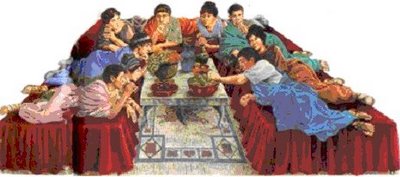 http://www.bib-arch.org/images/e-features/triclinium_lg.jpg
http://img135.imageshack.us/img135/5361/image024r.jpg
http://www.bib-arch.org/images/e-features/triclinium_lg.jpg
http://img135.imageshack.us/img135/5361/image024r.jpg
Secondly, it is unlikely that one would be buried in an unclean sheet. The Tannaitic principle is expressed by Rabbi Meir (ca. 2nd century), that at the resurrection the dead will wear the same garments in which they were interred, and wearing unclean clothes would obviously be a disgrace (
Sanhedrin 90b). The Gospel of Matthew also suggests that Jesus was buried in a “
clean sindon” (27:59): personally, I don’t think a cloth stained with food or drink is ‘clean’, and even in the event of a hurry, I don’t think they would have dared show disrespect for the dead.
Those who espouse this theory argue that Joseph of Arimathea would not have had time to buy any cloth to bury Jesus with - due to the confusion in the late afternoon - and ended up using the tablecloth, but Mark (15:46) mentions that Joseph purchased the sheet.


