Shroud of Turin?

  • Thread starter Thread starter Just_One_Touch
  • Start date Start date
Status
Not open for further replies.
There has been a lot of interesting work which question the carbon 14 dating, most obviously the discovery of a drawing done of the Shroud in 1192. That alone is reason to reject the Carbon 14 dating. Scientists at the Los Alamos National Laboratory have also questioned the dating:

shroudofturin.wordpress.com/fact-check/

The PBS (an entirely secular source) documentary on the subject offers others as well. Mechtild Flury Lemburg, a textile historian found the weave of the Shroud to be consistent with Jewish burial cloths of the first century. The weave is quite similar to that of those found at Masada, the Jewish fortress captured by the Romans in the first century.

pbs.org/wnet/secrets/previous_seasons/case_shroudchrist/interview.html

C.
 
40.png
thistle:
… I’m saying the weight of evidence is in favour of it being a hoax.

To the other poster please watch the documentary on the Shroud where it is demonstrated how to make the Shroud using a camera obscura and only materials available in the middle ages. Paint was not used.


You first have to get past the dating problem. The tests conducted so far only date it to the Middle Ages. Okay so we get people saying the bits tested must have been corrputed by fire or whatever. The bottom line is that the cloth is not dated to the time of Christ.
By the way the 3-D qualities are producted using the camera obscura.

The point I am making is that you should not be so loose with the word “proof”. There is no proof its authentic. From all the books I have read about the Shroud and the documentaries on it I have not read or seen anything that convinces me it is genuine. Let’s get past the dating problem then we might have something to talk about.
"Then the other disciple who had reached the tomb first also went in; HE SAW and believed." (John 20:8)

John doesn’t say what was it that he saw, but it was something eyeopening for him to believe immediately that Jesus had risen. An empty tomb and linen cloths (although laying flat) were not enough to convince him. I think it was until he entered and saw the image on the linen cloth that he “believed.”

Carbon dating is one method that counts the ratio of radiocarbon (C14) to stable carbon (C12) on a given sample. It is assumed that C14 decays at a stable ratio over the years, its ratio to C12 decreasing, and it can be calculated how much time has passed since the C14 started to decay, an event that happens when the living organism dies. The method cannot tell us if an external factor had an impact of the decay ratio or not, that is, if the ratio decayed in a stable environment. There are scientists who say that the fire the Shroud was exposed to in 1532, the heating of the metal box it was contained in when the fire erupted is a factor that could have contributed to alter the C14 presence. It is also known known that after the fire some parts of the linen were restored using, you guessed it! Middle Ages European linen. If the fire had no effect on the C14 count, it is still possible that the sample used to date it was taken from the restored Middle Ages linen.

Anyway, one has to look at other facts of the Shroud. From the book “La Sábana Santa”; Jorge Loring, S.J.; 9th Edition (my translation from Spanish):

“Professor G. Raes and his team from the Lab of Textile Technology of the University of Gante (Belgium) studied the fiber of the Shroud, and confirmed that it is a textile system which was not in use in Europe in the Middle Ages. On the contrary, it was widely used in the Middle East and its use ceased in the V Century AD … There are traces of cotton in it … and cotton was not known in Europe before the XIV Century.” (Page 39)
This proves the Shroud was not made in Europe.

“Dr. D. Leoncio Garza- Valdés, microbiologist from San Antonio, Texas (USA) has found in the fibers of the Shroud the “lichenotelia” fungus and the “leoncinella” bacteria. By the metabolic activity of these microorganisms some covers were produced around the fiber which have enriched C14. This enrichment of C14 has rejuvenated the linen. Thus the dates 1260- 1390 from the analysts.
Dr. D. Leoncio Garza- Valdés had the idea to do this analysis when he found out that at the Manchester Museum there is a mummy wrapped in a linen cloth, which when submited to the C14 radio dating resulted in it being 1000 years younger due to the contamination of the linen fiber.”
(Page 40)
External factors alter the C14 ratio.

“At the Congress of Rome [on further studies on the Shroud, 1993], Dr. Rodante showed us, superimposing slides, large grooves of blood over the forefront that coincide with the frontal vein and the temporal artery. This makes it impossible that the Shroud is a Middle Ages falsification as it would mean the falsifier had medical knowledge not know at that time.” (Page 45)
The alleged hoaxer, both a photographer (the image in negative) and a doctor from the 20th Century?

“In 1979 with modern amplifying equipment a coin over the right eye was photographed. The inscription U CAI can be read in the coin. The letter U is the last one in TIBERIU, and CAI are the frist three letters of CAISAROS. The complete inscription should be TIBERIU CAISAROS: as in Tiberious Caesar. Even though in Greek CAISAROS is written with a K, the error can be attributed to the coin maker due to the influx of Latin in the region as in Latin it is written with a C. In the numismatic there are coins like this one with the same error. This coin, studied by the numismatic Michael Marx, is found in the Catalog of Jewish Coins published by Madden in 1967.
The existence of this coin in the eye confirms that the Shroud is not a human fabrication as the coin is not visible to the naked eye.”
(Page 58)
What Middle Ages technology could have produced the coin in the eye?

“… when studying the coin over the eye, we know that it was in use between the years 26 and 36 of our era. Therefore, we have been able to date with much more precision the Shroud of Turin.” (Page 30)
Better than the C14 method.

There are other things found in the Shroud that a falsifier couldn’t produce, these three are very telling:
  1. Pollen from 13 plants from the Jerusalem area and pollen from a grand total of 49 different plants.
  2. Pollen of plants from Constantinople, France and Italy, which proves the Shroud followed this path from Jerusalem to Turin.
  3. Real blood in the linen, type AB, prevalent in Middle Eastern and not European citizens.
To me the Gospel of John confirms the truth of the Shroud. Not in vain they call the Shroud of Turin “The Fifth Gospel.”
 
Not only does the cloth not disconfirm any Gospel accounts. It is further strongly indicated to have a past history in the Byzantine Empire, in terms of artwork patterned on its data points and in descriptions by witnesses who describe a venerated cloth exposed sacramentally that has the cloth’s attributes. Chances are that the cloth was captured as religious booty in the Crusaders’ sack of Constantinople and transfered to France shortly thereafter. Its probable history is long and ancient in the Eastern Empire.
 
"Then the other disciple who had reached the tomb first also went in; HE SAW and believed." (John 20:8)
In the program I watched, I think it was an EWTN, or PBS…not sure which… they talk about this quote.

it’s suggested that down the length of the shroud is a strip that looks as though it’s been reattached… as if it might be a pc. that was torn off originally, and used as a tie to hold the shroud on the body.

Then, it’s referenced that PERHAPS the reason “he saw and believed” is that the shroud is really undisturbed but missing a body. As if it’s still in wrapped form. Not tossed aside. But that the body just was no longer inside the still laid out pc. of material.

All very interesting…
 
In the program I watched, I think it was an EWTN, or PBS…not sure which… they talk about this quote.

it’s suggested that down the length of the shroud is a strip that looks as though it’s been reattached… as if it might be a pc. that was torn off originally, and used as a tie to hold the shroud on the body.

Then, it’s referenced that PERHAPS the reason “he saw and believed” is that the shroud is really undisturbed but missing a body. As if it’s still in wrapped form. Not tossed aside. But that the body just was no longer inside the still laid out pc. of material.

All very interesting…
Unverifiable speculation. What happened need not have anything to do with his burial cloth.

In my view “he saw” (that Jesus body was not there) “and believed” that he is risen.
Why does the shroud have to come into it?
 
Unverifiable speculation. What happened need not have anything to do with his burial cloth.

In my view “he saw” (that Jesus body was not there) “and believed” that he is risen.
Why does the shroud have to come into it?
Well of course it’s Unverifiable…

However, you’ll remember the women infront of the tomb said “they have taken him.” Common sense suggests that if a body is missing, it was removed by a person.

You would have to see SOMETHING to know that he wasn’t just taken… an empty tomb doesn’t mean resurrection… Where there not appostles that did not believe until they personally put their fingers in the wounds of the risen Christ…

So… what do you suppose they SAW? I suspect they actually saw SOMETHING?

Obviously, I don’t KNOW what that was… I do however, believe that Christ was very good at making sure his miracles had a bit of proof to go with.

He didn’t cure a blind man recently blinded, he cured a blind man, blind from birth… something provable. AND he did so with dirt. Something that any person could pick up. He did not use some magic potion that would place doubt of what he used as the cure as opposed to him…

He didn’t just tell people there was water in the jug, and ta-da… it’s wine now. They KNEW there was water in there.

He didn’t happen to be parked next to a river hopping with fish… they were out in the middle of nowhere, when the fish just kept on going… there were no fires rolling to keep the hot fresh bread in supply…

The surroundings made it CLEAR that a miracle did in fact happen. A missing body is not 100% clear… for most it was his reappearance…

So, yeah, speculation… to have been a fly on the wall…

And finally, we do know that he would have been wrapped in a shroud. That’s just a sign of the time.

Do you think an inatimate object would rise WITH him? What do you suppose would actually happen to the wrapping? Would the wrapping be undisturbed? Or strewn all about the tomb? If you just had to toss a guess out? Because OBVIOUSLY non of us where there.
 
Unverifiable speculation. What happened need not have anything to do with his burial cloth.

In my view “he saw” (that Jesus body was not there) “and believed” that he is risen.
Why does the shroud have to come into it?
I would call it “circumstantial evidence.”

John saw the tomb was empty while he was outside waiting for Peter to catch up with him. He saw the body was not there and he saw the linen lying flat. Confronted with these facts he was still an unbeliever. Then he entered… “he saw and believed.”

I’ve read elsewhere that the silence in the Bible is at times more telling than the words. John doesn’t tell us what he saw, he’s silent about the details. I believe this is one of those times when silence speaks louder than words.

The Shroud is important because it was there to begin with and John mentions it. Also because of everything we know today about the Shroud and finally, I would add, because we know the face of Jesus.

I wondered for years why we see the same face of Jesus everywhere. Where did we Christians get the face of Jesus to be the one we know today? I knew he didn’t pose for a portrait, yet we see always the same face. I’m convinced that Jesus left us His own self portrait in the Shroud and that John saw it when he entered the tomb and believed. The face of Jesus that I’ve seen all my life is the same face imprinted 2000 years ago in that piece of cloth. When one adds up all there is with the Shroud then one understands why it comes into it.
 
Yes, it can be looked on as indirect evidence. Of course, there is no test for “Christness”, and we can only put together plausibilities based on facts.

But you do bring up the excellent point that in years prior to the Shroud’s emergence in France, much ancient art, particularly of the Eastern Empire, was producing Christ portraits that “just happen” to combine unique data points of the Shroud, thus providing strong indications that the Shroud, or a venerated cloth very much like it, was in circulation centuries before its acquisition by the deCharney family.

Moreover, it is a fact that the testing was skewed. That fact does not prove the Shroud’s genuiness, but it does invalidate the claim that we now “know” that the cloth is a “Medieval forgery”. Until the cloth is re-tested, its ancient provenance is still unknown. Only future work wil be able to dispell this mystery.

One side note: the image is not mentioned in the Gospels, but that is not surprising if the image side of the cloth had not been immediately examined. We might imagine the disciples reverently collecting the cloths and storing them. Perhaps it was only much later that someone noticed the very faint image, at some point when the cloth had been spread out and the image side viewed clearly.
 
I would call it “circumstantial evidence.”

John saw the tomb was empty while he was outside waiting for Peter to catch up with him. He saw the body was not there and he saw the linen lying flat. Confronted with these facts he was still an unbeliever. Then he entered… “he saw and believed.”

I’ve read elsewhere that the silence in the Bible is at times more telling than the words. John doesn’t tell us what he saw, he’s silent about the details. I believe this is one of those times when silence speaks louder than words.

The Shroud is important because it was there to begin with and John mentions it. Also because of everything we know today about the Shroud and finally, I would add, because we know the face of Jesus.

I wondered for years why we see the same face of Jesus everywhere. Where did we Christians get the face of Jesus to be the one we know today? I knew he didn’t pose for a portrait, yet we see always the same face. I’m convinced that Jesus left us His own self portrait in the Shroud and that John saw it when he entered the tomb and believed. The face of Jesus that I’ve seen all my life is the same face imprinted 2000 years ago in that piece of cloth. When one adds up all there is with the Shroud then one understands why it comes into it.
You may be convinced the Shroud is genuine and that is your right. However, you being convinced does not make it evidence or genuine.
The Shroud is NOT important to our faith so while I am open to it being real or not (to me evidence is more on it not being real), it makes no difference to me nor should anyone’s faith hang on it being genuine.
 
I think that very few Catholics or Christians generally make their faith hang on the Shroud’s genuineness. What its genuineness betokens is a fantastic archeological discovery and the potential capacity to look upon a real image of Jesus’ face. Note I said “potential”. As I said before, there is no test for “Christness”, but meticulous research can bring the cloth more and more into the ambit of historical plausibility… of proximity to Christ. And isn’t that what the best relics do, and are meant to do? What you have said before is correct, i.e., that the cloth is not *yet * an official relic. However, it is - quite correctly - an object of veneration … inasmuch as it *is really * venerated and conveys an unprecedented, unique presentation of the Passion. If it turns out merely to be an example of Medieval artwork, surely it will rank among the most devotional, clever, moving, shocking, awe-inspiring works of its kind.
 
You may be convinced the Shroud is genuine and that is your right. However, you being convinced does not make it evidence or genuine.
The Shroud is NOT important to our faith so while I am open to it being real or not (to me evidence is more on it not being real), it makes no difference to me nor should anyone’s faith hang on it being genuine.
How is this NOT a “given” at any point during the discussion?
 
You may be convinced the Shroud is genuine and that is your right. However, you being convinced does not make it evidence or genuine.
The Shroud is NOT important to our faith so while I am open to it being real or not (to me evidence is more on it not being real), it makes no difference to me nor should anyone’s faith hang on it being genuine.
Yes, we don’t know for sure if it’s genuine, but neither does anybody know for sure it is false. You say the Shroud is not important to our faith, but think for a moment that Jesus performed some miracles in order to move people to believe who He was. Remember what He said in John 20:29, «… You believe because you see me, don’t you? Happy are those who have not seen and believe.» Jesus knew that “seeing” was important for some to believe, that’s why he performed His miracles.

Since Jesus times it seems that in every generation there are people that “need to see” in order to believe. In today’s modern world even many Catholics have a hard time believing what the Gospel says about Jesus. Think now of the non Christian, the non believer. Would you not agree that the Shroud, something that can be seen, might help the unbeliever who “needs to see” to believe, and also reinforce the belief of the Catholic in doubt?

Many converts share stories of relatives being healed after they prayed to Jesus for the first time in their lives, and then “seeing” the relative being healed. These people were not Christians, their intellect told them Jesus was not God, but upon “seeing” the relative’s health restored, they believed. The Shroud can help the unbeliever to believe, it has done it throughout its history.
 
You didn’t read my wording carefully. I neither said it was true nor false.
I’m saying the weight of evidence is in favour of it being a hoax.

To the other poster please watch the documentary on the Shroud where it is demonstrated how to make the Shroud using a camera obscura and only materials available in the middle ages. Paint was not used.
Its not a hoax at all. Just recently I watched a program on History Channel on Holy Saturday and it stated that they have found that no artistic medium was ever used. There is no proof of paint or any other type of artisitic technique on the Shroud. The only thing they cannot confirm if it were Christ 100%. There is nothing around to say " Yes, this is Jesus Christ himself." The show even said the carbon dating is wrong due to the fact of where they took the sample on the cloth. It was from a portion that has been manhandled for centuries. Since no one wants to literally cut into the inside of the cloth they will never know the exact date. The outside of the cloth was actually the cloth that was torn to tie it around his body, then later on it was sown on. Why ? No one knows why.

It was a very interesting show. The man that was attempting the 3D image of Christ’s face was just taken aback by the torment that he must have suffered. Since the ‘person’s’ imprint showed someone that was tortured terribly. But he did manage to make what he feels is the exact replica of Christ’s face. It matched the 2D image after he was finished. It was something else. It was pretty much how I pictured him to look.

But anyways my longwinded point is that there is proof now that no artistic medium was used and its impossible for anyone to have used some kind of technique that no one knew about even to this day.
 
You didn’t read my wording carefully. I neither said it was true nor false.
I’m saying the weight of evidence is in favour of it being a hoax.

To the other poster please watch the documentary on the Shroud where it is demonstrated how to make the Shroud using a camera obscura and only materials available in the middle ages. Paint was not used.
Actually the weight of evidence is that it predates the middle ages. The only evidence of an origin in middle ages is the carbon 14 dating. That test is of dubious value since the area tested was a finge area that may have been subjected to repair and thus is not representative of the original cloth. It is an established fact that repairs were made to the cloth by nuns following the fire during which parts of the cloth were burnt. In addition, there are small holes in the cloth which predate the fire. These holes are in an “L” shaped pattern. These holes are extremely important as they are depicted along with the type of weave in the cloth in an icon that dates to about the sixth century. There is other evidence also that point to an earlier origin than what the carbon 14 dating indicated.
 
Actually the weight of evidence is that it predates the middle ages. The only evidence of an origin in middle ages is the carbon 14 dating. That test is of dubious value since the area tested was a finge area that may have been subjected to repair and thus is not representative of the original cloth. It is an established fact that repairs were made to the cloth by nuns following the fire during which parts of the cloth were burnt. In addition, there are small holes in the cloth which predate the fire. These holes are in an “L” shaped pattern. These holes are extremely important as they are depicted along with the type of weave in the cloth in an icon that dates to about the sixth century. There is other evidence also that point to an earlier origin than what the carbon 14 dating indicated.
Correct. But the fact that its known provenance goes back only to the age of the C14 is a serious objection by any measure.

I believe in the Shroud, but its authenticity is not an issue of faith for me.

ICXC NIKA
 
Correct. But the fact that its known provenance goes back only to the age of the C14 is a serious objection by any measure.

I believe in the Shroud, but its authenticity is not an issue of faith for me.

ICXC NIKA
The C14 dating is now widely believed to be not representative of the original cloth. The scientists who proposed the testing were aware of the repair work that was done to the cloth and thus wanted samples from different areas of the cloth in order to better insure they got at least one representative sample. However, the church would not agree to this as it would violate the relic and only agreed to to sample taken from an area that would be less conspicuous. So the one sample was taken from only one corner of the cloth. I don’t know of any scientist who says the C14 dating is inaccurate. They are saying that the C14 dating is accurate for the sample taken but the sample is not representative of the original cloth. If that is the case and there is a very good chance that it is then the C14 dating is unreliable for the purpose of dating the original cloth.

There is a theory, although unsubstantiated that the burial shroud is actually the table covering for the table used at the Last Supper. If that is true it would be absolutely awesome that Jesus is wrapped in the cloth used when He consecrated the Eucharist.
 
I recently was listening to EWTN radio and they had a guest on the air (name not remembered) who believes that the shroud is real. He and other scientist believe that the cloth was actually irradiated when Jesus rose from the dead. They have done some studies that show that radiation skews the C-14 dating procedure and believe if they are allowed to test the Shroud they can prove it was from the time of Christ once the radioactive isotope is proved to be on the Shroud. Obviously, they cannot prove it was the actual burial cloth, but can carbon date it to the time of Christ.

They have been seeking permission for over a year to test the Shroud and want to film a documentary on their findings.

Go with Gods Grace!!!
 
There is a theory, although unsubstantiated that the burial shroud is actually the table covering for the table used at the Last Supper. If that is true it would be absolutely awesome that Jesus is wrapped in the cloth used when He consecrated the Eucharist.
I’ve heard of that (it seems that it was based on what some purported were food or wine stains on the Shroud, of which there is no chemical analysis to suggest the veracity thereof), but I personally don’t hold it for a number of reasons:

One, having a fourteen foot long, three-and-a-half feet wide linen sheet as a tablecloth is only viable IMHO if you picture the Last Supper as occurring the way Renaissance artists painted it: Jesus and disciples sitting on high chairs and dining on a long table.

At the time of Jesus, the most common postures for eating are either crouching or sitting - either on the floor covered with rugs or on low stools - or reclining on couches and cushions (the Arabs still dine in this way today). Obviously the table used for this would have been low-legged, and probably not too long. In a Roman triclinium, for example, you have three couches (or a long, U-shaped couch) set on three sides of a low table (or three tables in arranged like the couches in a U-formation), enough to accommodate three diners or more. The Talmud suggests (Baba Batra 57b) that food was ordinarily eaten off the bare table top, and only the elite seem to have used a cloth to cover part of the small table for use as napkins. If this is indeed reflective of the custom at the time of Jesus, this puts any tablecloth out of the question.

Jesus and the others would have dined in this way, instead of what Leonardo would have us believe: reclining upon a couch or on the carpeted floor, with the food set up on a low, small table (or tables), which obviously would not hold a fourteen-foot long piece of cloth!
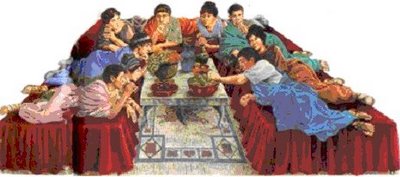


http://www.bib-arch.org/images/e-features/triclinium_lg.jpg

http://img135.imageshack.us/img135/5361/image024r.jpg

Secondly, it is unlikely that one would be buried in an unclean sheet. The Tannaitic principle is expressed by Rabbi Meir (ca. 2nd century), that at the resurrection the dead will wear the same garments in which they were interred, and wearing unclean clothes would obviously be a disgrace (Sanhedrin 90b). The Gospel of Matthew also suggests that Jesus was buried in a “clean sindon” (27:59): personally, I don’t think a cloth stained with food or drink is ‘clean’, and even in the event of a hurry, I don’t think they would have dared show disrespect for the dead.

Those who espouse this theory argue that Joseph of Arimathea would not have had time to buy any cloth to bury Jesus with - due to the confusion in the late afternoon - and ended up using the tablecloth, but Mark (15:46) mentions that Joseph purchased the sheet.

 
Status
Not open for further replies.
Back
Top