Small particles of the host - why no concern?

Status
Not open for further replies.
Have I accidentally committed sacrilege?

Is there even such a thing as accidental sacrilege?
Not a chance. Like I said, Jesus invented communion. If particles were a concern for Him, He would have used some other method.
 
Right. The Magisterium has said it is acceptable to receive on the tongue or in the hand. If I cannot trust in what the Church says anymore between what is or is not acceptable all the rest of it falls apart and everything is relative. I refuse to accept that.
 
USCCB - The Real Presence of Jesus Christ in the Sacrament of the Eucharist: Basic Questions and Answers " Does one receive the whole Christ if one receives Holy Communion under a single form?

Yes. Christ Jesus, our Lord and Savior, is wholly present under the appearance either of bread or of wine in the Eucharist. Furthermore, Christ is wholly present in any fragment of the consecrated Host or in any drop of the Precious Blood. …"

CCC #1376, 1377 "The Council of Trent summarizes the Catholic faith by declaring: “Because Christ our Redeemer said that it was truly his body that he was offering under the species of bread, it has always been the conviction of the Church of God, and this holy Council now declares again, that by the consecration of the bread and wine there takes place a change of the whole substance of the bread into the substance of the body of Christ our Lord and of the whole substance of the wine into the substance of his blood. …” So all of the hosts and all of the wine at each Mass is consecrated and so all parts are all of Christ.

1377 The Eucharistic presence of Christ begins at the moment of the consecration and endures as long as the Eucharistic species subsist. Christ is present whole and entire in each of the species and whole and entire in each of their parts, in such a way that the breaking of the bread does not divide Christ.

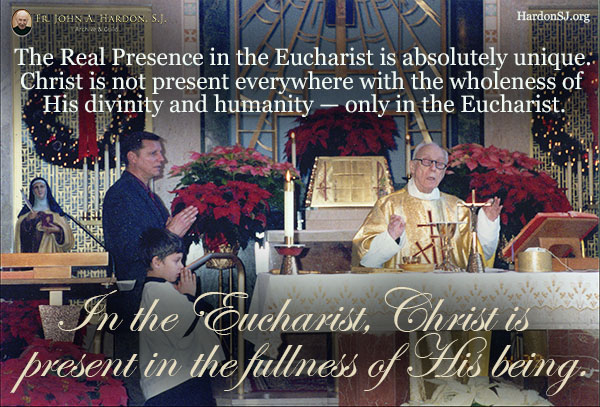
A Eucharistic Retreat Meditation #4 The Teaching of the Church on the Real Presence in the Sixteenth Century by Fr. John A. Hardon, S.J.
"What does the Church tell us about the species? She indelibly teaches that the entire Christ is entirely present in every particle of the consecrated host and in every drop of what looks and tastes like wine. In the whole Host, Christ is there. Broken in half, Christ is in both parts. Even a single particle contains the whole living Christ. "
 
Last edited:
Do EMHCs ever use the vasculum? More to the point, do EMHCs purify their hands after they have handled all those hosts? If not, why not? Why does the priest purify his hands (even in the OF/Novus Ordo) and the EMHCs do not? Do they not all handle the Body of Christ?
AFAIK, the rubric of the priest keeping his thumb and forefinger together from the time of consecration to the abultion after Communion did not make it into the OF of the Mass. So my thinking is whatever the thinking was at that time by those who made the changes, also saw no reason to keep the Vasculum beside the Tabernacle.

So as I don’t think it is common to have a Vasculum for this purpose, then no, it isn’t possible for an EMHC to purify their hands after Communion, nor is there any rubric (afaik) that indicates they are to.🤷‍♀️
 
Christ is more powerful than our anxiety over the possibility that a micro particle might fall on the floor.

Reasonable care must be taken to protect the Blessed Sacrament, but lets not behave like we have more power than God over such things and get into all sorts of gymnastics to appease our sensibilities.

BTW, if God the Father can turn the bread and wine into the body of Christ, he certainly can remove that consecration if need be.

Jim
 
Last edited:
Considering the discussion concerns Comunion time, any particle which is recognizable as coming from a consecrated host - which people would recognize it to be at that time, therefore is recognizable as bread/host fragment and visible to the eye - must be treated with the due reverence Our Lord should be treated with. Doing so is not being scrupulous.
 
As I don’t sit up close enough at any of the Churches I have attended or due to the fact the Altar is set up higher than the body of the Church, I don’t remember seeing what was done in the OF. I mostly attend the EF for the past 5 or so years, with a few times a year attending the OF and I usually have my head down in my missal praying the Mass.
 
Christ is more powerful than our anxiety over the possibility that a micro particle might fall on the floor.

Reasonable care must be taken to protect the Blessed Sacrament, but…
Why?
If we are not concerned with the smaller parts, why the concern over larger?
 
Visible to the naked eye . Simple. We are not expected to use magnifying glasses to discover microparticles.
 
There’s a time to be concerned and a time to know when we’re behaving like fanatics with little faith in God.

Jim
 
Ok, so why is concern over the crumbs from communion constitute fanaticism?

Is not the smallest part of God the whole?
 
I don’t even understand why we recieve Communion in the hand. I dunno, seems weird as a future convert.
 
Ok, so why is concern over the crumbs from communion constitute fanaticism?

Is not the smallest part of God the whole?
The Church has spoken of the consecrated Bread in those terms against ancient arguments about the nature of the host and with regard to reverence for the unconsumed Bread. It was not meant to go so far as to cause anxiety detracting from the experience of gratitude and joy at the great gift of the Eucharist as seems to pervade some peoples minds. To contemplate trampling Jesus under foot as you return from Communion can only be attributed to extreme legalism.

To demonstrate that the Church did not mean this interpretation, Aquinas wrote,

“But if the change be so great that the substance of the bread or wine would have been corrupted, then Christ’s body and blood do not remain under this sacrament; and this either on the part of the qualities, as when the color, savor, and other qualities of the bread and wine are so altered as to be incompatible with the nature of bread or of wine; or else on the part of the quantity, as, for instance, if the bread be reduced to fine particles, or the wine divided into such tiny drops that the species of bread or wine no longer remain.”

http://www.newadvent.org/summa/4077.htm#article4
 
Have you thought of raising this with the sacristan or parish council or clergy?
That’s what I’m saying.
I have never seen a host break in someones hand. Makes me wonder if maybe they are using old hosts. Parishes are supposed to be careful in how many hosts they purchase at a time because it can’t be old enough to go stale. And there are rules on this. A host can’t be stale when used. There is literally a kind of use by date.
This is actually more difficult than you think, and obviously there are some liturgical days which warrant the parish buy more hosts than other times of the year like on Christmas and Easter ( which is unfortunate but a reality).
However in regards to this thread, yes I think more reverence should be taken. I think patens should come back.
 
Last edited:
that the SPECIES of bread or wine no longer remain
the word species (is of great importance in this quote) of bread or wine no longer remain. That is, once diluted e.g. with water, then the species is no longer fully bread or fully wine, then it is no longer the Body/Blood of Christ.
No longer the color due to being diluted with another substance.
Such dilution renders the taste no longer the same.
All such changes which alter the nature of bread or the wine ie no longer the same.

The species are the size, texture, taste and weight of what was formerly bread and wine.

Not only in regards to unconsumed bread ie any reserved in the Tabernacle, but including any particles. Read the article written by Fr John Hardon in the link I gave in a previous post.
"What does the Church tell us about the species? She indelibly teaches that the entire Christ is entirely present in every particle of the consecrated host and in every drop of what looks and tastes like wine.
From the same article - "What does the Church tell us about the species? She indelibly teaches that the entire Christ is entirely present in every particle of the consecrated host and in every drop of what looks and tastes like wine. In the whole Host, Christ is there. Broken in half, Christ is in both parts. Even a single particle contains the whole living Christ.

Council of Trent Session 13 - Canons “CANON III.-If any one denieth, that, in the venerable sacrament of the Eucharist, the whole Christ is contained under each species, and under every part of each species, when separated; let him be anathema.”

 
the word species (is of great importance in this quote) of bread or wine no longer remain. That is, once diluted e.g. with water, then the species is no longer fully bread or fully wine, then it is no longer the Body/Blood of Christ.
No longer the color due to being diluted with another substance.
Such dilution renders the taste no longer the same.
All such changes which alter the nature of bread or the wine ie no longer the same.

The species are the size, texture, taste and weight of what was formerly bread and wine.

Not only in regards to unconsumed bread ie any reserved in the Tabernacle, but including any particles. Read the article written by Fr John Hardon in the link I gave in a previous post.
Aquinas specifically mentions quantity as per fine particles as changing the species. He distinguishes between when the bread is broken into small parts keeping the visible attribute of bread and then the corruption of the accidents such as the fine particles.

Read the link that I posted. It’s too long to cut and paste here but the overall will give you the meaning.
 
fine particles
Difference between fine particles and visible particles recognizable as part of the host.

As I said before - that which is plainly visible to the eye and recognizable as such. Using a magnifying glass to identify is not needed.

Again,
Read the article written by Fr John Hardon in the link I gave in a previous post.
 
Last edited:
Status
Not open for further replies.
Back
Top