Strange facts about Solomons temple

  • Thread starter Thread starter mikekle
  • Start date Start date
Status
Not open for further replies.
I’m game if you are.

I’ll take Josephus and Hagan, and you bring on the Archaeologists!

Josephus is the one we have to thank/blame for the identification of these sites, so don’t speak to me about him. 😉 Otherwise, fine by me.
 
I don’t want to divert the discussion, but I just wanted to say that the columns from the Temple of Solomon were put by Constantine into the first St Peters Basilica(at least 12 of them) . They were curvy like the ones Bernini made for the baldachino. I think some of the originals were incorporated into the newer basilica somewhere. Rafael has a painting where he depicts them. Also, someone might find it interesting that the Sistine Chapel was built to the same dimensions as the Temple of Solomon
 
Way cool.

One wonders where the old columns would be found in the present Vatican. Presumably not in the facade.

ICXC NIKA
 
I don’t want to divert the discussion, but I just wanted to say that the columns from the Temple of Solomon were put by Constantine into the first St Peters Basilica(at least 12 of them) . They were curvy like the ones Bernini made for the baldachino. I think some of the originals were incorporated into the newer basilica somewhere. Rafael has a painting where he depicts them. Also, someone might find it interesting that the Sistine Chapel was built to the same dimensions as the Temple of Solomon
Yeah, that’s deep. Very interesting.

Is this the painting? I know Patrick is somewhat knowledgeable about art.

Rapehael: The Healing of the Lame Man (1515)
http://upload.wikimedia.org/wikipedia/commons/thumb/1/1e/V&A_-Raphael%2C_The_Healing_of_the_Lame_Man%281515%29.jpg/800px-V%26A_-Raphael%2C_The_Healing_of_the_Lame_Man%281515%29.jpg

-Tim-
 
I think they are late antiquity columns, but Josephus doesn’t mention any columns in the Second Temple that were inordinately decorated and certainly not “curvy.” That would seem to go against Jewish tradition.

And Titus razed everything in A.D. 70. A mound of debris can be seen still at the southwest corner of the temple foundations today (ophlas).

Patrick, to start things off, Titus ordered everything leveled except for the three towers of Herod’s palace, and a portion of the western wall, which he wanted to leave intact to use for his main Roman army camp.

*Now as soon as the army had no more people to slay or to plunder, because there remained none to be the objects of their fury, (for they would not have spared any, had there remained any other work to be done,) Caesar gave orders that they should now demolish the entire city and temple, but should leave as many of the towers standing as were of the greatest eminency; that is, Phasaelus, and Hippicus, and Mariamne; and so much of the wall as enclosed the city on the west side. This wall was spared, in order to afford a camp for such as were to lie in garrison, as were the towers also spared, in order to demonstrate to posterity what kind of city it was, and how well fortified, which the Roman valor had subdued; but for all the rest of the wall, it was so thoroughly laid even with the ground by those that dug it up to the foundation, that there was left nothing to make those that came thither believe it had ever been inhabited. This was the end which Jerusalem came to by the madness of those that were for innovations; a city otherwise of great magnificence, and of mighty fame among all mankind. (Wars VII 1:1)
*
So to start things off, Hagan would submit that the citadel today stands where the headquarters of the Roman camp was built, and the foundations were made from the rubble gathered up and transported there from the various demolished buildings in the upper city of Jerusalem. That would explain the block with the Herodian borders found.

Quite a bit of terra-scaping was done on the west side during the siege, to provide a flat base for the camps and the siege engines. It was on this site that the headquarter Roman building was constructed, later to morph over the years into the citadel.
 
I’ll answer the first one in brief for now (I’ll go into a bit more depth later).

Yes, there’s a popular story that the barley-sugar columns (since that’s what their shape looks like) from the old St. Peter’s came from the temple in Jerusalem. Not the one that Herod the Great or even Zerubbabel built, but the original one erected under king Solomon. According to the story, Constantine found these columns in Jerusalem and then brought them to Rome to be used in the construction of the basilica.

But the clincher is, it’s only a legend, and a late one at that. The earliest tradition recorded in the Liber Pontificalis (6th century) is that these columns came “from Greece” (de Grecias), which is more likely: “And above he [Constantine] set porphyry columns for adornment and other spiral columns which he brought from Greece.” (The actual columns probably date from the 2nd century AD - well after Solomon’s time, obviously.) In fact, as late as the 12th century, a canon of St. Peter’s (Petrus Mallius) still claimed the columns to be of Greek origin, although at the same time he qualified ‘Greece’ to mean the temple of Apollo at Troy!
 
Way cool.

One wonders where the old columns would be found in the present Vatican. Presumably not in the facade.

ICXC NIKA
Eight of the twelve spiral columns are still around in the new St. Peter’s. Here are two of them. On each of the four piers beneath the dome there are two of the original columns each.


And here’s a single one. IMHO it doesn’t really take a professional to be able to tell that there’s no way that this could be an Israelite artifact dating from ca. 10th century BC.


Around the same time that Petrus Mallius claimed that the columns were from Troy, a Spanish Jew travelling to Rome (Benjamin of Tudela, 1130-1173) claimed that in Rome there were bronze pillars which were believed to have been made by Solomon. But he was referring to columns supposedly found in St. John Lateran. According to him, local Jews believed that every year, on the anniversary of the destruction of Jerusalem in AD 70, the columns became wet.

In the church of St. John in the Lateran there are two bronze columns taken from the Temple, the handiwork of King Solomon, each column being engraved “Solomon the son of David.” The Jews of Rome told me that every year upon the 9th of Ab they found the columns exuding moisture like water.

http://www.adoremus.org/NewABart/0312-2.10Stroik.jpg

Four gilded bronze columns currently in 16th-century the Altar of the Blessed Sacrament in St. John Lateran. The four columns are already mentioned in the 11th-century work Descriptio Lateranensis Ecclesiae (revised around the time of Benjamin), but no mention is made about where they came from. At that time, the columns still stood in a row across the church nave. Later sources meanwhile claimed that the columns were actually from, say, the Temple of Jupiter on the Capitoline Hill, that the bronze was taken from the prows of Cleopatra’s ships, that the columns originally supported the statue of Marcus Aurelius, that sort of thing.

It’s pretty much like the claims about the columns in St. Peter’s, really: by the end of the 13th century the mosaic on the Lateran’s apse advertised that “Titus and Vespasian had this ark and the candelabrum and … the four columns here present taken from the Jews in Jerusalem and brought to Rome.” During the Middle Ages people believed that treasures from the temple - this time Herod’s temple - were actually kept in the Lateran, ‘hidden’ (rather conveniently ;)) under the altar of course. (The belief perhaps started in a tradition also recorded in the Liber Pontificalis about Constantine donating a set of seven brass candelabra adorned with the images of Old Testament prophets to the Lateran.) So it wasn’t a big step from that to thinking that the mysterious columns must have once been in Jerusalem. Which of course appealed to many people at that time compared to the more ‘mundane’ claims about them coming from the Capitoline or something.

There was a rivalry of sorts at the time between St. Peter’s and the Lateran for primacy in Rome: the Lateran was the pope’s episcopal see and the “mother church” and was, before the whole Avignon fiasco, where the pope lived, but St. Peter’s is of course where the Prince of the Apostles is supposedly buried. One of the things the supporters of St. Peter’s attacked their rivals in the Lateran for is possessing Jewish relics: Petrus Mallius derogatorily dissed the Lateran as a “synagogue.”
 

And here’s a single one. IMHO it doesn’t really take a professional to be able to tell that there’s no way that this could be an Israelite artifact dating from ca. 10th century BC.
—]
Honestly, I am rather shocked they looked like that over a thousand years before the renaissance. I had no idea that Bernini had these as inspiration.

What would you expect them to look like for the temple time period?
 
Don’t know the history of these columns (other than the photos and the post), but I can tell you that any columns taken from the Temple of Solomon, (or Herod’s Temple) would have had no faces, animals or anything more than possibly grapes or grapevines on them at the most. Possibly a carving of a Menorah on Herod’s columns, not on Solomon’s of course. As for engravings of faces of the prophets – not in ANY Jewish Temple, or home for that matter. They did not carve images on things other than grapes, vines and in Herod’s time, possibly the Menorah (candlesticks to represent the Maccabees). They had NO graven images in the Temple, especially Solomon’s Temple, except for the possibility of grapes, sheaves of grain, VEGETABLE items or palm trees. No animals, and certainly no images of the prophets on items used in worship in the Temple! (Read the 10 Commandments for this).
 
I Kings 6:23-36; 7:27-39; 8:6-67 - Solomon’s temple contains statues of cherubim and images of cherubim, oxen and lions. God did not condemn these images that were used in worship.

2 Kings 18:4 - it was only when the people began to worship the statue did they incur God’s wrath, and the king destroyed it. The command prohibiting the use of graven images deals exclusively with the false worship of those images.

Taken from scripturecatholic.com

The prohibition of graven images was tied to the commandment “Thou shalt have no other gods before Me”. There are many accounts in the OT about statues and such things like the bronze serpent on Moses’ staff; the prohibition was constructing gods to worship.
 
Thank you, I stand corrected. However, in the one photo of the curving pillar I thought I saw a winged horse and a man with a definite Greek hairstyle. Maybe I’m wrong, but it didn’t look like something that would have been in Soloman’s Temple. However, you are correct, there were the cherubim over the Ark, which are “images”, but not intended for worship, of course. Haven’t read some of your references in a while, and did not realize that bulls or oxen were also carved into the Temple columns and walls. I thought only grapes with vines and sheaves of wheat and palm trees were used, rather than animals.

I stand corrected here. Thank you.
 
👍 I swear, I have to re-read every three months or I forget! I’m never going to get done with this book:D
 
Honestly, I am rather shocked they looked like that over a thousand years before the renaissance. I had no idea that Bernini had these as inspiration.

What would you expect them to look like for the temple time period?
Solomon’s temple is actually pretty much the same in structure to many other temples in the ancient Near East and Egypt. (As 1 Kings itself notes, Solomon was assisted in the construction by the Phoenicians of Tyre.) In particular, there’s a Syro-Hittite temple in the village of 'Ain Dara in Syria (ca. 1300 BC-740BC) which shows a number of similarities with it. Another example is the sanctuary in Tell Tayinat in modern southeastern Turkey.

http://dbcfaa79b34c8f5dfffa-7d3a62c...m/wp-content/uploads/temple-plans-260x266.png


Tell Tayinat palace (right) and temple (left; a more detailed reconstruction of the temple here)
I Kings 6:23-36; 7:27-39; 8:6-67 - Solomon’s temple contains statues of cherubim and images of cherubim, oxen and lions. God did not condemn these images that were used in worship.
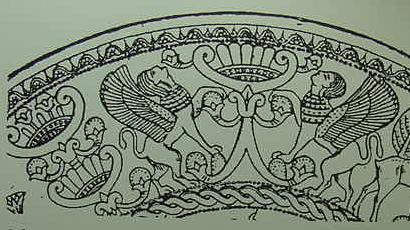
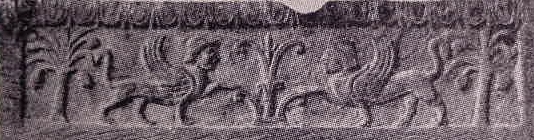
The decorations in Solomon’s temple? They’re also standard iconographic templates in ancient Near Eastern (particularly Phoenician) art: winged humans or winged human-headed beasts or winged animals flanking a sacred lotus-papyrus tree.

“Around all the walls of the house he carved engraved figures of cherubim and palm trees and open flowers, in the inner and outer rooms. …] He covered the two doors of olivewood with carvings of cherubim, palm trees, and open flowers. He overlaid them with gold and spread gold on the cherubim and on the palm trees.”


Human-headed winged sphinxes flanking a sacred tree, from a Phoenician platter (ca. 8th-7th century BC)


Date palms and human-headed winged sphinxes flanking a sacred tree, carving from a Sabaean stone stela from the Yemen (5th century BC)


Plaque with a griffin eating a palmette, Phoenician ivory from Nimrud (ca. 9th-8th century BC)

http://media.kunst-fuer-alle.de/img/36/m/36_65149~winged-genii,-assyrian-period,-c-750-bc.jpg
Winged humans, ivory plaque from Samaria (ca. 10th-9th century BC)

Remember Genesis 2? “Then the LORD God said, “Behold, the man has become like one of us in knowing good and evil. Now, lest he reach out his hand and take also of the tree of life and eat, and live forever—” therefore the LORD God sent him out from the garden of Eden to work the ground from which he was taken. He drove out the man, and at the east of the garden of Eden he placed the cherubim and a flaming sword that turned every way to guard the way to the tree of life.


http://www.tali-virtualmidrash.org.il/userfiles/Che22---Sphinx-&-Tree.jpg
 
Thank you, I stand corrected. However, in the one photo of the curving pillar I thought I saw a winged horse and a man with a definite Greek hairstyle. Maybe I’m wrong, but it didn’t look like something that would have been in Soloman’s Temple. However, you are correct, there were the cherubim over the Ark, which are “images”, but not intended for worship, of course. Haven’t read some of your references in a while, and did not realize that bulls or oxen were also carved into the Temple columns and walls. I thought only grapes with vines and sheaves of wheat and palm trees were used, rather than animals.

I stand corrected here. Thank you.
Herod’s temple is the one which didn’t have imagery on it. That’s because around the time after the Exile the commandment against images came to be interpreted in such a way that any depiction of living things was considered taboo. Basically the interpretation shifted from one way to the other was time went: pre-Exilic Israelites considered at least some images to be perfectly legit; post-Exilic Jews (particularly after the time of the Maccabees) thought most images aren’t okay; Jews by the 2nd-3rd century again thought that some images were fine. So it’s a shift from lax to strict and then back to lax.

And here’s a parallel to the wheeled bronze lavers, from Cyprus (1225-1100 BC).
 
Status
Not open for further replies.
Back
Top