S
steve53
Guest
I’m game if you are.…You don’t know much about archaeology, do you?
I’ll take Josephus and Hagan, and you bring on the Archaeologists!

I’m game if you are.…You don’t know much about archaeology, do you?
Josephus is the one we have to thank/blame for the identification of these sites, so don’t speak to me about him.I’m game if you are.
I’ll take Josephus and Hagan, and you bring on the Archaeologists!
 Otherwise, fine by me.
Yeah, that’s deep. Very interesting.I don’t want to divert the discussion, but I just wanted to say that the columns from the Temple of Solomon were put by Constantine into the first St Peters Basilica(at least 12 of them) . They were curvy like the ones Bernini made for the baldachino. I think some of the originals were incorporated into the newer basilica somewhere. Rafael has a painting where he depicts them. Also, someone might find it interesting that the Sistine Chapel was built to the same dimensions as the Temple of Solomon
Eight of the twelve spiral columns are still around in the new St. Peter’s. Here are two of them. On each of the four piers beneath the dome there are two of the original columns each.Way cool.
One wonders where the old columns would be found in the present Vatican. Presumably not in the facade.
ICXC NIKA

 ) under the altar of course. (The belief perhaps started in a tradition also recorded in the Liber Pontificalis about Constantine donating a set of seven brass candelabra adorned with the images of Old Testament prophets to the Lateran.) So it wasn’t a big step from that to thinking that the mysterious columns must have once been in Jerusalem. Which of course appealed to many people at that time compared to the more ‘mundane’ claims about them coming from the Capitoline or something.
 I swear, I have to re-read every three months or I forget! I’m never going to get done with this book
Sorry for the late reply, but yeah that was the one I was referring to.Yeah, that’s deep. Very interesting.
Is this the painting? I know Patrick is somewhat knowledgeable about art.
Rapehael: The Healing of the Lame Man (1515)
http://upload.wikimedia.org/wikipedia/commons/thumb/1/1e/V&A_-Raphael%2C_The_Healing_of_the_Lame_Man%281515%29.jpg/800px-V%26A_-Raphael%2C_The_Healing_of_the_Lame_Man%281515%29.jpg
-Tim-
Solomon’s temple is actually pretty much the same in structure to many other temples in the ancient Near East and Egypt. (As 1 Kings itself notes, Solomon was assisted in the construction by the Phoenicians of Tyre.) In particular, there’s a Syro-Hittite temple in the village of 'Ain Dara in Syria (ca. 1300 BC-740BC) which shows a number of similarities with it. Another example is the sanctuary in Tell Tayinat in modern southeastern Turkey.Honestly, I am rather shocked they looked like that over a thousand years before the renaissance. I had no idea that Bernini had these as inspiration.
What would you expect them to look like for the temple time period?

The decorations in Solomon’s temple? They’re also standard iconographic templates in ancient Near Eastern (particularly Phoenician) art: winged humans or winged human-headed beasts or winged animals flanking a sacred lotus-papyrus tree.I Kings 6:23-36; 7:27-39; 8:6-67 - Solomon’s temple contains statues of cherubim and images of cherubim, oxen and lions. God did not condemn these images that were used in worship.
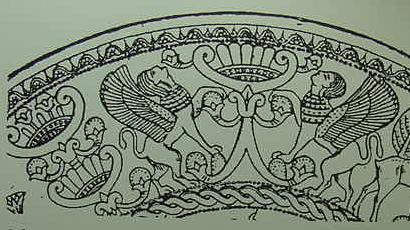
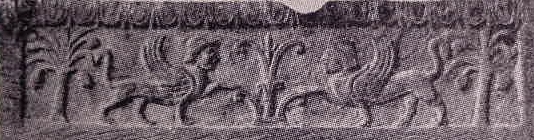


Herod’s temple is the one which didn’t have imagery on it. That’s because around the time after the Exile the commandment against images came to be interpreted in such a way that any depiction of living things was considered taboo. Basically the interpretation shifted from one way to the other was time went: pre-Exilic Israelites considered at least some images to be perfectly legit; post-Exilic Jews (particularly after the time of the Maccabees) thought most images aren’t okay; Jews by the 2nd-3rd century again thought that some images were fine. So it’s a shift from lax to strict and then back to lax.Thank you, I stand corrected. However, in the one photo of the curving pillar I thought I saw a winged horse and a man with a definite Greek hairstyle. Maybe I’m wrong, but it didn’t look like something that would have been in Soloman’s Temple. However, you are correct, there were the cherubim over the Ark, which are “images”, but not intended for worship, of course. Haven’t read some of your references in a while, and did not realize that bulls or oxen were also carved into the Temple columns and walls. I thought only grapes with vines and sheaves of wheat and palm trees were used, rather than animals.
I stand corrected here. Thank you.