F
Fidelis
Guest
Other thoughts and comments on the Gospel Reading:
**1 When Jesus was born in Bethlehem of Judea: **A small village south of Jerusalem. Its Hebrew meaning is “house of bread,” and it became known as “the city of David” (Lk 2:4). This was the hometown of David (whose kingdom Jesus was heir to), as well as the place where he was anointed (1 Sam 16:1-13).
**in the days of King Herod: **Four different Herods are mentioned in the New Testament. The first is Herod the Great, referred to in this passage and the next; the second is his son, Herod Antiapas, who had John the Baptist beheaded (Matthew 14:1-12) and who abused our Lord during His Passion (Luke 23:7-11); the third, Herod Agrippa I, a nephew of Herod the Great, who executed the apostle James the Greater (Acts 12:1-3), imprisoned Peter (Acts 12:4-7), and died suddenly and mysteriously (Acts 12:20-23). The fourth, Herod Agrippa II, was Herod Agrippa I’s son—it was before him that Paul answered Jewish accusations when he was a prisoner in Caesarea (Acts 23:23).
Herod the Great, who appears here, was the son of non-Jewish (Idumean—or Edomite) parents. He came to power with the aid of and as a vassal of the Romans, particularly Marc Antony (see Josephus, Antiquities of the Jews 14.13.1’324-326). He was a consummate politician and among other things he rebuilt the temple in Jerusalem on a lavish scale. Herod the Great had a persecution complex; everywhere he saw rivals to his throne. He was notorious for his cruelty: he killed over half of his 10 wives, some of his children, and many people of standing. He died in 4 BC.
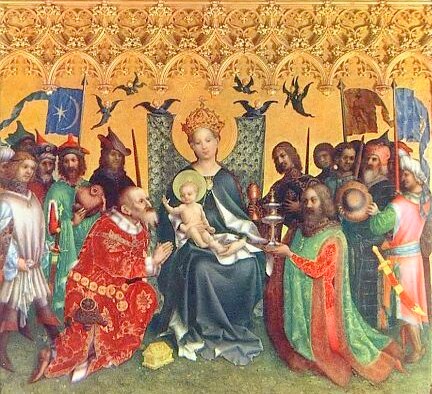
behold, magi: Wise men, astrologers. Originally the term designated the learned priestly caste of the Persians; later it came to mean anyone skilled in occult knowledge and power (magicians), or a charlatan or trickster. The word is not used in an abusive or derogatory sense here by Matthew and the mention of the star shows that they are wise men who study the stars (astrologers) and probably engaged in other scholarly and scientific pursuits. Catholic writer Frank Sheed, in his book “Life of Christ”, describes them as the equivalent of modern university professors—interested primarily in seeking knowledge, but not wise in the ways of political power or court intrigue. Since they are not Jews, they can be considered to be the very first Gentiles to receive the call to salvation in Christ.
from the east arrived in Jerusalem: This suggests Mesopotamia, the home of astrology in the Greek (Hellenistic) world.
**2 saying, "Where is the newborn king of the Jews?: **The Jews had made known throughout the East their hope of a Messiah. The wise men knew of this expected Messiah, king of the Jews (the Jews, recall, spent many years in exile in the East). According to ideas widely accepted at the time, this sort of person, because of his significance in world history, would have a star connected with his birth (Numbers 24:17-19, which many of the Church fathers have interpreted as messianic prophecy, though it is not quoted in the New Testament).
In any case, evidently God had revealed to them in some manner that a new King of the Jews had been born, and they understood from God that he was a special King; they did not come when Herod or Herod’s son was born.
Continued on the next post…**We saw his star at its rising and have come to do him homage." 3 When King Herod heard this, he was greatly troubled, and all Jerusalem with him: **When the leader gets stirred up, the populace gets agitated too; especially with the reputation which Herod had. In all Jewish circles at the time of Jesus, the hope was widespread that the Messiah would come soon. The general idea was that he would be a king, like a new and even greater David. Herod’s worry is therefore all the more understandable: he governed the Jews with the aid of the Romans and cruelly and jealously guarded his crown. Due to his political ambition and lack of a religious sense, Herod saw a potential messiah-king as a dangerous rival to his own worldly power. This is especially the case if his advisors brought to his mind the prophecy from Numbers 24:17-19: “I see him, though not now; I behold him, though not near: A star shall advance from Jacob, and a staff shall rise from Israel, That shall smite the brows of Moab, and the skulls of all the Shuthites, till Edom is dispossessed, and no fugitive is left in Seir. Israel shall do valiantly, and Jacob shall overcome his foes.” Being an Edomite by descent, he would not find this welcome news.