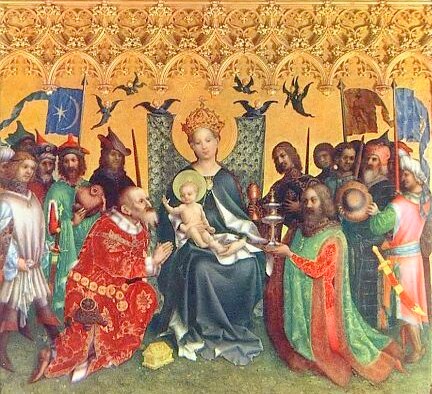
Study and Meditations on this Sunday's Scripture Readings: January 2, 2011

  • Thread starter Thread starter Fidelis
  • Start date Start date
Status
Not open for further replies.
Other thoughts and comments on the Gospel Reading:
**1 When Jesus was born in Bethlehem of Judea: **A small village south of Jerusalem. Its Hebrew meaning is “house of bread,” and it became known as “the city of David” (Lk 2:4). This was the hometown of David (whose kingdom Jesus was heir to), as well as the place where he was anointed (1 Sam 16:1-13).
**in the days of King Herod: **Four different Herods are mentioned in the New Testament. The first is Herod the Great, referred to in this passage and the next; the second is his son, Herod Antiapas, who had John the Baptist beheaded (Matthew 14:1-12) and who abused our Lord during His Passion (Luke 23:7-11); the third, Herod Agrippa I, a nephew of Herod the Great, who executed the apostle James the Greater (Acts 12:1-3), imprisoned Peter (Acts 12:4-7), and died suddenly and mysteriously (Acts 12:20-23). The fourth, Herod Agrippa II, was Herod Agrippa I’s son—it was before him that Paul answered Jewish accusations when he was a prisoner in Caesarea (Acts 23:23).
Herod the Great, who appears here, was the son of non-Jewish (Idumean—or Edomite) parents. He came to power with the aid of and as a vassal of the Romans, particularly Marc Antony (see Josephus, Antiquities of the Jews 14.13.1’324-326). He was a consummate politician and among other things he rebuilt the temple in Jerusalem on a lavish scale. Herod the Great had a persecution complex; everywhere he saw rivals to his throne. He was notorious for his cruelty: he killed over half of his 10 wives, some of his children, and many people of standing. He died in 4 BC.
behold, magi: Wise men, astrologers. Originally the term designated the learned priestly caste of the Persians; later it came to mean anyone skilled in occult knowledge and power (magicians), or a charlatan or trickster. The word is not used in an abusive or derogatory sense here by Matthew and the mention of the star shows that they are wise men who study the stars (astrologers) and probably engaged in other scholarly and scientific pursuits. Catholic writer Frank Sheed, in his book “Life of Christ”, describes them as the equivalent of modern university professors—interested primarily in seeking knowledge, but not wise in the ways of political power or court intrigue. Since they are not Jews, they can be considered to be the very first Gentiles to receive the call to salvation in Christ.
from the east arrived in Jerusalem: This suggests Mesopotamia, the home of astrology in the Greek (Hellenistic) world.
**2 saying, "Where is the newborn king of the Jews?: **The Jews had made known throughout the East their hope of a Messiah. The wise men knew of this expected Messiah, king of the Jews (the Jews, recall, spent many years in exile in the East). According to ideas widely accepted at the time, this sort of person, because of his significance in world history, would have a star connected with his birth (Numbers 24:17-19, which many of the Church fathers have interpreted as messianic prophecy, though it is not quoted in the New Testament).
In any case, evidently God had revealed to them in some manner that a new King of the Jews had been born, and they understood from God that he was a special King; they did not come when Herod or Herod’s son was born.
**We saw his star at its rising and have come to do him homage." 3 When King Herod heard this, he was greatly troubled, and all Jerusalem with him: **When the leader gets stirred up, the populace gets agitated too; especially with the reputation which Herod had. In all Jewish circles at the time of Jesus, the hope was widespread that the Messiah would come soon. The general idea was that he would be a king, like a new and even greater David. Herod’s worry is therefore all the more understandable: he governed the Jews with the aid of the Romans and cruelly and jealously guarded his crown. Due to his political ambition and lack of a religious sense, Herod saw a potential messiah-king as a dangerous rival to his own worldly power. This is especially the case if his advisors brought to his mind the prophecy from Numbers 24:17-19: “I see him, though not now; I behold him, though not near: A star shall advance from Jacob, and a staff shall rise from Israel, That shall smite the brows of Moab, and the skulls of all the Shuthites, till Edom is dispossessed, and no fugitive is left in Seir. Israel shall do valiantly, and Jacob shall overcome his foes.” Being an Edomite by descent, he would not find this welcome news.
Continued on the next post…
 
4 Assembling all the chief priests and the scribes of the people, he inquired of them where the Messiah was to be born: Herod, who was a pagan (half Jewish, at best), may have had some idea of the messianic promises which were the kernel of the Old Testament. But when the question of a special king of the Jews arose, some of his household must have told him that this must be the expected Messiah (a Hebrew word meaning the Anointed, or the Christ).
In the time of Jesus, both Herod’s monarchy and the occupying Romans recognized the Sanhedrin as the representative body of the Jewish people. The Sanhedrin was, therefore, the nation’s supreme council which ruled on day-to-day affairs, both religious and civil. Following Exodus 24:1-9 and Numbers 11:16, the Sanhedrin was composed of 70 members presided over by the high priest. The members were elected from three groupings:
  1. The chief priests, that is, the leaders of the principal priestly families; it was these families who appointed the high priest (the chief priests also included anybody who had formerly held the high priesthood).
  2. The elders, or leaders of the most important families.
  3. The scribes, who were teachers of the Law or experts in legal and religious matters – the majority of these scribes were Pharisees.
In this passage, only the 1st and 3rd groups are mentioned. This is understandable since the elders would have no authority in the matter of the birth of the Messiah—a purely religious question.
5 They said to him, "In Bethlehem of Judea, for thus it has been written through the prophet: 6 ’And you, Bethlehem, land of Judah, are by no means least among the rulers of Judah; since from you shall come a ruler, who is to shepherd my people Israel.’": Quotes Micah 5:2 (Micah 5:1 in NAB & NJB). It is worth noting that Jewish tradition interpreted this prophecy as predicting the Messiah’s exact place of birth and as referring to a particular person. The prophesies of the Old Testament are fulfilled in Jesus the Christ. The text quoted here is not a direct quotation from either the Hebrew or Greek texts but is colored by 2 Samuel 5:2, the offer of kingship to David made by the elders of Israel.
**
7 Then Herod called the magi secretly and ascertained from them the time of the star’s appearance:** Looks forward to verses 13-23 when the male children born around this time will be slain.
**
8 He sent them to Bethlehem and said, “Go and search diligently for the child. When you have found him, bring me word, that I too may go and do him homage.”:** Not to adore Him, but to dispose of Him. Such was Herod’s exclusively political view of things. Herod had already formed his plans—he would destroy that infant. The Magi had probably spent months on their journey. The star may have appeared some months before they left. The Baby could possibly be a year old. But Herod took no chances: when ordering the murder of all the male children of Bethlehem (3:16), he said: “from two years and under.”
**9 After their audience with the king they set out. And behold, the star that they had seen at its rising preceded them, until it came and stopped over the place where the child was. **10 They were overjoyed at seeing the star, 11 **and on entering the house they saw the child with Mary his mother: ** This heavenly light directed them to the place (not the stable, as it says, they “entered the house”) where they found the Child.
The omission of Joseph may be due to the simple fact that he was absent because he had found employment in Bethlehem as a carpenter. It is, however, more likely that Matthew who has already (1:18-25) told of the virginal conception of Christ, is emphasizing here the fact that Joseph was only the foster-father of Christ.
**
They prostrated themselves and did him homage:** That is, they paid him reverence by prostrating themselves before him. It does not prove they recognized him as God but they did recognize him as a special King.
Concluded on the next post…
 
**Then they opened their treasures and offered him gifts of gold, frankincense, and myrrh: **The prophets and the psalmists foretold that the kings of the earth would pay homage to God at the time of the Messiah (Isaiah 49:23). They would offer him their treasures (Isaiah 60:5-6) and adore Him (Psalm 72:10-15). Through the action of these wise men, these prophecies begin to be fulfilled; although there is no indication that these wise men were kings or emissaries of kings. The gifts offered were those most valued in the East and have symbolic meanings:
Gold - A symbol of royalty and Jesus’ kingship
Frankincense - A symbol of Jesus’ divine priesthood
*Myrrh - *A burial spice and symbol of Jesus’ death to redeem us. It was also used to anoint the OT Levitical priests and the Tabernacle (Ex 30:23-33).
St. Irenaeus says the treasures given by the magi signify the gifts we present to Christ in our daily lives. Gold is Christ’s wisdom, that shines in us, frankincense is the prayer and adoration we give him (see Rev 8:3-4), and myrrh is our daily self-sacrifices (10:39; see Rom 12:1).
**
12 And having been warned in a dream not to return to Herod, they departed for their country by another way: **The involvement of the wise men ends with an act of obedience and cooperation with God’s plan. Herod had told them to return to him but God had other plans—the Magi were instructed to return not via Jerusalem but by another route. This gave time to Joseph to remove the Child before Herod could lay hands on him.
Notice that throughout this story, nowhere is it stated how many magi there were. In later Christian tradition they became known as kings (in fulfillment of the above prophecy and referring to Psalm 72:10-11) and their number was settled at three; deduced from the number of gifts. Eventually, they were named Caspar, Balthasar and Melchior in the Western Church, and Caspar became a black. They were understood as representatives of the Gentile world in all its racial diversity who come to Christ.
 
Catechism of the Catholic Church paragraphs referencing this Sunday’s Gospel Reading:
439 Many Jews and even certain Gentiles who shared their hope recognized in Jesus the fundamental attributes of the messianic “Son of David”, promised by God to Israel.38 Jesus accepted his rightful title of Messiah, though with some reserve because it was understood by some of his contemporaries in too human a sense, as essentially political.39
Code:
38. Cf Mt 2:2; 9:27; 12:23; 15:22; 20:30; 21:9,15.
Code:
39. Cf. Jn 4:25-26; 6:15; 11:27; Mt 22:41-46; Lk 24:21.
**486 **The Father’s only Son, conceived as man in the womb of the Virgin Mary, is “Christ”, that is to say, anointed by the Holy Spirit, from the beginning of his human existence, though the manifestation of this fact takes place only progressively: to the shepherds, to the magi, to John the Baptist, to the disciples.123 Thus the whole life of Jesus Christ will make manifest "how God anointed Jesus of Nazareth with the Holy Spirit and with power."124
Code:
123. Cf. Mt 1:20; 2:1-12; Lk 1:35; 2:8-20; Jn 1:31-34; 2:11.
Code:
124. Acts 10:38.
528 The Epiphany is the manifestation of Jesus as Messiah of Israel, Son of God and Savior of the world. The great feast of Epiphany celebrates the adoration of Jesus by the wise men (magi) from the East, together with his baptism in the Jordan and the wedding feast at Cana in Galilee.212 In the magi, representatives of the neighboring pagan religions, the Gospel sees the first-fruits of the nations, who welcome the good news of salvation through the Incarnation. The magi’s coming to Jerusalem in order to pay homage to the king of the Jews shows that they seek in Israel, in the messianic light of the star of David, the one who will be king of the nations.213 Their coming means that pagans can discover Jesus and worship him as Son of God and Savior of the world only by turning towards the Jews and receiving from them the messianic promise as contained in the Old Testament.214 The Epiphany shows that “the full number of the nations” now takes its “place in the family of the patriarchs”, and acquires Israelitica dignitas215 (is made “worthy of the heritage of Israel”).
Code:
212. Mt 2:1; cf. LH, Epiphany, Evening Prayer II, Antiphon at the Canticle of Mary.
Code:
213. Cf Mt 2:2; Num 24:17-19; Rev 22:16.
Code:
214. Cf Jn 4:22; Mt 2:4-6.
Code:
215. St. Leo the Great, Sermo 3 in epiphania Domini 1-3, 5: PL 54, 242; LH, Epiphany, OR; Roman Missal, Easter Vigil 26, Prayer after the third reading.
724 In Mary, the Holy Spirit manifests the Son of the Father, now become the Son of the Virgin. She is the burning bush of the definitive theophany. Filled with the Holy Spirit she makes the Word visible in the humility of his flesh. It is to the poor and the first representatives of the gentiles that she makes him known.106
Code:
106. Cf. Lk 1:15-19; Mt 2:11.
 
Here are some questions on the Readings for personal or group reflection:
Code:
* The 1st Reading from Isaiah contains a prophecy which is directed to the Jews returning from Exile, but it is not primarily about them. Who does it describe and what will be their experience? What will Israel’s response to this be? What should our response be to seeing people who were formerly “outsiders” entering the Church?
Code:
* In the 2nd Reading, what is the “great mystery” of which St. Paul speaks of in verse 3? Why is this significant for the Church of his time? Of our time?
Code:
* Why was it important for Jesus to be born in the city of David, Bethlehem, a name which means “house of bread” (verses 4-6; Micah 5:1-3; 2 Samuel 5:2)?
Code:
* What do the star, the Magi, the gifts, the homage, the hostility and the prophecy teach about the significance of Jesus?
Code:
* Since the Magi were pagan astrologers, why would they leave everything to follow that star? In your journey toward God, how are you like the Magi? Unlike them? Have you had to leave anything to follow Jesus?
Code:
* Note the responses of the Magi upon finding Jesus. How are they similar to the response that Christians make to Jesus, including before the Blessed Sacrament?
Code:
* What is the “gold, frankincense, and myrrh” in your life? How have you offered this to Jesus?
 
A meditation for practical application on this Sunday’s Gospel Reading from Catholic Matters:
**APPLICATION: **The Magi are the central personages in today’s feast of Epiphany. They were pagans who did not know the true God of the Jews. Yet that true God revealed to them that the King he had promised to the Jews had come. The expected Prince was born. They came to Jerusalem, the capital of Judah, expecting, of course, to find the city and the whole country rejoicing. Instead they found suspicion and hatred in the reigning king—a hatred which in a few days turned to murder. Among the religious leaders they found knowledge of their past history, but utter indifference as regards the present and the future. These leaders knew the Messiah would be born in Bethlehem; they must have realized that the Magi were very sure of the truth revealed to them—they would not have come such a long journey on a “fool’s errand.” In spite of that, the thought of going to Bethlehem with the Magi never entered their minds. These were the leaders who some years later refused to listen to Christ and in spite of his miracles refused to admit his claim that he was not only the promised Messiah, but the true Son of God. These were the men who rejected him because he had mercy on sinners, and spoke of a future life. What they wanted from their Messiah was political power and earthly freedom and prosperity. Like Herod they ended with murder—the crucifixion of the “King of the Jews.” The pagan king was not much worse than the indifferent leaders of God’s Chosen People.
We too know the true facts concerning Christ, his mission, and his present and future kingdom. Like the leaders of the Jews of his day, we also could become absorbed in the affairs of this life and the quest for wealth, pleasure and power. We could become so totally absorbed in such things as to have neither the interest nor the time to pay our respects to Christ or to welcome him into our homes and our hearts, as our true Lord. God forbid it should ever be thus with us. Rather let us resolve this morning to make the Magi our models, to follow them to Bethlehem and offer him all that we have and are. He will accept our offering and we will return by another way, wiser and better men.
http://images.evangelizo.org/images/divers/icons/icon_Nativity.jpg
 
Meditations on this Sunday’s readings from Dr. Scott Hahn:
A King to Behold
An “epiphany” is an appearance. In today’s readings, with their rising stars, splendorous lights and mysteries revealed, the face of the child born on Christmas day appears.
Herod, in today’s Gospel, asks the chief priests and scribes where the Messiah is to be born. The answer Matthew puts on their lips says much more, combining two strands of Old Testament promise - one revealing the Messiah to be from the line of David (see 2 Samuel 2:5), the other predicting “a ruler of Israel” who will “shepherd his flock” and whose “greatness shall reach to the ends of the earth” (see Micah 5:1-3).
Those promises of Israel’s king ruling the nations resound also in today’s Psalm. The psalm celebrates David’s son, Solomon. His kingdom, we sing, will stretch “to the ends of the earth,” and the world’s kings will pay Him homage. That’s the scene too in today’s First Reading, as nations stream from the East, bearing “gold and frankincense” for Israel’s king.
The Magi’s pilgrimage in today’s Gospel marks the fulfillment of God’s promises. The Magi, probably Persian astrologers, are following the star that Balaam predicted would rise along with the ruler’s staff over the house of Jacob (see Numbers 24:17).
Laden with gold and spices, their journey evokes those made to Solomon by the Queen of Sheba and the “kings of the earth” (see 1 Kings 10:2,25; 2 Chronicles 9:24). Interestingly, the only other places where frankincense and myrrh are mentioned together are in songs about Solomon (see Song of Songs 3:6, 4:6,14).
One greater than Solomon is here (see Luke 11:31). He has come to reveal that all peoples are “co-heirs” of the royal family of Israel, as today’s Epistle teaches.
His manifestation forces us to choose: Will we follow the signs that lead to Him as the wise Magi did? Or will we be like those priests and the scribes who let God’s words of promise become dead letters on an ancient page?
 
A meditation on the Gospel from Daily Scripture Readings & Meditations:
"They fell down and worshiped Jesus"
Meditation: If Jesus truly is who he claims to be, the eternal Son of God and Savior of the world, then why is he not recognized by everyone who hears his word and sees his works? John the Evangelist states that when Jesus came into the world the world knew him not and his own people received him not (John 1:10-11). Jesus was born in obscurity. Only the lowly shepherds recognized him at his birth. Some wise men also found their way to Bethlehem to pay homage to the newborn King of Israel. These men were not Israelites, but foreigners. They likely had read and discussed the Messianic prophecies and were anxious to see when this Messianic King would appear. God led them by means of an extraordinary star across the desert to the little town where Jesus was born.
John Chrysostom (347-407), in his homily on this passage from Matthew 2, explains the significance of the star of Bethlehem:
  • “Note how fitting was the order of events: the wise men saw the star, were received by the Jews and their king; they heard prophecy to explain what had appeared; the angel instructed them; and then they journeyed from Jerusalem to Bethlehem by the guidance of the star. From all this we learn that this was not an ordinary star, for no other star has this capacity to guide, not merely to move but to beckon, to “go before them,” drawing and guiding them along their way. The star remained after bringing them to the place, in order that the child might also be seen. For there is nothing conspicuous about the place. The inn was ordinary. The mother was not celebrated or notable. The star was needed to manifest and illumine the lowly place, until they had reached their destination at the manger.”* [The Gospel of Matthew, Homily 7:3]
In their thirst for knowledge of God, the wise men from the East willingly left everything, their home and country, in pursuit of that quest. In their diligent search they were led to the source of true knowledge – to Jesus Christ, the Light and Wisdom of God. When they found the newborn King they humbly worshiped him and gave him gifts fitting for a king. How could they recognize this infant as both divine and a human king - born of flesh yet sent from heaven? The early church fathers taught that only divine revelation could open the minds and hearts of people to recognize and receive Christ as their King and Savior. Chromatius (died 406 or 407), a contemporary bishop and friend of Ambrose, Jerome, and John Chrysostom, wrote:
*
Let us now observe how glorious was the dignity that attended the King after his birth, after the magi in their journey remained obedient to the star. For immediately the magi fell to their knees and adored the one born as Lord. There in his very cradle they venerated him with offerings of gifts, though Jesus was merely a whimpering infant. They perceived one thing with the eyes of their bodies but another with the eyes of the mind. The lowliness of the body he assumed was discerned, but the glory of his divinity is now made manifest. A boy he is, but it is God who is adored. How inexpressible is the mystery of his divine honor! The invisible and eternal nature did not hesitate to take on the weaknesses of the flesh on our behalf. The Son of God, who is God of the universe, is born a human being in the flesh. He permits himself to be placed in a manger, and the heavens are within the manger. He is kept in a cradle, a cradle that the world cannot hold. He is heard in the voice of a crying infant. This is the same one for whose voice the whole world would tremble in the hour of his passion. Thus he is the One, the God of glory and the Lord of majesty, whom as a tiny infant the magi recognize. It is he who while a child was truly God and King eternal. To him Isaiah pointed, saying, “For a boy has been born to you; a son has been given to you, a son whose empire has been forged on his shoulders (Isaiah 9:6).” *[Tractate on Matthew, 5:1]
The Lord of the universe who revealed the star of Bethlehem to the Gentiles of the East so they could come and worship Jesus, the Prince of Peace (Isaiah 9:6) and King of Kings (Revelations 19:16), gives each one of us the same light of revelation to recognize and accept Jesus as our Lord and Savior. Faith is an entirely free gift that God makes to us. It is through the help of the Holy Spirit, who moves the heart and opens the eyes of the mind, that we are able to understand, accept, and believe the truth which God has revealed to us through his Son, Jesus Christ. In faith, the human will and intellect cooperate with grace. “Believing is an act of the intellect assenting to the divine truth by command of the will moved by God through grace” (Thomas Aquinas).
To know and to encounter Jesus Christ is to know God personally. In the encounter of the wise men with Jesus we see the plan of God to give his only Son as King and Savior, not just for the Jewish people but for all the nations as well. The Lord Jesus came that both Jew and Gentile might find true and lasting peace with God. Let us pray today that Jew and Gentile alike will find the Lord and Savior on their journey of life. Do you bring the light of Jesus Christ to those you meet through the witness of your life and testimony?
*“Lord Jesus Christ, we thank you for bringing salvation to all the nations. May the gospel of salvation be proclaimed to every nation today and to every person on the face of the earth. Help me to be a good witness of the joy of the gospel to all I meet.” *
 
From The Word Among Us devotional magazine: A meditation on Isaiah 60:1-6:
Your sons come from afar. (Isaiah 60:4)
With today’s feast, the Christmas season comes to a close with a burst of light—something like a spectacular fireworks display at the end of a big celebration. Epiphany is the shining revelation of Jesus as the Light and Savior of the world. The magi, glimpsing his light, are the first of the multitudes who will come to him “from the east and the west” to form a new people of God (Matthew 8:11).
Long before the magi, a prophet speaking in the name of Isaiah also saw multitudes united in praise of God. His vision was a confident assurance that God would make his people into a light to the nations. But how impossible this glorious destiny must have seemed to the prophet’s first audience! They were the exiles who had returned to Jerusalem to rebuild their ruined city and its Temple. And they were anything but joyful and radiant because the venture wasn’t going so well.
There was drought, and their crops failed. The rebuilt Temple was a disappointment—a poor relative of Solomon’s glorious construction. The neighboring nations were hostile. And perhaps most bitter of all, God’s people themselves were divided. Relatively few had returned to rebuild, and those who trickled in were quarreling and forming factions. What a contrast with the prophet’s picture of all the exiles streaming into Jerusalem, along with caravans from every nation—one people praising God together!
Maybe this picture seems out of reach to us as well. After all, we too are divided. We are hardly the unified family Jesus calls us to be. But the prophet tells us: Shake off gloom and “raise your eyes” to the higher vision of what God is doing (Isaiah 60:4)! His Spirit is at work to heal and unify —in official dialogues with theologians, in on-the-ground encounters involving Christians of all traditions, and in more ways than we can know. Let’s support these works and pray for them. Without denying our differences, let’s honor what we have in common with all our brothers and sisters in Christ. And let’s earnestly pray: Lord, make us one!
“Father, I look forward to the day when all your children will ‘come from afar’ to worship you as one. Increase my longing for that day, and show me what I can do to hasten its coming.”
Questions for Reflection or Group Discussion
  1. The first reading should fill us with hope as we contemplate what God has accomplished in the coming of Jesus. Through his coming: “the glory of the Lord shines upon you,” “your sons (and daughters) come from afar,” and “you shall be radiant at what you see, your heart shall throb and overflow” (Isaiah 60:1,4,5). In what ways does your faith in Jesus fill you with hope? What are some ways that you can increase your faith in him during 2011?
  1. The Responsorial Psalm speaks of a king endowed by God to “govern your people with justice,” “rescue the poor when he cries out,” “have pity for the lowly and the poor,” and “the lives of the poor he shall save” (Psalm 72: 2,12,13). In what ways has Jesus fulfilled these words? In 2011, what are some new steps you can take to share in this work of Jesus?
  1. In the second reading, we hear the wonderful revelation that the Gentiles are now coheirs with the Jewish people in all the promises fulfilled in Jesus Christ. How can we as Christian be a better witness of Christ’s love to our Jewish brothers and sisters? Why not spend a few minutes now to pray for Jewish people whom you know, and for all the Jewish people, that they may one day come to know Jesus as their Messiah.
  1. In the Gospel, we are told that when the magi inquired of the whereabouts of the “newborn king of the Jews,” King Herod was “greatly troubled and all Jerusalem with him” (Matthew 2: 2,3). Why do you think King Herod was so troubled by this news? The magi, on the other hand, were overjoyed when they found Jesus, and “did him homage” (2:11). Why do you think the magi’s reaction was so different than Herod’s? What is your reaction when you reflect on these events?
  1. In describing the efforts towards bringing unity among Christians, the meditation calls on us to “support these works and pray for them. Without denying our differences, let’s honor what we have in common with all our brothers and sisters in Christ. And let’s earnestly pray: Lord, make us one!” In what ways have you encouraged or supported unity with Christians from other denominations? What additional steps can you take?
  1. Take some time to pray for Christian unity, using the prayer at the end of the meditation as the starting point. Also, take some time to offer prayers of thanksgiving to the Lord for his great love and mercy toward you, and ask the Lord for his blessings upon you and your family in 2011.
 
Another reflection from The Word Among Us, this one on the Gospel Reading:
The Magi, the Holy Spirit, and You
How a Journey from Long Ago Invites Us Today
What could possibly have motivated the wise men to leave their homes and undertake a long, hard desert journey?
What did they think was so special about the “newborn king of the Jews” (Matthew 2:12)? Everyone knew that the people of Israel lived under Roman occupation and had no political power or prestige. Any “king” they had would be merely a puppet of the Roman emperor. So why, when they saw the rising star and discerned its message, were the magi attracted by this birth announcement of a powerless monarch in a faraway land?
Isn’t it possible that the Holy Spirit was moving in them, giving them a sense that this was an event of extraordinary significance? Perhaps the Spirit touched on a sense of longing and hope in the magi and compelled them to investigate.
And do you think that when they found the Holy Family, the wise men simply presented their gifts and then hurried back home? More likely, they asked Joseph and Mary many questions, trying to figure out what all the signs meant. And more than likely, these new parents were happy to oblige.
Imagine the evangelization that must have occurred as Mary told them about the angel’s visit and Joseph explained his dreams. Imagine them speaking of the Scriptures foretelling that, when the Messiah arrived, kings would come from distant lands bearing gold and frankincense (Isaiah 60:2,6). How these travelers must have thrilled to know that the longing in their heart could be fulfilled in this little child!
All of us long for a sense of meaning and purpose. All over the world, people are starving for answers, and the Holy Spirit wants to direct them to us, just as he directed the magi to Mary and Joseph. And like these two, all we have to do is share from our hearts about the ways that God has moved in us. The Holy Spirit will take care of the rest. As we begin a new year, then, let’s be prepared for everyone who may show up at our door!
“Lord Jesus, shine your light in every dark corner of the world today. By your Holy Spirit, stir hearts to seek you. Help those who know you to stand ready to share from their hearts the good news of your love and mercy.”
 
The Tedious Journey to Truth and Joy
Biblical Reflection for Jan. 2, Solemnity of the Epiphany, Year A

By Father Thomas Rosica, CSB
The word “epiphany” means “to show forth.” Epiphanies, both large and small, tend to be private events – yet events with great significance for the public. Trying to share the details with another of an epiphany is fraught with complications. The words are never quite right, and even the most sympathetic listener cannot fully bridge the gap between description and what is was like being there. Most of us keep our personal experiences of the Holy to ourselves. Who would believe it? And who would really understand? The irony is that epiphanies are made for sharing, even as they are impossible to communicate fully.
Messiah and Lord
This is certainly the case of today’s extraordinary Gospel story for the solemn feast of the Epiphany of our Lord Jesus Christ. It is the feast par excellence of the manifestation of Jesus as Messiah of Israel, Son of God and Savior of the world. Today the Church celebrates the adoration of Jesus by the wise men (magi) from the East, and also commemorates two other important moments of public revelation of Jesus to the world: at his baptism in the Jordan and the wedding feast at Cana in Galilee.
The purpose of the whole magi story is clearly Christological. The foreigners are Gentiles, illustrating the universal breadth of the good news brought by the “king of the Jews.” They are people of good will, open to God, ready to hear and follow the call of God. They are people willing to follow a star, wherever it might lead. Open and starry-eyes, they are naive, guileless, easily taken-in by self-serving priests and murderous kings. They are romantic and lovable figures, pursing the truth and searching for a deep and abiding joy that the world cannot give.
A tragic, adult story
If we read Matthew’s Gospel story carefully, we realize that far from being a children’s tale, it is a tragic adult story. Matthew’s shows us that right at the beginning of the story of Jesus, the one who is to rule Israel is greeted with the cheers of some and the fearful fury of others. The future rejection of Jesus by Israel and his acceptance by the Gentiles are retrojected (read back) into this scene of the narrative.
Matthew begins his story of the magi with the words: “In the days of King Herod” (2:1). Herod reigned from 37 to 4 B.C. “Magi” was originally a designation of the Persian priestly caste, and the word became used of those who were regarded as having more than human knowledge. Matthew’s magi are astrologers, searching the heavens for new signs and wonders.
Matthew draws upon the Old Testament story of Balaam, who had prophesied that “a star shall rise from Jacob” (Numbers 24:17), though there the star means not a phenomenon of the distant heavens but the king himself. Unlike the poor shepherds, the Magi had to travel a long road; they had to face adversity to reach their goal. It was anything but a romantic, sentimental pilgrimage that we often see in our manger scenes!
The magis’ coming to Jerusalem in order to pay homage to the king of the Jews shows that they seek in Israel, in the messianic light of the star of David, the one who will be king of the nations. Their coming to Jesus means that pagans can discover Jesus and worship him as Son of God and Savior of the world only by turning towards the Jews and receiving from them the messianic promise as contained in the Scriptures of the Old Testament.
**
What does the story mean for us?**
When we read the story of the turmoil the child Jesus brought into the lives of Mary, Joseph, the Magi, Herod, the whole of Jerusalem, and all the newborn babies of Bethlehem – we are forced to ask ourselves whether the adult Christ challenges and moves our lives in the same way. When we read the story of the shepherds and their vision of angelic choirs, we discover anew how God can break into our life as well. In remembering and reliving the angelic roles in Jesus’ birth in Bethlehem, the veil that separates us from the world of the spirit is drawn back. The experience of the magi reminds us that all who make the tedious journey to the truth will finally encounter it and be changed in the process. They can never go back to a “business as usual” way of life. When we meet Christ and see who he really is, we will never be the same – and only then can we hope to begin to share in his mission.
Concluded on the next post…
 
The great English Christian writer and apologist C.S. Lewis is associated more than anything else with his use of the word “joy.” It is interesting that he used it, not so much to describe his sense of the abiding presence of God, as to speak of the ongoing longing for God. The story of the magi and the brightness of the star in the heavens evokes profound feelings despite the fact that, as with many other signs of the sacred, it runs the risk at times of being emptied of its meaning. The star we contemplate in the manger also speaks to the mind and heart of the men and women of our time. The journey of the magi and the star speak to our secularized culture, awakening in our contemporaries the nostalgia of our condition as pilgrims in search of truth, of the absolute desire, and of a deep, abiding joy.
Speaking of joy, I encourage you to read section #123 of Benedict XVI’s apostolic exhortation “Verbum Domini” about the “The word and joy.”
“In God’s word, we too have heard, we too have seen and touched the Word of life. We have welcomed by grace the proclamation that eternal life has been revealed, and thus we have come to acknowledge our fellowship with one another, with those who have gone before us marked with the sign of faith, and with all those who throughout the world hear the word, celebrate the Eucharist and by their lives bear witness to charity. This proclamation has been shared with us,” the Apostle John reminds us, so that “our joy may be complete” (1 John 1:4).
The synodal assembly enabled us to experience all that Saint John speaks of: the proclamation of the word creates communion and brings about joy. This is a profound joy which has its origin in the very heart of the trinitarian life and which is communicated to us in the Son. This joy is an ineffable gift which the world cannot give. Celebrations can be organized, but not joy. According to the Scripture, joy is the fruit of the Holy Spirit (cf. Galatians 5:22) who enables us to enter into the word and enables the divine word to enter into us and to bear fruit for eternal life. By proclaiming God’s word in the power of the Holy Spirit, we also wish to share the source of true joy, not a superficial and fleeting joy, but the joy born of the awareness that the Lord Jesus alone has words of everlasting life (cf. John 6:68).
The true work of Christmas
In the end, the magi went their own way, and because they refused to be seduced by cynicism, because they allowed themselves to be surprised by this great joy, the star to which they had committed themselves appeared again. This is not only the description of the times into which Jesus was born, but also our times. When we have found our lasting joy in the midst of the encircling gloom, cynicism, despair, indifference and meaninglessness, the only thing to do is to kneel and adore, as did those foreign seekers long ago in Bethlehem.
**
If we are truly wise, let us do what the wise astrologers did. When we hear the voice of the old king of death and fear and cynicism, let us have the courage to go our own way – rejoicing. The star and the journey will send us onwards, by newer paths, to come into the presence of the Child of Light and the Prince of Peace, who is the fulfillment of humanity’s deepest hopes and desires for light, justice, love and peace.**
Today we can truly exclaim, with deep and abiding joy: Lord, every nation on earth will adore you! This poem from the Shaker tradition illustrates what the real work of Christmas and of Christ is all about:
“When the song of the angels is stilled,
When the star in the sky is gone,
When the kings are back home,
When the shepherds are once more with their flocks,
When Simeon and Anna have gone to their Master in peace,
Then the work of Christmas begins:
To find the lost, to heal the broken,
To release the prisoners, to rebuild nations,
To bring peace to all people,
To make music in the heart. Amen.”
 
Walking with the Wise Men: A Meditation on the Feast of Epiphany
By: Msgr. Charles Pope
Note: Here in America Epiphany is (sadly) transferred to a nearby Sunday instead of January 6. Hence, this Sunday we read of this event and celebrate it liturgically. With that in mind here are my homily notes for Epiphany, which, for some of you in other parts of the world may seem a bit premature.
There are so many wonderful details in the Epiphany story: the call of the Gentiles, the nations, and their enthusiastic response, the significance of the star they see and the gifts they bring, the dramatic interaction with Herod and their ultimate rejection of him in favor Christ.
In this meditation I would like especially to follow these wise men in their journey of faith. We can observe how they journey in stages from the dim light of a star to the bright and glorious Light of Jesus Christ. And, of course to authentically encounter the Lord is to experience conversion. All the elements of this story serve ultimately to cause them to “return to their country by another route.” Let’s look at the stages of their journey to Jesus, let’s walk the way of the wise men.
**Stage 1. CALL - **The text says – When Jesus was born in Bethlehem of Judea, in the days of King Herod, behold, magi from the east arrived in Jerusalem, saying, “Where is the newborn king of the Jews? We saw his star at its rising and have come to do him homage.” – Notice first the identity of these individuals. They are called Magi, (μάγοι, (magoi) in Greek) and they are from the East.
Exactly what “Magi” are is debated. Perhaps they are wise men, perhaps they are ancient astronomers. We often think of them as Kings though the text does not call them that. It also seems Herod would have been far more anxious had they been actual potentates from an Eastern Kingdom. In our imagination we often think of them as Kings since Psalm 72, read in today’s Mass, speaks of “Kings” coming from the East bearing gifts of gold and frankincense. However, for the record, the text in today’s gospel does not call them kings, but “magi.”
Yet, here is their key identity: they are Gentiles and they have been called. Up to this point in the Christmas story only Jews had found their way to Bethlehem. But now the Gentiles come. This detail cannot be overlooked, for it is clear that the gospel is going to go out to all the world. St. Paul rejoices in this fact in today’s second reading as he says: that the Gentiles are coheirs, members of the same body, and co-partners in the promise in Christ Jesus through the gospel (Eph 3:6). Most of us are not Jewish by ancestry, and hence we ought to rejoice for in the call of these Magi is prefigured our call.
And notice that God calls them through something in the natural world. In this case a star. God uses something in creation to call out to them. We do well to wonder what is the star that God used to call us? Perhaps it was Scripture but more usually it is first, someone God has used to reach us, a parent, a family member, a friend, a priest, religious sister, or devoted lay person. Who are the stars in your life by whom God called you? God can even use inanimate creation like he did for these Magi. Perhaps it was a beautiful Church, a painting or a song. By someone or something God calls. He puts a star in our sky. These wise men, these Magi, follow the call of God and begin their journey to Jesus.
**Stage 2. CONSTANCY **- Upon their arrival in Jerusalem the Magi find a rather confusing and perhaps discouraging situation. The reigning King, Herod, knows nothing of the birth of this new King. It must have seemed probable that the newborn King would be related to the current King so his surprise may have confused them. But Herod seems more than surprised, he seems threatened.
Even more puzzling, he calls religious leaders to further inform him of this King. They open the sacred writings and the Magi hear of a promised King. Ah so the birth of this king has religious significance! How interesting! But, these religious leaders seem unenthusiastic of the newborn King and after giving the location of his birth seem to make no effort to follow the Magi. There is no rejoicing, no summoning of the people that a longed for king had finally been born. Not even further inquiry!
So the wicked (Herod) are wakeful and the saints are sleepy. How odd this must have seemed to the Magi. Perhaps it occurred to them to suspend their search. After all, the actual King knew nothing of this birth and those who did seemed little interested.
Ah, but praise the Lord they persevere in their search. They do not give up! Thanks be to God too, that many today have found their way to Christ despite the fact that parents clergy and others who should have led them joyfully to Jesus were either asleep, or ignorant or just plain lazy. I am often amazed at some of the conversion stories I have heard, people who found their way to Christ and his Church despite some pretty discouraging obstacles like poor religious upbringing, scandalous clergy and bad example. God sometimes allows our faith and call to be tested but Those who persevere to the end will be saved (Matt 24:13).
Concluded on the next post…
 
**Stage 3. CONFESSION OF FAITH **- The text says, *After their audience with the king they set out. And behold, the star that they had seen at its rising preceded them, until it came and stopped over the place where the child was. They were overjoyed at seeing the star, and on entering the house they saw the child with Mary his mother. They prostrated themselves and did him homage. *– With what little information they have they set out and continue to follow the call of God through the star.

Note that they enter a “house.” We often think of the Magi as coming that same Christmas night to the cave or stable but it seems not. Mary (Joseph) and Jesus are found now in a house. It would seem that decent lodging has now been found. Has it been days since the birth? Perhaps even longer, but we are likely dealing with a different day than Christmas Day.

Notice too that they “prostrate” themselves before Jesus. The Greek word is προσεκύνησαν (prosekunēsan) which means more literally “to fall down in worship” or “give adoration.” The verb is used 12 times in the New Testament and it is clear each time that religious worship is the purpose of the prostration. This is no mere homage or a sign of respect to an earthly King, this is religious worship. This is a confession of faith. So our Magi manifest faith! But is it a real faith, or just a perfunctory observance? It’s not enough to answer an altar call, or to get baptized. Faith is never alone. It is a transformative relationship with Jesus Christ. So lets look for the effects of a real and saving faith.

**Stage 4. COST **- There is a cost to discipleship. The magi are moved to give three symbolic gifts that show some of what true faith includes. And they are costly gifts.

Gold is a symbol of all our possessions. In laying this gift before Jesus they and we are saying, “I acknowledge that everything I have is yours. I put all my resources and wealth under your authority and will use them only according to your will.” A conversion that has not reached the wallet is not complete.

Frankincense. is the gift of worship, for in the Bible incense is a symbol of prayer and worship (eg. psalm 141). In laying down this gift we promise to pray and worship God all the days of our life. To be in his holy house each Sunday and render him the praise and worship he is due. To listen to his word and to consent to be fed the Eucharist by him. To worship him worthily by frequent confession and to praise him at all times. And they give

**Myrrh **- a strange gift for an infant. Myrrh is usually understood as burial ointment. Surely this prefigures Jesus’ death but it also symbolizes our own. In laying this gift before Jesus we are saying, my life is yours. I want to die so that you may live your life in me. May you increase and may I decrease. Use me and my life as you will. So here are gifts that are highly symbolic.

The magi manifest more than a little homage to Jesus. They are showing forth the fruits of saving faith. And if we can give these gifts so too are we.

Stage 5. CONVERSION – The text says, *And having been warned in a dream not to return to Herod, they departed for their country by another way. *Here then is essential evidence for faith: conversion. It is not enough to get happy in Church, we have to obey. Hence, these wise men are walking differently now. They are not going home by the same way they came. They’ve changed direction, they’ve turned around (conversio). They are now willing to walk the straight and narrow path that leads to life rather than the wide road that leads to damnation. They are going to obey Christ. They are going to exhibit what St. Paul calls the “obedience of faith” (Rom 1:5; 16:26). They have not just engaged in a possibly perfunctory worship, they are showing signs of a true and saving faith. They are not just calling Jesus “Lord, Lord!” They are doing what he tells them (cf Luke 6:46).

So there it is. Through careful stages the Lord has brought the Gentiles (this means you) to conversion. He called. They remained constant, confessed him to be Lord, accepted the cost of discipleship and manifested conversion. Have you? Have I? Walk in the ways of the Wise men! Wise men still seek him. Even wiser ones listen to him and obey. Are we willing to go back to our country by another route? Is on-going conversion part of our journey home to heaven? If Epiphany means “manifestation” how is our faith manifest in our deeds and conversion?

http://www.corrado-giaquinto.org/Adoration-of-the-Magi-c.-1725.jpg
 
Sunday Gospel Reflections: A synthesis by the Vietnamese Christian Life (Dong Hanh) Community
Epiphany
Reading I: Isaiah 60:1-6 II: Ephesians 3:2-3,5-6 Gospel
Matthew 2:1-12
1 Now when Jesus was born in Bethlehem of Judea in the days of Herod the king, behold, wise men from the East came to Jerusalem, saying,
2 “Where is he who has been born king of the Jews? For we have seen his star in the East, and have come to worship him.”
3 When Herod the king heard this, he was troubled, and all Jerusalem with him;
4 and assembling all the chief priests and scribes of the people, he inquired of them where the Christ was to be born.
5 They told him, “In Bethlehem of Judea; for so it is written by the prophet:
6 ‘And you, O Bethlehem, in the land of Judah, are by no means least among the rulers of Judah; for from you shall come a ruler who will govern my people Israel.’”
7 Then Herod summoned the wise men secretly and ascertained from them what time the star appeared;
8 and he sent them to Bethlehem, saying, “Go and search diligently for the child, and when you have found him bring me word, that I too may come and worship him.”
9 When they had heard the king they went their way; and lo, the star which they had seen in the East went before them, till it came to rest over the place where the child was.
10 When they saw the star, they rejoiced exceedingly with great joy;
11 and going into the house they saw the child with Mary his mother, and they fell down and worshiped him. Then, opening their treasures, they offered him gifts, gold and frankincense and myrrh.
12 And being warned in a dream not to return to Herod, they departed to their own country by another way.

**
Interesting Details**
Code:
* Bethlehem is a small town six miles south of Jerusalem.
* Israel was ruled by the Romans and King Herod was the Roman appointed ruler of Palestine. He maintained law and order with cruelty. The Jews were waiting for a Savior to come.
* The ancients believed that each person was represented by a star at birth.
* The Magi belonged to a priestly caste in Persia where their principal task was to be intellectual and religious advisers to the Persian kings. They were trained in philosophy, medicine, and above all in astronomy.
* The meanings of the gifts:
  1. Gold: In the ancient time, gold was considered as a precious metal reserved only for the royalty. Gold is offered to infant Jesus as the king.
  2. Frankincense: Incense has always been a favorite part of religious ritual not only for its air-sweetening power but also because the rising plumes of smoke seems to be visible prayers bridging heaven and earth. The gift of frankincense adverts to Christ's priestly role.
  3. Myrrh: Myrrh is used to heal and embalm death body. The gift of myrrh implies the human nature of the infant Jesus and also announces his future death.
One Main Point
The visitation of the Persian Magi is regarded as the revelation of God to the world. God invites all, both Jews and Gentiles, to share equally the salvation brought by Christ.
Reflections
  1. What do I think about the Magi? What do they impress me most?
  2. If the infant Christ is born today, what presents do I offer Him?
  3. The infant Christ was born in the manger and revealed himself to the three Magi and to the uneducated shepherds. How do I “reveal” myself to others? How do I treat others?
  4. After the encounter with God, the three Magi returned home via another route. Believe in God, which “path” do I take in my daily life?
  5. God called for the Magi via a simple symbol, a star. This star was the main reason that attracted their attention. In my daily life, how do I recognize God’s wills?
  6. The three Magi recognized God through the image of an infant born in the manger. How does my daily life reflect the image of God?
 
Catena Aurea, Matthew 2:
  1. Now when Jesus was born in Bethlehem of Judaea in the days of Herod the king, behold, there came wise men from the east to Jerusalem,
  2. Saying, Where is He that is born King of the Jews? for we have seen his star in the east, and are come to worship Him.*
AUG. After the miraculous Virgin-birth, a God-man having by Divine power proceeded from a virgin womb; in the obscure shelter of such a cradle, a narrow stall, wherein lay infinite Majesty in a body more narrow, a God was suckled and suffered the wrapping of vile rags - amidst all this, on a sudden a new star shone in the sky upon the earth, and driving away the darkness of the world, changed night into day; that the day-star should not be hidden by the night. Hence it is the Evangelist says, Now when Jesus was born in Bethlehem.

REMIG. In the beginning of this passage of the Gospel he puts three several things: the person, When Jesus was born, the place, in Bethlehem of Judea, and the time, in the days of Herod the king. These three circumstances verify his words.

JEROME. We think the Evangelist first wrote, as we read in the Hebrew, ‘Judah,’ not ‘Judea.’ For in what other country is there a Bethlehem, that this needs to be distinguished as in ‘Judea’? But ‘Judah’ is written, because there is another Bethlehem in Galilee.

GLOSS. There are two Bethlehems: one in the tribe of Zabulon, the other in the tribe of Judah, which was before called Ephrata.

AUG. Concerning the place, Bethlehem, Matthew and Luke agree; but the cause and manner of their being there Luke relates, Matthew omits. Luke again omits the account of the Magi, which Matthew gives.

PSEUDO-CHRYS. Let us see to what serves this designation of time, In the days of Herod the king. It shows the fulfillment of Daniel’s prophecy, wherein he spoke that Christ should be born after seventy weeks of years. For from the time of the prophecy to the reign of Herod, the years of seventy weeks were accomplished. Or again, as long as Judea was ruled by Jewish princes, though sinners, so long prophets were sent for its amendment; but now, whereas God’s law was held under the power of an unrighteous king, and the righteousness of God enslaved by the Roman rule, Christ is born; the more desperate sickness required the better physician.

RABANUS.Otherwise, he mentions the foreign king to show the fulfillment of the prophecy. The Scepter shall not depart from Judah, nor a Lawgiver from between his feet, until Shiloh come (Gen 49:10).

AMBROSE; It is said, that some Idumean robbers coming to Ascalon, brought with them among other prisoners Antipater. He was instructed in the law and customs of the Jews, and acquired the friendship of Hyrcanus, king of Judea, who sent him as his deputy to Pompey. He succeeded so well in the object of his mission, that he laid claim to a share of the throne. He was put to death, but his son Herod was under Antony appointed king of Judea, by a decree of the Senate; so it is clear that Herod sought the throne of Judea without any connection or claim of birth.

CHRYS.Herod the king, mentioning his dignity, because there was another Herod who put John to death.

PSEUDO-CHRYS. When He was born . . . behold wise men, that is, immediately on His birth, showing that a great God existed in a little one of man.

RABANUS. The Magi are men who inquire into the nature of things philosophically, but common speech uses Magi for wizards. In their own country, however, they are held in other repute, being the philosophers of the Chaldaeans, in whose lore kings and princes of that nation are taught, and by which themselves knew the birth of the Lord.

Continued on the next post…
 
AUG. What were these Magi but the first fruits of the Gentiles? Israelitish shepherds, gentile Magians, one from afar, the other from near, hastened to the one Corner-stone.
ID. Jesus then was manifested neither to the learned nor the righteous; for ignorance belonged to the shepherds, impiety to the idolatrous Magi. Yet does that Corner-stone attract them both to Itself, seeing He came to chose the foolish things of this world to confound the wise, and not to call the righteous, but sinners; that nothing great should exalt himself, none weak should despair.
GLOSS. These Magi were kings, and though their gifts were three, it is not to be thence inferred that themselves were only three in number, but in them was prefigured the coming to the faith of the nations sprung from the three sons of Noah. Or, the princes were only three, but each brought a large company with him. They came not after a year’s end, for he would then have been found in Egypt, not in the manger, but on the thirteenth day. To show whence they came it is said, from the East.
REMIG. It should be known that opinions vary respecting the Magi. Some say they were Chaldaeans, who are known to have worshipped a star as God; thus their fictitious Deity showed them the way to the true God. Others think that they were Persians; others again, that they came from the utmost ends of the earth. Another and more probable opinion is that they were descendants of Balaam, who having his prophecy, There shall rise a Star out of Jacob (Numb 24:17), as soon as they saw the star, would know that a King was born.
JEROME. They knew that such a star would rise by the prophecy of Balaam, whose successors they were. But whether they were Chaldaeans, or Persians, or came from the utmost ends of the earth, how in so short a space of time could they arrive at Jerusalem?
REMIG. Some used to answer, ‘No marvel if that boy who was then born could draw them so speedily, though it were from the ends of the earth.’
GLOSS. Or, they had dromedaries and Arabian horses, whose great swiftness brought them to Bethlehem in thirteen days.
PSEUDO-CHRYS. Or, they had set out two years before the Savior’s birth, and though they traveled all that time, neither meat nor drink failed in their scrips.
REMIG. Or, if they were the descendants of Balaam, their kings are not far distant from the land of promise and might easily come to Jerusalem in that so short time. But why does he write from the East? Because surely they came from a country eastward of Judaea. But there is also great beauty in this, They came out of the East, seeing all who come to the Lord, come from Him and through Him; as it is said in Zechariah, Behold the Man whose name is the East (Zech 6:12).
PSEUDO-CHRYS.Or, whence the day springs, thence came the first-fruits of the faith; for faith is the light of the soul. Therefore they came from the East, but to Jerusalem.
REMIG. Yet was not the Lord born there; thus they knew the time but not the place of His birth. Jerusalem being the royal city, they believed that such a child could not be born in any other. Or it was to fulfill that Scripture, The Law shall go out of Sion, and the word of the Lord from Jerusalem (Is 2:3). And there Christ was first preached. Or it was to condemn the backwardness of the Jews.
PSEUDO-AUG. Many kings of Judea had been born and died before, yet had Magi ever sought out any of them for adoration? No, for they had not been taught that any of these spoke from heaven. To no ordinary King of Judea had these men, aliens from the hand of Judea, ever thought such honor due. But they had been taught that this Child was one, in worshipping whom they would certainly secure that salvation which is of God. Neither His age was such as attracts men’s flattery; His limbs not robed in purple, His brow not crowned with a diamond, no pompous train, no awful army, no glorious fame of battles, attracted these men to Him from the remotest countries, with such earnestness of supplication. There lay in a manger a Boy, newly born, of infant size, of pitiable poverty. But in that small Infant lay hid something great, which these men, the first-fruits of the Gentiles, had learned not of earth but of heaven; as it follows, We have seen His star in the east. They announce the vision and ask, they believe and inquire, as signifying those who walk by faith and desire sight.
GREG. It should be known that the Priscillianists, heretics who believe every man to be born under the aspect of some planet, cite this text in support of their error; the new star which appeared at the Lord’s birth they consider to have been his fate.
AUG. And , according, to Faustus this introduction of the account of the star would lead us rather to call this part of the history, ‘The Nativity,’ than ‘The Gospel.’
GREG; But far be it from the hearts of the faithful to call anything ‘fate.’
Continued on the next post…
 
AUG. For by the word ‘fate,’ in common acceptation, is meant the disposition of the stars at the moment of a person’s birth or conception, to which some assign a power independent of the will of God. These must be kept at a distance from the ears of all who desire to be worshippers of Gods of any sort. But others think the stars have this virtue committed to them by the great God; wherein they greatly wrong the skies, in that they impute to their host the decreeing of crimes such as should any earthly people decree, their city should in the judgment of mankind deserve to be utterly destroyed.
PSEUDO-CHRYS. If then any should become an adulterer or homicide through means of the planets, how great is the evil and wickedness of those stars, or rather of Him who made them? For as God knows things to come, and what evils are to spring from those stars, if He would not hinder it, He is not good; if He would but could not, He is weak. Again, if it be of the star that we are either good or bad, we have neither merit nor demerit, as being involuntary agents; and why should I be punished for sin which I have done not willfully, but by necessity? The very commands of God against sin, and exhortations to righteousness, overthrow such folly. For where a man has not power to do, or where he has not power to forbear, who would command him either to do or to forbear?
GREG NYSS. How vain moreover is prayer for those who live by fate; Divine Providence is banished from the world together with piety, and man is made the mere instrument of the sidereal motions. For these they say move to action, not only the bodily members, but the thoughts of the mind. In a word, they who teach this take away all that is in us and the very nature of a contingency; which is nothing less than to overturn all things. For where will there be free will? but that which is in us must be free.
AUG. It cannot be said to be utterly absurd to suppose that sidereal afflatus should influence the state of the body, when we see that it is by the approach and departure of the sun that the seasons of the year are varied, and that many things, as shells and the wonderful tides of the Ocean, increase or decrease as the moon waxes or wanes. But not so, to say that the dispositions of the mind are subject to sidereal impulse. Do they say that the stars rather foreshow than effect these results? how then do they explain that in life of twins, in their actions, their successes, professions, honors, and all other circumstances of life, there will often be so great diversity, that men of different countries are often more alike in their lives than twins, between whose birth there was only a moment’s, and between whose conception in the womb there was not a moment’s, interval. And the small interval between their births is not enough to account for the great difference between their fates. Some give the name of fate not only to the constitution of the stars, but to all series of causes, at the same time subjecting all to the will and power of God. This sort of subjection of human affairs and fate is a confusion of language which should be corrected, for fate is strictly the constitution of the stars. The will of God we de not call ‘fate,’ unless indeed we will derive the word from ‘speaking,’ as in the Psalms: God has spoken once, twice have I heard the same (Ps 62:11). There is then no need of much contention about what is merely a verbal controversy.
AUG. But if we will not subject the nativity of any man to the influence of the stars, in order that we may vindicate the freedom of the will from any chain of necessity; how much less must we suppose sidereal influences to have ruled at His temporal birth, who is eternal Creator and Lord of the universe? The star which the Magi saw, at Christ’s birth according to the flesh, did not rule His fate, but ministered as a testimony to Him. Further, this was not of the number of those stars, which from the beginning of time creation observe their paths of motion according to the law of their Maker; but a star that first appeared at the birth, ministering to the Magi who sought Christ, by going before them till it brought them to the place where the infant God the Word was. According to some astrologers such is the connection of human fate with the stars, that on the birth of some men stars have been known to leave their courses and go directly to the newborn. The fortune indeed of him that is born they suppose to be bound up with the course of the stars, not that the course of the stars is changed after the day of any man’s birth. If then this star were of the number of those that fulfill their courses in the heavens, how could it determine what Christ should do, when it was commanded at His birth only to leave its own course? If, as is more probable, it was first created at His birth, Christ was not therefore born because it arose, but the reverse; so that if we must have fate connected with the stars, this star did not rule Christ’s fate, but Christ the stars.
CHRYS. The object of astrology is not to learn from the stars the fact of one’s birth, but from the hour of their nativity to forecast the fate of those that are born. But these men knew not the time of the Nativity to have forecast the future from it, but the converse.
GLOSS. ‘His star,’ i.e. the star He created for a witness of Himself.
Continued on the next post…
 
GLOSS. To the Shepherds, Angels, and the Magians, a star points out Christ; to both speaks the tongue of Heaven, since the tongue of the Prophets was mute. The Angels dwell in the heavens, the stars adorn it, to both, therefore, the heavens declare the glory of God.
GREG.To the Jews who used their reason, a rational creature, i.e. an Angel, ought to preach. But the Gentiles who knew not to use their reason are brought to the knowledge of the Lord, not by words, but by signs; to the one prophecy, as to the faithful; to the other signs, as to the unbelievers. One and the same Christ is preached, when of perfect age, by Apostles; when an infant, and not yet able to speak, is announced by a star to the Gentiles; for so the order of reason required; speaking preachers proclaimed a speaking Lord, mute signs proclaimed a mute infant.
LEO; Christ Himself, the expectation of the nations, that innumerable posterity once promised to the most blessed patriarch Abraham, but to be born not after the flesh, but by the Spirit; therefore likened to the stars for multitude, that from the father of all nations, not an earthly but an heavenly progeny might be looked for. Thus the heirs of that promised posterity, marked out in the stars, are roused to the faith by the rise of a new star, and where the heavens had been at first called in to witness, the aid of Heaven is continued
CHRYSOST. This was manifestly not one of the common stars of Heaven. First, because none of the stars moves in this way, from east to south, and such is the situation of Palestine with respect to Persia. Secondly, from the time of its appearance, not in the night only, but during the day. Thirdly, from its being visible and then again invisible; when they entered Jerusalem it hid itself and then appeared again when they left Herod. Further, it had no stated motion, but when the Magi were to go on, it went before them; when to stop, it stopped like the pillar of cloud in the desert. Fourthly, it signified the Virgin’s delivery, not by being fixed aloft, but by descending to earth, showing herein like an invisible virtue formed into the visible appearance of a star.
REMIG. Some affirm this star to have been the Holy Spirit: He who descended on the baptized Lord as a dove, appearing to the Magi as a star. Others say it was an Angel - the same who appeared to the shepherds.
GLOSS. In the east. It seems doubtful whether this refers to the place of the star, or of those that saw it; it might have risen in the east, and gone before them to Jerusalem.
AUG. Will you ask, from whom had they learned that such an appearance as a star was to signify the birth of Christ? I answer from Angels, by the warning of some revelation. Do you ask, was it from good or ill Angels? Truly even wicked spirits, namely the demons, confessed Christ to be the Son of God. But why should they not have heard it from good Angels, since in this their adoration of Christ their salvation was sought, not their wickedness condemned? The Angels might say to them, ‘The Star which you have seen is the Christ. Go worship Him, where He is now born, and see how great is He that is born.’
LEO; Besides that star thus seen with the bodily eye, a yet brighter ray of truth pierced their hearts; they were enlightened by the illumination of the true faith.
PSEUDO-AUG. They might think that a king of Judea was born, since the birth of temporal princes is sometimes attended by a star. These Chaldean Magi inspected the stars, not with malevolence, but with the true desire of knowledge; following, it may be supposed, the tradition from Balaam; so that when they saw this new and singular star, they understood it to be that of which Balaam had prophesied, as marking the birth of a King of Judea
Continued on the next post…
 
Status
Not open for further replies.
Back
Top