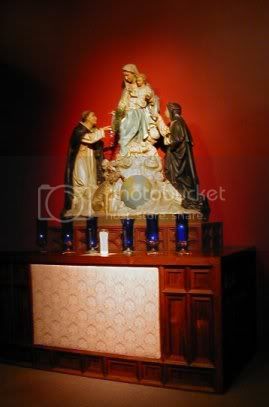
- Rosary Chapel
In the chapel south of the main sanctuary is a sculpture group, representing the Blessed Mother making a presentation of the rosary to St. Dominic, while the Child Jesus raises his hand in blessing and hands another rosary to St. Catherine of Siena. St. Dominic holds lilies, as he does in the statue in the north transept, signifying his virginity. He is also accompanied by a dog with a flaming torch in his mouth. St. Catherine wears a crown of thorns and holds a "corignens,’ a burning heart symbolic of her active love of God, a symbol related to that of the Sacred Heart of Jesus. The globe at Mary’s feet symbolizes the world to be enlightened, “set afire” by the preaching of the Gospel by the Dominican Order.The form of the modern Catholic rosary is attributed to Dominic, who constructed it as a result of a vision in which Mary revealed it to him. He popularized the devotion by using it in his missionary work against the Albigensians. The term rosary (from the Latin rosarium) means “rose garden.” The Infant of Prague is invoked as the patron of religious vocations, good health, solutions to financial problems; families, children, schools; peace, freedom, the missions, and the safety of individuals in times of danger.
- Crucifix and West Window.
The crucifix was made by Jens Miller-Christensen and donated by the Traxinger family in 1965. The corpus presents a beardless Jesus in a pose of rest rather than suffering. The pierced side indicates that this is a dead Jesus. However, the positions of the head and neck are upright and the hands are relaxed. This recalls the heiratic, victorious crucifixes of early Christian and Byzantine art rather than the broken and suffering images made from the high Middle Ages to the middle of this century.
http://i989.photobucket.com/albums/af16/HatboxGhost209/altarwindow-1.jpgThe West Window was donated to the church by Margaret Rummel, and designed and shaped by Tom Hemmen. It was installed in 1962-1963. In the two center panels we see Christ the King elevating the chalice and host above the empty cross of the crucifixion. We recognize first of all the dual image of Jesus as Priest and King, an honored theological concept.
On either side of the two central panels we find Mary, Mother of God, and John the Evangelist, further emphasizing the redemptive crucifixion and death of Jesus. Their frontal posture suggests, however, not their involvement in the sorrow of the Crucifixion, but their roles as intermediaries.
The two outer panels each contain three symbols. In the leftmost panel the top symbol is a scale, representing the virtue of justice as well as Melchizedek, the “king of justice.” The harp recalls King David, the Psalmist and ancestry of Mary and Joseph. The rising sun suggests the prophet Malachi, who prophesies of the judgment coming to all – “but to you who fear my name, the sun of righteousness will shine out with healing in his rays.” (Mal 3:20)
In the right-most panel, the Star of Jacob recalls the Old Testament seer Balaam. The candles emblematically refer to the two natures of Jesus, while the lily at the bottom symbolizes his Resurrection, paralleling one meaning of the rising sun on the other side.
http://i989.photobucket.com/albums/af16/HatboxGhost209/altarlower.jpgThe six lower panels offer a diverse series of emblems. The sword, anchor and heart represent the three theological virtues: faith, hope and charity. In the second panel the ship represents the Church. The palms recall the Palm Sunday entry of Jesus into Jerusalem. In addition the palm is a symbol of martyrdom. The fish in the next panel is one of the oldest symbols of Jesus, since the Greek word for fish (ichthus) was taken to be an anagram of the Greek phrase meaning “Jesus Christ, God’s Son, Savior.” The next panel presents chi-rho, the first two letters of the Greek “Christos” (the Anointed One, the Messiah); the Alpha and Omega, the first and last letters of the Greek alphabet, refer to the passage at the end of the Book of Revelation. Finally, in the rightmost lower panel the mother pelican is piercing her own breast to provide nourishment for her young. This story , taken from medieval bestiaries, is an apt symbol of Jesus’ redemptive suffering to bring life to His children.

 Check out this Church in NJ, By my Hometown.


