The beautiful church thread: please post photos / links to beautiful Catholic churches!

  • Thread starter Thread starter Lepanto
  • Start date Start date
Status
Not open for further replies.
I am glad you found the cathedral and its worship beneficial. I have always found Holy Name cathedral to be sparse and uninspiring. I had not seen it before Vatican II, so I don’t know how it looked originally. It has many nice features, but there are so many more beautiful and edifying churches in Chicago, like Our Lady of Sorrows or St. Mary of the Angels, as shown in the post above.

BTW, St. Mary of the Angels was scheduled for tear-down about ten or fifteen years ago, but a grass-roots fund-raising effort spared it. It had been shuttered and was refurbished over a couple years. Now it is an Opus Dei parish. It is one of several large churches that can be seen from the Kennedy Expwy just north of downtown. These churches were built by immigrants in the early 1900s and those in this general area were built mostly by Polish immigrants.

And thanks for sharing that pic, benedictgal. I had a friend who attended grammar school there, oh, many, many years ago. Kinda cool.

In any case, the Lord is there – Body, Blood, Soul and Divinity – so that’s what makes it wonderful. 👍

God bless,
Dan
Here’s a historic photo from the Mass held there for the famous 1926 International Eucharistic Congress. The extraordinary decorations include not only the banners, the draped fabrics and swags of flowers, but also the turning of the front rows of pews in choir arrangement. The photo also shows many of the features of the cathedral before its renovation in 1969, including the stone pulpit, the high altar and some of the murals.

(Please Note: This uploaded content is no longer available.)
 
Blessed Sacrament parish in Seattle, WA. Their 100th anniversary Domincan Rite Solemn High Mass(ordinarily they have a table altar set up in front for versus populum OF Masses).

The church is not finished, hence the bare brickwork. It is highly symbolic, and was the subject of the homily on this occasion. Also, the woodwork in the church was all done by hand, alone, by the former pastor during the 60s. This is what I would consider noble simplicity. Also, you can’t see it from the pictures, but it has the most beautiful stained glass I have ever seen, and I’ve been to Europe.

P8082060.JPG (image)

http://1.bp.blogspot.com/_5rsC2IPDM...AaA/IvtOCLlBcq4/s1600-h/BS-full+churchJPG.JPG

Especially beautiful…the fair sized number of Dominican friars there.

http://1.bp.blogspot.com/_5rsC2IPDM...in+coro+lopez,+augustine,+peretsky,+kraft.JPG
Blessed Sacrament Church was founded in 1908 by the Dominican Friars, upon the request of Bishop O’Dea to establish a community in his diocese and to assume the care of the students and residents of the University District in Seattle. The church was completed and dedicated on the Feast of St. Francis, October 4th, 1925. A major retrofit and restoration of the church building was completed in 2003, following the Nisqually Earthquake of 2001.
  1. Baptismal Font
The Baptismal Font was made in Italy in 1927. By tradition the baptismal font is located near the main portal as a symbol of our entry into the Christian life by Baptism.

  1. Nave and Coronation of Mary
The Nave (from the Latin, navis - ship) is where worshipers gather for services. It is meant to remind the faithful of Noah’s Ark which protected and brought its inhabitants to safety. Turn around to view the Coronation of Mary, and ancient theme in Christian art, above the swinging doors of the center aisle. This is a copy of a work by Fra Angelico, and was the gift of Fr. Joseph M. Aguius, twice pastor of Blessed Sacrament.
  1. Shrine of Our Lady of Perpetual Help
The shrine is in the distinctive style of a Byzantine icon, presenting the virgin, crowned and haloed in gold, holding a similarly crowned and haloed Jesus. The Greek letters at the top identify Mary as “Mother of God.” Above, on either side of the central figures, are two kneeling angels. The Archangel Gabriel, on the right, holds a cross of the distinctive Greek type; the other is Archangel Michael holding the cane with the sponge of vinegar offered to Jesus just before he died. Jesus, the infant, looks warily at these instruments, and clings to his mother.

  1. Shrine of St. Theresa of Lisieux
The shrine of St. Theresa of Lisieux, “The Little Flower,” was made in Liege, Belgium and installed in its present location in 1926. The roses she holds refer to the statement she made: “After my death, I will let fall a shower of roses.” Inscribed above her alcove in an arch are her words: “I will spend my heaven doing good on earth.” St. Theresa is a Doctor of the Church and, along with St. Francis Xavier, is the patron of foreign missions.
 
  1. Windows of Dominican Saints
Above the nave shrines, the windows along the north and south aisles depict ten prominent Dominican saints. These windows were created by Jill and Robert Hill, of HillHouse Studio on Guemes Island:
(Please Note: This uploaded content is no longer available.)
 
(Please Note: This uploaded content is no longer available.)

Under the windows of the saints and wrapping around the back of the church are fourteen depictions of the Stations of the Cross, a Franciscan tradition depicting the passion and death of Jesus.
(Please Note: This uploaded content is no longer available.)
  1. Sanctuary
The Sanctuary is where services are celebrated. The high altar was installed in the 1958 renovation and was used until the liturgical changes introduced by Vatican II. In 1966 and 1967 the sanctuary area was expanded into the crossing and the present altar placed in its current location.
(Please Note: This uploaded content is no longer available.)
 
http://i989.photobucket.com/albums/af16/HatboxGhost209/headless-1.jpg http://i989.photobucket.com/albums/...t.com/albums/af16/HatboxGhost209/francis2.jpg

Clerestery Windows. The Clerestery windows above the Rosary Chapel are in two sets of three lancet windows. The left panel of the south window depicts the angel’s instructions to Joseph to take Mary and Jesus into Egypt: with his left hand the angel points to a pyramid surrounded by palm trees. The middle lancet represents the adoration of the magi and the shepherd by means of a star, a shepherd’s crook, and the cradle from which three beams of light emanate. The third lancet depicts Joseph with a fiery halo, and in his left hand a carpenter’s square.http://i989.photobucket.com/albums/af16/HatboxGhost209/flightegypt.jpg
The north window has in its first panel a representation of Mary holding the Infant Jesus, while above her head a sword points down at her, an image derived from Simeon’s prophecy of Mary’s future sorrow (Lk 2:34-35). The next panel contains the figure of Joseph and the Child Jesus, who holds in his right hand a bright green globe, surmounted by the cross. The third Panel balances the first in the south group, presenting another angel, this one holding a folded piece of purple paper, with the word JESV written on it. This refers to the first vision Joseph had when he was thinking of divorcing Mary and an angel instructed him to name the Child Jesus (Mt 1:19-21).
http://i989.photobucket.com/albums/af16/HatboxGhost209/northwindowfamily.jpg
 
  1. Rosary Chapel
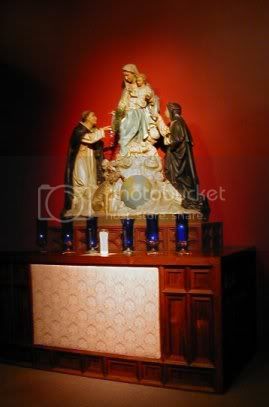
In the chapel south of the main sanctuary is a sculpture group, representing the Blessed Mother making a presentation of the rosary to St. Dominic, while the Child Jesus raises his hand in blessing and hands another rosary to St. Catherine of Siena. St. Dominic holds lilies, as he does in the statue in the north transept, signifying his virginity. He is also accompanied by a dog with a flaming torch in his mouth. St. Catherine wears a crown of thorns and holds a "corignens,’ a burning heart symbolic of her active love of God, a symbol related to that of the Sacred Heart of Jesus. The globe at Mary’s feet symbolizes the world to be enlightened, “set afire” by the preaching of the Gospel by the Dominican Order.The form of the modern Catholic rosary is attributed to Dominic, who constructed it as a result of a vision in which Mary revealed it to him. He popularized the devotion by using it in his missionary work against the Albigensians. The term rosary (from the Latin rosarium) means “rose garden.” The Infant of Prague is invoked as the patron of religious vocations, good health, solutions to financial problems; families, children, schools; peace, freedom, the missions, and the safety of individuals in times of danger.
  1. Crucifix and West Window.
The crucifix was made by Jens Miller-Christensen and donated by the Traxinger family in 1965. The corpus presents a beardless Jesus in a pose of rest rather than suffering. The pierced side indicates that this is a dead Jesus. However, the positions of the head and neck are upright and the hands are relaxed. This recalls the heiratic, victorious crucifixes of early Christian and Byzantine art rather than the broken and suffering images made from the high Middle Ages to the middle of this century. http://i989.photobucket.com/albums/af16/HatboxGhost209/altarwindow-1.jpgThe West Window was donated to the church by Margaret Rummel, and designed and shaped by Tom Hemmen. It was installed in 1962-1963. In the two center panels we see Christ the King elevating the chalice and host above the empty cross of the crucifixion. We recognize first of all the dual image of Jesus as Priest and King, an honored theological concept.

On either side of the two central panels we find Mary, Mother of God, and John the Evangelist, further emphasizing the redemptive crucifixion and death of Jesus. Their frontal posture suggests, however, not their involvement in the sorrow of the Crucifixion, but their roles as intermediaries.

The two outer panels each contain three symbols. In the leftmost panel the top symbol is a scale, representing the virtue of justice as well as Melchizedek, the “king of justice.” The harp recalls King David, the Psalmist and ancestry of Mary and Joseph. The rising sun suggests the prophet Malachi, who prophesies of the judgment coming to all – “but to you who fear my name, the sun of righteousness will shine out with healing in his rays.” (Mal 3:20)

In the right-most panel, the Star of Jacob recalls the Old Testament seer Balaam. The candles emblematically refer to the two natures of Jesus, while the lily at the bottom symbolizes his Resurrection, paralleling one meaning of the rising sun on the other side.
http://i989.photobucket.com/albums/af16/HatboxGhost209/altarlower.jpgThe six lower panels offer a diverse series of emblems. The sword, anchor and heart represent the three theological virtues: faith, hope and charity. In the second panel the ship represents the Church. The palms recall the Palm Sunday entry of Jesus into Jerusalem. In addition the palm is a symbol of martyrdom. The fish in the next panel is one of the oldest symbols of Jesus, since the Greek word for fish (ichthus) was taken to be an anagram of the Greek phrase meaning “Jesus Christ, God’s Son, Savior.” The next panel presents chi-rho, the first two letters of the Greek “Christos” (the Anointed One, the Messiah); the Alpha and Omega, the first and last letters of the Greek alphabet, refer to the passage at the end of the Book of Revelation. Finally, in the rightmost lower panel the mother pelican is piercing her own breast to provide nourishment for her young. This story , taken from medieval bestiaries, is an apt symbol of Jesus’ redemptive suffering to bring life to His children.

 
  1. Blessed Sacrament Chapel
The location of the Blessed Sacrament in its own chapel rather than at the main altar is an ancient practice of the Church, although it marks a distinct change from the usual American practice before Vatican II. While the Eucharist in this era tends to be defined in terms of the dynamic communal action of the worshipping people, the tradition of reserving the Blessed Sacrament is continued, so that the sacrament will always be available for distribution to the sick and for devotional adoration of Jesus’ Real Presence in His Church by the faithful. The lamp burning always in the chapel is a reminder that Jesus, the Light of the World, is in residence and an invitation for us to stop and visit, acknowledging his presence with a genuflection and a few moments of quiet meditation and prayer.The tabernacle, of steel and bronze, has engraved around its upper band the words “Magister Adest et Vocat Te” (“The Master is here and calls you”), the words of Martha to Mary at Jesus’ arrival in John’s account of the Raising of Lazarus. The tabernacle was installed on the high altar at the time of the church’s dedication in 1925 and moved to its present location in 1979.
St. Thomas Aquinas and St. Dominic, respectively:


The pair of windows here are by Tom Hemmen. Both windows contain symbols of Jesus’ suffering and death. The window on the left shows at the bottom the crown of thorns and the three nails used in the crucifixion; in the upper right are shown a pair of pincers, associated with the removal of the nails after the crucifixion. The right window has a pair of dice, representing the gambling over Jesus’ tunic; the artist has used the number two, to remind us of the double nature of Jesus, God and man, and the number three, to recall Jesus’ place in the Holy Trinity. The rope and lantern are symbols of the betrayal of Jesus by Judas and Judas’ subsequent suicide.

12. Shrine of St. Joseph

The Shrine of St. Joseph is dedicated to the foster-father of Jesus and husband of Mary. The present statue, the work of an Italian woodcarver, was installed in 1981. Joseph is shown holding carpenter’s tools, a square, a chisel, and a pair of pincers. The statue rejects the earlier tradition of making Joseph an old man, and instead makes him a handsome young man. Devotion to St. Joseph, emphasizing his position in the Holy Family, developed late in Church history. The chief reason for this delay, apparently, was the fear of misunderstanding which could arise concerning Mary’s perpetual virginity and Christ’s origin. In 1870 St. Joseph was declared patron of the Universal Church, an apt role for the guardian of Mary and Jesus. The Principal feast of St. Joseph is March 19, but in 1955 the feast of St. Joseph the Worker also established on May 1, to emphasize the dignity of labor and Christian ideals in labor relations.


]13. Shrine of St. Peregrine

The Shrine of St. Peregrine is located in the north aisle near the main entrance. The icon was painted by Fr. Brendan McAnerney, O.P., in 2000. St. Peregrine was born in Italy in 1260. He was well known for his preaching, austerities, and holiness. His fame grew after he was miraculously cured of an advanced foot cancer, having experienced a vision of the Healing Christ. St. Peregrine was canonized in 1726 and is the patron saint of those touched by cancer.
/IMG
 
  1. Blessed Sacrament Chapel
The location of the Blessed Sacrament in its own chapel rather than at the main altar is an ancient practice of the Church, although it marks a distinct change from the usual American practice before Vatican II. While the Eucharist in this era tends to be defined in terms of the dynamic communal action of the worshipping people, the tradition of reserving the Blessed Sacrament is continued, so that the sacrament will always be available for distribution to the sick and for devotional adoration of Jesus’ Real Presence in His Church by the faithful. The lamp burning always in the chapel is a reminder that Jesus, the Light of the World, is in residence and an invitation for us to stop and visit, acknowledging his presence with a genuflection and a few moments of quiet meditation and prayer.The tabernacle, of steel and bronze, has engraved around its upper band the words “Magister Adest et Vocat Te” (“The Master is here and calls you”), the words of Martha to Mary at Jesus’ arrival in John’s account of the Raising of Lazarus. The tabernacle was installed on the high altar at the time of the church’s dedication in 1925 and moved to its present location in 1979.
St. Thomas Aquinas and St. Dominic, respectively:


The pair of windows here are by Tom Hemmen. Both windows contain symbols of Jesus’ suffering and death. The window on the left shows at the bottom the crown of thorns and the three nails used in the crucifixion; in the upper right are shown a pair of pincers, associated with the removal of the nails after the crucifixion. The right window has a pair of dice, representing the gambling over Jesus’ tunic; the artist has used the number two, to remind us of the double nature of Jesus, God and man, and the number three, to recall Jesus’ place in the Holy Trinity. The rope and lantern are symbols of the betrayal of Jesus by Judas and Judas’ subsequent suicide.

12. Shrine of St. Joseph

The Shrine of St. Joseph is dedicated to the foster-father of Jesus and husband of Mary. The present statue, the work of an Italian woodcarver, was installed in 1981. Joseph is shown holding carpenter’s tools, a square, a chisel, and a pair of pincers. The statue rejects the earlier tradition of making Joseph an old man, and instead makes him a handsome young man. Devotion to St. Joseph, emphasizing his position in the Holy Family, developed late in Church history. The chief reason for this delay, apparently, was the fear of misunderstanding which could arise concerning Mary’s perpetual virginity and Christ’s origin. In 1870 St. Joseph was declared patron of the Universal Church, an apt role for the guardian of Mary and Jesus. The Principal feast of St. Joseph is March 19, but in 1955 the feast of St. Joseph the Worker also established on May 1, to emphasize the dignity of labor and Christian ideals in labor relations.

  1. Shrine of St. Peregrine
The Shrine of St. Peregrine is located in the north aisle near the main entrance. The icon was painted by Fr. Brendan McAnerney, O.P., in 2000. St. Peregrine was born in Italy in 1260. He was well known for his preaching, austerities, and holiness. His fame grew after he was miraculously cured of an advanced foot cancer, having experienced a vision of the Healing Christ. St. Peregrine was canonized in 1726 and is the patron saint of those touched by cancer.
 
From a Requiem Mass at the same church as above:

(Please Note: This uploaded content is no longer available.)

(Please Note: This uploaded content is no longer available.)
 
Thank you, CatholicTeen, for the pic of Holy Name Cathedral during the 1926 Eucharistic Congress. One can tell that there were murals where there are now blank shapes. I wonder what those murals showed.

Thank you again for your effort. 🙂

God bless,
Dan
 
Thank you, CatholicTeen, for the pic of Holy Name Cathedral during the 1926 Eucharistic Congress. One can tell that there were murals where there are now blank shapes. I wonder what those murals showed.

Thank you again for your effort. 🙂

God bless,
Dan
Actually, the panels now have some new artwork put in, it appears. Here’s a photo from before the post-Vatican II renovations.

(Please Note: This uploaded content is no longer available.)

The one below is Holy Name Cathedral decorated for the return of Cardinal Samuel Stritch from Rome, March 4, 1946.

(Please Note: This uploaded content is no longer available.)

Here’s another, this one showing what appears to be a bishop’s Funeral Mass. It appears to have been taken before the 1968-1969 renovation, yet after Vatican II. Here the liturgical “innovations” have just begun. A wooden altar was placed before the old high altar. Nonetheless the tabernacle still maintains its central place in the sanctuary, and the side altars were still present.

(Please Note: This uploaded content is no longer available.)

Here’s a link to a page the Cathedral website with a video on the history of the Cathedral, with a video featuring some historical photographs:

holynamecathedral.org/index.php?page=cathedral

Today, old high altar has been removed. The tabernacle containing our Lord Jesus Christ (body,soul and divinity) has been relegated to a side chapel, the Cardinal’s cathedra occupies the focal point of honor. An organ has been placed in the sanctuary, seperating it from the chapel to the Blessed Mother.

What a shame that the cathedral was “wreckovated” instead of maybe keeping the high altar and the appearance of the building as it was in the above photo. Someday, maybe…
 
On the feast day of St Boniface, it seemed like a good idea to show the abbey he founded at Fulda in Germany in 744. St Boniface named Saint Sturm as the first the abbot of the monastery.

At the age of 79, St Boniface set out with 52 companions on an evangelistic mission. At Pentecost, on 5 June 755 near the modern town of Dokkum in the Netherlands, they were all massacred by heathen brigands. Boniface was struck down by a sword which pierced the bible he had raised to shield his head As requested in his will, his body was taken back to the monastery he had founded at Fulda, where the Barouque Cathedral now encloses his tomb, and where all the Roman Catholic Bishops of Germany hold their meetings every year.

Interior
(Please Note: This uploaded content is no longer available.)

St Boniface’s crypt. He is buried behind the high altar


Pope John Paul II praying at the crypt
http://upload.wikimedia.org/wikipedia/en/b/ba/Pope_and_boniface_1980.jpg

The cathedral from the outside
 
Status
Not open for further replies.
Back
Top