The Book of Revelation-step by step

  • Thread starter Thread starter patrick457
  • Start date Start date
Status
Not open for further replies.
4-8: And I heard the number of them that were sealed, one hundred forty-four thousand, sealed out of every tribe of the sons of Israel:
Of the tribe of Judah twelve thousand were sealed;
Of the tribe of Reuben twelve thousand,
Of the tribe of Gad twelve thousand,
Of the tribe of Asher twelve thousand,
Of the tribe of Naphtali twelve thousand,
Of the tribe of Manasseh twelve thousand,
Of the tribe of Simeon twelve thousand,
Of the tribe of Levi twelve thousand,
Of the tribe of Issachar twelve thousand,
Of the tribe of Zebulun twelve thousand,
Of the tribe of Joseph twelve thousand,
Of the tribe of Benjamin twelve thousand were sealed.
One hundred forty-four thousand: cf. Rev. 14:1, 3.

Sons of Israel: The twelve sons of Jacob were (by order of birth): Reuben, Simeon, Levi, Judah, Dan, Naphtali, Gad, Asher, Issachar, Zebulun, Joseph, and Benjamin. Noticeably, the tribe of Dan is absent from the list and replaced by Manasseh (Joseph’s eldest son).

Some point here to a parallel with the twelve Apostles, which had one of its number (Judas) displaced and replaced by another one (in this case, Matthias). Others believe that the reason Dan is omitted is because of the belief that the Antichrist will come from that tribe (which had a rather infamous reputation of practicing idolatry).

Another curious omission is the tribe of Ephraim. The tribes of Joseph and of Levi are mentioned, while they were not commonly counted as tribes elsewhere. In most listings of the twelve tribes Levi is omitted, since the inheritance of Levi are the sacrifices of Israel and not an allotment of territory. Ordinarily Ephraim and Menasseh take the place of Joseph to keep the number of tribes at twelve once Levi is excluded. Some reason that this absence is due to the idolatry of the tribe of Ephraim (the other seat of idolatry in the Northern Kingdom of Israel was Bethel, located within Ephraim’s territory), like that of Dan.

Commentary by St. Bede (part 1):
number. By this definite number is signified the innumerable multitude of the whole Church, which is descended from the patriarchs either by the lineage of nature, or the imitation of faith. For, he says, “if ye be Christ’s, then are ye Abraham’s seed.
And it tends to additional completeness, that the twelve also should be multiplied by twelve, and brought to a sum of thousands, which is the cube of the number ten, by which is represented the enduring life of the Church. And for this reason, too, it is often denoted by the number twelve, because throughout the foursquare world it subsists by faith in the Holy Trinity, for three times four are ten and two. Finally, also, when the Apostles were to preach the same faith to the whole world, twelve were chosen, as signifying by their number the mystery of their work.

JUDAH, REUBEN, GAD, ASHER, NEPTHALI, MANASSEH, SIMEON, LEVI, ISSACHAR, ZABULON, JOSEPH AND BENJAMIN.

Judah. With good reason, he begins with Judah, from which tribe our Lord sprang; and has omitted Dan, from whom, as it is said, the Antichrist is to be born; for it is written, “*Let Dan become an adder in the way, a horned serpent in the path, biting the horse-hoofs, that his rider may fall * (Gen. 49:17)”
For he has not proposed to set forth the order of earthly generation, but according to the interpretation of the names the powers of the Church, which from present confession and praise is hastening to the right hand of eternal life. For this is the meaning of the name of Judah, who is placed first, and of Benjamin, who comes last. So, then, Judah is placed first, who is interpreted “confession,” or “praise;” for before the first step of confession no one reaches the height of good works, and unless we renounce evil deeds by confession, we are not fashioned in such as are good.
The second is Reuben, who is interpreted, “seeing the son.” That works are denoted in “sons,” the Psalmist testifies, when among the benedictions of the man who is blessed he says (Ps. 127 [128]:3) with the rest, “Thy sons like olive-plants;” and below, “That thou mayest see thy son’s sons.” For it is not, that he who fears the Lord cannot be blessed, unless he has begotten sons, and raised up grandsons, since a better reward awaits the faithful virgins; but in “sons,” he designates works, and in “son’s sons” the fruits of works, namely, an eternal reward. Accordingly, after Judah there follows Reuben, that is, after the commencement of divine confession and praise, the perfection of action.
But because “*we must through many tribulations enter into the kingdom of God *(Acts. 14:22),” after Reuben follows Gad, who is interpreted “temptation,” or, “girt.” For after the beginning of a good work, it is needful that a man should be proved by greater temptations, and be girt about for greater conflicts, that the strength of his faith may be approved. And so Solomon says, “*My son, when thou comest to the service of God, stand in righteousness and fear, and prepare thy soul for temptation *(Ecclesiasticus 2:1);” and the Psalmist also, “*Thou hast girded me with strength unto the battle *(Ps. 17:40 [18:39]).”
And because “we esteem the blessed who have maintained sufferance (James 5:11),” for this reason, after Gad is placed Asher, that is, “the blessed,” an order which is not unsuitable. For “*blessed is he who endures temptation, for when he has been proved, he will receive the crown of life *(James 1:12).”
But, inasmuch as they who rely upon the sure promise of this blessedness, are not straitened, but “*rejoicing in hope, patient in tribulation *(Rom. 12:12),” sing with the author of the Psalm, “*In tribulation Thou hast enlarged me *(Ps. 4:2),” and also “I ran in the way of Thy commandments, while Thou didst enlarge my heart (Ps. 118 [119]:2)” and say, exultingly, with the mother of the blessed Samuel, “My heart is enlarged above mine enemies, because I rejoiced in Thy salvation (1 Sam. 2:1);” therefore, Nepthali succeeds, that is, “enlargement.”
Moreover, he is followed by Manasseh, who is interpreted “forgetting,” or, “necessity.” And by the mystery of this name we are admonished, that being taught by the anguish of the present temptations, and “forgetting the things which are behind,” we should so “reach forward,” as the Apostle says, “to the things which are before,” as “not to make provision for the flesh in lust,” (Phil. 3:13; Rom. 13:14) but as compelled by the necessity of human nature alone. And concerning this the Psalmist prayed, when sighing for better things, “Deliver me out of my necessities (Ps. 24 [25]:17)”
Next to him is placed Simeon, that is, “he heard of sorrow,” or, “the name of his habitation;” in order that, by the character of this name also, he might more plainly inculcate both what is to be possessed here, and what is to be profitably expected. For the joy of the heavenly habitation will be given to those whose mind is here made sorrowful by a fruitful repentance; to whom it is also said, “*Your sorrow shall be turned into joy *(Jn. 16:20).”
In the next place follows Levi, that is, “added,” in whom we either understand those who by temporal obtain eternal things; as Solomon says, “The ransom of a man’s life are his riches (Prov. 8:8),” or those who, by following the counsel of God,“receive in this world a hundredfold with tribulations, but in the world to come, eternal life (Mk. 10:30).” And to these, also belongs this that is written, “He who adds knowledge, adds grief. (Eccles. 1:18)” For to this end also the bitterness of tribulation was added to the blessed Job, that having been proved, he might receive a greater recompense of reward.
And so, not without reason, there succeeds him in direct order, Issachar, who is interpreted “reward,” because, as the Apostle teaches, “The sufferings of this present time are not worthy to be compared with the future glory which shall be revealed in us (Rom. 8:18),” inasmuch as we fight with better success when there is hope of a sure reward.
But God operates and perfects this in the habitation of strength, which Zabulon means, when “strength is made perfect in weakness (2 Cor. 12: 9).” So that the body, which is considered weak by its enemies, and through the material substance of which they also strive to bring destruction to the soul, is found to be invincible through God Who strengthens it; and there succeeds a happy increase in this.
This is also denoted by the word Joseph, for it signifies, gifts and graces to be added, whether thou understand the increase of spiritual gain from the double return of the talents, or whether thou take it in respect of the offerings which are made to God the Redeemer by the devotion of the faithful.
Now, in order that thou mayest perceive that all these, who both by the succession and interpretation of the names are shewn not to be placed without significance, will be at the right hand of Christ, the eternal King, in the judgement to come; Benjamin, that is, “the son of the right hand,” is set last, as said before, as the end of the line. For, after the last enemy, death, has been destroyed (1 Cor. 15:26), the bliss of the eternal inheritance will be given to the elect. And this, whether each one of the faithful is rightly called the son of the right hand, or the whole assembly of the Church, of which it is sung: “Upon Thy right hand stood the queen, in a vesture of gold, clothed in variety (Ps. 45:10 [46:9]).”
 
Commentary by St. Bede (part 2):
So, then, from each tribe are sealed ten thousand. For in whatsoever virtues each one of the faithful has made progress, he must needs be ever strengthened by the faith, and instructed by the examples of the fathers of old. And it is most certain that frequently the body of doctors, frequently that of the whole Church, is designated by the number twelve, because of the sum of the Apostles, or patriarchs.
For whether each one is counted worthy of praise from confession, as in Judah; or is illustrious from the progeny of works, in Reuben; or is strong from the discipline of temptations, in Gad; or is happy from victory in conflicts, in Asher; or is enlarged by abundant works of mercy, in Napthali; or is forgetful of the things which are behind, in Manasseh; or is still sorrowful, as in the valley of tears, but always rejoicing in the name of his habitation, while sighing for the heavenly Jerusalem, in Simeon; or is rejoicing together in the promises of the life that now is, and of that which is to come, resting upon temporal good things, added to the eternal good, in Levi; or is strengthened by the contemplation of the future reward, in Issachar; or is laying down his life for Christ, in Zabulon; or is labouring earnestly for an increase of spiritual substance, and offering something more beyond the commands of God, either in virginity, or from the abundance of his means, in Joseph; or is expecting the right hand of eternal bliss, with unwearied prayer, in Benjamin; it is fitting that each should be sealed in his own profession by the rule of the preceding fathers, as by the number twelve, and that from the merits of individuals, should the most perfect beauty of the Church, as the sum of a hundred and forty-four thousand, be made up.
2.) Commentary by Oecumenius:
(verse 4) And the sealed, it says, was 144,000. For those from the Jews who believed in Christ were numerous and greater than [this] number, and they were accounted worthy to be saved from the common destruction, as those testified who spoke to Paul when he was in Jerusalem: “Do you see, brother, how many thousands there are of the Jews who have believed? (Acts 21:20)”
And it was likely that not only the faithful escaped, but also those who were deceived and in their ignorance assisted in the crucifixion of the Lord, about whom He said: “Father, forgive them; for they know not what they do (Lk. 23:34).”
…And perhaps not only these [escaped], but also those who were not present at that time or were not living in Jerusalem and so were not complicit in the impious plot of the accursed high priests concerning the crucifixion, and also those who were perhaps present but were not involved in that murderous defilement. Indeed, [Christ] Himself blessed everything under Heaven, in contrast to what that irreligious council of transgressors had wanted. It is likely that all of these were later sealed in the faith of Christ, otherwise the Angel would not have called them the servants of God.
And when these have been rescued, either by flight or by desertion to the Romans, those wicked ones who remained were destroyed in a terrible manner, “a spectacle to the world, to angels, and to men (1 Cor. 4:9),” in a way quite different from what Paul had said of the blessed Apostles. And of these things, Josephus is again witness, counting those who were killed by famine as no more than ten thousand (The Jewish War 5, 567-69; 6, 420-25).
(verse 5-8) That an equal number from each tribe is saved to have been sealed and to have believed indicates the equality and zeal of their faith, although there would have been more from one tribe and less from other tribes of those who were saved and believed on Christ, who although dishonored by the Jews, is worshiped [by us] and by every supernatural creature now and always and forevermore, Amen.
3.) Commentary by St. Jerome (Homilies on Mark 82, 8):
Someone may ask: Where does one read that Israel will be saved? First, of course, there is the Apostle: “*Until the full number of the Gentiles should enter, and thus all Israel should be saved *(Gal. 3:29).”
In the second place, John says in his Apocalypse: of the tribe of Judah, twelve thousand shall believe, of the tribe of Reuben, twelve thousand shall believe, and of the remaining tribes, he says the same; and the number of all who believe became 144,000. Then too Psalm 144, which is alphabetical, treats of this number saved.
If Israel had believed, our Lord would not have been crucified. If our Lord had not been crucified, the multitude of Gentiles would not have been saved. The Jews are going to believe, but not until the end of the world. It was not the time for them to believe in the cross; for if they have believed, the Lord would not have been crucified. It was not the time to believe. Their infidelity is our faith. By their downfall, we are raised up. It was not their time in order that it may be our time.
4.) Commentary by St. Andrew of Caesarea:
From the tribe of Judah, twelve thousand sealed.” Judah is interpreted ‘confession’, through which those are manifested who are being saved through the Confession to Christ who came forth as a branch from Judah.
From the tribe of Reuben, twelve thousand sealed.” Reuben is interpreted ‘son of vision’, through which those are shown who possess spiritual sight through purity of heart.
From the tribe of Gad, twelve thousand.” Gad is interpreted ‘temptation’, through which those are shown through the endurance of temptations are being crowned, after the example of Job.
From the tribe of Asher, twelve thousand.” Asher is interpreted ‘blessing’, through which are revealed those who are worthy of dominical blessings because of their life and are made worthy of standing at the right hand of Christ and are shown to be the sons of light and the day.
From the tribe of Naphtali, twelve thousand.” Naphtali is interpreted ‘prayer’, through which those are characterized who are bound to God through unceasing prayer.
From the tribe of Manasseh, twelve thousand.” Manasseh is interpreted ‘forgetfulness’, that is, it refers to those who on account of love for God, have forgotten the things from the past and the homes of their fathers.
From the tribe of Simeon, twelve thousand.” Simeon is interpreted ‘obedience’, clearly referring to those who are becoming righteous through obedience to the divine commandments.
From the tribe of Levi, twelve thousand.” Levi is interpreted ‘having been taken up’, through which are indicated those taken up by Christ through a life proper to the priesthood. Levi is listed eighth, since by the eighth day of the Resurrection the true priesthood is made known.
From the tribe of Issachar, twelve thousand.” Issachar is interpreted ‘reward’, that is, it refers to those who for the sake of the rewards from God have lived virtuously.
From the tribe of Zebulun, twelve thousand.” Zebulun is interpreted ‘abode of power’ or ‘fragrance’, through which are indicated those who by the indwelling of Christ have been made firm against sufferings and have become His sweet smell, as Paul says (2 Cor. 2:15).
From the tribe of Joseph, twelve thousand.” Joseph is interpreted ‘addition’, that is, those who in addition to the Kingdom of Heaven receive those things necessary for eternal life, as the Lord says (Mt. 6:33).
From the tribe of Benjamin, twelve thousand.” Benjamin means ‘son of sorrow’ or ‘son of day’ or ‘son of my right hand’ and refers to those with sorrow in their heart. This refers either to those believers from the Jews who fled the siege of the Romans and equaled this number, or, what is more likely, to those from the Jews who are saved at the consummation when, as the Apostle puts it, after “the full number of the Gentiles come in, all Israel will be saved.” Either interpretation is acceptable.
The exact equality of each tribe seems to me to show the utter fruitfulness of the Apostolic seed, since twelve multiplied by twelve and multiplied by the perfect number of a thousand yields the thousands here indicated. For these were the disciples of that seed that out of love for humankind fell upon the earth and brought forth the various fruits of universal salvation.
 
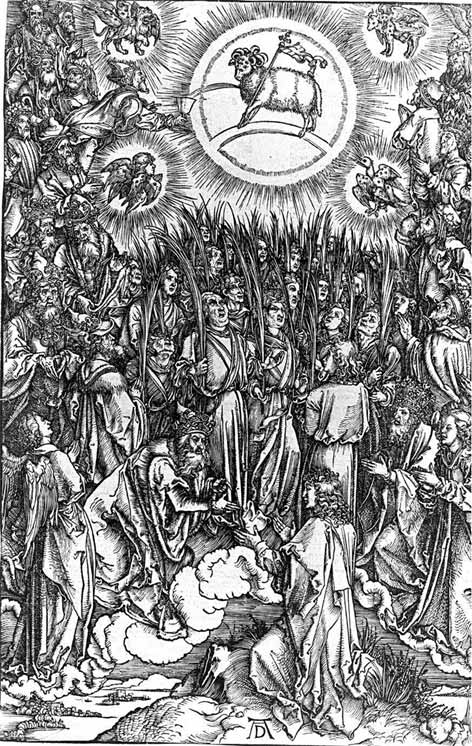
9-11: After these things I saw, and behold, a great multitude, which no man could number, out of every nation, and of all tribes, and peoples, and tongues, standing before the Throne and before the Lamb, clothed in white robes, and palms in their hands; and they cry out with a great voice, saying: “Salvation to our God who sits on the Throne, and to the Lamb!


White robes: The Greek here is stolē leukē, the same words that John used in 6:10 to describe the robe given to the martyrs.

Palms: A symbol of triumph and victory. The Romans rewarded champions of the games and celebrated military successes with palm branches. Also military triumphs, i.e. the celebrations of victory, were observed with palms. It seems that the Jews followed the same custom (Lev. 23:40; 1 Mac. 13:37) of carrying palm-branches on festive occasions, as what can be observed when Jesus entered the city of Jerusalem amidst much fanfare (Jn. 12:13).

In the New Testament, the palm-branches become a symbol of martyrdom meaning victory over death. For this reason, since early Christian art martyrs were usually represented with palms.

Salvation to our God: A rather similar hymn of praise is found at the fall of the dragon (Rev 12:10) and of Babylon (Rev 19:1).

1.) Commentary by St. Bede:
multitude. On the conclusion of the recapitulation, which had been interposed for the sake of example, he returns to the previous order, and announces the glory of those who are to overcome the wickedness of the last persecution. And that which follows, “From all nations, and tribes, and peoples and tongues,” may also be thus understood, that, after enumerating the tribes of Israel, to whom the Gospel was first preached, he desires to make mention of the salvation of the Gentiles as well.
robes. By “robes” he signifies baptism, by “palms” the triumph of the Cross, and he intimates that in Christ they have overcome the world. But robes may also double the glory which is given by the Holy Spirit.

cried. They proclaim with a loud voice, that is, with great devotion, an unceasing praise, that on the throne, namely, in the Church, there reign the Father and the Son; the Holy Spirit, nevertheless, reigning together with them. For it is said, “To Him Who sitteth upon the throne, and to the Lamb;” in the same manner as it is said in the Gospel, “And may know Thee, the true and only God, and Jesus Christ, whom Thou hast sent (Jn. 17:3);” in which place, “may know the only and true God” is understood.
2.) Commentary by St. Victorinus:
After this I beheld, and, lo, a great multitude, which no man was able to number, of every nation, tribe, and people, and tongue, clothed with white robes. What the great multitude out of every tribe implies, is to show the number of the elect out of all believers, who, being cleansed by baptism in the blood of the Lamb, have made their robes white, keeping the grace which they have received.
3.) Commentary by St. Caesarius of Arles:
He did not say “After this I saw another people,” but “I saw a people,” that is, the same people that he had seen in the mystery of the 144,000, which he now sees as without number from every tribe and tongue and nation. For by believing, all nations are engrafted into the root. In the Gospel the Lord showed forth in the [figure of the twelve tribes] the whole Church both from the Jews and from the Gentiles. He said, “You will sit on twelve thrones, judging the twelve tribes of Israel.
Clothed in white robes: By the white robes he means the gift of the Holy Spirit.
4.) Commentary by Oecumenius:
They are clothed in white robes as a sign of purity of their life, and the palm branches are symbolic of victory of Christ against every spiritual and physical foe. And they cry out, “Salvation belongs to our God and to the Lamb,” confessing that salvation is with them, since, having been sealed as servants of God, they were rescued from the universal destruction of the world.
5.) Commentary by St. Andrew of Caesarea:
(verse 9) These are the ones of whom David spoke: “*I shall number them, and they will be more than the sand *(Ps. 138 [139]:18).” Namely, these are those who long ago struggled as martyrs for the sake of Christ and those from every tribe and tongue who will fight valiantly at the end of time.
(verse 10) By the outpouring of their own blood for the sake of Christ, some have made white and others will make white the robes of their deeds. And they have in their hands palm branches, which are symbolic of victory and which are good, straight and white as are their hearts. And they form a chorus around the divine Throne of the Godly rest, as grateful family members ascribing the victory over the demons to Him who provides it.
6. Another Commentary by St. Bede (from Homilies on the Gospels 1:10):
Let us think attentively about the eternal feast of the Martyrs, which is in Heaven, and by following in their footsteps insofar as we can, let us also take care to become ourselves participants in this heavenly feast, for as the Apostle bears witness, if we have been companions of His Passion, we will at the same time be companions of His Consolation (2 Cor. 1:7). Nor should we mourn their death as much as we should rejoice about their attaining the palm of righteousness.
Rachel must groan over each of them when, through torments, they are driven away from this life — that is, the Church which begot [them] exhorts them with mourning and tears, but when they have been driven out, the heavenly Jerusalem, who is the mother of us all, soon receives them into another life by ministers of gladness who are ready at hand and introduces them into the joy of the Lord to be crowned as His forever.
Hence, says John, they were standing before the Throne “in the sight of the Lamb, dressed in white robes, and palms were in their hands.” For they now stand before God’s throne, crowned, who once lay, worn down by pain, before the thrones of earthly judges. They stand in the sight of the Lamb, and for no cause can they be separated from contemplating his glory there, since here they could not be separated from His love through punishments.
They shine in white robes and have palms in their hands, who possess the rewards for their works; while they get back their bodies, glorified through resurrection, which for the Lord’s sake they suffered to be scorched by flames, torn to pieces by beasts, worn out by scourges, broken by falls from high places, scraped by hoofs and completely destroyed by every kind of punishment.
 
11-12: And all the Angels were standing around the Throne, and the Elders and the four Living Creatures; and they fell before the Throne on their faces, and worshiped God, saying: “Amen; Blessing, and glory, and wisdom, and thanksgiving, and honor, and power, and might, be to our God to the ages of ages, Amen!
http://home.earthlink.net/~jorevel4/ANGELS-IN-PRAISE.jpg

1.) Commentary by Oecumenius:
And when they rendered their thanksgiving, all the heavenly hosts, together with the Elders, respond with “Amen,” adding their own approval to that which had been said. Then the holy Angels add their own praise to God, giving him honor with a sevenfold praise, which, as was earlier noted, signifies the neverending praise of the Angels, for the number seven suggests perfection.
2.) Commentary by St. Bede:
blessing. The Church offers the sevenfold praise of excellence unto the Lord, and in each of its members confesses to have received this from Him.
3.) Commentary by Primasius:
Whatever this multitude might be, by expressing these names he indicates the universal Church…Through the naming of these seven virtues, we are exhorted to inquire after the reason why he named those things here in which God desires His Church to participate. It is for this reason that when these [virtues] are given to God in praise, they might confess that they have received each of them from Him. For we ought not consider that God alone is capable of the [virtues] named here, but that He has found them worthy also to give to the faithful.
We rejoice that the Church of Christ is allowed to participate in all of these good things: blessing, glory, wisdom, thanksgiving, honor, power and might. It does not mention omnipotence or majesty or eternity, for God alone always rightly possesses these things. But in these seven we recognize all those virtues that could be granted to the faithful from him who gave them power to become sons of God (Jn. 1:12). And so, if we have acquired any of these good things, we shall know with certainly that we have them by the generosity of God.
4.) Another Commentary by St. Bede (from Homilies on the Gospels, 1:10):
With a loud voice [the martyrs] sing of salvation from God, since they recall with great thanksgiving that they have triumphed, not by their own virtue but by His help, in the struggle with the tribulations assailing them.
 
13-17: And one of the Elders answered, saying to me: “These who are clothed in white robes; who are they, and where did they come from?” And I said to him: “You know, my lord.
And he said to me: "*These are they who came through the great tribulation; and they have washed their robes, and made them white in the blood of the Lamb. Therefore, they are before the Throne of God; and they do service to Him day and night in His Temple; and He who sits on the Throne will spread His Tent over them.

They will hunger no more, nor thirst anymore; nor will the sun strike upon them, nor any heat; for the Lamb who is in the midst of the Throne will be their Shepherd, and will guide them to springs of the waters of life, and God will wipe every tear from their eyes.*"
Will spread His Tent (Tabernacle) over them (Greek: Skēnōsei ep’autous): cf. Leviticus 26:11; Ezekiel 37:27; Revelation 21:3; the Greek text of John 1:14a:
Greek: Kai o Logos sarx egeneto, kai eskēnōsen en imin.
English: “And the Word was made flesh, and pitched His tent (Tabernacle) amongst us.
For the Tabernacle (The Mishkan), cf. Exodus 25:8-9.

http://www.bibleplaces.com/images/Tabernacle_from_above_tb_n052201.jpg
A reconstruction of the Mosaic Tabernacle.

Have washed their robes, and made them white in the blood of the Lamb: cf. Zechariah 3:3-5; Hebrews 9:14; 1 John 1:7; Revelation 6:11, 7:9, 22:14.

And they do service to Him day and night in His Temple: Rev 4:8, 7:15, 11:19, 21:22, 22:3.

They will hunger no more, nor thirst anymore, etc.: cf. Psalm 121:5; Isaiah 49:10.

The Lamb who is in the midst of the Throne will be their Shepherd: cf. Psalm 23:1; Matthew 2:6; John 10:11-16.

The waters of life: cf. John 4:14, 7:37-38; Revelation 21:6, 22:1.

And God will wipe every tear from their eyes: cf. Isaiah 25:8, 49:10; Rev. 21:4.

1.) Commentary by St. Bede:
who? He asks for this end, that he may teach.

tribulation.Through many tribulations we must enter into the kingdom of God (Acts 14:22),” but who knows not that the tribulation of the Antichrist will be greater than all the rest?
washed. He speaks not of martyrs alone. They are washed in their own blood. But the blood of Jesus, the Son of God, cleanses the whole Church from all sin, therefore are they before the throne of God. For they are accounted worthy to stand there together in the service of God, who in the midst of adverse things are faithful confessors of His Name.

day and night. He speaks after our manner, and signifies eternity.
throne. The saints are the Throne of God, above whom and among whom the Lord for ever dwells.

hunger. This it is which the Lord Himself promised, saying, “I am the bread of life: he who comes to Me shall never hunger; and he who believes in Me shall never thirst (John 6:35)” Yes, “Blessed are they who hunger and thirst after righteousness, for they shall be filled (Matt. 5:6).”
the sun.We passed,” he says, “through fire and water, and thou broughtest us out into a place of refreshment (Ps. 45 [46]:12)”

the Lamb. He says, that the Lamb is in the midst of the throne, in that he had said above, that “the Lamb received the book from Him Who sitteth upon the throne;” and teaches that the Church is one Throne for the Father and the Son, in which one God, the undivided Trinity, dwells through faith.
fountains. That is to say, to the company of the saints, who are the fountains of heavenly doctrine. The vision of God itself may also be signified, “in Whom are hidden the treasures of wisdom and knowledge (Col. 2:3):” according to this that David says, “As the hart longeth for the fountains of waters, so longeth my soul after Thee, O God (Ps. 41:2 [42:1])”
tears. When the fulness of immortal bliss is gained, all sorrow will be at once consigned to forgetfulness. For, “Blessed are they who mourn, for they shall be comforted (Matt. 5:4).” The vision of the white-robed multitude may also be understood of the present time, when “we are saved in hope,” and “hoping for that which we see not, in patience wait for it (Rom. 8:25).”
2.) Commentary by Primasius:
This one elder represents either the body of the prophets or the Church. It depicts the leaders teaching the other members of the future reward for which the laborers might hope, just as the Apostle spoke of the Gospel: “In it the righteousness of God is revealed from faith for faith,” that is, from the faith of those who preach, for the faith of those who hear.
2.) Commentary by Oecumenius:
And it says, “they have washed their robes and made them white in the blood of the Lamb.” To be sure, one might think that robes dipped in blood would be red, not white. And so, how is it that they have become white? Because, according to the opinion of all-wise Paul, Baptism is completed in the death of the Lord and wipes clean from every filth of sin, so that those baptized in him are made white and clean. However, the reception of the life-giving blood of Christ also gives the same grace, for the Lord said concerning his own blood that it was poured out “for many” and “for the many” and “for the forgiveness of sins.
These will serve God forever, while God dwells among them. Indeed, one of the saints said that this dwelling of God is the never-ending remembrance of [God] which remains in the souls of the saints. Rightly, then, does God dwell with those who “serve him day and night.
They shall hunger no more, nor shall they thirst any more.” For, while formerly those from the Gentiles came through every trial, now they will be satisfied with countless blessings. “Nor,” it says, “will the sun strike them.” The sun is used figuratively by some writers of holy Scripture to refer to temptations. For example, the prophet said, “The sun will not strike you by day, nor the moon by night,” or the Evangelist, who wrote that the shining sun scorched that seed which sprouted on the stony soil, interpreting the sun to be temptations. And so also in this present passage, it says that temptation would no longer harm them.
 
8:1-6: And when He opened the seventh seal, there followed a silence in Heaven for about half an hour. And I saw the seven Angels that stand before God; and seven trumpets were given to them.
And another Angel came and stood over the Altar, having a golden censer; and there was given to him much incense, that he should add it to the prayers of all the Saints upon the golden Altar which was before the Throne. And the smoke of the incense, with the prayers of the Saints, went up before God out of the hand of the Angel.
And the Angel took the censer, and filled it with the fire of the Altar, and cast it upon the Earth, and there followed thunders, and voices, and lightnings, and an earthquake; and the seven Angels that had the seven trumpets prepared themselves to sound.
http://upload.wikimedia.org/wikiped...lio019v7AngelsWith7TrumpetsAnd1WithCenser.JPG
And seven trumpets were given to the seven Angels. And another Angel came and stood over the Altar, having a golden censer…He took the censer, and filled it with the fire of the Altar, and cast it upon the Earth, and there followed thunders, and voices, and lightnings, and an earthquake.


Excerpt from ‘The Apocalypse’ starring Richard Harris, showing Revelation 7:9-8:1
From the same, showing Revelation 8:2-12:17; 14:1

The seven Angels that stand before God: cf. Tobit 12:15; Lk. 1:19; Rev. 1:4.

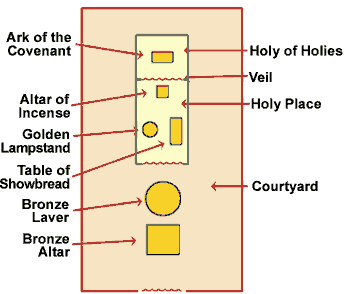
The golden Altar: Here is a definite reference to the Altar of Incense which stood before the Holy of Holies in both the Tabernacle and the Temple.


A diagram of the Tabernacle (Mishkan) of Moses.
http://www.templeinstitute.org/storeimages/item-C20.jpg
An artist’s conception of the interior of the Holy Place (Hekhal) in the Temple of Solomon. The Altar of Incense can be seen in between the Menorahs and the Tables of Showbread.

And another Angel came,…having a golden censer…and the smoke of the incense, with the prayers of the Saints, went up before God: cf. Ex. 30:1; Ps 141:2; Rev. 4:8.

And the Angel took the censer, and filled it with the fire of the Altar, and cast it upon the Earth: cf. Leviticus 16:12; Ezekiel 10:2.

Thunders, and voices, and lightnings, and an earthquake: cf. Rev. 4:5.

1.) Commentary by St. Bede:
seal. It is believed that after the death of the Antichrist, there will be some little rest in the Church, which Daniel thus foretold: “Blessed is he who waits and comes to the one thousand three hundred and thirty-five days.” And it is thus interpreted by the blessed Jerome: “Blessed,” he says, “is he, who when the Antichrist is slain, beyond the one thousand two hundred and ninety days, that is, three years and a half, waits for the forty-five days, in which the Lord and Saviour is to come in His own Majesty. Now for what reason, after the destruction of the Antichrist, there is silence for forty-five days, is a subject of divine knowledge, unless perhaps we say, the deferring of the kingdom of the saints is the trial of patience.
Observe that at the sixth seal, he sees the greatest afflictions of the Church, at the seventh, rest. For the Lord was crucified on the sixth day of the week, and rested on the Sabbath, awaiting the time of resurrection. Thus far concerning the opening of the closed book and the six seals. But now he recapitulates from the beginning, as he is about to say the same things in another manner.
trumpets. The Church, which is often presented under the number seven, is commended to the office of preaching.
And here the first trumpet denotes the common destruction of the ungodly in the fire and hail;
The second, the expulsion of the devil from the Church for the fiercer burning of the sea of the world;
The third, the falling away of heretics from the Church, and their corruption of the streams of Holy Scripture;
The fourth, the defection of false brethren in the darkening of the stars;
The fifth, the greater hostility of heretics, the precursors of the time of the Antichrist;
The sixth, the open war of the Antichrist and his own against the Church, and the destruction of the same enemy interposed by a recapitulation from the advent of the Lord;
The seventh, the day of judgement, in which the Lord is to render to His own their reward, and to examinate those who have corrupted the earth.

came. He says not, came afterwards; but on announcing that the angels have received trumpets, he returns to explain in what manner they have received them. For although the Church preached before the coming of the Lord, it was not in every place, until it was strengthened by His Spirit.
stood before. He appeared, that is, in the sight of the Church, Himself made the censer from which God received the odor of a sweet savor, and was propitiated towards the world. Another version has, “upon the Altar;” because on the Altar of the Cross, He offered to the Father for us His own golden censer, that is, His own immaculate body, conceived by the Holy Spirit.
incense. He offered incense from the prayers of the saints. For the Church entrusted to Him her prayers, saying, “Let my prayer be directed before Thee, as incense (Ps. 140:3 [141:2]).” The same is said both to have taken of the prayers of the saints and to have offered, because the prayers of all can come with a sweet savour to the Father by Him.

smoke. When Christ the Lord offered Himself a sacrifice of a sweet savour, the compunction of heart in the saints was made acceptable, for this arises from fire within, and like smoke is accustomed to excite tears.

censer. He fitly introduces a censer filled with fire, for “God gives not the Spirit by measure (John 3:34).” And this we know to have been specially fulfilled in respect of the Incarnation of Christ, “for in Him dwells all the fullness of the Godhead bodily (Col. 2:9).”
earth. So also the Lord in the Gospel says, “I have come to send fire upon the Earth (Lk. 12:34).”
earthquake. He shook the earth by the thunder of divine threatening, and the voice of exhortation, and the lightning of miracles, when some persecuted and some followed; when the latter said, “He is a good man,” and the former, “Nay, but He deceives people (Jn. 7:12).”

to sound. The Church, inflamed by the sevenfold Spirit, prepared herself to preach with confidence, so as to throw down the glory of the world like the walls of Jericho with heavenly trumpets. For that compassing about for seven days also suggests the whole time of the Church.
2.) Commentary by St. Victorinus:
And when He had opened the seventh seal, there was silence in heaven for about half an hour. Whereby is signified the beginning of everlasting rest; but it is described as partial, because the silence being interrupted, he repeats it in order. For if the silence had continued, here would be an end of his narrative.
 
7: And the first sounded, and there came hail and fire mixed with blood, and it was cast upon the Earth: and the third part of the Earth was burnt up, and the third part of the trees was burnt up, and all green grass was burnt up.
http://img293.imageshack.us/img293/1282/ps297856lvc2.jpg

Hail and fire mixed with blood: This woe resembles the seventh plague of Egypt; cf. Exodus 9:23-24; Is 28:2; Ezek 38:22; Joel 2:30.

1.) Commentary by St. Bede:
“And the first Angel sounded the trumpet.” This announcement of the plagues is rightly compared to a trumpet, which is the signal of battle. For he says, “Lift up thy voice as a trumpet, and declare unto My people their iniquities (Isaiah 43:1);” and in another place, “Let there be a trumpet in thy mouth, as an eagle upon the house of the Lord (Hosea 8:1),” that is, proclaim with a loud voice that Nebuchadnezzar will come for the destruction of the temple.
“And there followed hail and fire, mingled with blood.” That the punishment of hell is due to works of blood is announced by the voice of the preachers, who say, “they shall pass from snow-water to excessive heat.” The spiritual death of the soul may also be understood under the name of blood. Tichonius explains the verse in this way: “There followed the wrath of God upon which the death of many should ensue.
And the third part of the Earth was burnt up.” The life of the good is found in doctors and hearers. For, “Blessed,” he says, “is he who reads, and he who hears the words of the prophecy.” But the third part of the bad has neither of these. For, “the Earth, which brings forth fruit in patience, receives blessing from the Lord; but the bad produces thorns and thistles, whose end is for burning (Heb. 6:7).” So also the Father, Who is the husbandman, cultivates the fruitful, but cuts down the barren tree, and delivers it as fuel to the fire.
And all green grass was burnt up.” The grass is all flesh, which is now pampered with the softness of luxury, but which, when the sun of judgement is hot, loses the flower of beauty, and as the Lord says, “*Today is in the field, and tomorrow is cast into the oven *(Matt. 6:30).” Tichonius speaks in this way of the third part in this place: “By the third he means intestine foes.” But whatever is without the Church is called a third part, and the Church is a third which is to fight against a two-fold evil.
2.) From the Haydock Commentary:
The first Angel sounded, etc.” From this place to the eleventh verse of chapter 20 the visions are differently expounded. Some interpret them, without applying them to any particular events, as general comminations, in a mystical and allegorical sense, of the many persecutions which God permits to happen to his Church. Others think that they are all predictions, which shall not happen till a little time before the end of the world, in antichrist’s time, after which will follow the day of the general judgment, the punishment of the wicked, and the reward of the just. But there are others, both ancient and later writers, as in particular Alcazar, the bishop of Meaux (Bossuet,) Pere Alleman, to whom we may add among the Protestants, Dr. Hammond, whom the bishop of Meaux calls the most learned of all the English Protestants. According to the interpretations which these writers have followed, these predictions of St. John (except the last persecution, when the Devil shall be let loose, 20:7, in the time of the great Antichrist) have already happened in the three first ages [centuries], during the persecutions of the heathen Emperors, as I shall briefly take notice.
Hail therefore, and fire, blood, falling of stars, etc. some look upon as mystical representations, to signify that a great many trials and persecutions shall happen to the good, and a great many punishments and chastisements shall fall upon the wicked; with this grand difference that the sufferings of the good shall be short and momentary, and their reward a crown of endless glory; but the wicked, if any of them escape punishments in this world, can never escape eternal torments with the devils in the next.
  1. It is also a very common opinion, that all these disasters shall happen in a great measure, literally about the Antichrist’s time, a very short time before the end of the world.
  2. Others apply all these events to the judgments which God’s justice exercised either upon the Jews, in the time of Trajan and Adrian, or upon the heathen Roman emperors, and upon the pagan city of Rome, for persecuting the servants of God. (Witham)
As these Angels with their trumpets, according to Pastorini, denote the sufferings of the Church during the seven ages that it lasts, it may not be improper to point out the time, according to his opinion, when each Angel sounded the trumpet. Thus the first trumpet denotes the persecutions of the first three centuries, in which the Christians suffered death by the sword, (denoted by blood) by being stoned, (denoted by the hail) and by fire, when the third part of the trees were burnt, that is, the third part of the clergy were destroyed. (Pastorini)
3.) Commentary by Tyconius:
By the ‘fire and blood’ he signifies the wrath of God, which devours the multitude of the impious. Since the righteous have been accounted worthy of the blessed portion…and so are to be caught up ‘in the clouds of the air’ prior to the coming of the Lord, that they might greet the coming Lord (1 Thess. 4:17),…the vision now finally discusses the fate of the rest of humankind and the punishment of sinners. When the coming destruction occurs, there will necessarily be various kinds of death and various rewards for the wicked.
The greater part of these will be consumed by fire, for in his first letter to the Corinthians the holy Apostle wrote that that day will be revealed in fire (1 Cor. 3:13). For if there are ‘many rooms’ for rest, as the Lord says (Jn. 14:2), there are also different places for torment. And these trumpets that bring death to those upon Earth are the same that also raise the dead afterwards.
Why does it say that when the first Angel blew his trumpet, ‘hail and fire consumed a third’ of those upon the Earth? Were someone to think that this will happen literally, he would not be interpreting this passage incorrectly. But if we understand the passage figuratively, we will also not be wrong, for the passage speaks of “fire” when it refers to the distress and profound grief of the sinners who see the saints “caught up in the clouds to meet the Lord,” while they themselves remain dishonorable upon the Earth and are not regarded as worthy of any greeting. The passage refers figuratively to sinners as “trees” and “grass” that are on fire because of their folly and the insensitivity of their souls, which are hard as dry wood and so suitable for burning.
4.) Commentary by St. Andrew of Caesarea:
Some have interpreted these things to depict the punishment of sinners in Gehenna, which is symbolically described as various kinds of physical torment. However, we think it more likely that the third portion is not of those from the totality of people who will be punished in the coming age, but rather — “for the way which leads to destruction is broad” — this passage shows the plagues that will occur before the consummation.
The hail indicates the scourgings that will come from Heaven for righteous judgment, and the fire mixed with blood indicates the destruction by fire and slaughter at the hands of the barbarians that will occur daily.
 
8-9: And the second Angel sounded, and something like a great mountain burning with fire was cast into the sea; and the third part of the sea became blood, and the third part of the creatures which were in the sea, those having life, died; and the third part of the ships were destroyed.
http://home.earthlink.net/~jorevel4/TRUMPET-2.jpg

A great mountain burning with fire: cf. Jeremiah 51:25; Amos 7:4.

And the third part of the sea became blood: This echoes the first plague of Egypt; cf. Exodus 7:17-ff.

1.) Commentary by St. Bede:
And the second angel sounded the trumpet: and as it were a great mountain, burning with fire, was cast into the sea, and the third part of the sea became blood.” As the Christian religion increased, the devil, swollen with pride and burning with the fire of his rage, was cast into the sea of the world, for that the Lord says, “*If ye shall say unto this mountain, Be thou removed, and cast thyself into the sea, it shall be done *(Matt. 21:21).” Not that he was not there before, but that when he was cast out from the Church, he began to rage with greater madness against his own, while through the pride of carnal knowledge he wrought in them spiritual death; for, “*To be carnally minded is death *(Rom. 8:6).” But flesh and blood taught not the Apostles, but the Father who is in Heaven (Matt. 16:17), for they directed the ship of faith in that sea, which yielded itself to be trodden by the feet of the Lord.

And the third part of those creatures died, which had life in the sea.” He said, “Which have lives,” to represent the living, as spiritually dead; as the Apostle says of the widow who is living in pleasure, “she is dead, while she liveth (1 Tim. 5:6).”
And the third part of the ships was destroyed.” Another version, by saying, “and they destroyed the third part of the ships,” signifies that the third part which was dead killed another third, namely, that which came next to itself, by an injurious tradition, and following of unprofitable doctrine.
2.) From the Haydock Commentary:
The great mountain denotes the heresy of Arius, which caused the greatest troubles in the Church, and destroyed many churches, which are here denoted by the ships. (Pastorini)
3.) Commentary by Tyconius:
Another edition has the reading “a third of] those who have souls” and shows thereby that they have died a spiritual death, similar to that which the Apostle said about the widow, “*She who is self-indulgent is dead *(1 Tim. 5:6).” And so the passage suggests that one third has killed another third by a poisonous tradition and by imitation of a useless teaching. When he speaks customarily of the part that has a soul, he refers to persons who are spiritually dead and separated from the kingdom of God.
And a third of the birds fell to the ground.” (Note: The text of Tyconius here reads "tertia pars avium" meaning ‘a third of the birds’, which is perhaps an error for “tertia pars navium”, ‘a third of the ships’) Therefore, that third that died in the sea destroyed by its own death another third. He is describing the devil and those who are of one mind with the devil, who after the manner of birds fly around and deceive or wish to deceive all by their trickery.
3.) Commentary by Oecumenius:
According to analogy and rhetorical custom, the “sea” may be regarded as the present life because of its turbulence and its many distractions. And one might interpret the “fish” and the “boats” to be those persons who are made filthy by salty and bitter sins and who are dissipated by anxiety over useless regrets for what they did in life.
 
10-11: And the third Angel sounded, and there fell out of Heaven a great star, burning as a lamp, and it fell upon the third part of the rivers, and upon the fountains of the waters.
And the name of the star is called ‘Apsinthos’, and the third part of the waters became wormwood; and many men died of the waters, because they were made bitter.
http://www.pitts.emory.edu/woodcuts/1560Soli/00004779.jpg
The Angel sounded the trumpet; a burning star fell upon the rivers and the fountains, and many men died.
Apsinthos: The Greek word here means ‘Wormwood’, perhaps more specifically the plant Absinthe Wormwood (Artemisia absinthius), of the Artemisia family, native to temperate regions of Europe, Asia and northern Africa (the word absinthe itself traces its origin to the Latin absinthius, which in turn came from this word).


Absinthe Wormwood (also known as Grand Wormwood or simply Wormwood)
The plant was (and is) infamous for its bitter taste, and was commonly known and used as medicine, usually as a drinkable preparation applied for specific reasons.

Became wormwood: cf. Jeremiah 9:15; 23:15.

And many men died of the waters, because they were made bitter: It is interesting to note that pure wormwood oil (if taken in large doses), and parts of the plant are very poisonous.

COMMENTARIES

1.) Commentary by St. Bede:

And the third Angel sounded the trumpet, and a great star fell from heaven, burning as it were a torch, etc.” Heretics, who are called by the Apostle Jude, “stars of seduction (Jude 13),” fall from the height of the Church, and by the flame of their own wickedness they endeavour to corrupt the fountains of the divine Scripture, not the sense of which alone, but also the words, they dare to falsify. These are worthy of the name of Wormwood, for a slight admixture of it is wont to make bitter much sweetness.

And the third part of the waters became wormwood; and many men died of the waters, because they were made bitter.” For “many,” as the Apostle says, “follow their own luxuries, through whom the way of truth is evil spoken of (2 Pet. 2:2).” By the people of God, however, as Moses teaches, every kind of water can be drunk (Exodus 15:25).
2.) From the Haydock Commentary:
A great star fell. The bishop of Meaux thinks this agrees very well to Cochebas, or Barcochebas (Simon bar-Kokhba), who in Hadrian’s time pretended to be the true Messias of the Jews; his name also signifying a star (Personal note: He was given the name 'Bar-Kokhba’, which in Aramaic means ‘Son of a Star’, by his contemporary Rabbi Akiva ben-Yosef. The star refers to Numbers 24:17, which says: “A star has shot off Jacob”). He was the chief cause of those wars, and of the other destruction of the Jews. (Witham)
The third trumpet points out to us the punishment that falls upon the Roman Empire, in its destruction by the northern nations. These people spread themselves over the third part of the rivers and provinces of ancient Rome. The star is called Wormwood, from the bitter calamities and miseries which they inflicted upon the Roman Empire. (Pastorini)
3.) Commentary by St. Andrew of Caesarea:
Some say that the bitterness revealed through the wormwood is symbolic of the torment that comes to those sinners being punished in Gehenna, who, on account of their number, are reasonably called “waters.” But we think that these depictions signify the sufferings at the time, which has been shown. The star indicates either that these things come upon people from heaven, or it refers to the Devil, of whom Isaiah says, “*How has the Day Star, which rose in the morning, fallen from Heaven *(Isaiah 14:12).”
For, through pleasure he gives people a foul and bitter destruction to drink and through this allows punishing torments to come upon them, although not to everyone, but by the long-suffering of God to a third part…It is necessary, therefore, that we examine ourselves lest we be judged. As the holy Apostle says, “For if we judged ourselves, we should not be judged, but when we are judged by the Lord, we are chastened (1 Cor. 11:31-32),” and we receive the sufferings that come upon us with thanksgiving.
For those who are concerned about sicknesses in the body bear patiently the cuts and cauteries of the physician, for they desire to be healed. Therefore, [we should examine ourselves] so that being spiritually healthy and bringing no wood to fuel the fire of Gehenna, we might not be condemned with the world but eternally rule with Christ, to whom be glory, honor and worship, together with the Father and the Holy Spirit forever. Amen.
4.) Commentary by Tyconius:
The “great star” is the Devil, of whom the Lord spoke in the Gospel, “*I saw Satan fall from Heaven as fire or lightning *(Lk. 10:18).” It is possible that this passage also refers to Ecclesiastical people, who living the spiritual life in the Church, have become forgetful of themselves and like animals bend down to the things of the Earth and fall from their positions of authority. We read what has been written of such persons: “*Although he is in honor, he does not understand; he is compared to the senseless cattle and has become like them *(Ps. 48:13 LXX).”
The rivers and fountains of waters signify the teachers of the divine Scriptures who instruct others but turn themselves away from the way of truth. Indeed, the name Wormwood indicates either the bitterness or the sweetness of sins, which give a present sweetness to those who desire them but afterwards change themselves into bitterness.
5.) Commentary by Oecumenius:
Naomi, who lived long ago, was called “Bitter” because of the many troubles she had with her children and with other circumstances of her life (Ruth 1:20). A sample of the extraordinary plagues is that bitterness that we sinners suffer at that time when we are embittered at the glory of the Saints. For although such good things have been prepared for humankind, we ourselves have exchanged the things of the present for those which are to come.
I think the falling star refers to a certain wrath of God that makes the waters bitter. He speaks figuratively of people as “waters,” according to that spoken by the prophet: “From the voice of many waters, wonderful are the waves of the sea (Ps. 93 [92]:4),” and again, “The floods have lifted up, O Lord, the floods have lifted up their voice, the floods lift up their roaring (Ps. 93 [92]:3).” Although these things are spoken in figurative speech, it is not impossible that these things and things like them will occur at that time.
6.) Commentary by St. Caesarius of Arles:
A third part of humankind was made like the star that fell upon it…“Many die from the waters.” This can manifestly be interpreted to those who are rebaptized.
7.) Commentary by Primasius:
It speaks of men who have fallen from Heaven as though from the Church, that is, of those who have the public reputation of shining brightly with good merits. For that reason they are compared to stars and torches, as did the apostle Jude, who called them “stars of seduction” (Jude 13), since they lead astray by a superficial splendor. And the Lord compared such people with walls and whitewashed tombs (Matt. 23:27).
Since the ruin of those who are great often confuses many, it says that the star fell upon part of the rivers and fountains, and that its name was Wormwood because of its great bitterness. We know that many are weakened by the fall of such persons and are corrupted by an evil imitation of their teaching. [The star] is rightly compared with wormwood, since a small amount of bitterness, when mixed with that which is sweet, will make the whole bitter. Elsewhere the Scriptures make the same point: “I planted you as a chosen vine; how did you turn into the bitterness of the vine of another? (Jer. 2:21)”
 
12: And the fourth Angel sounded, and the third part of the Sun was smitten, and the third part of the Moon, and the third part of the stars, so that the third part of them would be darkened and the day would not shine for the third part of it, and the night in the same way.
http://img201.imageshack.us/img201/5324/41234927nr2.jpg

The third part of the Sun was smitten, and the third part of the Moon, and the third part of the stars: cf. Exodus 10:21-29; Isaiah 13:10; Ezekiel 32:7; Joel 2:10, 31, 3:15; Revelation 6:12.

1.) Commentary by St. Bede:
And the fourth Angel sounded the trumpet, and the third part of the sun was smitten, and the third part of the moon, and the third part of the stars.” The glory of the Church, which shines like a star, is often obscured through false brethren, who, either in the prosperity or adversity of the age, cause it to shine less brightly by their defection.
So that the third part of them was darkened, and the day did not shine for a third part of it, and the night in like manner.” Another version has this, “And that the third part of the day might appear, and of the night likewise.” That is, it was smitten for this end, that the third part of the day and the third of the night might appear either to be Christ’s or the Devil’s. To this end, I say, it was smitten, that is, was given up to its own desires, that as its sins became more abundant and more flagrant, it might in its own time be revealed.
2.) From the Haydock Commentary:
The third part of the sun was smitten.” This may signify a third part of men killed in those wars, or (according to the opinion that refers all to the Antichrist’s time) that in those days the sun and moon shall not give above a third part of their light. (Witham)
Here we behold a noble figure of the Church, which whilst in its most flourishing state, like the sun, is suddenly obscured, and a third part extinguished by the heresy and schism of the Greeks, under Photius, which began in 866, and infected all orders of Christians, clergy and laity, princes and individuals, signified by the sun, moon, and stars. (Pastorini)
3.) Commentary by Tyconius:
The sun, moon and stars represent the Church, a third part of which is struck. This third is a designation, not a quantity. For there are two peoples within the Church, that part of God, which is compared with the light, and that part of the Devil, which is surrounded by the darkness of shadows, as the Scripture says, “*I have compared your mother to the night *(Hosea 4:5 LXX).” And this part was struck so that it might become apparent who is of God and who of the Devil. It has been given over to its own sins and desires, so that their faults that have remained hidden and unknown to all might be revealed.
4.) Commentary by Dionysius bar-Salibi (quoting Gaius Romanus and Hippolytus):
On this Gaius said that, just as in the Flood the heavenly bodies were not taken away and suddenly submerged, thus also is it to be in the end, as it is written (Matt. 24:37); and Paul says, “When they shall say, Peace and safety, destruction shall come upon them (1 Thess. 5:3).”
But Hippolytus says, in reply to this objection of the heretic: Before the Flood there was none of these signs, inasmuch as the Flood was partial; and the heavenly bodies were not removed, inasmuch as the general end had not arrived; but when Heaven and Earth are about to pass away (Matt. 24:35), it must needs be that by little and little their splendor shall perish.
And to this Joel testifies: “Before him verily the earth shall be confounded and the heavens shaken, and the sun and moon shall be darkened, and the stars their light shall set (Joel 2:10).” And our Lord said, in the Book of Luke, “And there shall be signs in the sun and moon and stars, and on the earth distress of nations, and the powers which are in Heaven shall be shaken (Luke 21:25-26).” And as to this, that He sent a manifest token, it is with regard to the non-perception of the unbelieving that He signifies. And as to the text, “When they shall say Peace, destruction shall come upon them,” it is with regard to the Jews that He signifies, that they expect to possess their land and to be able to live in peace, and forthwith Christ appears and they are put to shame.
 
13: And I saw, and I heard an eagle, flying in mid-Heaven, saying with a great voice: “Woe, woe, woe, for those who dwell upon the Earth, because of the remaining voices of the trumpet of the three Angels who are about to sound!
http://beatus.saint-sever.fr/folios/f141.JPG
And I saw, and I heard an eagle, flying in mid-Heaven…

DEFINITIONS AND CROSS-REFERENCES
Eagle (Greek Aetos):
This Greek word, usually translated as ‘eagle’, is also rendered as ‘vulture’ in some contexts, for example in Matthew 24:28 and Luke 17:37.

Most manuscripts contain the word ‘aetos’ here, with the Vulgate, Wescott-Hort, and most modern translations following this rendering, while some minuscule manuscripts contain here the word ‘angelos’, meaning ‘Angel’, with the Textus Receptus, the King James Version (and subsequently, the New King James) following this latter use.

From Bruce M. Metzger & United Bible Societies’ A Textual Commentary on the Greek New Testament (2nd edition, 1994):
Instead of ‘aetos’ (which is decisively supported by א (Codex Sinaiticus, c. 330-350 AD), A (Codex Alexandrinus, 5th century), 046 (Codex Vaticanus 2066, 8th-10th c.), most minuscules, itgig (Vetus Latina, Codex Gigas, early 13th century), h vg (Latin Vulgate 382-405 AD), syrph (Syriac Philoxenian, 508-509 AD), h copsa (Coptic-Sahidic), bo eth (Bohairic Ethiopic), the Textus Receptus, following P 1 680, 2059, 2060 (Vatican Gr. 542, 1330-31 AD), 2081, 2186 (Athos Vatopedi 333, 12th century), 2286, 2302, arm (Armenian) and others read ‘angelou’. The substitution may have been accidental (a scribe misread ‘aetou’ as ‘angelou’), but more likely it was deliberate, since the function ascribed to the eagle seems more appropriate to an Angel (cf. 14.6)…The two readings are conflated by 42 al into ‘angelou ōs aetos’ (an Angel, like an eagle).

A Golden Eagle (Aquila chrysaetos), one of the most common species of eagles in Palestine. The subspecies pictured here may be different from the ones that frequent that area.
I heard an eagle flying in mid-Heaven: cf. Hosea 8:1:
Masoretic Hebrew: Unto your mouth–a trumpet! As an eagle ('ayit, bird of prey) he shall come] against the house of the LORD, because they have transgressed my covenant, and rebelled against my law.
Septuagint: He shall come into their midst as the land, as an eagle (aetos, eagle or vulture) against the house of the Lord; because they have transgressed my covenant, and have sinned against my law.
Vulgate (Douay-Rheims): Let there be a trumpet in thy throat like an eagle (aquila, eagle) upon the house of the Lord: because they have transgressed my covenant, and have violated my law.
Woe, woe, woe: cf. Revelation 9:12; 11:14; 12:12.

COMMENTARIES
1.) Commentary by St. Bede:

And I beheld, and heard the voice of one eagle flying through the midst of Heaven.” The voice of this eagle daily flies through the mouths of eminent doctors in the Church, when they announce that the cruelty of the Antichrist and the day of judgment will come with all the severity to those who are lovers of the earth; while they say, “In the last days perilous times will be at hand, and men will be lovers of themselves;” and below, “men corrupt in mind, reprobate concerning the faith (2 Tim. 3:1);” and in another place, “Then will the wicked one be revealed, who opposes and exalts himself above all that is called God, or is worshipped (2 Thess. 2:4);” and again, “The day of the Lord will so come, as a thief in the night; for when they shall say, peace and security, then sudden destruction comes upon them (1 Thess. 5:2).”
Woe, woe, woe to the inhabitants of the earth: by reason of the rest of the voices of the three Angels, who are yet to sound the trumpet.” Not that the trumpets of the Angels bring the plagues upon the world, but that each of them in his own time announces such as are coming, or are to come.
2.) From the Haydock Commentary:
The voice of one eagle: in diverse Greek copies, of an Angel, saying: Woe, woe, woe! It is to foretell, in general, greater punishments and miseries. The Protestant translation has followed those Greek copies that read an Angel; but Dr. Wells, in his amendments, has restored that reading of an eagle which the ancient Latin interpreter had met with. (Witham)
An eagle, on account of its swiftness, is here represented as chosen to announce by its cry of woe on the three succeeding ages of the Church, greater disasters to be sustained than in the preceding ages. (Pastorini)
3.) Commentary by St. Victorinus:
And I saw an eagle flying through the midst of Heaven.” The Holy Spirit is indicated, who through two prophets proclaims that the great wrath of plagues is imminent. This occurs so that, although it is the end of time, someone might in some manner still be saved.
4.) Commentary by Primasius:
He speaks of an eagle that moves through the Heavens in swift flight out of contempt for the Earth. He speaks of the Church flying in mid-Heaven, for She is going to possess the whole world, and She says: “Our abode is in the Heavens (Phil. 3:20).” And He rightly says that She was “in the middle,” for “all who are around Him offer gifts (Ps. 76:11 [75:12]),” and God works His way in the midst and “*works salvation in the midst of the Earth *(Ps. 74 [73]:2),” and “the Lord is round about his people (Ps. 125:2 [124:1]).”
5.) Commentary by Tyconius:
The eagle that he saw flying in mid-Heaven is the Word of God, which has free course in the middle of the Church and announces openly and publicly the the plagues of the last time.
6.) Commentary by Oecumenius:
We recognize in the eagle flying in mid-Heaven a certain Divine Angel who looks in sorrow upon the sufferings of those on earth and is sympathetic with humankind in their plight.
7.) Commentary by St. Andrew of Caesarea:
This passage shows the sympathy and goodness of the holy Angels, who, like God, are merciful toward the transgressors who are being chastised, and especially toward those who do not recognize that their suffering is for the purpose of their conversion. For these especially the “woe” is fitting, since they live upon the Earth, think Earthly thoughts and exhale dust rather than the perfume that has been poured out for us. For those whose citizenship is in Heaven (Phil. 3:20), the sufferings become the cause of unfading crowns and rewards.
 
9:1-6: And the fifth Angel sounded, and I saw a star from Heaven which had fallen to the Earth: and there was given to him the key of the shaft of the Abyss. And he opened the shaft of the Abyss; and there went up a smoke out of the shaft, like the smoke of a great furnace; and the sun and the air were darkened because of the smoke of the shaft.
And out of the smoke came forth locusts upon the Earth; and power was given them, as the scorpions of the Earth have power. And it was said to them that they should not hurt the grass of the Earth, nor any green thing, nor any tree, but only the men who do not have the seal of God on their foreheads.
And it was given them that they should not kill them, but that they should be tormented five months; and their torment was like the torment of a scorpion when it strikes a man. And in those days men will seek death, and they will not find it; and they will desire to die, and death will flee from them.
http://www.pitts.emory.edu/woodcuts/1522Bibl1-2/00006686.jpg

DEFINITIONS AND CROSS-REFERENCES
I saw a star from Heaven which had fallen to the Earth:
The nuance of the perfect tense ‘peptōkonta’ (had fallen) suggests that John saw the star after it had fallen into the Earth and identifies it as such.

Late Judaism usually represented fallen powers as stars (Isaiah 14:12-15; Luke 10:18; Jude 1:13); a comparison with Rev 1:20 and Rev 20:1 suggests that here it means an Angel.

In the (Apocryphal) 1 Enoch 88:1-3, an evil Angel (perhaps Satan, as per 1 Enoch 10:4) was described thus:
And I saw one of those four who had come forth first, and he seized that first star which had fallen from Heaven, and bound its hand and foot and cast it into an abyss: now that abyss was narrow and deep, and horrible and dark. And one of them drew a sword, and gave it to those elephants and camels and asses: then they began to smite each other, and the whole Earth quaked because of them. And as I was beholding in the vision, lo, one of those four who had come forth stoned (them) from Heaven, and gathered and took all the great stars whose privy members were like those of horses, and bound them all hand and foot, and cast them in an abyss of the earth.
In other parts of the book (18:11-16; 86:1-3; 90:23-26), disobedient Angels are also described as ‘stars’ which are bound and cast from Heaven into the ‘abyss’.

The shaft of the Abyss (Greek: Phreatos tēs Abyssou): Where Satan and the fallen Angels are kept for a thousand years, to be cast afterwards into the pool of fire; cf. Rev. 20:7-10.

The Abyss was conceived of as a vast subterranean cavern full of fire. Its only link with the Earth was a kind of passage or mine shaft, which was kept locked.

There went up a smoke out of the pit…and the sun and the air were darkened…and out of the smoke came forth locusts upon the Earth: This echoes both the eighth Plague of Egypt (Ex. 10:12-15, 21-23); also see Wisdom 16:9; Joel 1:4-2:10.

Grass of the Earth…green thing…tree: The targets of natural locusts.

The men who do not have the seal of God on their foreheads: cf. Rev. 7:1-8.

That they should be tormented five months: This period of time corresponds with a locust’s natural lifespan, which usually lasts 3-5 months, and the dry season, which usually lasts five months, during which swarms of locusts could come and infest crops.

Torment (Greek: Basanismos): The connotations of this word, as used elsewhere in the Book of Revelation, is primarily in a spiritual and/or psychological manner (11:10; 14:10-11; 18:7,10,15; 20:10).

In the (Deuterocanonical) book of Wisdom 16:1,4 the verb “basanizō” (to torment) is used twice of the torment of the enemies of Israel, which was inflicted to them by the “dire venom of beasts” and “the bite of crooked serpents” (verse 5, NAB). The same verb is also used to say that the Egyptians “were being tormented…[with] a twofold grief” (Wis. 11:9-12, NAB; cf. Ex. 12:30)

Another occurence of “basanos” in that book is in 2:24-3:1, 5:6 (but cf. 2:19):
They who are in [the Devil’s] possession experience [death]; but the souls of the just are in the hand of God, and no torment shall touch them.
They seemed, in the view of the foolish, to be dead; and their passing away was thought an affliction and their going forth from us, utter destruction. But they are in peace.
For if before men, indeed, they be punished, yet is their hope full of immortality; chastised a little, they shall be greatly blessed, because God tried them and found them worthy of Himself. As gold in the furnace, He proved them, and as sacrificial offerings [literally: *burnt offerings] He took them to Himself.
-Wisdom 2:24b-3:6, NAB (cf. Rev. 3:4, 18; 6:9-10)
The book of Deuteronomy (28:27, 60) also predicts that “in the latter days” (so 32:20: 4:30) Israel will suffer the plagues of Egypt because of idolatry (e.g., v. 14; 29:22-27; 30:17; 31:16-20):
And it shall come to pass, if you will not listen to the voice of the LORD your God, to observe to do all his commandments and his statutes which I command you this day, that all these curses shall come on you, and overtake you…The LORD will strike you with the boil of Egypt, and with the tumors, and with the scab, and with the itch, whereof you can not be healed.
The LORD will strike you with madness [LXX: insanity], and with blindness, and with astonishment of heart; and you shall grope at midday, as the blind gropes in darkness, and you shall not prosper in your ways: and you shall be only oppressed and robbed always, and there shall be none to save you…
…All these curses shall come on you, and shall pursue you, and overtake you, until you be destroyed; because you did not listen to the voice of the LORD your God, to keep his commandments and his statutes which he commanded you, and they shall be on you for a sign and for a wonder, and on your seed forever…Among these nations shall you find no ease, and there shall be no rest for the sole of your foot: but the LORD will give you there a trembling heart, and failing of eyes, and despair of soul; and your life shall hang in doubt before you; and you shall fear night and day, and shall have no assurance of your life.
In the morning you shall say, “If only it was evening!” and at even you shall say, “If only it was morning!” for the fear of your heart which you shall fear, and for the sight of your eyes which you shall see.
-Deuteronomy 28:15, 27-29, 45-46, 65-67
Men will seek death, and they will not find it; and they will desire to die, and death will flee from them: As elsewhere in Scripture, severe suffering causes a desire for death in place of a life of torment; cf. 1 Kings 19:1-4; Job 3:1-26, 6:8-9, 7:15-16; Jer. 8:3, 20:14-18; Jonah 4:3, 8; Lk. 23:27-30.
 
COMMENTARIES
1.) Commentary by St. Bede:

star. He declares with what fuel the flame of heretics, of which he had spoken briefly, was kindled. The old enemy forsooth, whom the Lord saw “like lightning fall from Heaven (Luke 10:18),” opened the heart of his own by blasphemous doctrine, and taught them to speak impiety against the Most High.
smoke. The madness of heresy rages to announce beforehand the great furnace namely, the last persecution; and it labours to obscure not the weak alone, who like the air touch, as it were, the confines of Earth and Heaven, but the light also of the lofty, though unable to extinguish it. For even the Elect (Matt. 24:24), if it be possible, will be led into error.
locusts. As the saints are the body of Christ and members one of another, so also the members of the flesh of the Dragon cleave to one another, and are born one from the other, and the smoke of heretical blindness generates the pride of the ungodly, which hurts with its mouth. And although these are shaken by the wind of exaltation, yet they leave not the places of Earth, for so also the smoke from which they are produced, though it seek to ascend, always sinks back into itself.
power. Heretics are compared with hostile powers, and appear harmless in their countenance, but keep poison in their hinder parts.

grass. He shews that the locusts are men, for they are not sent to the grass, but to men, for we understand locusts simply in this place.
seal. They are said to have the seal of God on their foreheads who have it, as they ought to have; and the number of these was reckoned above, as being inviolate and fixed by the Angel, who brought from the East the seal of the living God. For here he has been pleased to use the form of speech in which it is said, “*No man saith that Jesus is the Lord, but in the Holy Ghost *(1 Cor. 12:3),” that is, perfectly and truly.

kill. Although heretics are supported by the secular power, and are permitted for a time to assail the good, yet, as the Lord saith, “*they are not able to kill the soul *(Matt. 10:28).” For by the five months he signifies the time of the age, because of the division into five of the sense which we use in this life. But in that another translation has “six months,” it agrees with this interpretation, because of the six periods of the age.
scorpion. As the scorpion diffuses poison from its hinder parts, so the ungodliness of the wicked injures from their hinder parts, when by threats or blandishments it causes the temporal things which are behind to be preferred to the eternal good things which are before. In opposition to the parable of the Gospel (Luke 11:12), the generation of vipers gives this scorpion to its own offspring.

death. They would rather that a life of misery should be ended by a speedy death, as the blessed Cyprian complained that it happened under the Decian persecution. “When they wished to die,” he says, “it was not permitted them to be slain.
2.) Commentary by Tyconius:
In this star he speaks of the body of those many persons who have fallen from Heaven through agreement [with the Devil]…We ought to understand the key to the pit to be false teachings that confine those within it in such a way that they are not able to look upon the light of truth. And so the Devil fell from Heaven and received the key to the pit, and [he] opened his mouth in blasphemy and taught his followers not to do the will of God but to do their own will.
He opened the shaft of the pit” means that he revealed his own heart and taught people to sin without any fear or shame.
And smoke arose from the pit,” that is, from the heart of a blasphemous people which also persecutes the Church.
And the sun and air were darkened by the pit.” The sins that people constantly commit through the world obscure among them the sun of faith and of righteousness and in some produce a blindness so that they do not see the light of the truth.
As smoke from a great furnace.” This smoke that precedes the fire of the furnace generally refers to the last persecution, for the earlier persecution burns against the Church, and then the crowd ot hypocrites and unbelievers will be manifested. And outside [the Church] the insanity of many caused by this smoke is aldready advanced.
In the locusts he signifies spiritual and adversarial powers that we see flying around in the air in the manner of locusts for the purpose of harming humankind.
3.) Commentary by Oecumenius:
Until now the vision has explained to us how and by what manner of plagues that upon the earth and in Heaven and humankind together with them shall be brought to completion or will be changed. But now, since the consummation has already occurred and the resurrection has been effected, the vision indicates the punishment of sinners.
I saw a star fallen from Heaven to the Earth,” calling an Angel of God a “star” because it descends to the Earth with brightness. For the judgment of sinners will be on the Earth, which was called the “valley of Jehoshaphat” by one of the holy prophets.
And he was given,” it says, “the key of the shaft of the bottomless pit.” He calls Gehenna “the shaft of the bottomless pit.
And “smoke rose from the shaft,” as though a significant fire was evidently burning in the shaft. So the smoke indicates not only fire but also darkness. For the words of the Prophet, “the voice of the Lord divides the flame of fire (Ps. 29 [28]:7),” is interpreted by the saints in this way, that the light-giving fire of Gehenna will be divided, so that only the burning heat of the fire along with the darkness remain in it.
And the sun and the air were darkened with the smoke.” This does not suggest that these elements were themselves darkened but that those cast into the shaft were filled with darkness because of their punishment and could not any longer see the air and the sun. For, one ot the holy prophets said, “*The sun will be darkened at midday *(Amos 8:9),” referring by this to the misfortunes of the Jews, even though the sun had not been darkened. But those who were suffering in this tribulation were not able to see the sun, because the magnitude of misfortune sometimes causes dizziness.
I think that he calls “locusts” those worms of which Isaiah spoke: “Their worm will not die, and their fire will not be quenched (Isaiah 66:24),” perhaps calling a “worm” that gnawing of the soul and the unceasing, creeping pain that it suffers.
They were told not to harm the grass of the Earth or any green growth or any tree, but only those of humankind who do not have the seal of God upon their foreheads,” since by a transformation the Earth had become new. Somewhere it says concerning this, “You will send forth your Spirit, and they will be created, and you will renew the face of the Earth (Ps. 104 [103]:30).” It was not yet good for anything that adorns the earth to be stricken, neither a tree nor any plant, only those persons who “do not have the seal of God upon their foreheads.
For those persons who were perfectly holy and pure had received that place mentioned above, being always with Christ and gazing upon the Throne of God. However, those who have been baptized and bear the sign of Christ upon their foreheads, yet are less holy and have seriously soiled themselves and their Baptism by their sinful behavior, such persons are, so to speak, halfway between virtue and evil and remain upon the Earth, although they experience no further punishment.
4.) Commentary by St. Caesarius of Arles:
[The Devil] revealed his own heart, which sins without any fear or shame.
And smoke rose from the pit,” that is, from a people that covers and obscures the Church, so that it is said that “the sun and air were darkened with the smoke.” It says that the sun was darkened, not that it fell to the Earth. For the sins of evil and prideful persons, which are constantly being committed throughout the world, obscure the sun, that is, obscure the Church and sometimes cause darkness for the Saints and righteous. For the number of the evil is so great that it is often with great difficulty that the good among them become evident.
 
7-10: And the shapes of the locusts were like horses prepared for war; and upon their heads were crowns like gold, and their faces were like faces of men, and they had hair like hair of women, and their teeth were like those of lions, and they had breastplates like breastplates of iron, and the noise of their wings were as the noise of chariots of many horses rushing to war, and they have tails like to scorpions, and stings; and in their tails is their power to hurt men five months. They have over them a king–the Angel of the Abyss; his name in Hebrew is “Abaddon,” and in the Greek, he has the name “Apollyon.
The first Woe is past; behold, two Woes are still to come after this!
Locusts…like horses prepared for war: cf. Joel chapters 1-2; especially 2:4-7.

Their teeth were like those of lions: cf. Joel 1:6. Later Jewish writings also compared the teeth of the locusts that plagued Egypt with that of lions.

Like the noise of chariots of many horses: cf. Joel 2:4-5; Jeremiah 51:14, 27.

And they have tails like to scorpions, and stings: cf. Jeremiah 8:16-19. The targum of Jeremiah 8 sees this as part of a plague in which people will ‘delight in death rather than life.

Interestingly, in Jeremiah 8:16, the horses are said to come from Dan, from which many early Church Fathers believed the Antichrist will hail from (Hippolytus in his De Antichristo 14-15 even identifies the passage as a prophecy of the Antichrist).

Abaddon (Hebrew “Destruction”): In the Old Testament, “Destruction” is sometimes equated with Sheol, the abode of the dead (Job 26:6; 28:2; Ps. 88:11; Prov. 15:11; 27:20).

Louis Ginzberg, in his Legends of the Jews mention that in Jewish tradition, in both Sheol and Abaddon there were ‘Angels of Destruction’:
…Corresponding to the seven Heavens, God created seven Earths, each separated from the next by five layers. Over the lowest earth, the seventh, called Erez, lie in succession the abyss, the Tohu, the Bohu (the Hebrew phrase “tohu va-bohu” is the phrase usually translated as ‘a formless wasteland’ or ‘empty and shapeless’ in Genesis 1:2), a sea, and waters.
Then the sixth earth is reached, the 'Adamah, the scene of the magnificence of God.
In the same way the Adamah is separated from the fifth earth, the Arka, which contains Gehenna, and Sha’are Mawet, and Sha’are Zalmawet, and Be’er Shahat, and Tit ha-Yawen, and Abaddon, and Sheol, and there the souls of the wicked are guarded by the Angels of Destruction…
In another place of the aforementioned work he mentions that God allowed Moses to see both Heaven and Hell:
…Moses went thence to another place, and there he saw sinners prone on their faces, with two thousand scorpions lashing, stinging, and tormenting them, while the tortured victims cried bitterly. Each of the scorpions had seventy thousand heads, each head seventy thousand mouths, each mouth seventy thousand stings, and each sting seventy thousand pouches of poison and venom, which the sinners are forced to drink down, although the anguish is so racking that their eyes melt in their sockets. Nasargiel (the Angel of Hell) explained: “These are the sinners who caused the Israelites to lose their money, who exalted themselves above the community, who put their neighbors to shame in public, who delivered their fellow-Israelites into the hands of the Gentiles, who denied the Torah of Moses, and who maintained that God is not the Creator of the world.
…Then Nasargiel said to Moses: “Come and see how the sinners are burnt in Hell,” and Moses answered, “I cannot go there,” but Nasargiel replied, “Let the light of the Shekinah precede you, and the fire of Hell will have no power over you.” Moses yielded, and he saw how the sinners were burnt, one half of their bodies being immersed in fire and the other half in snow, while worms bred in their own flesh crawled over them, and the Angels of Destruction beat them incessantly.
Nasargiel explained: “These are the sinners who committed incest, murder, and idolatry, who cursed their parents and their teachers, and who, like Nimrod and others, called themselves gods.In this place, which is called Abaddon, he saw the sinners taking snow by stealth and putting it in their armpits, to relieve the pain inflicted by the scorching fire, and he was convinced that the saying was true, "The wicked mend not their ways even at the gate of Hell."
In one of the Dead Sea Scroll fragments (Hodayot or “The Thanksgiving Hymns”), it says thus (1QHa XIX, 6–17 [11:3–14]):
I thank you, Lord, because You save my life from the pit;
and from Sheol and Abaddon You lift me up to an everlasting height,
so that I walk on a boundless plain.
And I know that there is hope
for someone You fashion out of clay
to be an everlasting community.
The corrupt spirit You purify from the great sin,
so that he takes his place with the host of the holy ones,
and enters in communion with the congregation of the sons of Heaven.
You cast eternal destiny for man with the spirits of knowledge,
so that he praises Your Name together in celebration,
and tells of Your wonders before all Your works.
And I, a creature of clay, what am I?
Mixed with water, with whom am I counted?
What is my strength?
For I find myself at the boundary of wickedness and with those doomed by lot.
The soul of the poor person lives amongst great turmoil,
and the calamities of hardship with my footsteps.
When the traps of the pit open, all the snares of wickedness spread,
and the nets of the doomed upon the surface of the sea.
When all the arrows of the pit fly without return, they hit without hope. When the measuring line for judgment falls,
and the lot of anger against the forsaken,
and the outburst of wrath against the hypocrites,
and the period of anger against Belial,
and the ropes of death approach with no escape,
then the torrents of Belial overflow their high banks like a fire which devours all those drawing water (?),
destroying every tree, green or dry, from its canals.
He revolves like flames of fire, until none of those who drink are left.
He consumes the foundations of clay, and the tract of dry land;
the bases of the mountains does he burn,
and converts the roots of flint rock into streams of lava.
It consumes right to the great deep.
The torrents of Belial burst into Abaddon, the schemers of the deep howl with the din of those extracting mud.
The Earth cries out at the calamity which overtakes the world;
and all its schemers scream, and all who are upon it go crazy, and melt away in the great calamity.
For God thunders with the thunder of His great strength,
and His holy residence echoes with the truth of his glory,
and the host of the Heavens adds its noise,
and the eternal foundations melt and shake,
and the battle of heavenly heroes spans the globe,
and does not return until it has terminated, the destruction decided forever.
There is nothing like it.
They have over them a king: According to the book of Proverbs, natural locusts have no king.

Apollyon: A Greek word meaning “Destroyer,” from the verb “apolluein,” ‘to destroy.’

Some identify the Greek god Apollo with Apollyon, citing that Apollo may have also been symbolized as a locust and that his name is the same Greek word behind Apollyon (apollymi, “destroy”, as in Aeschylus, Agamemnon 1082).

Hebrew…Greek: The Latin Vulgate adds a phrase, “And in Latin, ‘Exterminans’.
 
COMMENTARIES

1.) Commentary by St. Bede:
crowns. The twenty-four Angels, who are the Church, have crowns of gold. But these have crowns like gold, as pretending to false triumphs from an empty victory.
faces. In the human face he represents a pretence of reason; in the hair of women, lax and effeminate manners; in the teeth of lions, which are wont to tear in pieces, and which bring with them a natural stench, ferocity of mind and the infamy of evil doctrine; and in breastplates of iron, hearts which are hardened against the truth. For “these having a form of godliness, but denying its power,” “come in sheep’s clothing, but inwardly are ravening wolves.”

wings. It is matter for fear rather than exposition, that this army has its powers so greatly increased. First, the smoke ascends, then it produces locusts, which at first are compared to scorpions, and presently afterwards to horses and lions. Their power too would be great enough, even if they did not come armed with breastplates; but now they are said to be winged, and like chariots of war.

tails. As the scorpion goes along softly, but strikes with its tail, so the pernicious craftiness of the wicked seems in appearance gentle and harmless, but in that it secretly destroys as in some hidden manner, it brings with it death.
five months. Again he signifies this life, in which falsehood may avail either to catch the unprofitable, or torment for a time the spiritual.

king. God, supremely good, in His secret but just counsels, permitted an Angel, not unfit for such as these, to have rule over them.

past. Since he had foretold that three woes were to come, he now mentions that one had already come, in the deceit of heresy, and that two remain, which will happen to the perverse in the time of the Antichrist, and at the day of judgment.
2.) Commentary by Tyconius:
In the image of the horses he shows the suddenness of persecution that runs around so that it might oppress the innocent and obstruct [their path] to the celestial Kingdom…We recall that it was written that upon the heads of the twenty-four Elders, who were a figure of the Church, there were crowns of gold. However, these [locusts] do not present a true figure of the Church but one only by way of pretense, and so they are not said to have crowns of true gold but crowns similar to gold.
Likewise, they are not perfect human beings but like human beings…And by the hair he speaks not only of the effeminacy and laxity of women, but he speaks of those from either sex who are given to wantonness and are stained by every baseness…[By the teeth like lions’ teeth] they daily devour the Church.
By the “tails” he speaks of the leaders who have fallen away from the Head of the Church, that is, from the Lord, and so those who were the first have become the last. This is as God thought it worthy to say through Isaiah, “The elders who are honored and admired are the head; and the prophet who teaches iniquity is the tail (Isaiah 9:15-16).” Therefore, the “power” of the locusts refers to the character of the false prophets who never desist from attacking the true church by their lying and venomous doctrines.
[The *Angel of the bottomless pit
] is the Devil, who possesses great power among the kings of the world.

3.) Commentary by Primasius:
By the locusts prepared as horses for war he means those who originate evil teachings. For just as locusts which destroy by their mouth, so also these persons tear asunder by their preaching. It is as we read, “*fierce wolves not sparing the flock *(Acts 20:29).”
Moreover, they are like horses running around aimlessly and so destroy in such a war many whom they lead astray…And if false doctrine is indicated by the mouth, by the hair of women he aptly describes their effeminate morals and their souls that are open to seduction. And so the Apostle says, “These are those who make their way into households and capture weak women, burdened with sins and swayed by various impulses (2 Tim. 3:6)”
By these images he suggests both leaders and those whom they have led astray, so that he shows them to be not only deceitful in their faith but also hateful in their morals. The historical record shows that some of both sexes exhibit [these characteristics]. For women gave their support to many heretics, such as Priscilla and Maximilla to Montanus and Lucilla to Donatus…It is natural for the teeth of lions not only to mangle but also to give off a natural stench. And since [the heretics] run around like horses to acquire for themselves fleeting fame as preachers, their opinion is rightly regarded as a stench. For in a good sense the Apostle said, “We are the good aroma of Christ (2 Cor. 2:15).” This bad odor, therefore, is derived from their evil doctrine and is by comparison like the odor of a lion’s mouth.
[The noise of their wings was like the sound of chariots] signifies that the few who were in the lead as the horses have now been multiplied in the chariots [that follow]. This suggests either an increase in the diversity of new opinions or the increase in the number of those who have been led astray. Moreover, they rush into battle because the preachers of error rebel against the truth and fight against unity. The Apostle described such persons in a similar fashion, “As Jannes and Jambres opposed Moses, so these men also oppose the truth, men of corrupt mind and counteirfeit faith (2 Tim. 3:9),” and following.
…[That they had power in their tails] reminds us of what Isaiah wrote, “The elder and the honored man is the head, and the prophet who teaches falsehood is the tail, and those who bless my people will lead them astray, and those who are blessed have fallen (Isaiah 9:15-16).” It is clear from this that these persons wish to rule that which every saint and teacher of the truth desires at all costs to avoid, namely, the glory of the world and the error of a destructive preaching. That they have power in their tails for five months indicates again the present life where falsehood can be strong and can either capture the useless or torment the spiritual for a short amount of time.
“As king they have over them the Angel of the bottomless pit, whose name in Hebrew is ‘Armageddon,’ (sic) whose name in Greek is ‘Apollion,’ and whose name in Latin is ‘Exterminans’.”] Although God is supremely good, by hidden yet just judgments he nevertheless allows an Angel suitable for such persons to rule over them. For a person is awarded as servant to the one who conquered him. And so the Apostle said that they had been handed over “to every wicked deception because they refused to love the truth and so be saved. Therefore, God sends upon them a strong delusion that they might believe what is false and that all who did not believe the truth but consented to iniquity might be condemned (2 Thess. 2:10-12).” The kind of work He did, therefore, was befitting to the character of his name, that is, the “exterminator.”
4.) Commentary by St. Andrew of Caesarea:
Some have interpreted these words and those which come afterward to indicate that the locusts are Angels who administer the divine punishment and who are metaphorically described through each of the various images. These images would then describe either their fearsomeness and the panic they arouse or their swiftness, or the destruction that comes upon those worthy of condemnation in Gehenna. However, I think that the image of these locusts depicts rather evil demons who are prepared for war against us and who wear upon their heads crowns as of gold in expectation of victory against us. Whenever we submit to these demons and win an evil victory through pleasure, we believe ourselves also to be crowned with such crowns.
That their hair is like that of women reveals their love of luxury and their arousal to fornication. The teeth like those of a lion signifies their murderous and poisonous character. Their iron breastplates show their hardness of heart…We think that the sound of the wings of these spiritual locusts is said to resemble the sound of war chariots because of their speed in the air. For, as the blessed David says, “They make war upon us from on high (Ps. 56:2 [55:3])” And their tails which are like those of scorpions symbolize the result of sins, the producing of spiritual death. For “sin when it is perfected brings brings forth death (Jas. 1:15).”
 
13-14: And the sixth Angel sounded, and I heard a voice out of the [four] horns of the Altar of gold that is before God, saying to the sixth Angel who had the trumpet: “Release the four Angels who are bound at the great river Euphrates!
And the four Angels were released, who had been prepared for the hour, and day, and month, and year, so that they would kill the third part of mankind. And the number of the armies of the horsemen was twice ten thousand times ten thousand; I heard the number of them.
[Four] horns of the Altar: Yet another reference to the golden Altar of Incense, which had horns protruding from its four corners (cf. Exodus 30:1-6; 37:25-28).

Euphrates (Akkadian: Pu-rat-tu, Arabic: Al-Furāt, Hebrew: Perath, Kurdish: Firat or Ferat, Persian: Ferat, Sumerian: Buranun, Syriac: Prath or Frot, Turkish: Fırat): The western of the two great rivers that define Mesopotamia (the other being the Tigris) which flows from Anatolia. For several centuries, the river formed the eastern limit of effective Egyptian and Roman control and western regions of the Persian Empire.

http://upload.wikimedia.org/wikipedia/commons/4/48/The_Euphrates_River-Iraq.jpg
The Euphrates as seen from Central or Southern Iraq.


The reference to Euphrates here may evoke various Old Testament prophecies of an army from beyond the river (from ‘the north’) whom God will bring to judge Israel (cf. Isaiah 5:26-29; 7:20; 8:7-8; 14:29-31; Jeremiah 1:14-15; 4:6-13; 6:1, 22; 10:22; 13:20; Ezekiel 38:6, 15; 39:2; Joel 2:1-11, 20-25) and other nations surrounding it (cf. Isaiah 14:31; Jeremiah 25:9, 26; 46-47; 50:41-42; Ezekiel 26:7-11; Amos 7:1 LXX).

The strongest OT echo of the sixth (and the fifth) trumpet comes from Jeremiah 46, which portrays the coming judgment on Egypt: the army of horsemen from the north are like serpents, innumerable locusts, wearing breastplates (cf. 46:4, 22-23) and standing “by the Euphrates River” (LXX ‘Epi tō potamō Euphratē’, 26 [46]:2; likewise 46:6, 10).

Also see Revelation 16:12 for another appearance of the river Euphrates in this work.

COMMENTARIES

1.) Commentary by St. Bede:

sixth. The sixth angel denotes the preachers of the last conflict, who, as the Gospel forwarns, detect the frauds of the Antichrist. For the horns of the golden Altar are the Gospels, which rise above the Church.

four. He signifies how much the Church will be persecuted at the end of the world, by the old enemy with his satellites, who from the time of the Lord’s Passion is shut up in the hearts of the ungodly, and is restrained by the divine power from injuring it as much as he desires. For the Euphrates, which is a river of Babylon, signifies the power of the kingdom of the world, and the waves of persecutors. This is the great mountain, which he had foretold would be cast in burning fire into the sea.

loosed. In the same manner as prophecy, which points out to us things to come, he himself in spirit sees them come to pass. And he has said four angels, because the persecution will rage in the four parts of the world. For these are they whom he saw above, standing at the four corners of the earth, and restrained from injuring the earth and the sea for the sealing of the servants of God.
prepared. The malignant spirits, who at every moment of the hours and times hunger for the death of man, are then permitted for the trial of the Church to rage more freely, and are to be destroyed in their time? but what, thinkest thou, will they do, when they are lossed, who now injure so much while they are bound?
number. This number designates the crafty duplicity of the perverse army; and this may more easily be perceived in another translation, which says, “two myriads of myriads.” This is the number which the parable of the Gospel opposes to the king who has ten thousand, as if the duplicity of the wicked resists the simple faith of Christ, for “thousands of thousands minister unto Him, and ten thousand times a hundred thousand stand before Him.
 
13-14: And the sixth Angel sounded, and I heard a voice out of the [four] horns of the Altar of gold that is before God, saying to the sixth Angel who had the trumpet: “Release the four Angels who are bound at the great river Euphrates!
And the four Angels were released, who had been prepared for the hour, and day, and month, and year, so that they would kill the third part of mankind. And the number of the armies of the horsemen was twice ten thousand times ten thousand; I heard the number of them.
[Four] horns of the Altar: Yet another reference to the golden Altar of Incense, which had horns protruding from its four corners (cf. Exodus 30:1-6; 37:25-28).

Euphrates (Akkadian: Pu-rat-tu, Arabic: Al-Furāt, Hebrew: Perath, Kurdish: Firat or Ferat, Persian: Ferat, Sumerian: Buranun, Syriac: Prath or Frot, Turkish: Fırat): The western of the two great rivers that define Mesopotamia (the other being the Tigris) which flows from Anatolia. For several centuries, the river formed the eastern limit of effective Egyptian and Roman control and western regions of the Persian Empire.

http://upload.wikimedia.org/wikipedia/commons/4/48/The_Euphrates_River-Iraq.jpg
The Euphrates as seen from Central or Southern Iraq.


The reference to Euphrates here may evoke various Old Testament prophecies of an army from beyond the river (from ‘the north’) whom God will bring to judge Israel (cf. Isaiah 5:26-29; 7:20; 8:7-8; 14:29-31; Jeremiah 1:14-15; 4:6-13; 6:1, 22; 10:22; 13:20; Ezekiel 38:6, 15; 39:2; Joel 2:1-11, 20-25) and other nations surrounding it (cf. Isaiah 14:31; Jeremiah 25:9, 26; 46-47; 50:41-42; Ezekiel 26:7-11; Amos 7:1 LXX).

The strongest OT echo of the sixth (and the fifth) trumpet comes from Jeremiah 46, which portrays the coming judgment on Egypt: the army of horsemen from the north are like serpents, innumerable locusts, wearing breastplates (cf. 46:4, 22-23) and standing “by the Euphrates River” (LXX ‘Epi tō potamō Euphratē’, 26 [46]:2; likewise 46:6, 10).

Also see Revelation 16:12 for another appearance of the river Euphrates in this work.

COMMENTARIES

1.) Commentary by St. Bede:

sixth. The sixth angel denotes the preachers of the last conflict, who, as the Gospel forwarns, detect the frauds of the Antichrist. For the horns of the golden Altar are the Gospels, which rise above the Church.

four. He signifies how much the Church will be persecuted at the end of the world, by the old enemy with his satellites, who from the time of the Lord’s Passion is shut up in the hearts of the ungodly, and is restrained by the divine power from injuring it as much as he desires. For the Euphrates, which is a river of Babylon, signifies the power of the kingdom of the world, and the waves of persecutors. This is the great mountain, which he had foretold would be cast in burning fire into the sea.

loosed. In the same manner as prophecy, which points out to us things to come, he himself in spirit sees them come to pass. And he has said four angels, because the persecution will rage in the four parts of the world. For these are they whom he saw above, standing at the four corners of the earth, and restrained from injuring the earth and the sea for the sealing of the servants of God.
prepared. The malignant spirits, who at every moment of the hours and times hunger for the death of man, are then permitted for the trial of the Church to rage more freely, and are to be destroyed in their time? but what, thinkest thou, will they do, when they are loosed, who now injure so much while they are bound?
number. This number designates the crafty duplicity of the perverse army; and this may more easily be perceived in another translation, which says, “two myriads of myriads.” This is the number which the parable of the Gospel opposes to the king who has ten thousand, as if the duplicity of the wicked resists the simple faith of Christ, for “thousands of thousands minister unto Him, and ten thousand times a hundred thousand stand before Him.
 
COMMENTARIES (continued)

2.) Commentary by St. Victorinus (St. Jerome’s edited/redacted version):

And I heard a voice from the four horns of the golden Altar which is in the presence of God, saying to the sixth angel which had the trumpet, Loose the four Angels. That is, the four corners of the earth which hold the four winds.
Which are bound in the great river Euphrates. By the corners of the earth, or the four winds across the river Euphrates, are meant four nations, because to every nation is sent an Angel; as said the law, He determined them by the number of the angels of God, until the number of the saints should be filled up. They do not overpass their bounds, because at the last they shall come with the Antichrist.
3.) From the Haydock Commentary:
At the sounding of the sixth trumpet, are said to be loosed the four Angels bound in the river Euphrates. By these four Angels, and the two hundred millions of horsemen, many understand the devils and their instruments, men incited by them in the Antichrist’s time, to make war and persecute the Church of Christ, who shall destroy a third part, that is, a great part of men then in the world.
Diverse others apply this to the Persians, the successors of the Parthians, who about the middle of the third age [century], in the time of Valerian, a great persecutor of the Christians, passed the Euphrates, which used to be the bounds of the Roman empire to the east, defeated, took, and kept Valerian prisoner, which by its consequences gave a great stroke to the Roman Empire. See the bishop of Meaux, Pere Alleman, etc. (Witham)
And the four angels were loosed. This seems to indicate the moment in which Satan himself is loosed from the Abyss or Hell, where, as we shall see [in] Apocalypse 20:2, he was chained up for a thousand years. This is the time of the Antichrist, whose coming, as St. Paul says, is according to the working of Satan (2 Thess. 2:9).
The Antichristian period is described by the ancient Fathers as the most dreadful of all; and the Apocalypse plainly shows it to be so, as we shall see. But we have this comfort, that his time will be short. He must be loosed a little time (Apoc. 20:3).
Twenty thousand times ten thousand, or two hundred millions. Such an immense multitude cannot be accounted for, but by supposing a great part of it consist of the infernal beings in human form, as it is doubtful whether there be that number of men capable of bearing arms upon the whole globe of the Earth.
4.) Commentary by Tyconius:
When it says that the first woe has passed and the trumpet of the sixth Angel has sounded, it announces the final preaching, that of the sixth Age.
In these four Angels that are bound at the Euphrates River we understand those adversaries that God will command to be loosed for the testing of his Church. To be sure, this passage shows that the winds and the Angels are the same thing, for it said that the winds were held back by the Angels and now that the Angels are to be loosed by an Angel. “Loose,” it says, “the four Angels at the great river Euphrates.” Those whom above it said were at the “four corners of the Earth” it now says are bound “at the great river Euphrates.
In this people, Satan and his will are bound, lest he should accomplish whatsoever he desires before it is time. The Euphrates is in the land of Babylon, of which the prophet Jeremiah testifies as follows, “This says the Lord” concerning this Euphrates, “This is the day of the Lord God of hosts, so that He might avenge Himself on His foes, and the sword shall devour and be sated and drink its fill of their blood. For the sacrifice to the Lord of hosts is in the north country by the river Euphrates.” He speaks of sacrifice, but that of strangled animals, not of praise. And Isaiah said, “The sword of the Lord is sated on blood, it is gorged with the fat of goats and rams, for the sacrifice of the Lord is in Bosor and a great slaughter in Idumea.” Bosor and Idumea are cities of Esau, who by persecution forced his brother, Jacob, to flee from his father’s lands.
5.) Commentary by Oecumenius:
By the “horns of the Altar” he refers to those preeminent among the Angels and who are superior to all the others. He says that the Altar is “golden,” for in mentioning that element that is of great value among us, he describes the altar as precious and holy and wondrous. And since we understand “the horns of the Altar” to refer to the leaders of the angels, it follows that we interpret the Altar itself to refer to all the ministering spirits on account of the spiritual sacrifice they bring to God.
The divine Scriptures sometimes represents to us the apostate angel — by which I mean Satan and those who fell along with him — as having been bound in darkness by eternal chains. At other times it represents him as having been condemned to the depths of the sea. In his second letter Peter says, “For if God did not spare the Angels when they sinned but cast them into Tartarus and to the pits of gloom, to be held for judgment (2 Peter 2:4),” and in his letter Jude said, “The Angels that did not keep their own rule but left their proper dwelling, he kept in gloom by eternal chains for the judgment of the great day (Jude 6).”
Also in the book of Job it says that the apostate was cast into the sea, in many ways speaking figuratively of the form, size and bitterness of his abode, saying also that “the angels of God make sport of him (Job 40:14; Oecumenius also quotes Is. 27:1; Ps. 104 [103]:26; Ezek.32:2).”…But there is no tradition among us that they are bound at the river Euphrates or will ever be loosed, or that people will be punished through them. For when Jude says that they are bound by “eternal chains,” he excludes the idea that they will ever be released…How, therefore, should someone understand the present claim that they are bound “at the river Euphrates” and that they will be released and that they themselves will punish sinners?
I think that he is speaking figuratively, as is customary in visions. I think he means to say that the Angels are bound to the vision of God, which gladdens the soul. For that which is divine is figuratively called a “river” by Isaiah, “Behold, I will extend peace to them like a river and the wealth of nations like an overflowing stream (Isaiah 66:12),” and by the prophet, “The streams of the river make glad the city of God (Ps. 46:4 [45:5]).” And in section twenty-two of the Gospel of John, the Lord himself speaks of the Holy Spirit: “He who believes in me, as the Scripture says, rivers of living water will flow from his belly (John 7:38).”
It says that he loosed these [Angels] from the vision of God and sent them for the punishment of the wicked, for these have been set apart for the coming day. What kind of angels are these? Perhaps they are those mentioned in the Scripture — Michael, Gabriel, Uriel and Raphael. When this happens, they went out with an army of cavalry of a great, indeterminate size. This indicates the invincible power of the Angels of God, whom he compares to a very large cavalry.
6.) Commentary by St. Caesarius of Arles:
In the altar that is in the sight of God we are to understand the Church. In the time of the last persecution She will despise the words and commands of that most inhumane of kings and will separate from those who have submitted to him.
7.) Commentary by St. Andrew of Caesarea:
I think that these [Angels] are the most evil of the demons who were bound at the coming of Christ and who, according to a Divine command that comes from the heavenly Altar (whose image was the ancient Tabernacle), will be loosed by a divine Angel so that they might trouble the nations. They will fight not only against the Christians but also against each other, so that while some, like ripe wheat, might be made manifest as approved and faithful and worthy of the best rewards and of the highest mansions and dwellings, others, like chaff, namely, the wicked and the gross sinners and those unrepentant, might be here justly punished but receive at the judgment an even harsher condemnation.
It is not strange that they are bound at the Euphrates*, for according to the ordinance of God, some [demons] were condemned for a time to the Abyss, others to the swine, and others to other places, so that after the conclusion of their warfare against humankind they might receive eternal punishment. And perhaps the mention of “Euphrates” indicates that the Antichrist will come from those regions. And we have no reason to doubt concerning the multitude of demons, for all the saints say that the air is replete with them.
  • Andrew may have been responding to Oecumenius at this point.
 
18-21: And thus I saw the horses in the vision, and those sitting upon them, having breastplates of fiery-red and hyacinth and sulfur; and the heads of the horses were like heads of lions, and out of their mouths came fire, and smoke, and sulfur.
By these three plagues were a third part of mankind killed, by the fire and the smoke and the sulfur which came out of their mouths, for the power of the horses is in their mouth, and in their tails; for their tails are like serpents, having heads, and with them they do harm.
And the rest of mankind, who were not killed by these plagues, did not repent of the works of their hands, to give up the worship of demons and idols of gold, and of silver, and of brass, and of stone and of wood, which can neither see nor hear nor walk; and they did not repent of their murders, nor of their potions, nor of their immorality, nor of their thefts.
http://img353.imageshack.us/img353/5629/472pxbescorial97vai8yf4.jpg
And thus I saw the horses in the vision, and those sitting upon them…

DEFINITIONS

Fiery-red and hyacinth and sulfur (Greek: Pyrinous kai Hyakinthinous kai Theiōdeis):
Pyrinous denotes the reddish-orange color of fire, while Hyakinthinous is the dark purple-bluish color of hyacinth, and Theiōdeis is the yellow of sulfur.

Fire, smoke, and sulfur (Greek: Pyr kai Kapnos kai Theion): This emphasizes this cavalry’s destructive power. Elsewhere in Revelation the phrase fire and sulfur (pyr…kai theion) is used in references to the final judgment of the idolaters (14:10; 21:8) and of the Dragon, the Beast and the false prophet (19:20; 20:10). Likewise in the Old Testament, the phrase “fire and sulfur”, sometimes with “smoke”, indicate a fatal judgment (cf. Gen. 19:24, 28; Deut. 29:23; 2 Sam. 22:9; Isa. 34:9-10; Ezek. 38:22).

Some see a connection in the fire, smoke, and sulfur which come out of the horses’ mouths with the colors of the breastplates that the riders wear (fiery-red=fire, hyacinth=smoke, sulfur yellow=sulfur).

The sixth trumpet seems to intensify further on the woe of the fifth trumpet: whereas the smoke from the Abyss affects people in the fifth trumpet, in the sixth they are now affected with smoke together with the fire from which it comes.

Killed: In the book of Revelation, most of the connotations of the word ‘kill’ (apokteinō) outside of 9:15-20 appear to be in a literal sense. Whereas the locusts of the fifth trumpet are not allowed to kill but only to torture, the horses from beyond the Euphrates river are pemitted to kill. The horses thus cause the physical death of those who are dead spiritually.

The power of the horses is…in their tails: Note the similarity with the locusts of the fifth trumpet: “In [the locusts’] tails is their power to hurt men five months.

Their tails are like serpents, having heads, and with them they do harm: Another similarity to the locusts of the fifth trumpet is that the horses inflict harm (adikeō) with their tails, which here are likened to serpents. If so, the ‘harm’ mentioned here may not be death but (spiritual) torment preceding death, as in 9:10.

Furthermore, this trumpet, again like the fifth, most likely affects only those who do not have the “seal of the living God” in their foreheads. In Rev. 2:11; 7:3 and 9:4, the Greek word adikeō has in its focus spiritual harm, which cannot affect the true saint (the one ‘who overcomes’, according to Rev. 2:11).

The worship of demons: cf. 1 Corinthians 10:20.

The works of their hands…idols of gold, and of silver, and of brass, and of stone and of wood: cf. Ps. 115:4-7; 135:15-17; Dan. 5:23; Baruch 6:7-14; 45-64.

Murders…potions…immorality…thefts: cf. Isaiah 47:9-12; Rev. 17:2, 4, 5; 18:23.

COMMENTARIES (part 1)

1.) Commentary by St. Bede:

horses. The malignant spirits are involved in the same punishments with those over whose hearts they preside. For we read, that “they who worship the beast are to be tormented with fire and brimstone (Rev. 14:11),” and that “the smoke of their torments goes up for ages of ages.
Observe, that in the plague of locusts, he said not that he saw horsemen, but only horses. For here the magnitude of the persecutions make manifest the presence of a contrary power.
Lastly, here there are heads of lions, but there there is the face of men, and the teeth alone of brutes. For heretics often make a show of humanity, but the ministers of the last persecution exact by punishments even that which they recommended by words and signs.
mouths. He shows that he said “jacinth” for smoke. These things do not proceed visibly from their mouth; but they are the source of punishment to themselves and their hearers by their injurious preaching. “I will bring fire,” he says, “out of the midst of thee, which is to devour thee (Ezek. 28:18).”
tails. That is, in the their speech and office. For “*the prophet that teacheth a lie, he is the tail *(Isaiah 9:15),” for he conceals a part which is in a manner hidden and unclean by the volubility of a flattering tongue, saying to the ungodly, “Thou art good (Prov. 24:24).”
serpents. For the false teachers of the old serpent who deceived man, like those who are supported by the protection of princes, hurt more than if they persuaded by words alone. “He sitteth,” he says, “lying in wait with the rich (Ps. 10:8).”
the rest. As he had described the false Christians and heretics, in order that he may comprehend the whole body of the Devil, he now mentions also the error of the heathen, to whom it is of no avail not to have been slain by these plagues, as it is evident that they still continue in heathen wickedness. For not even in that last persecution will the heathen be compelled to yield their assent by the things mentioned above, but will die in their unbelief.
repented not. To an ungodly religion they add also an unholy manner of life. After he has described the cruelty of the Antichrist, in order to show his fall, he recapitulates in the usual way the commencement from the birth of Christ, and the glory of the Church.
2.) From the Haydock Commentary (The horses are here interpreted as referring to modern [as of 1859] artillery, i.e. the cannon):
And thus I saw the horses in the vision. The horsemen appeared to St. John with breastplates of fire, and of hyacinth, and of brimstone. By this expression is indicated the firing of carabines, or such firearms as cavalry use, which are applied to the breast when shot off. St. John took the fire that issued out of the muskets to come from the horsemen’s breast, on which the muskets rested, and so thought the horsemen had breastplates of fire. The prophet here even describes to us the composition of gunpowder, with its three ingredients, viz. brimstone or sulphur, fire or charcoal, and hyacinth or saltpetre; because saltpetre, when set on fire, emits a flame of fine purple colour, similar to the colour of the hyacinth stone. Here then we see revealed to St. John both the composition and use of gunpowder, to which he and all mankind at that time were strangers.
Then it is said: And the heads of the horses, etc. Here is pointed out the artillery of the army, or cannon. He saw in this vision the whole army drawn up at a distance, and the artillery placed upon a line with the cavalry. He seemed to confound the cannon with the horses, and the cannons’ mouths with the mouths of the horses, as the height of both from the ground is nearly the same. He describes the appearances as he saw in the vision, not the reality. When therefore he says, the heads of the horses were as the heads of lions, it is the same as if, the mouths of the cannon were as to the noise they made, like the mouths of roaring lions. Hence it appears that St. John, in this vision, both saw the fire of the cannon, and heard the explosion.
For the power of the horses. The power of the imagined horses or real cannon, lying in their mouths and in their tails, signifies that the mischievous power of the cannon is directed to the object by their mouths, but takes its birth in the tail or breech of the cannon, where the charge is lodged: whence the cannon’s breech is here compared to the serpent’s head, which contains its venom. (Pastorini, hic.[here])
The rest of men, who were not slain by these plagues, which before are metaphorically called fire, smoke, and brimstone, did not for all that do penance, nor repent of their idolatrous worship of devils, and of idols of gold, silver, etc. nor for their sorceries of magic, nor for their fornication, nor for their thefts. This again may be either understood of what shall happen hereafter, a little before the end of the world (see Cornelius a Lapide); or perhaps of the Roman heathen idolaters, who still persisted in their iniquitous practices. Dr. Hammond expounds it of the Gnostic heretics.
But to apply it to popish Christians, is a groundless invention of the late pretended reformers, neither supported by any authority or reason; (though Dr. W. is pleased to join with them) whereas all Catholics (and as he calls them, Papists) have constantly declared in their controversies, in all their catechisms, that they adore none but God alone. Of this more hereafter. (Witham)
 
3.) Commentary by Oecumenius:
The fire is symbolic of wrath and punishment. The hyacinth reveals that these who are sent are of Heaven, for the sky is similar to hyacinth. The sulfur indicates that they are pleasing to God, since they are delightful to God — for to delight is to please. And who would please God more than the holy Angels? Then the vision changes imagery and exalts the power of the holy Angels, comparing them with lions and to fire, smoke and brimstone and snakes. In all of these analogies their fearsomeness and irresistibility is signified.
The prophet had described for us the fate of those being punished in Hades, saying to God, “In death there is no one who remembers You; in Hades who will confess You? (Ps. 6:5 [6])” He thus indicates that they are deprived of both joy with God and repentance. For spiritual joy comes from the remembrance of God — for somewhere else he says, “*I remembered God and was made glad *(Ps. 76:4 LXX)” — and through confession there is repentance.

Confession is the declaration of faults out of sorrow and a conversion that comes from contrition in the soul. Indeed, God has set before us two kinds of life, the present one and the future one. In the present one we are to live according to prudent judgment and authority, while in the future life there are rewards for how one has lived. The present life is not one of judgment, unless someone should perhaps be beneficially reminded and urged toward repentance. Nor is the future life one of works and habits, so that indeed we may be changed from a life filled with accusations into something better.
This being the case, how is it then that this verse says of those being punished there, “and the rest of humankind, who were not killed by these plagues, did not repent of the works of their hands?” He did not say this for those who did not repent in the life there but for those who are still living and have not repented from such and such evil deeds out of obedience or from the sight of that which will occur then. And by this present plague they will not die the spiritual death — calling punishment “death” — since they endure forever with the wicked, unless they will be punished in another, harsher manner, which he attempted to explain but wisely kept secret. May it be that all of us remain free from such things by the grace and goodness of our Lord, Jesus Christ, with whom be glory to the Father with the Holy Spirit forever, Amen.
4.) Commentary by Primasius:
The horses are men, and their riders are evil spirits. Just as we could say in a good sense “You mounted upon your horses,” referring to preachers, “*and your victorious cavalry *(Hab. 3:8),” so here in an evil sense [these horses] are joined to iniquitous spirits…And although little similarity can be found between locusts and horses, the same is true concerning lions. Yet each of these is suitable for symbolizing the persons of heretics…The description of the breastplate signifies the punishments of the impious, for we read that those who worship the beast are promised fire and sulphur, and “the smoke of their torments goes up forever and ever (Rev. 14:11).”
5.) Commentary by St. Andrew of Caesarea:
I think that these “horses” are either men who, like beasts, lust after women, or they are those who are submitted to demons and are ruled by them. For those who sit upon others are those who also govern them. t is common for these to use not only each other as servants but also to use evil people as instruments for plotting against people of similar kind. We interpret “the breastplates of fire and of smoke and of sulfur” to signify the aerial nature of the evil demons and of their destructive work, and that the heads of lions show their murderous and beastly nature.
The fire that proceeds with smoke and sulfur from their mouths,” through which one third of humankind is killed, signifies those sins that consume the fruits of the heart by means of the poisonous assaults and instigations of the demons. Or the fire signifies the devastation of cities by fire and by the shedding of blood, which God allows to be done through the hands of the barbarians.
The rest of humankind, who were spared and did not suffer these things, yet remained unrepentant. They will suffer these same things, since they did not keep themselves from idolatries and murders and fornications and thefts and works of magic. It is clear that the universal wrath comes from such things as these. These various deceits effect a frenzy in those nations that do not acknowledge the truth and that worship idols and the creature rather than the Creator. And this is certainly so among those who confess to know God but deny Him by their works and who wrap themselves up in the form of piety but deny the power of it…May it be that we display the purity and authenticity of our faith in Christ by deeds so that we never hear those terrible words, “*Truly, truly I say to you, I do not know you *(Matt. 25:12).” “*Depart from me, you workers of iniquity *(Matt. 7:23).” Rather, may we hear this blessed invitation, “*Come, you blessed of my Father, inherit the kingdom prepared for you from the foundation of the world *(Matt. 25:34).”
6.) Commentary by St. Caesarius of Arles:
[The smoke, fire, and sulphur from their mouths] are the blasphemies that proceed from their mouths against God. “Their tails are like serpents.” The leaders [of the heretics] we call “tails,” and the rulers of the world we call “heads.” It is through these that the Devil does his harm, and without these he is not able to do harm. For either irreligious kings do harm by an evil exercise of authority, or worldly prelates do harm by teaching badly.
 
Status
Not open for further replies.
Back
Top