
The Catholic-Orthodox Dialogue: Where does it truly stand at present?

  • Thread starter Thread starter ByzCathCantor
  • Start date Start date
Status
Not open for further replies.
Out of the three groups, the Eastern Orthodox and the Oriental Orthodox are considered to be the closest together. (Although, speaking as a Catholic, I consider the Eastern Orthodox to be slightly closer to us than the Oriental (Non-Chalcedonian) Orthodox are.)
Duly noted.

Pardon my little interjection, but if I understand what you are saying to be true, than those of the Eastern Orthodox extraction feel themselves to be closer in terms of…theology?/ritual practice?/beliefs? to the Oriental Orthodox.

If this is the case, and that particular rift hasn’t healed yet via dialogue, doesn’t that bode particularly ill for the time-frame of both of your churches unification?

ie: If they cannot even agree to reincorporate with the group they feel closer to, wouldn’t it undoubtedly take much longer for the one they don’t feel as close to?
 
Out of the three groups, the Eastern Orthodox and the Oriental Orthodox are considered to be the closest together. (Although, speaking as a Catholic, I consider the Eastern Orthodox to be slightly closer to us than the Oriental (Non-Chalcedonian) Orthodox are.)
FWIW I would share that perspective
 
Duly noted.

Pardon my little interjection, but if I understand what you are saying to be true, than those of the Eastern Orthodox extraction feel themselves to be closer in terms of…theology?/ritual practice?/beliefs? to the Oriental Orthodox.

If this is the case, and that particular rift hasn’t healed yet via dialogue, doesn’t that bode particularly ill for the time-frame of both of your churches unification?

ie: If they cannot even agree to reincorporate with the group they feel closer to, wouldn’t it undoubtedly take much longer for the one they don’t feel as close to?
Last time I pointed this out, certain posters treated me like I was a crazy person for even suggesting that EO and OO are actually closer to each other than either are to the Catholic Church. So be it. That’s how I see it, and from discussions with everyone at my church (including the priests), that’s how it seems most OO see it, as well.
 
Last time I pointed this out, certain posters treated me like I was a crazy person for even suggesting that EO and OO are actually closer to each other than either are to the Catholic Church. So be it. That’s how I see it, and from discussions with everyone at my church (including the priests), that’s how it seems most OO see it, as well.
The same was suggested to me by an EO friend of mine - however because I am not a “member of the club” so to speak, I was unable to determine the veracity of the statement in question.

ie: Do other EOs feel the same way? Do the Catholics?

I vaguely recall his argument, but the small part i do remember is that if the focus shifted from discussions of theological points toward discussions about how one lived (and here i get confused if he means in terms of religious practice), much more common ground could be found between the EO and OO.

ie: Its about the Orthopraxy rather than the Orthodoxy - or at least that’s what i got out of it.
 
Last time I pointed this out, certain posters treated me like I was a crazy person for even suggesting that EO and OO are actually closer to each other than either are to the Catholic Church. So be it. That’s how I see it, and from discussions with everyone at my church (including the priests), that’s how it seems most OO see it, as well.
Until about 6 years, I was completely convinced that Catholicism and Eastern Orthodoxy are the two that are really close. But I think it was largely a matter of (1) never having questioned it and (2) not knowing much about the Oriental Orthodox.
 
Until about 6 years, I was completely convinced that Catholicism and Eastern Orthodoxy are the two that are really close. But I think it was largely a matter of (1) never having questioned it and (2) not knowing much about the Oriental Orthodox.
Always time to learn something new. 😉

Although now i have to wonder if either the RC or EO have reached out to what i’d call from my modernist mindset the “truly obscure” groups like the remanents of the Church of the East.
 
The same was suggested to me by an EO friend of mine - however because I am not a “member of the club” so to speak, I was unable to determine the veracity of the statement in question.

ie: Do other EOs feel the same way? Do the Catholics?

I vaguely recall his argument, but the small part i do remember is that if the focus shifted from discussions of theological points toward discussions about how one lived (and here i get confused if he means in terms of religious practice), much more common ground could be found between the EO and OO.

ie: Its about the Orthopraxy rather than the Orthodoxy - or at least that’s what i got out of it.
Well, the thing about Orthodoxy (to tie it back to the major argument that has gone on in the “Can EC receive with serious sin?” thread) is that it can’t really be divided that way. There’s no single point that would override the heterodoxy of existing RCC beliefs which separate it from Orthodoxy, so the fact that the EO and the RCC share Chalcedonian Christology is less unifying than the competing fact that they don’t really share much else. Whereas, in the case of the OO, there are recognized basic commonalities that, while also not overriding the lack of shared Christology, place the two churches (OO and EO) in a much better position to see one in the life of the other, which is really a prerequisite for any talk of unification (see the EP’s address at Georgetown entitled “Phos Hilarion”…almost as if they want to illustrate the EP’s point, many Catholics say they haven’t the foggiest idea what the EP is getting at in this address; for the Orthodox, that’s not terribly surprising).
 
Last time I pointed this out, certain posters treated me like I was a crazy person for even suggesting that EO and OO are actually closer to each other than either are to the Catholic Church. So be it. That’s how I see it, and from discussions with everyone at my church (including the priests), that’s how it seems most OO see it, as well.
FWIW, dear friend, I’m sure your opinion and that of your brethren are well founded.
 
Well, the thing about Orthodoxy (to tie it back to the major argument that has gone on in the “Can EC receive with serious sin?” thread) is that it can’t really be divided that way. There’s no single point that would override the heterodoxy of existing RCC beliefs which separate it from Orthodoxy, so the fact that the EO and the RCC share Chalcedonian Christology is less unifying than the competing fact that they don’t really share much else. Whereas, in the case of the OO, there are recognized basic commonalities that, while also not overriding the lack of shared Christology, place the two churches (OO and EO) in a much better position to see one in the life of the other, which is really a prerequisite for any talk of unification (see the EP’s address at Georgetown entitled “Phos Hilarion”…almost as if they want to illustrate the EP’s point, many Catholics say they haven’t the foggiest idea what the EP is getting at in this address; for the Orthodox, that’s not terribly surprising).
Pardon, i mean no offense in what i say - bu it essentially sounds like it would literally take the return of your Messiah himself to put the “egg” back together.

That or some rather unfortunate events brought about by non-religious factors.
 
Pretty much, yes, but we’ve always said that (well, except for the “unfortunate events” part…it’d be hard to imagine more unfortunate circumstances than what is going on to our brothers and sisters of all the churches in the Middle East right now, yet we remain not in ecclesiastical union). It is through the power of God alone that we make any progress at all in our efforts at reconciliation.
 
Well, the thing about Orthodoxy (to tie it back to the major argument that has gone on in the “Can EC receive with serious sin?” thread) is that it can’t really be divided that way. There’s no single point that would override the heterodoxy of existing RCC beliefs which separate it from Orthodoxy, so the fact that the EO and the RCC share Chalcedonian Christology is less unifying than the competing fact that they don’t really share much else. Whereas, in the case of the OO, there are recognized basic commonalities that, while also not overriding the lack of shared Christology, place the two churches (OO and EO) in a much better position to see one in the life of the other, which is really a prerequisite for any talk of unification (see the EP’s address at Georgetown entitled “Phos Hilarion”…almost as if they want to illustrate the EP’s point, many Catholics say they haven’t the foggiest idea what the EP is getting at in this address; for the Orthodox, that’s not terribly surprising).
Well you have to admit it was a rather odd statement coming from someone who is regarded as a ecumaniac by many of his fellow Orthodox.
 
Pretty much, yes, but we’ve always said that (well, except for the “unfortunate events” part…it’d be hard to imagine more unfortunate circumstances than what is going on to our brothers and sisters of all the churches in the Middle East right now, yet we remain not in ecclesiastical union). It is through the power of God alone that we make any progress at all in our efforts at reconciliation.
Well, look on the bright side.

Unification may be a literal impossible goal for you all. But the amount of understanding you have between each others positions seems to have grown quite considerably.

If you cannot be one, you can at least live alongside each other.

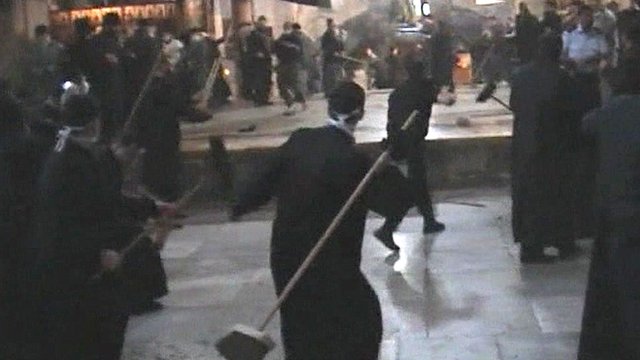
Minus the isolated incidents of course, although that little snafu that occurred at the Church of the Holy Sepulchre even got my secularist eyebrows raised going “Huh?! Really?! This isn’t a joke right?” 😉
 
Well you have to admit it was a rather odd statement coming from someone who is regarded as a ecumaniac by many of his fellow Orthodox.
I don’t think so. While it’s nothing to me either way, in the sense that I am not in communion with him or his detractors, but I would say it is evidence that he is not an ecumeniac after all.
 
Minus the isolated incidents of course, although that little snafu that occurred at the Church of the Holy Sepulchre even got my secularist eyebrows raised going “Huh?! Really?! This isn’t a joke right?” 😉
:slapfight: :crutches: :stretcher: :slapfight: :crutches: :stretcher:

Break out the brooms !

 
Minus the isolated incidents of course, although that little snafu that occurred at the Church of the Holy Sepulchre even got my secularist eyebrows raised going “Huh?! Really?! This isn’t a joke right?” 😉
That is an ongoing shame to all churches (also when the Copts and the Ethiopians fight over Deir el-Sultan, which is also in the area…that makes even less sense). Just as I would say never to let anyone tell you that the divisions are only or even primarily a result of ego, I would also say that no one should ever say that there isn’t a whole heaping helping of ego involved. Lord have mercy.
 
Well, the thing about Orthodoxy (to tie it back to the major argument that has gone on in the “Can EC receive with serious sin?” thread) is that it can’t really be divided that way. There’s no single point that would override the heterodoxy of existing RCC beliefs which separate it from Orthodoxy, so the fact that the EO and the RCC share Chalcedonian Christology is less unifying than the competing fact that they don’t really share much else. Whereas, in the case of the OO, there are recognized basic commonalities that, while also not overriding the lack of shared Christology, place the two churches (OO and EO) in a much better position to see one in the life of the other, which is really a prerequisite for any talk of unification (see the EP’s address at Georgetown entitled “Phos Hilarion”…almost as if they want to illustrate the EP’s point, many Catholics say they haven’t the foggiest idea what the EP is getting at in this address; for the Orthodox, that’s not terribly surprising).
?? The Orientals deny an Ecumenical Council! That is why I did not explore my local Coptic church despite my holding to a Miaphysite Christology. Recognizing that Chalcedon is equivalent is important to me, even though I think its definition is a bit wrongheaded, since it avoids scandal and disunity. IMO the same goes for the Filioque, which can and has indeed led to more problems than has presented practically for the Oriental rejection of Chalcedon, but was valid in its original intent as not meaning the same role for procession in regards to the Father and Son.
 
What are you exclaiming things at me for? You can go be a fake miaphysite at any church you choose. I can hardly be bothered to be upset that someone comes out of the woodwork to announce that they don’t favor the Copts. Go be whatever you want, wherever you want. That doesn’t change the reality of the relationship between the EO and OO vis-a-vis the relationship of either to the Latins, which is what my post you quoted is about. Nobody brought up the supposed equivalency of Chalcedon but you, and obviously since the non-Chalcedonians don’t recognize it as an ecumenical council, quoting it at me as though it is self-evident and ought to be law in the non-Chalcedonian communion, too, is frankly just nonsense. Literally, it makes no sense. Miaphysitism with acceptance of Chalcedon makes no sense, because it is by the Orthodox faith of St. Cyril of Alexandria that the non-Chalcedonians came to reject the definition of the council in the first place. Resolve your own internal contradictions and cognitive dissonance rather than typing things at me that have nothing to do with what I posted.
 
I was just about to respond to this,
?? The Orientals deny an Ecumenical Council! That is why I did not explore my local Coptic church despite my holding to a Miaphysite Christology. Recognizing that Chalcedon is equivalent is important to me, even though I think its definition is a bit wrongheaded, since it avoids scandal and disunity. IMO the same goes for the Filioque, which can and has indeed led to more problems than has presented practically for the Oriental rejection of Chalcedon, but was valid in its original intent as not meaning the same role for procession in regards to the Father and Son.
when I got called away.

I think I was going to say something like "It’s true that OOs and EOs disagree on the number of ecumenical councils (3 vs 7); but then again, EOs and Catholics disagree on the number of ecumenical councils too (7 vs 21).
 
Status
Not open for further replies.
Back
Top