The Church chose the Biblical canon infallibly?

  • Thread starter Thread starter Kullervo
  • Start date Start date
Status
Not open for further replies.
K

Kullervo

Guest
How do we know the Church chose the Biblical Canon infallibly, if the idea of infallibility of the Church comes from the “binding and loosing” passage in the Gospel of Matthew. Thanks for answers!

 
It doesn’t just come from that passage. We can also see, 1 Tim 3:15, which says that the Church is the Pillar and Foundation of the truth.

That means that the Church will always uphold the truth. Obviously, if the Church has chosen a book of the Bible, which does not contain the truth, it would not be upholding the truth.

Then there’s Eph 3:10, which says that the Church will teach the Wisdom of God eternally.

Again, if the Church picked the wrong book and it does not contain the Wisdom of God, but contains errors, this would be proven false.

Then there are the verses which say that Jesus is always with the Church and that the Holy Spirit will guide the Church into all truth. And I’m sure there are others. But those are the one’s that come to mind, right now.

I hope that helps.
 
Unfortunately, quoting other verses has the same problem.

How can we know the Church chose the Canon infallibly if we base this off passages from the Canon?

OP, is that a fair restating of your question?
 
How do we know the Church chose the Biblical Canon infallibly, if the idea of infallibility of the Church comes from the “binding and loosing” passage in the Gospel of Matthew. Thanks for answers!
The idea of infallibility does not come from the bible but this idea is revealed in the bible. The written always comes after the idea and not everything was written.

Peace!!!
 
Last edited:
The authority of the Church to determine the canon of scripture is the same authority of the Church to define Dogma. It has had that authority since Christ founded it.
 
The Church has only ever infallibly defined which books are Canon.
It has never infallibly said which books are not Canon. Thus there is some question regarding some books that have either been in the Vulgate through the centuries or were accepted in the east but not the west. In the pre Challoner Douay Rheims when there were many more annotations,( and 3 and 4 Esdras and the Prayer of Manasseh were in the appendix of the Old Testament) Cardinal Allen said this.

True it is that some of these books … were sometimes doubted of by some Catholics, and called Apocrypha, in that sense as the word properly signifieth hidden, or not apparent. So St. Jerome (in his prologue before the Latin Bible) calleth divers books Apocryphal, being not so evident, whether they were Divine Scripture, because they were not in the Jews’ Canon, nor at first in the Church’s Canon, but were never rejected as false or erroneous. In which sense the Prayers of Manasses, the third book of Esdras, and the third of Machabees are yet called Apocryphal. As for the fourth of Esdras, and the fourth of Machabees there is more doubt.
In other words, it is possible other books are scripture which have not been infallibly defined as such by the Church.
 
Last edited:
Thanks! It’s a bit circular reasoning quoting Bible verses that confirm that they are true, but on the other hand it’s more evidence for the claim of infallibility, so yeah it helps a lot. I think this answer settles it for me.
I
The authority of the Church to determine the canon of scripture is the same authority of the Church to define Dogma. It has had that authority since Christ founded it.
 
Yes. It’s a bit circular reasoning, but it’s additional sources which bring us closer to the conclusion. I think this quote settles it for me.
The authority of the Church to determine the canon of scripture is the same authority of the Church to define Dogma. It has had that authority since Christ founded it.
 
Yeah a little bit, on the other hand it’s more proof that not only the Gospel of Matthew talks about, but sources too. I think this post settles the question for me:
The authority of the Church to determine the canon of scripture is the same authority of the Church to define Dogma. It has had that authority since Christ founded it.
 
Which books were chosen is explained here.

 
not only the Gospel of Matthew
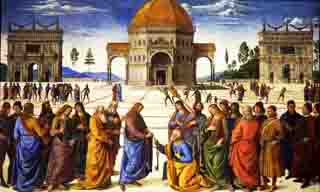
Saint Peter

Luke 22:29-32
“ ‘… and I assign to you, as my Father assigned to me, a kingdom, that you may eat and drink at my table in my kingdom, and sit on thrones judging the twelve tribes of Israel. Simon, Simon, behold, Satan demanded to have
you(plural in Greek),
that he might sift
you(plural in Greek)
like wheat, but I have prayed for
you (singular in Greek)
that
your (singularin Greek)
faith may not fail; and when
you(singular in Greek)
have turned again, strengthen
your(singular in Greek)
brethren.’ ” RSV (emphasis added in parenthesis to clarify the Greek text.)

The King James version retains the meaning of the original Greek where Satan had demanded to have “you -plural,” - meaning all of the disciples - but Christ says that He prayed for “you -singular” meaning Peter uniquely.

Luke 22:31-32
“And the Lord said, Simon, Simon, behold, Satan hath desired to haveyou, that he may sift you as wheat: But I have prayed for thee, that thyfaith fail not: and when thou art converted, strengthen thybrethren.” KJV

Christ only started one Church. And He built that Church on Saint Peter.

See more at


When I get to the end of another thread on 153 fish I will show how to use John 21

John
 
Last edited:
Actually no, it doesn’t come from Matthew 16. Right chapter - wrong book. A hint is given at John 16, wherein our Lord teaches:
John 16:13
When the Spirit of truth comes, he will guide you into all the truth ; for he will not speak on his own authority, but whatever he hears he will speak, and he will declare to you the things that are to come.
More importantly, why does this question arise?
 
Last edited:
Unfortunately, quoting other verses has the same problem.

How can we know the Church chose the Canon infallibly if we base this off passages from the Canon?
Lol! Catholics don’t go by Scripture alone. We actually don’t need Scripture to tell us that the Catholic Church is infallible. We know it because we believe the Sacred Traditions of Jesus Christ passed down by the Catholic Church through the centuries. One of those is the Bible. But that’s only one.

And, in fact, I personally did not need Scripture to tell me that the Catholic Church is infallible. When I came back into the Catholic Church, I didn’t trust Scripture because I couldn’t make heads or tails of it.
 
How does my response warrant a lol? I never claimed the Church uses Scripture alone.
But you claimed that I did when you insinuated that I was using circular reasoning. You claimed that a Catholic, myself, arrived at that conclusion based merely upon that which is written in Scripture. Whereas, I was using Scripture because that is what the OP used in his question and I assumed he was asking for more.
How do we know the Church chose the Biblical Canon infallibly, if the idea of infallibility of the Church comes from the “binding and loosing” passage in the Gospel of Matthew. Thanks for answers!
Notice, he said, “if it comes from the binding and loosing passage”. Well, there’s more than just a binding and loosing passage in Scripture. There are also the ones’ I mentioned.
 
Don’t feel bad, all! I haven’t understood anything anyone has said and I’m not sure I grasp the subject matter…
 
Status
Not open for further replies.
Back
Top