(Continued)
As for the Holy Innocents, their feast is on May, with the station being Bethlehem. One version has them on May 18th, the other on May 9th.
We come to January 6th. The thing is, in most ancient liturgical books the Nativity of Jesus - usually the vigil before it - is the usually at the beginning of the year. (The practice of beginning with Advent comes from the Franks.)
The Armenian lectionary reflects the January 6th commemoration that was standard in the East by the late 4th century. The station for the vigil of “the Holy Epiphany” is “
the Place of the Shepherds” (where the people gather “at the tenth hour” - 4:00 PM) and the readings in general have a shepherd theme (Psalm 22/23 “The Lord is my shepherd”; Psalm 79/80 “Give ear, O Shepherd of Israel”; Luke 2:8-20 - describing the visit of the shepherds to the manger). Next the congregation moves to “the cave in Bethlehem” where you have eleven readings from the Old Testament (Genesis 1:28-3:20; Isaiah 7:10-17; Exodus 14:24-15;21; Micah 5:2-7; Proverbs 1:2-9; Isaiah 9:5b-7; Isaiah 11:1-9; Isaiah 35:3-8; Isaiah 40:10-17; Isaiah 42:1-8a; Daniel 3:1-90), followed by the main liturgy (Psalm 2; Titus 2:11-15; Psalm 109/110; Matthew 2:1-12).
The station of the actual feast itself is “at the Holy Martyrium” (the Church of the Holy Sepulchre), at dawn. The readings are mostly the same as that of the vigil save for the gospel (Psalm 2; Titus 2:11-15; Psalm 109/110; Matthew 1:18-25).
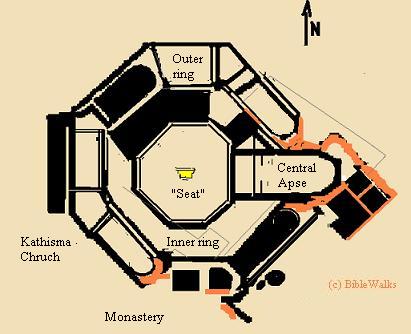
(Here you’d notice an important difference between the Armenian and the Georgian lectionaries. The Armenian keeps the January 6th date, but in the Georgian lectionary - dating from around a couple of centuries later - the feast is now in December 25th. Also note that by the time of the Georgian lectionary, August 15th already became the feast of the Dormition, with the station being in Gethsamane; the feast of Mary’s
kathisma was moved two days earlier.)
This is how the pilgrim Egeria describes the event as held in Jerusalem during the 380s, a few decades earlier than the old Armenian lectionary:
… ‘Blessed is he that cometh in the Name of the Lord,’ and the rest which follows. And since, on account of the monks who go on foot, it is necessary to proceed more gently, they arrive in Jerusalem about the hour when one man begins to recognise another, i.e., near daylight, but before the day has fully broken. When they have arrived, straightway the bishop and all with him enter the Anastasis = The tomb of Jesus] where the lights are now superfluously shining. There one psalm is sung, prayer is offered, and first the catechumens, then the faithful, are blessed by the bishop. The bishop then departs, and everyone goes to his lodging to recruit. But the monks stay there, and sing hymns until daylight.
And when the crowd is refreshed, at the beginning of the second hour = 8:00 AM], they all assemble at the Great Church, i.e., in Golgotha. It is unnecessary to describe the decoration on that day of the Church, of the Anastasis, or of the Cross, or the Church at Bethlehem; you can see nothing but gold and gems and silk. If you look at the veils, they are of silk, studded with gold; if you look at the curtains, they are likewise all of silk, studded with gold. All the gold and jewelled vessels are brought out on that day. As to the number or weight of the tapers or candles or lamps or different vessels, how could it be estimated or described? And what shall I say of the decoration of that structure which Constantine, with the assistance of his mother, adorned, as far as the resources of his kingdom would go, with gold, mosaic, and precious marbles – a larger church than the Anastasis or the Church at the Cross or any of the holy places in Jerusalem?
But to return. On the first day Mass is celebrated in the Great Church in Golgotha. And whether they preach or read the several lections or say hymns, everything is appropriate to the day. And thence, when Mass has been celebrated at the church, they go to the Anastasis with hymns according to custom; and Mass is held about the sixth hour. On this day vespers are said as usual, after the daily custom.
That the Nativity was commemorated at this time on January 6th in Jerusalem meant that the Circumcision was commemorated on January 13th and that the Presentation was on February 14th/15th. Here’s the interesting thing. For December 25th, the lectionary gives the feasts “Of James = the ‘brother’ of Jesus] and of [King] David,” with the station being given as “at
Holy Sion.” At the same time, however, the lectionary does note that “During this day, in other cities, they celebrate the Nativity of Christ.” So the lectionary already shows awareness of areas where the Nativity is held on December 25th, although it itself has it on January 6th.
That’s all from me.

 (I’m aware my reply isn’t full here. I’ll elaborate when I have more time, which unfortunately is not now.)
 And the sentence before that where Clement claims that Jesus was born “a hundred and ninety-four years, one month, thirteen days” before the death of Commodus," which would give you a November 18th, 3 BC date. All in all, Clement gives three different dates on that passage.
 As I noted, it essentially preserves the tradition of liturgical usage in 4th-5th century Jerusalem (our earliest manuscripts of them come from the early 5th century). (Not) surprisingly, the readings correspond almost exactly with the ones known to St. Cyril of Jerusalem (ca. 313-386). In fact, Armenian tradition believed that the lectionary was first prepared by St. James the ‘brother’ of Jesus and the first bishop of Jerusalem in the 1st century and was completed by Cyril four centuries later. (Another lectionary which preserves the Jerusalem tradition