The dates we celebrate Christmas and Easter

  • Thread starter Thread starter StuMondo
  • Start date Start date
Status
Not open for further replies.
That information is entirely false. Though conspiracy theories are wonderful things.

I assume you read Macrobius rather than just googling until you found a site which contains information you would like to contain some shred of truth, sorry I mean until you found a site which contains information that is agreeable to your world-view.

As I said, none of this false information arose until the Puritans of the 1600s suddenly became obsessed with discrediting the Catholic Church, and they did this in the most ingenious way, they invented falsehoods that could not be validated from history, that the Catholic Church had paganized itself. Result was as expected, unfortunately the future consequence of attempting to discredit the Catholic Church was that they unwittingly also gave opportunity to discredit the birth of Jesus Christ. By calling that into question which is also the birth of Chritianity itself, it has then back-fired.
The information was from a Jewish perspective and a Jewish site, not a Protestant or “Puritan” one.
 
The information was from a Jewish perspective and a Jewish site, not a Protestant or “Puritan” one.
They have just borrowed the puritan arguments (as I have said many times before), just like everyone else does, because it would also suit their world-view.
 
A Christian POV on the date for Christmas:
“The fact is that people have been celebrating Christmas, long before the birth of Christ. The festivity was known then, as Saturnalia. Saturnalia was a festival in which the Romans commemorated the dedication of the temple of the god Saturn. As winter approached, they were losing harvest & were in need of the sun in order for their harvest to grow & bear fruit. Saturn was the Roman god of agriculture and harvest.
This meant that the god Saturn was in need of the sun god in order to complete his job, therefore the attention was then shifted to the sun god.”
“In the 4th century The Roman Catholic Church adopted the Saturnalia festival hoping to take the pagan masses in with it. Chatolic leaders succeeded in converting to “Christianity” large numbers of pagans by promising them that they could continue to celebrate their Saturnalia as “Christmas”.Christians had little success, however, refining the practices of Saturnalia. As Stephen Nissenbaum, professor history at the University of Massachussetts, Amherst, writes, “In return for ensuring massive observance of the anniversary of the Savior’s birth by assigning it to this resonant date, the Church for its part tacitly agreed to allow the holiday to be celebrated more or less the way it had always been.””
“In pre-Christian Rome, the emperors compelled their most despised citizens to bring offerings and gifts during the Saturnalia (in December) and Kalends (in January). Later, this ritual expanded to include gift-giving among the general populace. The Catholic Church gave this custom a Christian flavor by re-rooting it in the supposed gift-giving of Saint Nicholas.”
thetruthandlight.wordpress.com/2008/12/25/saturnalia-the-real-roots-of-christmas/
 
A Christian POV on the date for Christmas:
“The fact is that people have been celebrating Christmas, long before the birth of Christ. The festivity was known then, as Saturnalia. Saturnalia was a festival in which the Romans commemorated the dedication of the temple of the god Saturn. As winter approached, they were losing harvest & were in need of the sun in order for their harvest to grow & bear fruit. Saturn was the Roman god of agriculture and harvest.
This meant that the god Saturn was in need of the sun god in order to complete his job, therefore the attention was then shifted to the sun god.”
“In the 4th century The Roman Catholic Church adopted the Saturnalia festival hoping to take the pagan masses in with it. Chatolic leaders succeeded in converting to “Christianity” large numbers of pagans by promising them that they could continue to celebrate their Saturnalia as “Christmas”.Christians had little success, however, refining the practices of Saturnalia. As Stephen Nissenbaum, professor history at the University of Massachussetts, Amherst, writes, “In return for ensuring massive observance of the anniversary of the Savior’s birth by assigning it to this resonant date, the Church for its part tacitly agreed to allow the holiday to be celebrated more or less the way it had always been.””
“In pre-Christian Rome, the emperors compelled their most despised citizens to bring offerings and gifts during the Saturnalia (in December) and Kalends (in January). Later, this ritual expanded to include gift-giving among the general populace. The Catholic Church gave this custom a Christian flavor by re-rooting it in the supposed gift-giving of Saint Nicholas.”
You can keep doing this all day my friend, but that doesn’t make it truth, it just makes in a puritan invention of the 1600s.

Have you read Macrobius? Do that instead of believing everything you hear on the internet.
 
You can keep doing this all day my friend, but that doesn’t make it truth, it just makes in a puritan invention of the 1600s.
I think it goes back before 1600.
Saturnalia was the ancient Roman festival of light in honor of Saturn, and led to the winter solstice. The renewal of light and the coming of the new year was celebrated in the Roman Empire at the Dies Natalis of Sol Invictus, the “Birthday of the Unconquerable Sun,” on December 25. According to Cyprian, “De pasch. Comp.”, xix, “O quam præclare providentia ut illo die quo natus est Sol . . . nasceretur Christus.” And according to Chrysostom, “del Solst. Et Æquin.” (II, p. 118, ed. 1588), says: “Sed et dominus noster nascitur mense decembris . . . VIII Kal. Ian. . . . Sed et Invicti Natalem appelant. Quis utique tam invictus nisi dominus noster? . . . Vel quod dicant Solis esse natalem, ipse est Sol iustitiæ.”
Cyprian: about 250 AD
Chrysostom: about 400 AD
 
jimmyakin.com/wp-content/uploads/nativity2-300x239.jpgWas Jesus really born on December 25th?

You’ll find strong opinions on both sides of this question, with some saying definitely yes and some saying definitely no.

I don’t have strong feelings on this question. Although the Church today liturgically celebrates the birth of Our Lord on December 25th, whether this is the exact date of his birth is a question that the Magisterium has not settled. I would be fascinated if it turned out he was born on this date, but it would not upset me if it turned out he wasn’t.

The important thing is that he**was* born!

Over time, I want to look at some of the arguments (good and bad) about the day of Christ’s birth, and I’ll use this page to keep track of those posts, since the subject is too broad to be dealt with in a single, initial post.

Oh, and before we begin, a note for those who wonder if I’ve seen the**Star of Bethlehem* documentary (I get asked about this regularly when I talk about Christmas). Yes, I’ve seen it. It has both positive and negative aspects. Some of the things it argues are correct, but not everything it says is perfectly argued. I’ll try to deal with it in the fullness of time.

Here goes . . .

How the accounts of Jesus’ childhood fit together: 6 things to know and share

Here I argue that, despite claims to the contrary, the infancy narratives in Matthew and Luke do not contradict each other. Instead, they fit together amazingly well.

Does St. Luke contradict himself on when Jesus was born?

Here I deal with an alleged contradiction between Luke’s statements that Jesus was born during the reign of Herod the Great, given the connection he makes to the enrollment of Quirinius.

Was the Star of Bethlehem a myth? A UFO? Or something else?

Here I argue that the Star of Bethlehem could have been an ordinary, if uncommon, astronomical phenomenon and that we need not suppose that it was a myth or something preternaturally strange.

Responding to the “Go To” Skeptic on the Star of Bethlehem

Here I respond to arguments posed by Dr. Aaron Adair, a skeptic who thinks that the way Matthew describes the Star of Bethlehem aren’t consistent with ordinary astronomical phenomena.

Is the “integral age” theory an apologetics myth?

Here I look at the claim that the date of Christmas and the Annunciation were determined by an alleged Jewish belief that prophets live in whole year units. In it, I point out the lack of clear evidence for this and ask for further help researching the idea.

“Integral Age” update!

Here I record the results of further research that I was able to do with the help of various individuals who responded to the above post. Conclusion: The*most that can safely be claimed is thatsomeJewish sages fromapproximatelythis period in history had the idea thatsomeholy men (at least Moses) lived in whole year units and thismay or may nothave played a role in the thinking of early Christians in fixing certain feast days.

Do sheep prove that Jesus wasn’t born on December 25th?

feeds.feedburner.com/~ff/jimmyakin/HPRf?d=yIl2AUoC8zA
http://feeds.feedburner.com/~r/jimmyakin/HPRf/~4/MHH8MWj8q3w

More…
 
In John 1:2, immediately after establishing the Word, and His origin, His source, he then ventures into the birth of Jesus Christ in this way.

In him was life, and the life was the light of men. The light shines in the darkness, and the darkness has not overcome it. There was a man sent from God, whose name was John. He came for testimony, to bear witness to the light, that all might believe through him, he was not the light, but came to bear witness to the light. The true light that enlightens every man was coming into the world, and the world was made through him, yet the world knew him not.

Festival of lights would be the first thing that a Jewish reader would draw from this writing of John, and the marvel of John, is that is probably what he was referencing. The birth of Jesus was in this way.
 
Just this post, and I’ll really be off this thread. If you have anything else, PM me, okay? 🙂 (I’m aware my reply isn’t full here. I’ll elaborate when I have more time, which unfortunately is not now.)
Did they follow the Jewish Calendar? The concept of Epiphany can be confused to either mean the manifestation of his birth, or the manifestation to the Gentiles. So if there were to be a misunderstanding,
That’s the point really. The Christians who celebrated Jesus’ birth on January 6th celebrated pretty much all the events of Jesus’ early life on that date, particularly the ones that are considered to be His ‘manifestations’ - His birth, His baptism, the miracle at Cana. (That’s what Armenians still do today.) You might say that this is even symbolism at play, since we believe that baptism is a new birth.

The January 6th date is probably be based on a literal reading of Luke 3:23 (“Jesus, when he began his ministry, was about thirty years of age”). They thought, if Jesus was about thirty at His baptism, hey, He must have been baptized on His birthday.
If we take out the dates that exclude the Baptism and Passion we are left with the above. 25th of Pachon is the 25th of the 9th month of the Egyptian calendar, what it equates to in our calendar is not important. It is the 25th of the 9th month of the Egyptian calendar.
Now consider that the 25th of the 9th month of the Jewish calendar is 25th of Chislev, see what they did there?
You’ve skipped the Parmuthi date. 😛 And the sentence before that where Clement claims that Jesus was born “a hundred and ninety-four years, one month, thirteen days” before the death of Commodus," which would give you a November 18th, 3 BC date. All in all, Clement gives three different dates on that passage.
No offense, but do you?
Well, what do you think? :cool:
More special than Hanukkah? There is one question that one must ask oneself. Does God work in random ways, or does God work in planned ways. One would represent a God of chaos, the second would represent a God of order, revealing his intentions and plans through signs and wonders.
I don’t think it necessarily has to be black and white as you’re implying. And you may not agree with me, but I could apply the same rationale to claims of Jesus being born on Pentecost or on Passover - these two dates would fit to the Jewish beliefs about Isaac - or on a Wednesday (= the day God supposedly created the sun). I might even apply it to the January 6th date - hey, wouldn’t it be nice to think the two occasions when Jesus was ‘manifested’ to mankind historically occur on the same day?

Even if we suppose that as you claim the December 25th date was indeed based on Hanukkah, it still is not an automatic guarantee that Jesus was actually historically born on that date - only that early Christians (or at least, a segment of early Christians) thought that it is a good day for Him to be born in, what with the symbolism and everything.

(An aside - I recommend you read this. I mentioned the May 18th feast of the Holy Innocents from medieval Armenian lectionaries, right? Those Armenian lectionaries reflect the practice of late 4th-5th century Jerusalem. Those lectionaries do heavily imply that Jesus’ birthday was celebrated on January 6th at that time in Jerusalem as in most of the East - which would fit in with Egeria’s testimony, but the Holy Innocents date is a bit odd, since they are usually commemorated on or near the date when the Nativity is commemorated. That’s why most of us right now commemorate them on either December 27th or the 28th or the 29th, well within the octave of December 25th. And we have indication that once they were also commemorated on the original Eastern date of January 6th.

This is where August 15th, another ancient feast from Jerusalem, comes in. We now celebrate the Assumption/Dormition on this date, but it’s unlikely that that was the original commemoration - the only thing that did not change is that it was, then and now, a feast of Our Lady. And guess what? As per the aforementioned Armenian lectionaries - where the feast is simply given as “Of Mary the Theotokos” - the gospel for this day is that of the Nativity (Luke 2:1-7), and the station (the place/church where the congregation gathers) is given as “at the second mile from Bethlehem” or “at third milestone from Jerusalem.” All these elements could point to August 15th actually originally being a Jerusalem commemoration of the Incarnation/Annunciation (fits the description well enough: ‘Mary the Mother of God’), which would mean that the original celebration of Jesus’ birth in Jerusalem (before the January 6th date was adopted) was around May 15th, just three days before the Holy Innocents.

And what does the Book of Jubilees say?

And in the middle of the sixth month (Elul = August/September) the Lord visited Sarah and did unto her as He had spoken and she conceived. And she bare a son in the third month (Sivan = May/June), and in the middle of the month, at the time of which the Lord had spoken to Abraham, on the festival of the first fruits of the harvest, Isaac was born.

You might say this could be coincidental, and it very well could, but for the fact (1) that early Christians did know of Jubilees and held it in high regard, and (2) just like I have been saying, the fact that Isaac is seen as a type of Christ could have influenced the institution of these feasts. Not to mention that the stational church (two-three miles from Bethlehem) commemorates the supposed the site of Mary’s short rest (kathisma) before she gave birth to Jesus, already a tradition found in the Protoevangelium of James. All signs point to the feast originally being connected with the Nativity.
 
I’ll eat my words just to expand on the old Armenian lectionary a little bit. 😊 As I noted, it essentially preserves the tradition of liturgical usage in 4th-5th century Jerusalem (our earliest manuscripts of them come from the early 5th century). (Not) surprisingly, the readings correspond almost exactly with the ones known to St. Cyril of Jerusalem (ca. 313-386). In fact, Armenian tradition believed that the lectionary was first prepared by St. James the ‘brother’ of Jesus and the first bishop of Jerusalem in the 1st century and was completed by Cyril four centuries later. (Another lectionary which preserves the Jerusalem tradition is the Georgian one.)

For August 15th you have the following entry:

15 August. Of Mary the Theotokos, at the second mile from Bethlehem, and this canon is performed:

Psalm 131, antiphon: Rise up, Lord, from Your rest, You and the ark of Your holiness! [131.8 LXX; 132.8 NRSV]
Reading from the Prophet Isaiah [7.10-16a]
Reading from the Letter of the Apostle Paul to the Galatians [3.29-4.7]
Alleluia, Psalm 109 [110.1-7]
Gospel according to Luke [2.1-7]

You would notice that the readings for this feast are Incarnation/Nativity-centered. There’s the birth narrative from Luke, the prophecy from Isaiah (“A virgin will conceive and bear a son…”), Psalm 109/110 (incidentally, this is also a Psalm that was used for the midnight Christmas Mass in the old Roman Rite), and the passage from Galatians containing St. Paul’s famous statement of God sending His son “born of woman, born under the law” (4:4-5).

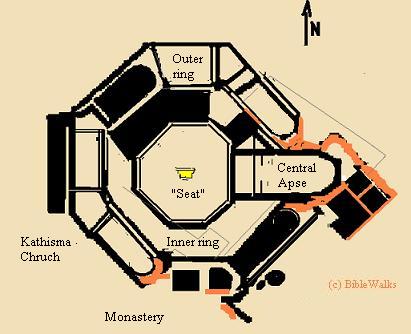
“The second mile from Bethlehem” refers to the Church of the Kathisma (aka the Church of Mary’s Seat), located halfway on the road between Jerusalem and Bethlehem. Tradition has it that the site is built on the site where a pregnant Mary took a short rest before she and Joseph arrived at Bethlehem (which explains the antiphon: “Rise up, O Lord, from your rest, you and the ark of your holiness” - this same antiphon was used in Jerusalem for the commemoration of the Ark of the Covenant in July 2nd); at the center of the church (it no longer stands BTW; in fact it was only recently excavated) there was a rock, which is believed to have been where Mary sat to rest.


The kathisma or the ‘seat’ where Mary is said to have rested. The site where the church once stood is frankly, not in a very good condition nowadays.

This tradition, as I noted earlier, is already found in the Protoevangelium of James (17.1-3).

And there was an order from the Emperor Augustus, that all in Bethlehem of Judaea should be enrolled. (Luke 2:1) And Joseph said: I shall enrol my sons, but what shall I do with this maiden? How shall I enrol her? As my wife? I am ashamed. As my daughter then? But all the sons of Israel know that she is not my daughter. The day of the Lord shall itself bring it to pass as the Lord will. And he saddled the ***, and set her upon it; and his son led it, and Joseph followed. **And when they had come within three miles, Joseph turned and saw her sorrowful; and he said to himself: Likely that which is in her distresses her. And again Joseph turned and saw her laughing. And he said to her: Mary, how is it that I see in your face at one time laughter, at another sorrow? And Mary said to Joseph: Because I see two peoples with my eyes; the one weeping and lamenting, and the other rejoicing and exulting. And they came into the middle of the road, and Mary said to him: Take me down from off the *, for that which is in me presses to come forth. And he took her down from off the ***, and said to her: Whither shall I lead you, and cover your disgrace? For the place is desert.
 
(Continued)

As for the Holy Innocents, their feast is on May, with the station being Bethlehem. One version has them on May 18th, the other on May 9th.

We come to January 6th. The thing is, in most ancient liturgical books the Nativity of Jesus - usually the vigil before it - is the usually at the beginning of the year. (The practice of beginning with Advent comes from the Franks.)

The Armenian lectionary reflects the January 6th commemoration that was standard in the East by the late 4th century. The station for the vigil of “the Holy Epiphany” is “the Place of the Shepherds” (where the people gather “at the tenth hour” - 4:00 PM) and the readings in general have a shepherd theme (Psalm 22/23 “The Lord is my shepherd”; Psalm 79/80 “Give ear, O Shepherd of Israel”; Luke 2:8-20 - describing the visit of the shepherds to the manger). Next the congregation moves to “the cave in Bethlehem” where you have eleven readings from the Old Testament (Genesis 1:28-3:20; Isaiah 7:10-17; Exodus 14:24-15;21; Micah 5:2-7; Proverbs 1:2-9; Isaiah 9:5b-7; Isaiah 11:1-9; Isaiah 35:3-8; Isaiah 40:10-17; Isaiah 42:1-8a; Daniel 3:1-90), followed by the main liturgy (Psalm 2; Titus 2:11-15; Psalm 109/110; Matthew 2:1-12).

The station of the actual feast itself is “at the Holy Martyrium” (the Church of the Holy Sepulchre), at dawn. The readings are mostly the same as that of the vigil save for the gospel (Psalm 2; Titus 2:11-15; Psalm 109/110; Matthew 1:18-25).

(Here you’d notice an important difference between the Armenian and the Georgian lectionaries. The Armenian keeps the January 6th date, but in the Georgian lectionary - dating from around a couple of centuries later - the feast is now in December 25th. Also note that by the time of the Georgian lectionary, August 15th already became the feast of the Dormition, with the station being in Gethsamane; the feast of Mary’s kathisma was moved two days earlier.)

This is how the pilgrim Egeria describes the event as held in Jerusalem during the 380s, a few decades earlier than the old Armenian lectionary:

… ‘Blessed is he that cometh in the Name of the Lord,’ and the rest which follows. And since, on account of the monks who go on foot, it is necessary to proceed more gently, they arrive in Jerusalem about the hour when one man begins to recognise another, i.e., near daylight, but before the day has fully broken. When they have arrived, straightway the bishop and all with him enter the Anastasis = The tomb of Jesus] where the lights are now superfluously shining. There one psalm is sung, prayer is offered, and first the catechumens, then the faithful, are blessed by the bishop. The bishop then departs, and everyone goes to his lodging to recruit. But the monks stay there, and sing hymns until daylight.

And when the crowd is refreshed, at the beginning of the second hour = 8:00 AM], they all assemble at the Great Church, i.e., in Golgotha. It is unnecessary to describe the decoration on that day of the Church, of the Anastasis, or of the Cross, or the Church at Bethlehem; you can see nothing but gold and gems and silk. If you look at the veils, they are of silk, studded with gold; if you look at the curtains, they are likewise all of silk, studded with gold. All the gold and jewelled vessels are brought out on that day. As to the number or weight of the tapers or candles or lamps or different vessels, how could it be estimated or described? And what shall I say of the decoration of that structure which Constantine, with the assistance of his mother, adorned, as far as the resources of his kingdom would go, with gold, mosaic, and precious marbles – a larger church than the Anastasis or the Church at the Cross or any of the holy places in Jerusalem?

But to return. On the first day Mass is celebrated in the Great Church in Golgotha. And whether they preach or read the several lections or say hymns, everything is appropriate to the day. And thence, when Mass has been celebrated at the church, they go to the Anastasis with hymns according to custom; and Mass is held about the sixth hour. On this day vespers are said as usual, after the daily custom.

That the Nativity was commemorated at this time on January 6th in Jerusalem meant that the Circumcision was commemorated on January 13th and that the Presentation was on February 14th/15th. Here’s the interesting thing. For December 25th, the lectionary gives the feasts “Of James = the ‘brother’ of Jesus] and of [King] David,” with the station being given as “at Holy Sion.” At the same time, however, the lectionary does note that “During this day, in other cities, they celebrate the Nativity of Christ.” So the lectionary already shows awareness of areas where the Nativity is held on December 25th, although it itself has it on January 6th.

That’s all from me.

 
(Continued)

As for the Holy Innocents, their feast is on May, with the station being Bethlehem. One version has them on May 18th, the other on May 9th.

We come to January 6th. The thing is, in most ancient liturgical books the Nativity of Jesus - usually the vigil before it - is the usually at the beginning of the year. (The practice of beginning with Advent comes from the Franks.)

The Armenian lectionary reflects the January 6th commemoration that was standard in the East by the late 4th century. The station for the vigil of “the Holy Epiphany” is “the Place of the Shepherds” (where the people gather “at the tenth hour” - 4:00 PM) and the readings in general have a shepherd theme (Psalm 22/23 “The Lord is my shepherd”; Psalm 79/80 “Give ear, O Shepherd of Israel”; Luke 2:8-20 - describing the visit of the shepherds to the manger). Next the congregation moves to “the cave in Bethlehem” where you have eleven readings from the Old Testament (Genesis 1:28-3:20; Isaiah 7:10-17; Exodus 14:24-15;21; Micah 5:2-7; Proverbs 1:2-9; Isaiah 9:5b-7; Isaiah 11:1-9; Isaiah 35:3-8; Isaiah 40:10-17; Isaiah 42:1-8a; Daniel 3:1-90), followed by the main liturgy (Psalm 2; Titus 2:11-15; Psalm 109/110; Matthew 2:1-12).

The station of the actual feast itself is “at the Holy Martyrium” (the Church of the Holy Sepulchre), at dawn. The readings are mostly the same as that of the vigil save for the gospel (Psalm 2; Titus 2:11-15; Psalm 109/110; Matthew 1:18-25).

(Here you’d notice an important difference between the Armenian and the Georgian lectionaries. The Armenian keeps the January 6th date, but in the Georgian lectionary - dating from around a couple of centuries later - the feast is now in December 25th. Also note that by the time of the Georgian lectionary, August 15th already became the feast of the Dormition, with the station being in Gethsamane; the feast of Mary’s kathisma was moved two days earlier.)

This is how the pilgrim Egeria describes the event as held in Jerusalem during the 380s, a few decades earlier than the old Armenian lectionary:

… ‘Blessed is he that cometh in the Name of the Lord,’ and the rest which follows. And since, on account of the monks who go on foot, it is necessary to proceed more gently, they arrive in Jerusalem about the hour when one man begins to recognise another, i.e., near daylight, but before the day has fully broken. When they have arrived, straightway the bishop and all with him enter the Anastasis = The tomb of Jesus] where the lights are now superfluously shining. There one psalm is sung, prayer is offered, and first the catechumens, then the faithful, are blessed by the bishop. The bishop then departs, and everyone goes to his lodging to recruit. But the monks stay there, and sing hymns until daylight.

And when the crowd is refreshed, at the beginning of the second hour = 8:00 AM], they all assemble at the Great Church, i.e., in Golgotha. It is unnecessary to describe the decoration on that day of the Church, of the Anastasis, or of the Cross, or the Church at Bethlehem; you can see nothing but gold and gems and silk. If you look at the veils, they are of silk, studded with gold; if you look at the curtains, they are likewise all of silk, studded with gold. All the gold and jewelled vessels are brought out on that day. As to the number or weight of the tapers or candles or lamps or different vessels, how could it be estimated or described? And what shall I say of the decoration of that structure which Constantine, with the assistance of his mother, adorned, as far as the resources of his kingdom would go, with gold, mosaic, and precious marbles – a larger church than the Anastasis or the Church at the Cross or any of the holy places in Jerusalem?

But to return. On the first day Mass is celebrated in the Great Church in Golgotha. And whether they preach or read the several lections or say hymns, everything is appropriate to the day. And thence, when Mass has been celebrated at the church, they go to the Anastasis with hymns according to custom; and Mass is held about the sixth hour. On this day vespers are said as usual, after the daily custom.

That the Nativity was commemorated at this time on January 6th in Jerusalem meant that the Circumcision was commemorated on January 13th and that the Presentation was on February 14th/15th. Here’s the interesting thing. For December 25th, the lectionary gives the feasts “Of James = the ‘brother’ of Jesus] and of [King] David,” with the station being given as “at Holy Sion.” At the same time, however, the lectionary does note that “During this day, in other cities, they celebrate the Nativity of Christ.” So the lectionary already shows awareness of areas where the Nativity is held on December 25th, although it itself has it on January 6th.

That’s all from me.
I thought that January 7 on the Gregorian calendar currently corresponds to December 25 on the Julian calendar?
 
I thought that January 7 on the Gregorian calendar currently corresponds to December 25 on the Julian calendar?
Well, it’s a bit more complicated than that.

1.) You mean January 6th.

2.) Note that during the 5th century, nobody used the Gregorian calendar, because well, was not invented yet. So both the Christians who celebrated the Nativity on January 6th and those who celebrated it on December 25th were not really using calendars of the same level of difference as the Julian and the Gregorian.

3.) Yes, Gregorian January 7th does correspond with Julian December 25th, at least today, but it was not always the case. To sum, from 1582 up to February 28th, 1700 (all dates given are Gregorian) there was only a difference of 10 days between the Julian and the Gregorian calendars. From March 1st, 1700 up to February 28th, 1800 it became 11 days; by March 1st, 1800 up to February 28th, 1900, 12 days; and by March 1st, 1900 up to February 28th, 2100, 13 days. The difference will again increase by one day by the March 1st, 2100. In other words, the gap between the Gregorian and the Julian increases by three days every 400 years.

So in 1582 (when the Gregorian calendar was introduced), Gregorian January 7th, 1582 was actually Julian December 28th, 1581. Gregorian January 7th, 1701 was Julian December 27th, 1700; Gregorian January 7th, 1801 was Julian December 26th, 1800; and Gregorian January 7th, 1901 was Julian December 25th, 1900. By 2101, Gregorian January 7th will become Julian December 24th. (By the time you get to the year 4401, there’s already a thirty-one-day gap between the two calendars: Gregorian January 7th = Julian December 7th.)

Speaking of which, during the 5th century day between the Julian and the Gregorian calendars.one (I say ‘would have’, because as I said, there was no Gregorian calendar yet; we just use the Gregorian rules to reckon backward from October 15th, 1582.) By the time of the Chronography of 354 (our earliest source that explicitly lists December 25th as a celebration of the Nativity in Rome), Egeria’s pilgrimage to the Holy Land (381-384), and the Old Armenian Lectionary (dated to between AD 417 and AD 439), Julian January 6th was simply Gregorian January 7th, and Julian December 25th was Gregorian December 26th.
 
Here’s a little table I made.

Gregorian to Julian; Julian to Gregorian

Mar. 1st (Mar. 1st), 200-Feb. 28th (Feb. 28th), 300: Jan. 6th - Jan. 6th / Dec. 25th - Dec. 25th || Jan. 6th - Jan. 6th / Dec. 25th - Dec. 25th (0 days)
Mar. 1st (Mar. 2nd), 300-Feb. 28th (Mar. 1st), 500: Jan. 6th - Jan. 5th / Dec. 25th - Dec. 24th || Jan. 6th - Jan. 7th / Dec. 25th - Dec. 26th (1 day)

Mar. 1st (Mar. 3rd), 500-Feb. 28th (Mar. 2nd), 600: Jan. 6th - Jan. 4th / Dec. 25th - Dec. 23rd || Jan. 6th - Jan. 8th / Dec. 25th - Dec. 27th (2 days)
Mar. 1st (Mar. 4th), 600-Feb. 28th (Mar. 3rd), 700: Jan. 6th - Jan. 3rd / Dec. 25th - Dec. 22nd || Jan. 6th - Jan. 9th / Dec. 25th - Dec. 28th (3 days)
Mar. 1st (Mar. 5th), 700-Feb. 28th (Mar. 4th), 900: Jan. 6th - Jan. 2nd / Dec. 25th - Dec. 21st || Jan. 6th - Jan. 10th / Dec. 25th - Dec. 29th (4 days)

Mar. 1st (Mar. 6th), 900-Feb. 28th (Mar. 5th), 1000: Jan. 6th - Jan. 1st / Dec. 25th - Dec. 20th || Jan. 6th - Jan. 11th / Dec. 25th - Dec. 30th (5 days)
Mar. 1st (Mar. 7th), 1000-Feb. 28th (Mar. 6th), 1100: Jan. 6th - Dec. 31st / Dec. 25th - Dec. 19th || Jan. 6th - Jan. 12th / Dec. 25th - Dec. 31st (6 days)
Mar. 1st (Mar. 8th), 1100-Feb. 28th (Mar. 7th), 1300: Jan. 6th - Dec. 30th / Dec. 25th - Dec. 18th || Jan. 6th - Jan. 13th / Dec. 25th - Jan. 1st (7 days)

Mar. 1st, 1300 (Mar. 9th)-Feb. 28th (Mar. 8th), 1400: Jan. 6th - Dec. 29th / Dec. 25th - Dec. 17th || Jan. 6th - Jan. 14th / Dec. 25th - Jan. 2nd (8 days)
Mar. 1st (Mar. 10th), 1400-Feb. 28th (Mar. 9th), 1500: Jan. 6th - Dec. 28th / Dec. 25th - Dec. 16th || Jan. 6th - Jan. 15th / Dec. 25th - Jan. 3rd (9 days)
Mar. 1st (Mar. 11th), 1500-Feb. 18th (Feb. 28th), 1700: Jan. 6th - Dec. 27th / Dec. 25th - Dec. 15th || Jan. 6th - Jan. 16th / Dec. 25th - Jan. 4th (10 days)

Feb. 19th (Mar. 1st), 1700-Feb. 17th (Feb. 28th), 1800: Jan. 6th - Dec. 26th / Dec. 25th - Dec. 14th || Jan. 6th - Jan. 17th / Dec. 25th - Jan. 5th (11 days)
Feb. 18th (Mar. 1st), 1800-Feb. 16th (Feb. 28th), 1900: Jan. 6th - Dec. 25th / Dec. 25th - Dec. 13th || Jan. 6th - Jan. 18th / Dec. 25th - Jan. 6th (12 days)
Feb. 17th (Mar. 1st), 1900-Feb. 15th (Feb. 28th), 2100: Jan. 6th - Dec. 24th / Dec. 25th - Dec. 12th || Jan. 6th - Jan. 19th / Dec. 25th - Jan. 7th (13 days)
 
It’s amazing how many experts on sheep-herding practices and weather patterns in 1st century Palestine there are on the Internet. Every neo-Puritan and atheist writer who wants to write an article debunking a wintertime birth for the Savior feels compelled to include a tidbit that “it was too cold for the sheep to be out.”

The original source for the hoary old Protestant cliche that sheep could not be outside in the winter was an anti-Catholic writer named Alexander Hislop, a Free Church of Scotland minister whose book “The Two Babylons: Papal worship Proved to be the worship of Nimrod and His wife” (1853) is the source for a lot of modern claims that Catholicism is pagan in origin.

The Scottish winter, where Hislop (who was pretty much a nut) resided, is a whole lot harsher than winters around Bethlehem. I live on the same approximate latitude and altitude as Bethlehem, and the Navajo sheepherders here keep their sheep out all year 'round, as do the Bedouin sheepherders in present-day Bethlehem. The Navajo sheepherders, who face the same approximate weather as the sheepherders in 1st Century Palestine, do, in fact, keep their sheep out in the winter, and the shepherds stay with the sheep at night to prevent coyote attacks…which often come at dark. (There were canids in 1st century Palestine, as we know.) Yes, I have actually asked real, actual, bonafide Navajo shepherds about this.

Like Navajo shepherds, I would presume the shepherds around Bethlehem would have some shelters they could throw up quickly, or that might have been set up permanently in their grazing areas, like lean-tos or rock walls, to herd the sheep into if the winds got bad. In temperate climes, like the middle east, sheep are often kept outside year-around.

Shepherds also have access to lots and lots of nature’s best insulator, wool, As do their sheep. Wool continues to insulate and keep you warm even if it is soaking wet, a claim no modern space-age backpacking fabric can make. If you’d be okay going out on a cold night in a thick wool sweater, so would the sheep.

It’s also healthier for sheep in Mediterranean climates not to be kept inside in the winter. Sheep do quite well outside, and don’t like the dust that can build up inside standing barns. Keeping sheep inside in temperate coastal climes like Bethlehem is bad for the sheep’s feet, for their metabolic adjustment, and it aids in the spread of disease.

If you pen the sheep, you will also have to supply them with hay (which would have been in short supply and an additional cost for the owners of the herd in 1st century Palestine, who were on the evidence, poor men.) It would have been more economical to leave them outside and let them graze.

It’s possible, of course, that Jesus was born on another date, and it would not affect my faith in the slightest if he was. But there is no evidence against a winter date, and many early Christians (such as Augustine) felt it was likely that he was born in late December.
 
Here’s a picture of a Bedouin sheep herd in Israel on Christmas day:


A modern Bedouin shepherd near Bethlehem:


These are the kind of simple, open-air enclosures the Bedouin shepherds use. They don’t use barns.

(Please Note: This uploaded content is no longer available.)
 
Here’s a picture of a Bedouin sheep herd in Israel on Christmas day:

http://www.waynestiles.com/wp-conte...th-sheep-grazing-on-Christmas-tbs79039312.jpg

A modern Bedouin shepherd near Bethlehem:

http://www.waynestiles.com/wp-conte...d-with-lamb-in-Negev-riverbed-tb010303618.jpg

These are the kind of simple, open-air enclosures the Bedouin shepherds use. They don’t use barns.

http://www.bibleplaces.com/images12/Shepherd-with-flock-near-Bethlehem,-tbs43309009-bibleplaces.jpg
👍
 
Status
Not open for further replies.
Back
Top