The development of the Tridentine Form

  • Thread starter Thread starter GangGreen
  • Start date Start date
Status
Not open for further replies.
G

GangGreen

Guest
I started reading some of the writings of the Early Church Fathers, there are descriptions of liturgies from the 4th Century. There are two liturgies outlined, and they are surprisingly similar to the N.O.
I had read that the reason for the changes to the New Order were partly to bring back those traditions. This does NOT change my preference for the TLM, but it does show a little more historic validity for the changes that were made.
Everything I’ve read about the ancient Masses is so vague that it’s not that easy to put together that clear of a picture of what it was like. There’s too much taking something that this guy wrote, and something that this guy wrote, and saying well the Mass was like this. The Mass could have also been different where St. X was compared to St. Y and still more different somewhere else. There are references to the Roman Canon made since at least the 3rd or 4th century, it could back even prior to that. None of us know for sure.

As far as I’ve read much of what we see in the EF was at the very least codified by Pope St. Gregory the Great for the Roman Mass. Then by AD 1000, the Roman Mass wasn’t all too much different than we see today in the EF. From what I understand, there weren’t that many changes in the Mass between that time and Trent.
 
There was a Council of Bent? :confused:

-Tim-
Yes, the little known Council of Bent in 1089. Banned the use of harps during Mass and holding hands during the Sanctus. Preceded, of course, by the Unidentine Mass, formalized after the Council of Unent in 223 which permitted Mass in the vernacular, i.e., Latin, but acknowledging Greek as the universal language of the Church.
 
Yes, the little known Council of Bent in 1089. Banned the use of harps during Mass and holding hands during the Sanctus. Preceded, of course, by the Unidentine Mass, formalized after the Council of Unent in 223 which permitted Mass in the vernacular, i.e., Latin, but acknowledging Greek as the universal language of the Church.
I tip my hat to you, sir…
 
I found some interesting points by reading on the history of the Anglican church. Since the two churches, being one at one time, have alot of similarities in their ancient liturgies. Very interesting as to what the Anglicans still practice.
 
That’s unfortunate. Why not?
I’m not the one who originally commented, but I do not support them either. Simply because they think they know better than the Church does… According to the Church, “Until the doctrinal questions are clarified, the Society has no canonical status in the Church, and its ministers - even though they have been freed of the ecclesiastical penalty - do not legitimately exercise any ministry in the Church.” - Pope Benedict circa Mar 2009.

I’ll stick with the Church…
 
Here is what has been supposedly determined so far. Hope you have a nice wide screen. 🙂

ecclesiadei.nl/docs/timeline.pdf
I love it! Awesome resource; thank you!

It reminded me of rumors I heard a while back that the Sign of Peace would be moving to before the Liturgy of the Word. Any idea why that change didn’t take place, or is it still “in the works?”
 
The Eucharist began as “agape (love) feasts,” which are described (not explicitly) in 1 Corinthians 11 and explicitly in Jude 12. These agape feasts feature in writings of Christians up until around the year 600, when they fade from existence. St. Paul’s exhortations in 1 Corinthians 11 describe liturgical norms of a very different type, relative to either the Tridentine or Novus Ordo mass.

The first references we have to liturgy is in Justin Martyr (died c. 165):
“On the day called Sunday, all who live in cities or in the country gather together to one place, and the memoirs of the apostles or the writings of the prophets are read, as long as time permits; then, when the reader has ceased, the president verbally instructs, and exhorts to the imitation of these good things. Then we all rise together and pray, and, as we before said, when our prayer is ended, bread and wine and water are brought, and the president in like manner offers prayers and thanksgivings, according to his ability, and the people assent, saying Amen; and there is a distribution to each, and a participation of that over which thanks have been given, and to those who are absent a portion is sent by the deacons.”

We have corroborating evidence from Pliny the Younger’s letter to Trajan (ca. 111-112) and the house-church at Dura Europos that the liturgy of the Eucharist/agape feasts took place outside of the main place of prayer.

In the west, liturgy was probably in Koine Greek at first. Pope Victor I (190-202) may have used Latin, but Damasus I was the first to make Latin standard, along with the Vulgate Bible. Between about 200 and the pontificate of Gregory I, there is not a lot of documentation of liturgical changes, which are known to have taken place. Gregory I introduced a wholesale revision of the Canon of Mass.

In the 4th Century, the Antiochene rites began to be standardized, and the basic structure of the Antiochene anaphora is found in the Tridentine and post-Tridentine rites today.

The eastern rites claim liturgical descent going back to ancient times. Maronites claim that the Syriac of their divine liturgy reaches back to the very words of Jesus Christ in Aramaic. Other eastern rites make claims of similar ancient provenance.
 
The Tridentine Mass substantially has been the same since St. Gregory the Great (c. AD 590). He also wrote most of the chants still used today. The TLM is closest to the Mass of the Apostles.
Was Jesus’ back to the apostles when he said, “this is my body” and “this is my blood?”
😉
 
Was Jesus’ back to the apostles when he said, “this is my body” and “this is my blood?”
😉
Haha, I see the humor here, but very knowledgable priests have also said that Our Lord didn’t sit opposite them, facing them, either. Apparently, according to the way formal Jewish meals were taken, everyone really did sit on one side of the table like in the famous portrait of the Last Supper.

So our Lord’s example is actually closer to ad orietem – if we understand that ad orientem is not about facing away from the people but is actually about everyone facing east. And I have read that the early Christians did in fact all turn and face east at least during the consecrations, without exception that we know.
 
CAUTION

I carved this out from an older thread, because the information is educational. Keep it that way. No EF vs OF please.

Thanks

Thomas Casey
 
From what I understand about the development of liturgy especially around Trent, the Mass, not universally practiced in the Latin rite, was so full of symbolism that Trent came in and simplified the Mass.

Also what I understand is that the Mass was in no way universally practiced meaning you can’t really say the EF is exactly like what the early church did, sure there are similarities but a universal rite followed by all really doesn’t come into play until Trent. No council before Trent, I don’t think, gave the church mandated rubrics to follow.
 
From what I understand about the development of liturgy especially around Trent, the Mass, not universally practiced in the Latin rite, was so full of symbolism that Trent came in and simplified the Mass.

Also what I understand is that the Mass was in no way universally practiced meaning you can’t really say the EF is exactly like what the early church did, sure there are similarities but a universal rite followed by all really doesn’t come into play until Trent. No council before Trent, I don’t think, gave the church mandated rubrics to follow.
You’re absolutely right. The Latin Mass as we know it didn’t begin to take shape until about the 3rd century when the Roman Canon was finalized. Then it wasn’t until the 6th century when Gregory the Great formalized it and added chant as we know it. From his time (d. ~600) until the 16th century, more pieces were gradually added, like the Gloria, for intance around 800. Only two things were suppressed–the kiss of peace among the laity, and Communion under both species. Gradually Roman and Gallic influences melded to create the Mass we know today.

There is a surviving missal from 1474 showing the exact Mass that was later formalized after the Council of Trent in 1570, so the Tridentine Mass literally predates the reformation. It wasn’t “created” at Trent, they just took the Mass as it already existed in Rome and made it official for everyone. I believe the general Roman calendar was also universally imposed at that time, and before that, local liturgical calendars were often used.

True, there wasn’t uniformity in the Roman Mass until Trent, but of the other variations, only 2 or 3 were older than 200 years. Those 2 or 3 were allowed to survive without changes (in Milan and Toledo).

From what I’ve read, there was actually less variation in the pre-Tridentine Roman Masses than in the OF today–they all used Latin, the Roman Canon, the Nicean Creed, etc.
 
There is a surviving missal from 1474 showing the exact Mass that was later formalized after the Council of Trent in 1570,
FWIW, the Campion Missal shows surviving pages of a 750 AD Missal which are easily recognizable in their Latin form to those familiar with the Roman Canon or EP1.
 
Haha, I see the humor here, but very knowledgable priests have also said that Our Lord didn’t sit opposite them, facing them, either. Apparently, according to the way formal Jewish meals were taken, everyone really did sit on one side of the table like in the famous portrait of the Last Supper.
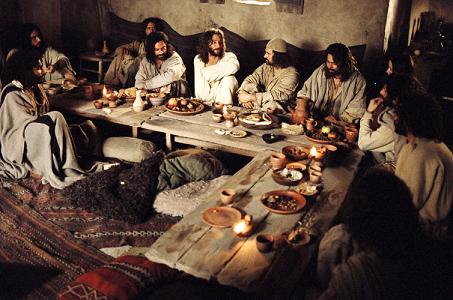
There’s much that we don’t know about Jewish meals in the 1st century, but it’s highly doubtful that they sat on benches in long tables medieval refectory-style like how Leonardo portrayed it. 😃 Some have inferred from the use of the Greek word anakeimai (‘to recline at table’; usually obscured by English translations which render it as ‘to sit’) as well as from what are seen as clues from John’s gospel (the beloved disciple leaning on Jesus’ bosom for instance) that the meal probably had the diners recline on cushions or mats or whatever - or maybe they were sitting on the mats - eating off common dishes placed on a low table/tables while surrounding said table/s, almost similar to a Greco-Roman triclinium, minus the U-shaped raised couches or niches where the diners sat.

(The discoveries in the Galilean village of Gamla have been interpreted to suggest that normally, Jewish villagers in the Galilee might have gathered around one or two shared dishes while sitting on mats/rugs on the floor for their daily meals. But of course this doesn’t tell us anything about Jesus and the disciples sat at the Last Supper.)

http://nyackajco.files.wordpress.com/2012/04/meal.jpg


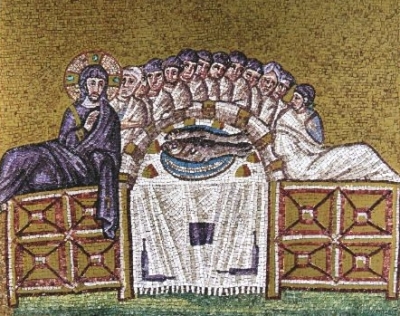
Besides, the everyone-sitting-on-one-side-of-a-long-table type of portrayal is mostly Western and medieval in origin. We have examples of early Christian portrayals of a banquet (either a symbol of the Eucharist or a representation of an agape meal) showing the participants eating triclinium-style. This portrayal influenced portrayals of the Last Supper (which was one of those events from the life of Jesus that was never explicitly portrayed in art until some time had passed), where we can see Jesus and disciples reclining on semicircular couches and eating fish off a table.

http://img145.imageshack.us/img145/6382/image024az.jpg


Byzantine art continued to show everyone reclining around a table, but around the 9th century, the depiction of reclining seems to have been gradually abandoned in favor of sitting. (I think a change in dining habits may have contributed to this shift.) Even so, in some depictions Jesus is still shown as reclining on a couch - even if everyone else around Him sits. Eventually, the couch was dispensed altogether, and Jesus and the disciples (excluding Judas) are shown as sitting on one end of a long dining table.
So our Lord’s example is actually closer to ad orietem – if we understand that ad orientem is not about facing away from the people but is actually about everyone facing east. And I have read that the early Christians did in fact all turn and face east at least during the consecrations, without exception that we know.
It would seem that in the early days (when Christians already in the basilicas but still before the second millennium), the congregation, segregated into men and women, stood separately in opposing halves of the nave and the adjacent aisles: the men were at the southern side aisle(s), while the women were on the opposite side. They were not standing (there were no pews then) in the central nave facing the sanctuary front-and-center like we do at church today.
You’re absolutely right. The Latin Mass as we know it didn’t begin to take shape until about the 3rd century when the Roman Canon was finalized. Then it wasn’t until the 6th century when Gregory the Great formalized it and added chant as we know it.
The traditional story is that ‘Gregorian Chant’ was the product of Pope St. Gregory the Great. This is however complicated by the discovery in the early 20th century of medieval manuscripts containing the so-called ‘Old Roman Chant’ - a chant tradition which is highly similar to the Gregorian (and thus was a chant tradition of the Roman Rite) but at the same time, is distinct from it. From what we can infer, Old Roman chant was apparently used in Rome up until the 13th century, when the Gregorian replaced it. The exact relationship between the two chants is still unclear, but the most common theory today is that Old Roman Chant is the original chant tradition of Rome, while the Gregorian was a Gallican (Frankish) version of Roman plainchant that eventually managed to gain a foothold in Rome itself and supplant its parent.

Which leaves us with the question as to why it was called ‘Gregorian’ Chant. Either it could have been a different Gregory, or perhaps the name was given to associate the chant tradition with a respected pope-saint and thereby, give it a legitimate air.

 
True, there wasn’t uniformity in the Roman Mass until Trent, but of the other variations, only 2 or 3 were older than 200 years. Those 2 or 3 were allowed to survive without changes (in Milan and Toledo).
Not exactly. There were more liturgies which were older than 200 years but with the passage of time most of them were eventually abandoned in favor of the Roman Rite anyway. Some (say, the Bragan rite in Portugal, the Lyonese rite, or the liturgies used by religious orders such as the Carmelites, the Dominicans, the Cistercians or the Carthusians) actually held out up until after VII. Out of the religious orders, only the Carthusians retained their rite up to the present day - most of the others decided to adopt the Roman Missal after VII, although some of the liturgies are experiencing revivals (say, the Dominican).
 
Not exactly. There were more liturgies which were older than 200 years but with the passage of time most of them were eventually abandoned in favor of the Roman Rite anyway. Some (say, the Bragan rite in Portugal, the Lyonese rite, or the liturgies used by religious orders such as the Carmelites, the Dominicans, the Cistercians or the Carthusians) actually held out up until after VII. Out of the religious orders, only the Carthusians retained their rite up to the present day - most of the others decided to adopt the Roman Missal after VII, although some of the liturgies are experiencing revivals (say, the Dominican).
I always wondered how there were only two regional rites older than 200 years, thanks for clearing that up. I always forget about the religious orders. There is occasionally a pre-Vatican II Dominican Mass in my area and I always mean to go. My friends say it’s wonderful.
 
The traditional story is that ‘Gregorian Chant’ was the product of Pope St. Gregory the Great. This is however complicated by the discovery in the early 20th century of medieval manuscripts containing the so-called ‘Old Roman Chant’ - a chant tradition which is highly similar to the Gregorian (and thus was a chant tradition of the Roman Rite) but at the same time, is distinct from it. From what we can infer, Old Roman chant was apparently used in Rome up until the 13th century, when the Gregorian replaced it. The exact relationship between the two chants is still unclear, but the most common theory today is that Old Roman Chant is the original chant tradition of Rome, while the Gregorian was a Gallican (Frankish) version of Roman plainchant that eventually managed to gain a foothold in Rome itself and supplant its parent.

Which leaves us with the question as to why it was called ‘Gregorian’ Chant. Either it could have been a different Gregory, or perhaps the name was given to associate the chant tradition with a respected pope-saint and thereby, give it a legitimate air.
In my Heritage of Sacred Music class I’m taking right now, this is the theory we were taught on how Gregorian chant developed: The popes really started gaining power around the 7th century, and Charlemagne, in the early 9th century, realized that one way to centralize his (and the pope’s) authority would be to have a unified liturgy. However, since chant was not notated at this time, the only way to spread the Roman chant was by rote. Roman cantors were spread throughout Gall to teach the Gauls the old Roman chant. The Gauls learned the chant, but infused into the Roman chant some of their own Gallican chant’s characteristics. The chant that spread and became known as Gregorian chant is, as you mention, a mix of Old Roman and Gallican chant.

I guess the reason it was still known as Gregorian was either because it was still more like the Old Roman Chant than the Gallican, or simply because it was taught by the Romans, and therefore the resulting chant continued to be called Gregorian Chant, though it wasn’t exactly the same as before.
 
I always wondered how there were only two regional rites older than 200 years, thanks for clearing that up. I always forget about the religious orders. There is occasionally a pre-Vatican II Dominican Mass in my area and I always mean to go. My friends say it’s wonderful.
The Ambrosian and the Mozarabic are actually (even in their heavily Romanized state) the only surviving liturgies which were distinctive enough from the Roman so they stand out more. Most of the other rites (such as the Bragan, Lyonese, or those of the religious orders) are - superficially at least - either very similar to the Roman or are just (originally) local variations of the Roman rite. At least text-wise they are almost the same.
In my Heritage of Sacred Music class I’m taking right now, this is the theory we were taught on how Gregorian chant developed: The popes really started gaining power around the 7th century, and Charlemagne, in the early 9th century, realized that one way to centralize his (and the pope’s) authority would be to have a unified liturgy. However, since chant was not notated at this time, the only way to spread the Roman chant was by rote. Roman cantors were spread throughout Gall to teach the Gauls the old Roman chant. The Gauls learned the chant, but infused into the Roman chant some of their own Gallican chant’s characteristics. The chant that spread and became known as Gregorian chant is, as you mention, a mix of Old Roman and Gallican chant.

I guess the reason it was still known as Gregorian was either because it was still more like the Old Roman Chant than the Gallican, or simply because it was taught by the Romans, and therefore the resulting chant continued to be called Gregorian Chant, though it wasn’t exactly the same as before.
This theory makes sense because that’s exactly what happened to the Roman liturgy itself. Charlemagne, as you say, decided to adopt the Roman rite and make it the standard (in fact, the only) form of liturgical practice in his realm, at the expense of the local liturgies (the so-called Gallican rites). In the process of the adoption of the Roman liturgy, however, Frankish/Gallican customs crept in, which resulted in the Gallo-Roman rite. Eventually, this hybrid was also adopted in Rome itself, supplanting the original (and more simpler) local liturgy in use there. (The modern Roman rite - EF and OF - is, strictly speaking, the descendant of this Gallo-Roman hybrid.) And since chant was part of the liturgy…
 
Everything I’ve read about the ancient Masses is so vague that it’s not that easy to put together that clear of a picture of what it was like. There’s too much taking something that this guy wrote, and something that this guy wrote, and saying well the Mass was like this. The Mass could have also been different where St. X was compared to St. Y and still more different somewhere else. There are references to the Roman Canon made since at least the 3rd or 4th century, it could back even prior to that. None of us know for sure.

As far as I’ve read much of what we see in the EF was at the very least codified by Pope St. Gregory the Great for the Roman Mass. Then by AD 1000, the Roman Mass wasn’t all too much different than we see today in the EF. From what I understand, there weren’t that many changes in the Mass between that time and Trent.
Mike Aquilina has
recently published “The Mass of the Early Christians” which may be of some interest to you.
 
Status
Not open for further replies.
Back
Top