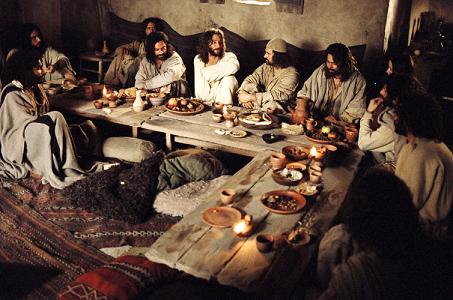
Haha, I see the humor here, but very knowledgable priests have also said that Our Lord didn’t sit opposite them, facing them, either. Apparently, according to the way formal Jewish meals were taken, everyone really did sit on one side of the table like in the famous portrait of the Last Supper.
There’s much that we don’t know about Jewish meals in the 1st century, but it’s highly doubtful that they sat on benches in long tables medieval refectory-style like how Leonardo portrayed it.

Some have inferred from the use of the Greek word
anakeimai (‘to recline at table’; usually obscured by English translations which render it as ‘to sit’) as well as from what are seen as clues from John’s gospel (the beloved disciple leaning on Jesus’ bosom for instance) that the meal probably had the diners recline on cushions or mats or whatever - or maybe they
were sitting on the mats - eating off common dishes placed on a low table/tables while surrounding said table/s, almost similar to a Greco-Roman
triclinium, minus the U-shaped raised couches or niches where the diners sat.
(The discoveries in the Galilean village of Gamla have been interpreted to suggest that normally, Jewish villagers in the Galilee might have gathered around one or two shared dishes while sitting on mats/rugs on the floor for their daily meals. But of course this doesn’t tell us anything about Jesus and the disciples sat at the Last Supper.)
http://nyackajco.files.wordpress.com/2012/04/meal.jpg
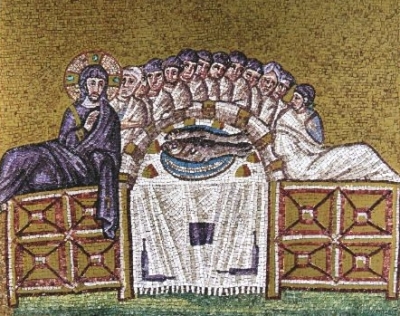
Besides, the everyone-sitting-on-one-side-of-a-long-table type of portrayal is mostly Western and medieval in origin. We have examples of early Christian portrayals of a banquet (either a symbol of the Eucharist or a representation of an agape meal) showing the participants eating
triclinium-style. This portrayal influenced portrayals of the Last Supper (which was one of those events from the life of Jesus that was never explicitly portrayed in art until some time had passed), where we can see Jesus and disciples reclining on semicircular couches and eating fish off a table.
http://img145.imageshack.us/img145/6382/image024az.jpg

Byzantine art continued to show everyone reclining around a table, but around the 9th century, the depiction of reclining seems to have been gradually abandoned in favor of sitting. (I think a change in dining habits may have contributed to this shift.) Even so, in some depictions Jesus is still shown as reclining on a couch - even if everyone else around Him sits. Eventually, the couch was dispensed altogether, and Jesus and the disciples (excluding Judas) are shown as sitting on one end of a long dining table.
So our Lord’s example is actually closer to ad orietem – if we understand that ad orientem is not about facing away from the people but is actually about everyone facing east. And I have read that the early Christians did in fact all turn and face east at least during the consecrations, without exception that we know.
It would seem that in the early days (when Christians already in the basilicas but still before the second millennium), the congregation, segregated into men and women, stood separately in opposing halves of the nave and the adjacent aisles: the men were at the southern side aisle(s), while the women were on the opposite side. They were not standing (there were no pews then) in the central nave facing the sanctuary front-and-center like we do at church today.
You’re absolutely right. The Latin Mass as we know it didn’t begin to take shape until about the 3rd century when the Roman Canon was finalized. Then it wasn’t until the 6th century when Gregory the Great formalized it and added chant as we know it.
The traditional story is that ‘Gregorian Chant’ was the product of Pope St. Gregory the Great. This is however complicated by the discovery in the early 20th century of medieval manuscripts containing the so-called ‘Old Roman Chant’ - a chant tradition which is highly similar to the Gregorian (and thus was a chant tradition of the Roman Rite) but at the same time, is distinct from it. From what we can infer, Old Roman chant was apparently used in Rome up until the 13th century, when the Gregorian replaced it. The exact relationship between the two chants is still unclear, but the most common theory today is that Old Roman Chant is the
original chant tradition of Rome, while the Gregorian was a Gallican (Frankish) version of Roman plainchant that eventually managed to gain a foothold in Rome itself and supplant its parent.
Which leaves us with the question as to why it was called ‘Gregorian’ Chant. Either it could have been a different Gregory, or perhaps the name was given to associate the chant tradition with a respected pope-saint and thereby, give it a legitimate air.