The Flood: Did it happen?

  • Thread starter Thread starter Inquiringperson
  • Start date Start date
Status
Not open for further replies.
Precisely my point. I can’t help but think that this isn’t a coincidence - and, being a Christian, I find great pleasure when I hear the similiarities in the stories. I am a big believer in there being one “truth”.

As for the “fluidity” of Native American teachings…that could be, or could not be. Since our tribe is one of the few with its own written language, and a few stories written before the settlement of the US (creation being one of them), I have doubts that this was influenced by Christianity. Our tribe were also monotheists with beliefs of a “second coming” - it was very easy for my ancestors to adopt Christianity, for it was essentially the same beliefs in a more organized substance.
Agreed.

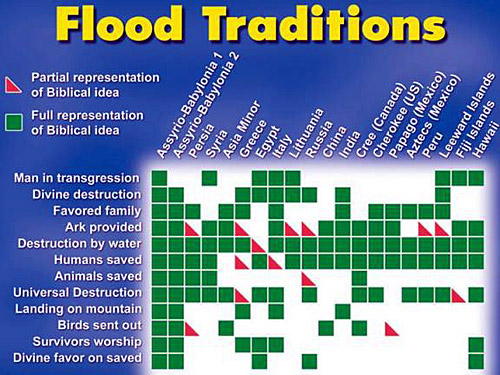
nwcreation.net/noahlegends.html


D = Destruction by Water
. G = (God) Divine Cause
. W = Warning Given
. H = Humans Spared
. A = Animals Spared
. V = Preserved in a Vessel
D . . H A V 01 Australia- Kurnai
D . W H A V 02 Babylon- Berossus’ account
D G W H A V 03 Babylon- Gilgamesh epic
D G W H . V 04 Bolivia- Chiriguano
D . . H A V 05 Borneo- Sea Dayak
D . . H A V 06 Burma- Singpho
D G . H A V 07 Canada- Cree
D G W H A V 08 Canada- Montagnais
D G . H A V 09 China- Lolo
D . W H A V 10 Cuba- original natives
D G W H A V 11 East Africa- Masai
D G W H . V 12 Egypt- Book of the Dead
D G . H . V 13 Fiji- Walavu-levu tradition
D G W H A . 14 French Polynesia- Raiatea
D . . H A V 15 Greece- Lucian’s account
D G . H A V 16 Guyana- Macushi
D G . H . V 17 Iceland- Eddas
D G . H . V 18 India- Andaman Islands
D . W H A V 19 India- Bhil
D G W H . V 20 India-Kamar
D . W H A . 21 Iran- Zend-Avesta
D G . H . V 22 Italy- Ovid’s poetry
D G . H . V 23 Malay Peninsula- Jekun
D . W H . V 24 Mexico- Codex Chimalpopoca
D . W H A V 25 Mexico- Huichol
D G . H . V 26 New Zealand- Maori
D . W H A . 27 Peru- Indians of Huarochiri
D . W H . V 28 X . Russia- Vogul
D . W H A V 29 U.S.A. (Alaska)- Kolusches
D G . H A V 30 U.S.A. (Alaska)- Tlingit
D . W H A V 31 U.S.A. (Arizona)- Papago
D G . H A V 32 U.S.A. (Hawaii)- legend of Nu-u
D . . H A V 33 Vanualu- Melanesians
D . . H A V 34 Vietnam- Bahnar
D . . H A V 35 Wales- Dwyfan/Dwyfan legend
35 18 17 35 24 32 Total Occurrences out of 35
 
It is a false dillemma to assume that the possibilities here are:
  1. Genesis flood accounts are similar to, but more journalistically accurate than a CNN news report.
  2. The whole thing is a pious fairy tale made to convey a point.
I see no reason that the bulk of human civilization and agriculture could not have been wiped out in a massive regional flood that destroyed all towns, farms and livestock (except Noah whose family and animals survived in the ark). Such an event would have been described in the storytelling tradition typical of that era as a “whole world” cataclysm and yet the literal facts would in no way reduce the meaning we need to comprehend. Furthermore, such an event would be expected to be carried to some extent or other in the histories of ALL the people who descended from the survivors (i.e. Noah’s family). Perhaps not coincidentally, most cultures DO have a global flood story.

Personally, I’ve always wondered if the Mediterranean might once have been isolated from the world’s oceans and several hundred feet lower in elevation until an earthquake or something created a breach near Gibraltar that allowed the basin to fill up. (But I have absolutely no standing to even call that a theory, mind you). The Red Sea didn’t connect until the canal was built, right?
 
As for the “fluidity” of Native American teachings…that could be, or could not be. Since our tribe is one of the few with its own written language, and a few stories written before the settlement of the US (creation being one of them), I have doubts that this was influenced by Christianity. Our tribe were also monotheists with beliefs of a “second coming” - it was very easy for my ancestors to adopt Christianity, for it was essentially the same beliefs in a more organized substance.
newadvent.org/cathen/02758c.htm :tiphat: Have you read Francesco Clavigero’s History of Mexico? Interestingly, he was familiar with the St. Brendan tale, but thought he was Iberian rather than Irish. :rolleyes:

books.google.com/books?id=RjDVAAAAMAAJ&printsec=frontcover&dq=francesco+clavigero&hl=en&ei=DuGQTYbhEay60QHlr4yiCw&sa=X&oi=book_result&ct=result&resnum=1&ved=0CCsQ6AEwAA#v=onepage&q&f=false

books.google.com/books?id=sCkOAAAAQAAJ&dq=francesco+clavigero&source=gbs_similarbooks_s&cad=1

In Spanish:

books.google.com/books?id=WKhJPgAACAAJ&dq=francesco+clavigero&hl=en&ei=DuGQTYbhEay60QHlr4yiCw&sa=X&oi=book_result&ct=result&resnum=8&ved=0CEoQ6AEwBw
 
Icamay, the Great Bonneville Lake flood occurred about 15,000 years ago, well after Native Americans populated North America. It is pretty impressive to think that this would live in the cultural tradition for so long.
 
They omission of the dinosaur`s, could parallel any discourse of negative or literal meaning from the bible text.
 
Why doubt the Written Word of God?

God did not tell Moses a bunch of fairy tales. He told Truth.

If He said the whole world was flooded and every one was killed except for those who got on the boat, then it happened.

God has this way of making the impossible easy to do.
 
Noah’s Ark (Catholic Encyclopedia):
The opinion that these chapters are mere legendary tales, Eastern folklore, is held by some non-Catholic scholars; according to others, with whom several Catholics side, they preserve, under the embroidery of poetical parlance, the memory of a fact handed down by a very old tradition.
 
A lot of people seem to be missing the point… Please, when the validity of the bible’s stories are in dispute DO NOT back them up with more bible quotes. It is like circular reasoning that spirals inward.

If the flood was a regional flood then god did not flood the whole earth and the story in the bible is factually incorrect, by my reading.

Lastly, I think that this whole thread is plagued by a false dichotomy, everyone seems to think the story is either literal or allegorical. I propose a third option. Is it not possible that the story is based on true historic events, as understood by an extremely simple-minded people, but they got the cause wrong? Bad things happen, it is a fact of nature, earthquakes, tornadoes, tsunamis etc all have a natural cause.
 
Why doubt the Written Word of God?

God did not tell Moses a bunch of fairy tales. He told Truth.

If He said the whole world was flooded and every one was killed except for those who got on the boat, then it happened.

God has this way of making the impossible easy to do.
So was god telling the truth when he said you should stone disobedient children? I could sit here and list things like that for hours but I will simply ask you first if you take every word of the bible literally.
 
There are some terrifying things written in the Bible.

I do not often like what i read because it is not what I want God to have said. .

But God did not consult with me .

But I am going to ask Him about it when I see Him.

Will you do the same?
 
@doxiemom

You don’t seem to have really answered my question. Do you think the bible is all literally true? I will answer your question… Yes I plan on asking god a lot of questions if the opportunity ever arrises. However, I don’t have any reason to believe that he would be any more obliged to answer these questions than he is to answer prayers. That is to say it’s a veritable crapshoot.
 
Yes, a flood did happen.

Exactly how big it was has yet to be determined, and we probably won’t know in this lifetime.

Remember, the book is intended to tell a story about God interacting with people. It’s not necessarily always to be taken literally. The ancient people loved storytelling, and saying the whole world was flooded could either be an exaggeration because it was big and destructive, or maybe to them their whole world, everywhere they knew and had travelled since they were born was destroyed.

Worldwide flood? Not likely, although we must remember that with God all things are possible.
 
VicApple, I once sat where you are now, and I can understand the import of your question. Let me ask one other question before I answer yours. How far can you go in reading any document before you come to something that is not to be understood literally. After all, the word “literally” is one of the most abused words in American English today.
 
old timer, forgive my puncuation, im on my cell. How far can i read into a document before i find something that can’t be taken literally. I am an engineer so i spend a lot of time with my nose in technical works and scientific, peer-reviewed journal articles and they are very very literal. If you are talking about the books i read lets say they are usually fiction. Then yes they have a lot of non-literal material. That seems irrelevant because i do not live my life based on tom clancy’s rainbow six (good thing)
 
old timer, forgive my puncuation, im on my cell. How far can i read into a document before i find something that can’t be taken literally. I am an engineer so i spend a lot of time with my nose in technical works and scientific, peer-reviewed journal articles and they are very very literal. If you are talking about the books i read lets say they are usually fiction. Then yes they have a lot of non-literal material. That seems irrelevant because i do not live my life based on tom clancy’s rainbow six (good thing)
Catholics understand the Bible as to what the author intended to convey and the constant teaching and understanding of the Church.

Now as for quoting from the skeptics Bible - go on for hours if you wish. 🙂 How sure are you the skeptics got it right?

Do you understand Bible genres?
 
i am not quooting the skeptics bible. I am quoting what i have read from the bible i recieved at confirmation. Plain old bible. How do i know the skeptics got it right? How do you know that the church knows what the authors intended the meaning to be thousands of years ago. I personally prefer the variaties of christianity that promote the serious thought of each particular member rather than just going with what ‘the church’ teaches. I forget who said it but ‘i find it very hard to believe that a god who gave us intelligence would be so offended that we use it’ now i know catholics arent mindless pope following zombies but i think the catholic church promotes the teachings of ‘the church’ more forcefully than other denominations
 
i am not quooting the skeptics bible. I am quoting what i have read from the bible i recieved at confirmation. Plain old bible. How do i know the skeptics got it right? How do you know that the church knows what the authors intended the meaning to be thousands of years ago. I personally prefer the variaties of christianity that promote the serious thought of each particular member rather than just going with what ‘the church’ teaches. I forget who said it but ‘i find it very hard to believe that a god who gave us intelligence would be so offended that we use it’ now i know catholics arent mindless pope following zombies but i think the catholic church promotes the teachings of ‘the church’ more forcefully than other denominations
The Church is like a three legged stool - Scripture, Tradition and the Magisterium. Take any one away and it topples.

The bible did not just fall from the sky yesterday and we are trying to figure it out using modern methods. We have a long tradition that goes right to the beginning. Catholics do not believe in private interpretation. The fruits of private interpretation are spoiled and rotten.

The Church systems protects the deposit of faith. No other system works better.

Now the Catholic Church does encourage intelligent thought. That is where modern science has come from. St Paul tells us to test everything.
 
The Church is like a three legged stool - Scripture, Tradition and the Magisterium. Take any one away and it topples.

The bible did not just fall from the sky yesterday and we are trying to figure it out using modern methods. We have a long tradition that goes right to the beginning. Catholics do not believe in private interpretation. The fruits of private interpretation are spoiled and rotten.

The Church systems protects the deposit of faith. No other system works better.

Now the Catholic Church does encourage intelligent thought. That is where modern science has come from. St Paul tells us to test everything.
I want you to be aware of how your statements appear to me. I just see you making claims without backing them up or providing a reason. I very much agree with what Paul said about questioning everything. However, I don’t think it’s fair to imply him the credit for pioneering this position.

Aside from that, my biggest contention is with the statements “the fruits of private interpretation are spoiled and rotten.” and “Paul tells us to test everything”

This is my big issue. How do these two claims not contradict each other. One one hand you are supporting the idea that if a person thinks of something on their own it is automatically spoiled. On the other hand you are saying that we should think about everything. Should we do it knowing that the results are null and void? If that’s the case why do we think at all? Are the fruits of private interpretation only spoiled if they don’t agree with the currently held church positions?

Am I to assume that we just need to question everything except what the church teaches? I think it would be indefensible to say that everything the church has ever said is true, so why not question what they say? Do you think everything the church says is correct? I think that the case of Galileo (sadly overused as it might be, but still a valid point I think) definitely points to the fallibility of church teaching.

Also on the Galileo note, I think you might be overstepping the boundaries of intellectual honesty when you try to claim that Christianity is somehow the source or basis of modern science.
 
Status
Not open for further replies.
Back
Top