P
patrick457
Guest
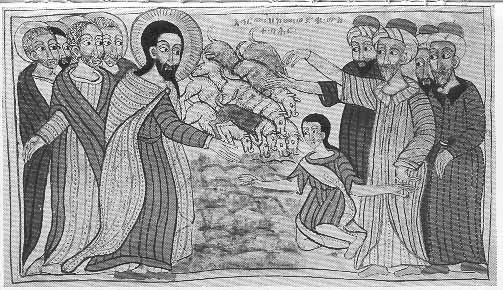
22-30: And the scribes who came down from Jerusalem said, “He has Beelzeboul,” and, “By the ruler of the demons He casts out demons.”
And he called them to Him, and said to them in parables: "*How can Satan cast out Satan? And if a kingdom is divided against itself, that kingdom cannot stand; and if a house is divided against itself, that house will not be able to stand. And if Satan has risen up against himself and is divided, he cannot stand, but has an end!
But no one can enter into a strong man’s house and plunder his property unless he first binds the strong man; and then he will plunder his house.
DEFINITIONSAmen, I say to you, all sins will be forgiven the sons of men, and whatever blasphemies with which they may blaspheme; but whoever blasphemes against the Holy Spirit will never have forgiveness, but is guilty of an everlasting sin*"—because they said, ‘He has an unclean spirit.’
Beelzeboul: The Hebrew name Ba‘al Zebûb appears as the name of a deity worshipped in the Philistine city of Ekron. In ancient contexts, there appears to have been little, if any, meaningful distinction between Beelzebub and the Semitic god Ba‘al. Jewish reference to the deity was almost certainly pejorative, and the title thus grew to be used among other terms for Satan.
The name might mean ‘Lord of Zebûb’, referring to an unknown place called Zebûb, or ‘Lord of things that fly’ (zebûb being a Hebrew collective noun for ‘fly’, thus the common lay translation ‘Lord of the Flies’).
It has been suggested that it might be a derogatory corruption of Ba’al Zebul, ‘Lord of the High Place’, or ‘Lord of Heaven’. Septuagint A renders the name as Baalzeboub, Septuagint B as Baal myîan, meaning ‘Baal of flies’, but Symmachus the Ebionite, a late 2nd-century translator of the Old Testament in Greek, may have reflected a tradition of its offensive ancient name when he rendered it as Beelzeboul.
It is unknown whether Symmachus was correct in identifying these names or not since we otherwise know nothing about either of them. Zeboul might derive from a slurred pronunciation of zebûb; from ‘zebel’, a word used to mean ‘dung’ in the Targums; or from Hebrew zebûl found in 1 Kings 8:13 in the phrase beth-zebûl ‘lofty house’ and used in Rabbinical writings to mean ‘house’ or ‘temple’; thus Beelzebul could also be taken to mean “lord of the house.”
In any case the form Beelzebub was substituted for Belzebul in the Syriac translation and the Vulgate, which was eventually repeated in the King James Version, the result of which is the form Beelzebul was mostly unknown to western European and descendant cultures until some more recent translations restored it. In summary, it is unknown if either or both of these names were a title applied to persons, to divinities exclusively, or otherwise were a corruption of such a title, possibly as a denigration.
Whoever blasphemes against the Holy Spirit…An everlasting sin: The Catechism tells us that:
The Jerome Biblical Commentary (The Gospel According to Matthew, Part II; Page 85, #31) tells us that:“‘Whoever blasphemes against the Holy Spirit never has forgiveness, but is guilty of an eternal sin.’ There are no limits to the mercy of God, but anyone who deliberately refuses to accept his mercy by repenting, rejects the forgiveness of his sins and the salvation offered by the Holy Spirit. Such hardness of heart can lead to final impenitence and eternal loss.” (C.C.C. # 1864)
Blasphemy against the Spirit: The saying about blasphemy against the Spirit has long presented difficulty, particularly in Catholic theology, which affirms the possibility of repentance up to the moment of death. This teaching is solidly founded in the NT, and this saying of Jesus cannot be understood in a way that contradicts his invitations to repentance. Refusal to recognize the Son of Man as Messiah can be forgiven; faith atones for previous denial of faith. This Messianic claim is missing in Mk.
COMMENTARIESBlasphemy against the Holy Spirit, however, attributes the activity of the Spirit to some other power. The present activity of God can be attested only through the actions of the Spirit. If these are not recognized, then there is no means by which God can reach man. The one who will not accept the work of the Spirit has made it impossible for himself to recognize the word and the work of God. Only he can be forgiven who confesses that he has something to be forgiven.
1.) From the Haydock Commentary:
Ver. 22. From St. Matthew 12:22. et dein. we learn that it was on the occasion of the delivery of a possessed person, this blasphemy was uttered.
Ver. 24. Kingdom against kingdom: As this is true in all kingdoms and states where civil dissensions obtaineth, so it is especially verified in heresies and heretics which have always divisions among themselves, as a punishment for their abandoning the Church, the pillar and ground of truth, the only centre of peace and unity.
Ver. 29: See St. Matthew 12:32. Of an everlasting sin; i.e. of eternal punishment. (Witham)
2.) Commentary by St. Ambrose (Concerning Repentance, Book II, chapter 4:20-22):What is here called everlasting offence, is (as St. Matthew expresseth it) that which shall neither be remitted in this life, nor in the life to come; which words would not be true, says St. Augustine, if some sins were not forgiven in the world to come. Now, as no mortal sin can be forgiven after death, there must necessarily be smaller transgressions, which we call venial; though many of our separated brethren will needs have all sins to be mortal; which is very far from a comfortable tenet.
But we have heard that you (the Novatians) are accustomed to bring forward as an objection that which is written: “Every sin and blasphemy shall be forgiven unto men, but blasphemies against the Spirit shall not be forgiven unto men. And whosoever shall speak a word against the Son of Man, it shall be forgiven him, but whosoever shall speak against the Holy Spirit, it shall not be forgiven him, neither in this world, nor in that which is to come (Matthew 12:31-32).” By which quotation the whole of your assertion is destroyed and done away, for it is written: “Every sin and blasphemy shall be forgiven unto men.” Why, then, do you not remit them? Why do you bind chains which you do not loose? Why do you tie knots which you do not unfasten? Forgive the others, and deal with those who you think are bound for ever by the authority of the Gospel for sinning against the Holy Spirit.
But let us consider the case of those whom the Lord so binds, going back to the words before the passage quoted, that we may understand it more clearly. The Jews were saying: “This man does not cast out devils, but by Beelzebub, prince of the devils.” Jesus replied: “Every kingdom divided against itself shall be destroyed, and every city or house divided against itself shall not stand; for if Satan casts out Satan, he is divided against himself, how then shall his kingdom stand? But if I cast out devils by Beelzebub, by whom do your sons cast them out?”
3.) Commentary by St. Thomas Aquinas (Summa Theologica, Tertia Pars, Question 43, Article 2):Now we see plainly here that the words are expressly used of those who were saying that the Lord Jesus cast out devils through Beelzebub, to whom the Lord gave that answer, because they were of the heritage of Satan, who compared the Saviour of all to Satan, and attributed the grace of Christ to the kingdom of the devil. And that we might know that He was speaking of this blasphemy, He added: “O generation of vipers, how can you speak good, being yourselves evil?” He says, then, that those who thus speak attain not to forgiveness.
Objection 3: Further, what is done by Divine power cannot be done by the power of any creature. But the things which Christ did could be done also by the power of a creature: wherefore the Pharisees said (Luke 11:15) that He cast out devils “by Beelzebub the prince of devils.” Therefore it seems that Christ did not work miracles by Divine power.
Reply to Objection 3: Christ cast out demons otherwise than they are cast out by the power of demons. For demons are cast out from bodies by the power of higher demons in such a way that they retain their power over the soul: since the devil does not work against his own kingdom. On the other hand, Christ cast out demons, not only from the body, but still more from the soul. For this reason our Lord rebuked the blasphemy of the Jews, who said that He cast out demons by the power of the demons: first, by saying that Satan is not divided against himself; secondly, by quoting the instance of others who cast out demons by the Spirit of God; thirdly, because He could not have cast out a demon unless He had overcome Him by Divine power; fourthly, because there was nothing in common between His works and their effects and those of Satan; since Satan’s purpose was to “scatter” those whom Christ “gathered” together [Cf. Matthew 12:24-30; Mark 3:22; Luke 11:15-32].