P
patricius79
Guest
You said that Luther said that he and the devil (the deciever) agreed about justification by faith alone, etc, right?
Last edited:

I agree. We should let Martin Luther speak for himself.I agree that we should be careful to be balanced and chartiable in our treatment of Luther., making sure that claims are factual. However we can’t whitewash him either. He did say some terrible things.
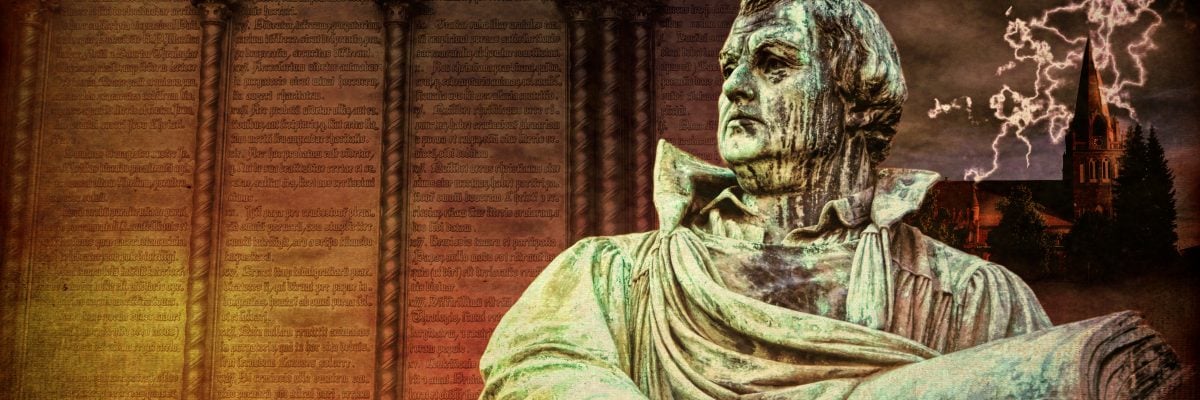
As Catholics faithful to the Holy See, we recognise and use the titles that the Holy See bestowed upon Martin Luther from his 500th birthday through even to this recent anniversary: “Witness of Jesus Christ” and “Witness to the Gospel”.Because Luther doesn’t teach the Gospel.
Yet there is a very significant disunity, otherwise there would be Communion with His one Eucharist!R_H_Benson:
Nothing “fake” about the unity. It is from the Holy Spirit, as Saint John Paul II wrote in Ut Unum Sint of "the deep communion — linked to the baptismal character — which the Spirit fosters in spite of historical and canonical divisions among all th ebaptised – Catholic and non-Catholic alike.You mean the purging of the historical record of anything that could hinder the progress of almighty “ecumenism”. Fake unity at all costs!
As he went on to say, “This broadening of vocabulary is indicative of a significant change in attitudes. There is an increased awareness that we all belong to Christ.”
This is a genuinely good point! How can the Church be expected to praise a man (and a movement) which opposed the Roman See to the point of a separated and invalid celebration of the Lord’s Supper, while demanding that we submitt to hierarchy or be criticized as ignorant, rebellious, uncharitable, etc.Martin Luther didn’t listen to and follow his shepherds and he’s cool now. It’s all good
The Popes have quite explained that. The words are there for those who read them.But how far can we really say non-Catholic Christians belong to Christ, if they are not receiving His broken body and shed blood at the one table???
If you are American, I suggest you begin with Declaration on the WayCan you provide a link with that explanation? The Catholic Eucharist is quite different than the sacramental union of Luther. Waaay different. Having the benefit of reviewing the papal explanations that are meaningful to you would likely by helpful to me.
You seem to need to re-read Church history on the place of antisemitism within Catholicism and its history.So for those who spin to make Martin Luther some kind of a folk hero, please just stop!!! You are fooling nobody. You are at best being dishonest and at worst an anti-semite symphatiser.
…which is exactly what I did on that day in March 2000.As the Successor of Peter, I asked that “in this year of mercy the Church, strong in the holiness which she receives from her Lord, should kneel before God and implore forgiveness for the past and present sins of her sons and daughters”
Indeed, “because of the bond which unites us to one another in the Mystical Body, all of us, though not personally responsible and without encroaching on the judgement of God who alone knows every heart, bear the burden of the errors and faults of those who have gone before us”
I am reminded of a very important passage in From Conflict to Communion…Not quite. Luther’s words … directly quoted from the original German texts…relay Luther’s thoughts. There is no “editing” ---- words have not been altered, changed or chopped out.l. the accompanying commentary and discussion is from a catholic perspective, for each to review and use or discard when forming their own conclusions.
- How theologians presented their theological convictions in the battle for public opinion is quite another matter. In the sixteenth century, Catholics and Lutherans frequently not only misunderstood but also exaggerated and caricatured their opponents in order to make them look ridiculous. They repeatedly violated the eighth commandment, which prohibits bearing false witness against one’s neighbor. Even if the opponents were sometimes intellectually fair to one another, their willingness to hear the other and to take his concerns seriously was insufficient. The controversialists wanted to refute and overcome their opponents, often deliberately exacerbating conflicts rather than seeking solutions by looking for what they held in common. Prejudices and misunderstandings played a great role in the characterization of the other side. Oppositions were constructed and handed down to the next generation. Here both sides have every reason to regret and lament the way in which they conducted their debates. Both Lutherans and Catholics bear the guilt that needs to be openly confessed in the remembrance of the events of 500 years ago.
Of course he is.Is Martin Luther a witness to the Lord’s Eucharist?