And who determines the correct interpretation? How have disputes been corrected throughout Church history in this regard?
Not sure"corrected’’ is the term, more like addressed. I am thinking of Jerusalem council and the proof being in the pudding. Where specifically did God say not to circumcise ? The proof was that God gave the gift of the Holy Spirit to Gentiles exactly as He did to the apostles and the Jews, before any ritual /rite. They could have very easily said then be baptized and circumcised and we would all probably do it. I guess the council decided keep the main thing the main thing, and don’t push to much with ritual or doctrine (Christ did say baptize, and did not mention circumcise though it was still ok to be Jewish, even become Jewish as a Christian.) So I apply that to the Orthodox and say the proof is in them, that the head bishop/pope controversy is not the main thing, and not necessary to be dogmatic on it. They have not fallen apart and remain being fruitful to the Body. That is why I said succession shouldn’t be so dogmatic but rather to be fruitful or as I said to be a “right on” congregation. (To be like the first Gentiles, filled with the Holy Spirit and in the Body as first class citizens.)
Not only a pillar but a bulwark as well. The fullness of truth is found in Her, because it is Christ’s. No need to add qualifiers.
Well maybe. Infallibility for one branch is a “qualifier”.
The individual is brought to a life in Christ, which is found in the Body of Christ. The individual becomes part of something much bigger than himself. I frankly don’t care about politicians and what they say or don’t say about their faith. I care in how they become a part or not of the body of Christ. Again, there is no need for qualifiers or dis-qualifiers for that matter
Agreed, but I feel some qualify the offices too much or disqualify the lay priesthood too much.
And how many times do we need to disagree and rebel and separate and further divide the body of Christ? I mean, who are we going to learn from? (From the Holy Spirit, like thousands and thousands of dissenters and heretics claim…) Are we ever going to admit we might be wrong?
One can certainly focus on the cup being half empty. The half full to some is perfect . As has been suggested here there may be two or three views on the Eucharist (not 40,000). CS Lewis wrote a beautiful article on the unity there really is amongst us all in what we hold in common over communion. Again, the proof is in the pudding of the participants and the positive effectualness for all three views…As far as people splitting, there is a time and place for it and you just let them go. I also know you alienate others by trying to unify in the wrong way. I recall the Easter controversy early in the church. Is that something to fight over , as to just when to celebrate it, especially when the tradition for some was apostolic…I tell you it is far more spiritually challenging and rewarding to be unified with a brother that is not exactly like you in dogamtic makeup. There are times to bite our tongue. Yet which church has the biggest catechism, the biggest set of binding rules and dogmas and doctrine and “Confessions” ? Like biting the tongue the question of admitting wrong can help. How does infallibility help ? How does it help to say only one is right from beginning to end ? There has been some CC movement in binding together and recognizing the good pudding that is in other churches yet we are second class and are in eternal danger if we knowingly reject all Catholic dogma. Hopefully on our end we give honor to where it is due and recognize some of the good of our (your) long history.
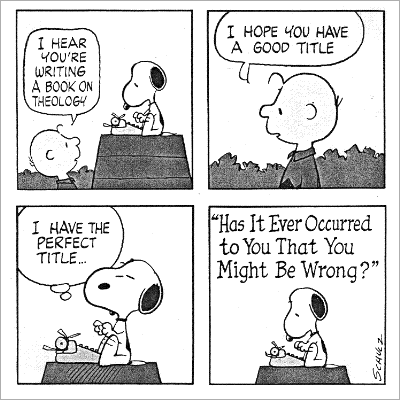
Things started to change for me the moment I realized that I was wrong in some of my assumptions and beliefs. Once I was humble enough and understood that Christ left us with something to guide us, being the Church, and not something left for each individual interpretation things started to fall into place.
I have only had one crisis where I realized I was wrong, totally wrong and greatly humbled. I was in danger of hellfire, of remaining in my sins yet was gloriously saved by Christ thru His illumination, thru the "preacher’’, thru the Word, thru the Body, thru a church, thru the church. Thankfully I have not had a crisis as to which definition of church is true. I would not have you kick against that which has and is saving you. The proof is in the pudding.
Don’t want to dogmatize any more than I have to. I was "broken’’ just to get here, don’t mind being “broken” to remain (yet forgive me for i can be guilty of all things, as your perfect cartoon suggests-thank you)
But what are we left with then? Church relativism? Or is there something bigger than ourselves?
OK. Just don’t make it to bigger than it has to be. May you or me always be more important than being right about something that neither puts you in or out of the "pudding’’…Hey, He is Risen…Blessings on tomorrow.



