The Minor, Trivial Stuff Thread

  • Thread starter Thread starter patrick457
  • Start date Start date
Status
Not open for further replies.
No, I meant that they wear the ankle length, long sleeved tunic similar to modern Arab Dress, as opposed to the knee-length (for men) and ankle-length (for women) sleeveless Greco-Roman like tunics that Yadin and others have found. (Though I am aware that the Priests wore tunics similar to the above, as indicated in Josephus.)
 
A few days after the birth of Jesus, Mary took the child to the temple for a sacrifice to be made. It said that they offered a dove since that is what poor people offered.

Was the dove offered for sin? or thanksgiving?

And do you happen to know the ceremony of this sacrifice? That is, how and what the priest did?

It was done in the temple, but I thought the altar of sacrifice, tho on temple grounds, was not done in the temple. Is this correct?

Thanks.
 
A few days after the birth of Jesus, Mary took the child to the temple for a sacrifice to be made. It said that they offered a dove since that is what poor people offered.

Was the dove offered for sin? or thanksgiving?

And do you happen to know the ceremony of this sacrifice? That is, how and what the priest did?

It was done in the temple, but I thought the altar of sacrifice, tho on temple grounds, was not done in the temple. Is this correct?

Thanks.
Edersheim’s work, “The Temple”, discribes the rituals and sacrifices of the Temple. He mentions the dove offering. The book is available on-line for you to consult. See more here: ccel.org/ccel/edersheim/temple.vii.html
 
No, I meant that they wear the ankle length, long sleeved tunic similar to modern Arab Dress, as opposed to the knee-length (for men) and ankle-length (for women) sleeveless Greco-Roman like tunics that Yadin and others have found. (Though I am aware that the Priests wore tunics similar to the above, as indicated in Josephus.)
Never been there, but what I can see from pictures is that there are men in Nazareth Village who wear knee-length tunics alongside those who have them lower down the legs or down to the ankles.
 
A few days after the birth of Jesus, Mary took the child to the temple for a sacrifice to be made. It said that they offered a dove since that is what poor people offered.

Was the dove offered for sin? or thanksgiving?

And do you happen to know the ceremony of this sacrifice? That is, how and what the priest did?

It was done in the temple, but I thought the altar of sacrifice, tho on temple grounds, was not done in the temple. Is this correct?

Thanks.
This is basically the purification sacrifice. As per Leviticus 12, Mary is ritually impure because she had given childbirth.

The LORD spoke to Moses, saying, “Speak to the people of Israel, saying, If a woman conceives and bears a male child, then she shall be unclean seven days. As at the time of her menstruation, she shall be unclean. And on the eighth day the flesh of his foreskin shall be circumcised. Then she shall continue for thirty-three days in the blood of her purifying. She shall not touch anything holy, nor come into the sanctuary, until the days of her purifying are completed. But if she bears a female child, then she shall be unclean two weeks, as in her menstruation. And she shall continue in the blood of her purifying for sixty-six days.

And when the days of her purifying are completed, whether for a son or for a daughter, she shall bring to the priest at the entrance of the tent of meeting a lamb a year old for a burnt offering, and a pigeon or a turtledove for a sin offering, and he shall offer it before the LORD and make atonement for her. Then she shall be clean from the flow of her blood. This is the law for her who bears a child, either male or female. And if she cannot afford a lamb, then she shall take two turtledoves or two pigeons, one for a burnt offering and the other for a sin offering. And the priest shall make atonement for her, and she shall be clean.

Yes, the altar of sacrifice was in the Court of Priests instead of being inside the sanctuary proper.
 
When Jesus was 12, he stayed behind in the temple. Do you have any idea where in the temple?
 
Something else I have always wondered about. Just what did the place where Jesus was born look like? Was it a wooden stable, or a cave? I’ve even heard that it was a storage area under a building to house the animals. And on Christmas, there are different kinds of structures portrayed.
 
When Jesus was 12, he stayed behind in the temple. Do you have any idea where in the temple?
I never dreamed this thread would be active again. 😃 (Is this legit, or should we make a whole new thread while we close this one?)

It’s really difficult, since we are only told that it was in “the temple,” which could really denote the whole compound. Of course, the sanctuary proper and the Court of the Priests could be ruled out since they were reserved for the priests.
 
Something else I have always wondered about. Just what did the place where Jesus was born look like? Was it a wooden stable, or a cave? I’ve even heard that it was a storage area under a building to house the animals. And on Christmas, there are different kinds of structures portrayed.
Back then, people usually kept their livestock inside the house to protect them from the weather and from theft. Freestanding barns and stables were very rare. It was very practical too: in the days before central heating, the animals’ body heat helped keep the house warm. Not to mention that if you kept a sheep or a cow, you’d have a ready supply of milk and dung (fuel source). One possible way of keeping the animals was by dividing the house into two storeys: the animals would be at the lower level, while the family’s living quarters would be upstairs. Yes, kind of like a garage, a basement, or a back room.


(Please Note: This uploaded content is no longer available.)


http://www.welcometohosanna.com/LIFE_OF_JESUS/JESUS_LIFE_PIX/NAZARETH_VILLAGE_HOME_INT.jpg

There was a tradition that Jesus was actually born in a cave, something that is already attested in the Protoevangelium of James (mid-2nd century AD) and in the writings of St. Justin Martyr (ca. 100-165). This belief derives from Isaiah 33:16, which in the Greek Septuagint reads, “he will dwell in the high cave of a strong rock.” This identification is ostensibly supported by the underground cave within the Church of the Nativity in Bethlehem, which is believed to be the birthplace of Jesus. Even today this tradition continues to be very strong in the East; most icons of the Nativity still show a cave.

Later in the West however, because the Latin translation of that verse reads (as per the Hebrew), “the fortifications of rocks shall be his highness,” there was no prophecy to fulfill. So the cave tradition was largely forgotten in the West, and because of Luke’s mention of the ‘manger’ people seem to have just begun to assume that Jesus was born in a wooden, Western-style barn. Some early medieval artists made a compromise and portrayed both a cave and a wooden stable to accomodate both versions, but the cave was eventually done away with altogether in later medieval and Renaissance art.
 
How about, why Jews believed that corruption only kicked in on the 4th day of death (hence why Jesus was only in the grave for 3)?
Well, we do know why the Jews believed that the soul hovers by the corpse for three days before leaving: because it waits for the possibility that it could reenter the body. At that fourth day, the soul finally sees the decomposition setting in and passes on. The idea is that the face of the deceased needed to be recognizable: the maximum limit they had set for this is three days. (Leviticus Rabbah 18.1)

R. Abba b. R. Pappi and R. Joshua of Siknin said in the name of R. Levi: For three days (after death) the soul hovers over the body, intending to reenter it, but as soon as it sees its appearance change, it departs. … Bar Kappara said: The full force of mourning lasts for three days. Why? Because (for that length of time) the shape of the face is recognisable.

There is also the following from the Mishnah, in the context of levirate marriage (Yebamoth 16.3):

Testimony [regarding the identity of a deceased] is not accepted [in order to permit the widow to remarry], unless [afforded by] the full face including the nose, though there were also marks on the man’s body or clothing. Testimony [regarding a man’s death] is not accepted before his soul has departed; even though the witnesses have seen him [with his arteries] cut or hanged or being devoured by a wild beast. *Testimony [regarding a man’s death] is not accepted only [by those who saw the corpse] within three days [after death; afterwards, decomposition makes dentification unreliable]. Rabbi Yehudah ben Baba, however, says; [Since] not all men, places, and seasons are alike [and each affects the speed of decomposition, therefore, it very much depends on the circumstances; the halachah does not follow Rabbi Yehudah].

I personally (huge emphasis on ‘personally’ here, note) think that the idea is more symbolic than practical. The Jews never embalmed their dead, unlike the Egyptians; on the contrary, they waited for the body to decompose in the space of a year before they could perform secondary burial, where they would take the bones of the deceased (which up to then had lain in a shelf inside the tomb) and then rebury it in some fashion; at the time of Jesus, it was the custom for these bones to be placed in bone-boxes - ossuaries - made of stone. This of course being Israel, the body would have rotted quickly due to the hot climate.
 
I don’t know if I’ve posted this here, but this is gonna be a partial repost. 😃

At the time of Jesus, there two popular modes of burial: the method more popular with the poorer classes - which of course in those days meant the majority of the population - and some groups such as the Qumran community involved burying the body of the deceased (sometimes placed in a wooden coffin) in a trench grave, not unlike modern day grave cuts. After the pit was filled in, the grave was marked either by erecting a headstone or a pile of rocks at one or both ends, or simply pouring a mixture of lime/chalk and water over the backfill, so that people would recognize the presence of a burial - and thus avoid accidentally passing through it and becoming ritually impure as a result. Given the inconspicuous and highly flimsy nature of this type of grave, relatively few examples of this type of burial survives in the archaeological record.

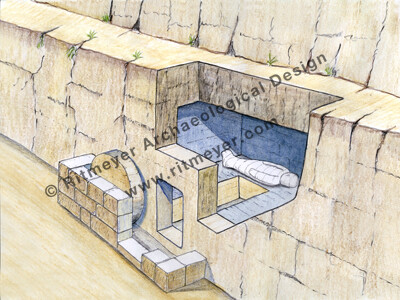
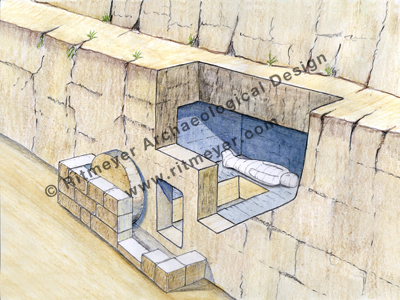
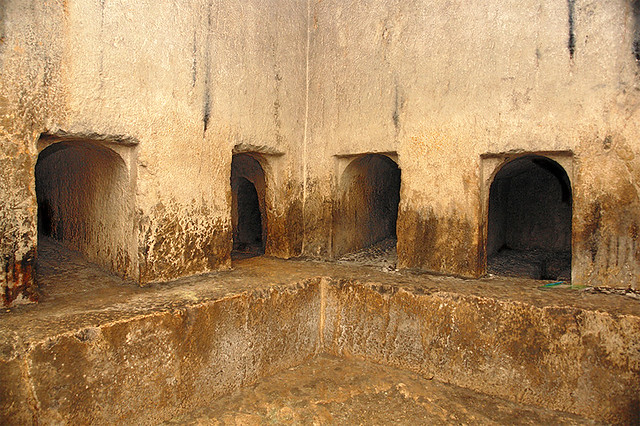
The other available option was a burial cave, either natural or man-made (completely man-made burial complexes were more rare and costly than natural caverns), which were family affairs, unlike the individual trench graves: the bones of generations upon generations could all be interred in a single cave. The basic design of these rock-cut tombs consists of a square or rectangular room with benches on three sides of the chamber, leaving a pit in the middle, and a low, narrow doorway which could be closed with a blocking stone, which could be either a round disk which could be rolled over the entrance, or more commonly, square/rectangular ‘plug-type’ stones). Some tombs could be more elaborate - for instance, having multiple chambers, decorated with carvings, and whatnot. Around the time of Jesus you also had tombs with shelves cut into the walls of the interior: one type of shelf is called the arcosolia, which has a bench-like aperture (known as an arcosolium) with an arched ceiling hewn into the length of the wall. Another is the loculus or kokh, a narrow shaft running perpendicularly back from the chamber wall.

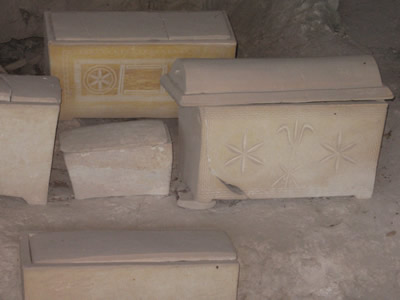
In this scenario, the body of the deceased would usually first be laid on the bench, a shelf (arcosolium) or on a niche (kokh) inside the burial chamber and left there, allowing the flesh to rot (the Jews did not practice embalming) until it has totally decomposed - something which is usually considered to occur within the space of a year. Sometimes the body could even be placed on a sort of coffin when it is placed on the shelf. This is what is known as primary burial. At the following year, once the flesh had decomposed, family members would return to the tomb and practice the continuation of the funerary rite known as secondary burial, which involves taking the bones and reinterring it in some way, either by depositing it in a specially-designated area somewhere inside the tomb or - more common at the time of Jesus - in stone boxes called ossuaries, which would then be also placed on a certain spot inside the burial chamber, in the loculi or on the benches.

http://rsc.byu.edu/sites/default/files/image/Religious Educator/4 1/image019.gif
Single-chamber tomb from Herodian period, located at Gilo, Jerusalem, shown with (square) blocking stone

http://rsc.byu.edu/sites/default/files/image/Religious Educator/4 1/image020.gif
Single-chamber tomb (Tomb of Caiaphas) from Herodian period with kokhim, located at Jerusalem, Peace Forest
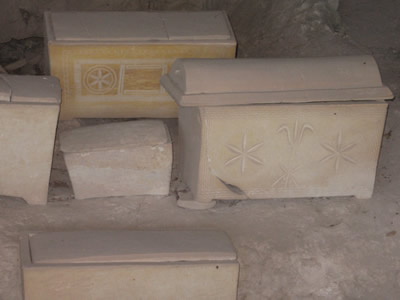

Ossuaries

http://rsc.byu.edu/sites/default/files/i4.jpg
Tomb with the corpse in an arcosolium and ossuaries on shelf and loculi

Kokhim atop benches


The tomb of Joseph of Arimathea where Jesus was buried, a newly-hewn tomb (Matthew 27:60; Luke 23:53; John 19:41), would have probably looked like this. You can notice that only the benches are present: the first stage in tomb construction is the cutting out of the chamber with the benches on three sides. Other chambers and niches and shelves could then be added.

BTW, archaeologists have recently found the tomb of a 1st century man in Jerusalem who was afflicted with leprosy and tuberculosis, but was clearly a man of means - for one, our man was buried in an ornamented burial cave, had a well-groomed (no traces of lice), short-cropped hair, was apparently buried in burial cloths of some quality, and was buried close to other tombs of importance, notably the tomb of Annas/Ananus (cf. Josephus, War 5.506). Given the nature of the diseases however, the man’s family did not return to practice secondary burial, but left him lying inside the tomb’s kokh (which was where his bones and the fragments of his burial shroud were found) and apparently had the entrance to the tomb completely sealed with plaster.

http://jamestabor.com/wp-content/uploads/2009/12/ShroudDrawing.jpg

 
Very interesting thread idea! I haven’t been here since Ash Wednesday, so I haven’t seen these new posts on this old thread.

I have a question (that’s not related to Easter, however :p):

I apologize if this question has been asked previously, but I was wondering: why/how exactly would Israelite/Jewish women (or men, also applicable) cover their hair? Was it required (like a modern example: the burqa in Afghanistan during the rule by the Taliban), or was it simply custom and they could show their hair?

I’ve always heard that it was for modesty and humility (in front of God), but I’ve never read anything more specific (if I have, I’ve forgotten it).
 
Question: why do Christian men pray with their head uncovered while Jews pary with theirs covered?
 
Very interesting thread idea! I haven’t been here since Ash Wednesday, so I haven’t seen these new posts on this old thread.

I have a question (that’s not related to Easter, however :p):

I apologize if this question has been asked previously, but I was wondering: why/how exactly would Israelite/Jewish women (or men, also applicable) cover their hair? Was it required (like a modern example: the burqa in Afghanistan during the rule by the Taliban), or was it simply custom and they could show their hair?

I’ve always heard that it was for modesty and humility (in front of God), but I’ve never read anything more specific (if I have, I’ve forgotten it).
Many women - especially married women - wore veils first off, because it was the customary style of dress in the area, and second, because doing so was thought to be a sign of modesty: any married woman with her hair disheveled or exposed to public view would have been seen as promiscuous, especially in the light of the sotah’s (errant woman) hair being disheveled ceremonially (Numbers 5:11-31). Now note that covering the head wasn’t peculiar to Jewish women, note; in the eastern Empire many women wore veils in public, and Jewish women would hardly have been distinctive. In fact, there seems to have been no specifically ‘Jewish’ dress that easily set them apart from gentiles: Jews at the time wore clothing that are more or less similar to what other peoples in that part of the world were wearing. Especially in the Diaspora, Jews living outside Palestine would have not looked any different from their non-Jewish neighbors or from other ‘Easterners’.

http://img706.imageshack.us/img706/1344/synagoguefrescomosesres.jpg
 
Here’s a quote from Martin Goodman’s Rome and Jerusalem: The Clash of Ancient Civilizations:

According to the Babylonian Talmud, it was a religious duty for all Jews, men as well as women, to wear special clothes on the Sabbath: “your Sabbath garments should not be like your weekday garments…” In general, however, expenditure on personal appearance was assumed by Jews to be a characteristic of women rather than men. Jewish clothing, apart from the uniforms of the priests and Levites, seems to have been the same as that of others in the eastern Mediterranean. It would be wrong to imagine the Jewish tallit as an identity marker similar to the distinctively Roman toga; tallit in Hebrew means simply “cloak” and the use of such a garment as a dedicated prayer shawl did not begin until after late antiquity. The biblical prohibition on wearing garments manufactured from wool and linen, stated simply as a general law in Deuteronomy, was explained by Josephus as a way to preserve the unique status of the priesthood: such raiment “is reserved for priests alone.” That priests did indeed wear clothes made from such materials is confirmed in the Mishnah. When the Pharisees chose to “make broad their phylacteries and enlarge the borders of their garments,” they did this in order “to be seen of men;” but such ostentation must have been unusual for it to be alleged that it attracted Jesus’ criticism, and it is probably significant that no gentile pagan source betrays any knowledge of this distinctive Jewish custom. The Jewish figures in the frescoes from the synagogue at Dura-Europus have fringes on the corners of some of their cloaks, but if this reflected standard male Jewish practice, the fringes must have generally been discreet. Jewish men did not specially cover their heads. The dress of Jewish women also seems to have been much the same as that of gentile contemporaries; the Christian Tertullian remarked in Carthage at the end of the second century CE that Jewish women could be recognized as Jews by the fact that they wore veils in public, but it seems likely that such veils, common in the eastern Mediterranean, marked them out less as specifically Jewish than as simply oriental in the Roman West, where women were generally unveiled. According to the Mishnah it was regarded as immodest and shaming for a woman to wear her hair loose. The Mishnah refers to types of jewellery that a woman should not carry on a Sabbath: “She may not go out…with forehead-band or head-bangles if they are not sewn, or with a hairnet…or a necklace or nose-rings…”

http://www-neu.bibelwissenschaft.de.../image/am_WILAT_Samuel_Abb_3_Dura_Europos.jpg

Too much pride by males in their long hair was dangerously immoral, as the story of Absalom showed: he gloried in his hair, so he was hanged by it. A few hairstyles were specially forbidden by the rabbis in the Tosefta on the grounds that they looked too gentile and therefore smacked of idolatry or magic: “What are the matters which constitute ‘the ways of the Amorites?’ He who trims the front of his hair, and he who makes his locks grow long, and he who makes a baldness in front for a particular star…” But these restrictions are the exception that prove the rule, that Jews generally looked like non-Jews. Romans often noted that foreign peoples looked different from themselves, but (apart from male circumcision) they never noticed this of the Jews. One passing remark by a Roman author does, however, suggest that some Romans thought Jews had a distinctive smell: the historian Ammianus Marcellinus recorded in the fourth century CE a comment of the philosopher Marcus Aurelius in the second century CE about the Jews as malodorous. This was not a standard form of abuse of other people in the Roman world. It may even have some basis in a real difference. If modesty requires more clothing, in a hot climate old sweaty clothes may become smelly. If everyone smells equally, no one notices, and the issue of body odour (except of tanners) fails to surface in the Jewish texts.
 
Shaye J.D. Cohen’s The Beginnings of Jewishness provides a little more comprehensive information about factors that did not make Jews distinctive in the ancient world. We’ll just quote two elements - looks and clothing (N.B. I did not include most of the footnotes; if anyone would like to see them you could click on the link and read the preview for yourself; pages 28-34).

I begin with a discussion of those factors that did not render Jews distinctive. Many Greek and Roman authors talk about Jews and Judaism, usually focusing on those characteristics that make Jews and Judaism peculiar, different from what these authors take to be “normal.” 8 It is striking to note, then what these authors do not say. Not a single ancient author says that Jews are distinctive because of their looks, clothing, speech, names, or occupations. I shall now discuss each of these points.

LOOKS

The Romans, and the Greeks before them, noted that foreign peoples often looked different from themselves: they were peculiarly tall or short, hairy or smooth, dark or fair. The Romans also noted peculiar styles of hair and beard. 9 But not a single author comments on the distinctive size, looks, or coiffure of the Jews. In Europe from the high Middle Ages until the early modern period, Jewish men were recognizable by their beards. The Cistercian abbot Richalm of Schöntal (early thirteenth century) said that he was sometimes called a Jew because of his beard; in 1748 Emperor Frederick II of Prussia forbade Jews from shaving their beards, so that they could not pass as gentiles. But no ancient author comments on the Jewish beard. 10 The rabbis prohibited a certain type of haircut because in their estimation it was quintessentially gentile, an “Amorite custom,” and in one rabbinic legend a rabbi adopts this haircut precisely in order to be able to pass as a gentile, infiltrate the councils of state, and thwart some anti-Jewish decrees; perhaps we might conclude that at least some rabbis followed this prohibition, but we surely cannot conclude that non-rabbinic Jews did. 11 In any case even the rabbis do not enjoin a distinctive Jewish hairstyle. Apparently Jews looked “normal.” 12

Papyri of the Ptolemaic period regularly contain descriptions of the physical appearance of parties or witnesses to contracts. A few such descriptions of Ioudaioi are extant:

  1. *]Apollōnios, aged about thirty-five, tall, honey-colored skin, with rather bright eyes and protruding ears
    *]Sōstratos, aged about thirty-five, of middle height, honey-colored skin … with a scar over his right eyebrow
    *]Jōnathas, aged about …, of middle height, honey-colored skin
    *]Apollōnios, aged about thirty-eight, of middle height, honey-colored skin
    *]Philopatros, aged about fifty-three, … honey-colored skin, long-faced, with a scar …, a bald forehead
    *]Diagoras, aged about …, of middle height, honey-colored skin, round-faced, snub-nosed, somewhat nearsighted
    *]Nikopolē, aged about twenty-two, of middle height, honey-colored skin, broad-faced, … mouth
    *]Dōsitheos, aged about thirty-five, of middle height, honey-colored skin, a bald forehead, long-faced
    *]Dōsitheos, aged about thirty-eight, of middle height, honey-colored skin, a bald forehead, with light eyes, no hair on the face
    *]Philoumenē, aged about fifty, of middle height, honey-colored skin, round-faced, a mole on the chin on the right side, a scar under …
    *]Pythoklēs, aged about …, tall, dark-colored skin, with deeply set eyes, a mole on the neck on the left side
    *]Menestratos, aged about thirty-six, of middle height, honey-colored skin, long-faced, a mole on the cheek near the nose on the right side
    *]Philistiōn, aged about …, tall, honey-colored skin, long-faced, a scar on the right eyebrow
    *]Theodoros, aged about twenty-x, of middle height, honey-colored skin, straight-nosed, with deeply set eyes 13

    There is nothing “Jewish” about any of these descriptions. 14 A distinguished papyrologist writes: “Nothing we find here [in these descriptions] … can help us distinguish a Jew from a Greek.” Circumcision was, of course, the one obvious corporeal indication of Jewishness, but Ptolemaic descriptions of free persons list only features visible on the head and neck; apparently it was unseemly to inspect the body of a free person any more closely. 15 In a society in which public nudity was uncommon, and the inspection of the bodies of free persons was deemed inappropriate, circumcision, or its absence, was not a usable marker of identity. I shall return to this below.

    12 Cf. M. Smith, Studies, 1.100: “I do not recall any ancient reference to a man’s being recognized, from his physical appearance, as a Jew, except when the recognition was an inference from circumcision.” Marcus Aurelius (cited by Ammianus Marcellinus, in M. Stern, Authors no. 506) is said to have noted a peculiar Jewish odor or stench (Iudaeorum fetentium). The idea that Jews have a peculiar smell will recur frequently in the Middle Ages, but no one in antiquity suggests that Jews are recognizable by their odor! The notion that Jews look different—that is, different from other white Europeans—by reason of their hair, skin, face, or nose became widespread only in the nineteenth century, although the notion has roots in earlier medieval conceptions. See the numerous works of Sander L. Gilman on the body of the Jew in the nineteenth century— for example, Sander Gilman, “The Jewish Nose: Are Jews White? Or, The History of the Nose Job,” in The Other in Jewish Thought and History, ed. Laurence Silberstein and Robert Cohn (New York: New York University Press, 1994) 364-401.
 
Status
Not open for further replies.
Back
Top