The Minor, Trivial Stuff Thread

  • Thread starter Thread starter patrick457
  • Start date Start date
Status
Not open for further replies.
P

patrick457

Guest
To give many people a break from the oft-heated (fiery!) debates of this subforum, I’d like to open this thread. Now by “minor stuff” I mean the small, ‘trivial’ things related to the Bible that never make it in serious high discussion; say, things like “how were Biblical Jews clothed?” or “What was a Roman soldier’s armor like?” or “How did houses look like?” or even “Were there already tallitot in those days?”

Now, does anybody have a suggestion as to what ‘minor’ thingie we shall tackle first? Anyone? 🙂
 
okay, what’s a “tallitot”?
Ack. 😛 Tallitot is the Hebrew plural of tallit (taleisim is the Yiddish plural; the singular is tallis), the “prayer shawl” with the four tzitzit (fringes) on the corners most commonly identified with Jews.
 
Ack. 😛 Tallitot is the Hebrew plural of tallit (taleisim is the Yiddish plural; the singular is tallis), the “prayer shawl” with the four tzitzit (fringes) on the corners most commonly identified with Jews.
Thank you. I have learned something new already today:thumbsup:

I always wondered who went with Mary when she went to visit Elizabeth after the Annunciation. And did they know she was pregnant? That was a long trip for a young pregnant girl!
 
That’s something I also wondered about. :o It could be likely that she went with a caravan en route to Judea Province (some have estimated that it would take a three to five days’-journey from Nazareth to Judea’s hill country), which was pretty much normal in those days as travelling alone was very dangerous, what with the highway brigands and other dangers of the way. Also, there’s the fact that Mary is a woman - ancient Middle Eastern women can never do anything by themselves in that culture unless watched by a male relation or in a group with other women.

================

Now, since it’s been already asked, a bit on the tallit:

As of now, it is doubted whether Jews of the 1st century actually had something similar to the modern-day tallit (despite the quite-popular image of the Pharisees proudly sporting them); what we know is that its modern-day form only came up later than the time of Jesus. In the 1st century it was a sign of grief or humility for a man to cover his head, but many men and women did have headcoverings for the practical purpose of shielding themselves from the weather. The Jewish custom of covering the head for prayer did not arise until around the 3rd and 4th century AD.

If we look at Numbers 15:38-40, the commandment is to place fringes on “the corners of their garments”; surely enough, the finds at the Cave of Letters included tzitzit on the cloaks. Note that there’s not much difference and Jewish cloaks and non-Jewish ones* (in fact, the term tallit is thought to come from the Latin word stola!); its the tassels that give them away. Jesus, being a good Jew, most likely had tzitzit in His cloak, the “edge” which the hemorrhaging woman touched (Luke 8:44).

It is said that the tallit is created so that the commandment would never vanish from Jewish life. As time went on and fashions changed, in many places there was no longer a four-cornered garment in which to attach the tzitzit, so public wearing of the fringes disappeared. Some rabbis were concerned that the commandment might become extinct and suggested that the Jews at least wear a piece of clothing with the tassels in prayer (there’s also another tallit which serves as an undergarment, the tallit katan). Since the main purpose of the tallit is to hold these fringes, I think it is rather redundant if they had tallitot like modern-day ones back then (and hey, the bigger ones do kind of look like cloaks! :))

 
Quote:
I always wondered who went with Mary when she went to visit Elizabeth after the Annunciation. And did they know she was pregnant? That was a long trip for a young pregnant girl!


I would say her parents and I would say she told them all about it :blushing: C
 
Since we’ve talked about the tallit, let’s now go over to the phylacteries, or the tefillin. The form of the tefillin cases we are all familiar with today are a pair of box-shaped compartments containing Biblical verses, like in the picture below:


Even so, the tefillin housings found at Qumran, seen below, (dating ca. 1st century BC-1st century AD) look more like flattish rectangular leather pouches with one or more small compartments where the slips would be placed (also this one).


There’s also a minor difference in the choice of Scripture. Modern tefillin usually contain the following four passages, all of which include a reference to the commandment of tefillin:
  • Exodus 13:1-10
  • Exodus 13:11-16
  • Deuteronomy 6:4-9
  • Deuteronomy 11:13-21
Even so, based on the discoveries of ancient tefillin, we can see that phylacteries also contained the text of the Ten Commandments (Deut. 5:1-6:3), at least before the early 2nd-century Mishnaic reforms. The Talmud (both the Babylonian and the Jerusalem) testify to the fact that reciting the Ten Commandments in daily morning prayer was struck before the end of that century in order to counter the minim (“heretics”), who claim that only the Decalogue was given to Moses on Sinai instead of the whole Torah:

We have learnt elsewhere: The deputy high priest said to them [the priests], “Say one benediction,” and they said the benediction and recited the Ten Commandments, the Shema’, the section “And it shall come to pass if ye hearken diligently” (Deuteronomy 11:13ff.), and “And the Lord said” (Numbers 15:37ff.), and recited with the people three benedictions, viz., “True and firm” (Emet ve’yatziv, the benediction following the Shema’), [the benediction of the 'Avodah (Avodah - Blessing Seventeen of the Amidah), and the priestly benediction (Numbers 6:24-26). On Sabbath they said an additional benediction for the outgoing watch…

They recited the Ten Commandments, the Shema’, the sections “And it shall come to pass if ye diligently hearken”, and “And the Lord said”, “True and firm”, the 'Avodah, and the priestly benediction.
Rab Judah said in the name of Samuel: “Outside the Temple also people wanted to do the same, **but they were stopped on account of the insinuations of the Minim.****”

*To say the Ten Commandments before the Shema’. (footnote)
*That the Ten Commandments were the only valid part of the Torah. (footnote)

-Babylonian Talmud, tractate Berakhot folio 11-12a

We can now see and understand why Jesus complained that the Pharisees “make their phylacteries broad (platynousin, ‘to broaden’ or ‘to make wide’)” and how they are able to do it.

Does anyone have any more good suggestions? 🙂
 
Just to lift this up with a very minor information.

In 1960, Israeli archaeologist Yigael Yadin discovered a cave located in the Dead Sea area, near Ein-Gedi, that contained one of the largest caches of ancient documents and personal correspondence dating from the time of Bar Kochba, known as the Cave of Letters. Along with the letters, he also found fragments of clothing and footwear - the only material remains we have of Jewish clothing of the period.

Contemporary evidence testifies that at the time of Jesus, the basic items of Jewish clothing was not too different from what the other inhabitants of the Greco-Roman world have been wearing - indeed many of the names of clothing in Hebrew were loanwords from Greek or Latin. What set the Jews apart from other peoples are the laws of shatnez (the prohibition of wearing a fabric containing both wool and linen) and tzitzit (applying tassels on the four corners of the mantle).

The tunics (haluq) found in the Cave of Letters were sleeveless, woven in two pieces and joined at the shoulders, leaving an opening for the neck (hence the Hebrew name, from heleq). This method had a ritual advantage: if one piece of the tunic becomes ritually defiled, the other piece would not be afftected by this impurity. The wearer could just remove the ‘unclean’ piece and replace it with a fresh one. The garment is considered finished when the pieces are sewed together and the neck hole finished. It is worth noting that most of the tunics found (except for one child’s linen shirt) were all made of wool - none of the linen textiles in the site had colored, decorative patterns.

Most of the tunics found also bore two parallel strips woven on the tunics, spaced widely apart, so that they descend from the shoulders: these are the clavi, which is one characteristic of tunics in the Roman period. Yadin has demonstrated that these stripes are referred in the Talmud under the name 'imrah.

http://img340.imageshack.us/img340/7466/synagoguefrescoexoduscbf.jpg
Moses (in tunic and cloak) parting the Sea, from the mid-3rd century synagogue of Dura Europos. Note the clavi on Moses’ tunic.

Over the tunic is worn the tallit. As noted in a former post, the tallit of the period were not similar to the prayer shawls of modern-day Jews (of which it is probably a descendant); these were true cloaks - a huge rectangular sheet which one wraps around oneself, with the tzitzot attached to the four edges. These were worn by all men, but people of rank (scholars or those who led in prayers) had larger, finer cloaks than those of commoners. The scholar’s tallit was so big that it completely covered his tunic.

The cloaks in the Cave of Letters were decorated with notched bands, checkerboard patterns, gamma-shaped designs (at the corners), and what appears to be weaver’s marks. The gamma pattern is mentioned in the Talmud Yerushalmi:

There is a colored bent piece like a Greek gamma, one thread to this direction, the other to the other direction, which forms a sign…that is to say, that [the weaver] when he weaves, he forms ornaments like letters…as if he is found to be writing.

These probably have no symbolism and were just decorative patterns.

http://img340.imageshack.us/img340/6218/800pxbaptisteryarians11.jpg
Mosaic depicting the Apostles, from the Baptistery of the Arians in Ravenna (5th-6th century AD). They are shown as wearing long, sleeved tunics with clavi and mantles with H- and gamma-shaped designs at the corners.

As for colors, the evidence we have suggests that women’s clothing tend to be more colorful than men, who usually wore white or off-white clothing (with colored bands) - note the depiction of Moses above. The Sifre to Deuteronomy (115b) in fact states that “a woman shall not wear a man’s white garments and a man shall not wear colored garments.” Jewish women, however, were apparently not allowed to wear red garments - which were seen as symbolizing menstrual blood (again note ritual impurity!) and as the color of gentile women.

 
I believed that the forbidden fruit were birds eggs when I was very young. And I haven’t found a better idea.

I wondered whether the stone selected by David from the stream to slay Goliath might have been a hollow geode which contained a vacuum, and sucked out part of his brain when it struck the giants head.

I thought that perhaps Jesus was the dove that was slain when Adam founded the world by biting into the egg.

Jesus said that salt could lose its savor, but I think that if you can not taste salt your body needs salt so you shouldn’t throw it away.

Paul could not tell whether he had ascended to heaven or not because he returned to the same place and position. He was dreaming I guess.

The bronse bath in Kings which held 2000 bath of water was not constructed to give a measure of pi. It has a brim around it and the circumference was measured under the brim with a line, which was also used to give the diameter across from brim to brim. If you do the calculation you can find the width of the brim. It was ten cubits across and thirty cubits round about under the brim.

I am sure I have other odd ideas, but its late now…
 
I believed that the forbidden fruit were birds eggs when I was very young. And I haven’t found a better idea.

I wondered whether the stone selected by David from the stream to slay Goliath might have been a hollow geode which contained a vacuum, and sucked out part of his brain when it struck the giants head.

I thought that perhaps Jesus was the dove that was slain when Adam founded the world by biting into the egg.

Jesus said that salt could lose its savor, but I think that if you can not taste salt your body needs salt so you shouldn’t throw it away.

Paul could not tell whether he had ascended to heaven or not because he returned to the same place and position. He was dreaming I guess.

The bronse bath in Kings which held 2000 bath of water was not constructed to give a measure of pi. It has a brim around it and the circumference was measured under the brim with a line, which was also used to give the diameter across from brim to brim. If you do the calculation you can find the width of the brim. It was ten cubits across and thirty cubits round about under the brim.

I am sure I have other odd ideas, but its late now…
Well, in order to explain why there are images of an adult Jesus beside the child Jesus, I thought that He just somehow miraculously turned into a full-grown adult in a short period of time when I was a kid. 😛 (I don’t get the dove and the biting eggs though; where did you get those?)

As an aside, here’s 2 Corinthians 7 (where Paul speaks of “a man in Christ” - often identified as a reference to himself in the third person):

Boasting is necessary. Though it is not profitable, I will go on to visions and revelations of the Lord. I know a man in Christ who fourteen years ago – whether in the body I do not know, or whether out of the body I do not know; God knows – such a man was caught up to the third heaven. And I know such a man – whether in the body or out of the body I do not know, God knows – was caught up into Paradise and heard inexpressible words, which it is not lawful for a man to utter.
Of such a one I will boast; and of myself I will not boast, except in my weaknesses.
For even if I wish to boast, I will not be a fool, for truth I will say. But I refrain so that no one may think of me above what he sees me to be or hears from me, even considering the surpassing greatness of the revelations. Therefore, to keep me from being exalted above measure, a thorn was given me in the flesh, there was given to me a thorn in the flesh, a messenger of Satan to punch me, lest I be exalted above measure.
About this I asked the Lord three times that it would leave me; and He said to me, “My grace is sufficient for you, for might is perfected in weakness.” Therefore most gladly I will rather boast in my weaknesses, that the power of Christ may fix its dwelling on me.
 
On the term “rabbi

The Hebrew word rabbi literally means “my lord” or “my great.” At the 1st century, the word was merely an unofficial honorific, usually used for teachers (especially teachers of the Torah) or people of higher social rank. Other terms for wise men and Torah scholars in use were “sage” (Hebrew: hakham, plural hakhamim; Greek: sophos) or “father” (Aramaic: 'abba). Out of these, only rabbi was exclusively used for Jewish teachers; non-Jewish scholars and holy men were also applied the title of ‘sage’ and ‘'abba’ (the latter also being in use amongst Christians of the late Roman period).

It was only after 70 AD that the meaning of the word changed, when the focus of scholarly and spiritual leadership of the Jews shifted almost entirely to the sages of the Sanhedrin at the wake of the destruction of the Temple and the end of its cult. Only from that timedid the term ‘rabbi’ started to become an official title borne by scholars ordained by the Sanhedrin. Some scholars therefore object to calling Jesus ‘rabbi’ due to the implications of the term post-70 AD and prefer to label Him with the all-purpose ‘sage’ instead.
 
Geometer said:
Jesus said that salt could lose its savor, but I think that if you can not taste salt your body needs salt so you shouldn’t throw it away.
This isn’t about salt losing its taste in one person’s mouth. It’s about salt not being good salt anymore.

The Land and the Book by William McClure Thomson (published in 1860) talks about this. He went to the Holy Land and saw people make salt from the marshes and Dead Sea salt. It’s not pure sodium chloride, like you get from sea salt or salt mines. Because of all the impurities in it, it quickly effloresces and “loses its savor” when exposed to rain and sun, or stored next to the floor in a storage shed with an earthen floor. This wasted salt in storage is still salty enough to make soil infertile, so they carefully would throw it into the village street, where it would do no harm.

Apparently, they would also use salt in kilns, which would have to be changed every few months, and was also thrown into the village street once it became useless.

Pretty neat, huh!
 
This is turning into a very interesting thread, I must say. 🙂 Here’s one more subject I was rather fascinated about:

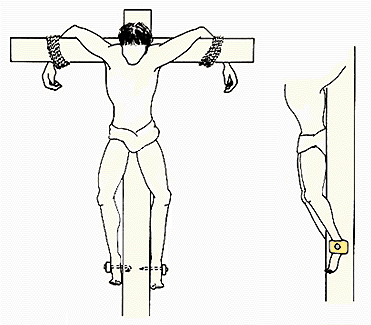
The Nails - Three or Four?
Part 1


(Warning: I link a lot in this post)

Most of us western Christians grew up looking at images of the crucifixion that show Jesus freewebs.com/catholicweb/Jesus-dies-on-cross-prose.jpg/"]being pierced with one nail over both feet. Sometimes we see images which have both feet nailed separately (for a total of four nails), but the three nails version is, for most of the time, definitive. Some people would even say that this is “traditional”, sometimes givine the impression that the four-nails version were somehow a novel variation.

One should note, however, that depicting only three nails is purely a medieval (this iconographic convention only started around the end of the 1st millenium), Western thing; Eastern icons (with a few Western-influenced exceptions) uniformly portray four nails being used to pin Jesus down to His cross. And here they are following a more ancient iconographic tradition which may have some basis in historical reality.

The oldest depiction of a crucifixion we have, the Alexamenos Graffito (dating from the late 1st-3rd century AD), clearly shows the crucified figure’s feet as being separate; see below. Other early images, such as a late 2nd-3rd century carved gem from Syria, a graffito found in Puzzuoli, another gem, and a relief from Santa Sabina in Rome (ca. 430-435 AD), follow suit in not showing the feet as being placed above the other.

http://upload.wikimedia.org/wikipedia/en/a/ab/Alexorig.jpg

This has passed on to Christian iconography, and people, both in the East and the West, were showing the Lord being pierced with four nails.

It was around the early part of the 13th century that most of Western art (with a few exceptions) began to represent the feet of Jesus as placed one over the other and pierced with a single nail. This convention had already existed for a century or two, but it was around that time when the three-nails version took hold in Western art.

Not all greeted this ‘novelty’ with open arms; in fact, this depiction showing three nails had actually caused some controversy when it was first introduced. For example, in the latter part of the 13th century, Lucas the bishop of Tuy in Iberia wrote in horror about the Cathars who carve “ill-shapen” images of the crucified Jesus “with one foot laid over the other, so that both are pierced by a single nail, thus striving to annul or render doubtful men’s faith in the Holy Cross and the traditions of the sainted Fathers.” The Cathars, based on Lucas’ report, apparently manufactured a cross composed only of the vertical post, the inscription, and the footrest without the horizontal beam - while showing Jesus pierced with three nails, one of which went on both feet. To all this, Lucas retorted that a proper cross must take the shape of overlapping arms and represent the four regions of the earth. Not only this, there were also complaints about the rather ‘new’ convention of showing Jesus as showing indications of suffering and death, in contrast to the serene and triumphant Christ many people back then were used to - Cardinal Humbert, infamous for placing the bull of excommunication in the Hagia Sophia, cried heresy upon seeing such a cross in Constantinople (Byzantine art started to show a closed-eyed Jesus with bowed head in the 9th-11th century AD).

(Continued next post)
 
The Nails - Three or Four?
Part 2


Now, it is unclear why the three nails version became predominant. It has been suggested that it was because of the symbolic/religious connotations of the number three that it became a popular choice for medieval artists in Eurpoe. By contrast, the Eastern Church was unaffected by all of this and continued to show four nails in most cases, even to this day. The four nails version also lasted a bit longer in medieval Italian art because of the strong Byzantine influence in it (Byzantine artisans were used in important projects throughout Italy, and Byzantine styles of painting can be found up through the 14th century), and also in Spanish art well into the Renaissance.

Now, we go off into the archeological evidence.

The only artifact we have of an ancient Roman crucifixion, found in 1968 in Giv’at ha-Mivtar, is that of the bones of a man called Yehohanan, who was executed in his twenties; more specifically, his right heel bone, pierced by an iron nail 11.5 centimerers in length. The nail penetrated the lateral surface of the heel bone emerging on the medial surface in which the distal end of the nail had become bent. The bending of the distal end of the nail upon itself suggests that after the nail penetrated the tree or the upright it may have struck a knot in the wood which made it difficult to remove from the heel when the victim was taken from the cross. Remains of olive wood found between the head of the nail and the heel bone suggest that prior to penetrating the heel bone the nail was driven through a wooden plaque (serving as a washer) so as to increase the head of the nail thus making it difficult for the victim to free his legs from the vertical post.

Anthropologist Professor Nicu Haas of the Hebrew University Medical School in Jerusalem examined the bones and originally came into the conclusion (1970) that both heels were affixed by one nail to the front of the cross, as in the reconstruction below. (As an aside, films such as The Last Temptation of Christ and The Miracle Maker follow Prof. Haas’ theory here, showing Jesus nailed very much in the same position as the below reconstruction).


However, in 1985, Joe Zias, then-curator of Archaeology/Anthropology for the Israel Antiquities Authority and Eliezer Sekeles reexamined the bones and found that many of the conclusions upon which Haas’ attempted reconstruction were made were flawed; for example, the nail which he reported to be 17-18 centimeters long was but 11.5 centimeters, thus making it anatomically impossible to pierce two heels with one nail. It is instead proposed that both heels may have been nailed - one on the left side, one on the right side (interestingly, the Visual Bible’s The Gospel of John follows this version; as of now the only film daring to do so). In light of the iconographic evidence, Zias’ hypothesis of how Jehohanan was crucified might lead credence to the four-nails depiction:

 
Geometer said:

This isn’t about salt losing its taste in one person’s mouth. It’s about salt not being good salt anymore.

The Land and the Book by William McClure Thomson (published in 1860) talks about this. He went to the Holy Land and saw people make salt from the marshes and Dead Sea salt. It’s not pure sodium chloride, like you get from sea salt or salt mines. Because of all the impurities in it, it quickly effloresces and “loses its savor” when exposed to rain and sun, or stored next to the floor in a storage shed with an earthen floor. This wasted salt in storage is still salty enough to make soil infertile, so they carefully would throw it into the village street, where it would do no harm.

Apparently, they would also use salt in kilns, which would have to be changed every few months, and was also thrown into the village street once it became useless.

Pretty neat, huh!
Israeli salt has always been the worlds finest. It is not simply sodium cloride, which is ancient chineese salt famous for being of the lowest quality and the cheapest salt.

I believe that Jesus said what he said because he worked outside in the heat and many times suffered from salt loss through sweating. If you can not taste the saltiness of salt you are suffering from low salt levels and you need to eat salt.

Kosher salt is complete biological salt it contains all of the necessary salts, clorides and what not, for human health.
 
“Impurities” in this case is just a chemical term for having other stuff than just NaCl present.
For example, you can pay a lot of money for mineral water that’s good for your health and tasty. Mineral water to a chemist would be water full of “impurities”, because it’s not just water; it has minerals in it. It doesn’t mean it’s bad for you, or not kosher, or anything like that.

If the Victorian guy was wrong in his observations of salt in his day, fine; but those crazy Victorian travel writers tended to be excruciatingly accurate about stuff like this.
 
“Impurities” in this case is just a chemical term for having other stuff than just NaCl present.
For example, you can pay a lot of money for mineral water that’s good for your health and tasty. Mineral water to a chemist would be water full of “impurities”, because it’s not just water; it has minerals in it. It doesn’t mean it’s bad for you, or not kosher, or anything like that.

If the Victorian guy was wrong in his observations of salt in his day, fine; but those crazy Victorian travel writers tended to be excruciatingly accurate about stuff like this.
To complement this, I just found something interesting in the footnotes of the New English Translation:

The difficulty of this saying is understanding how salt could lose its flavor since its chemical properties cannot change. It is thus often assumed that Jesus was referring to chemically impure salt, perhaps a natural salt which, when exposed to the elements, had all the genuine salt leached out, leaving only the sediment or impurities behind. Others have suggested that the background of the saying is the use of salt blocks by Arab bakers to line the floor of their ovens; under the intense heat these blocks would eventually crystallize and undergo a change in chemical composition, finally being thrown out as unserviceable.
A saying in the Talmud (b. Bekhorot 8b) attributed to R. Joshua ben Chanania (ca. A.D. 90), when asked the question “When salt loses its flavor, how can it be made salty again?” is said to have replied, “By salting it with the afterbirth of a mule.” He was then asked, “Then does the mule (being sterile) bear young?” to which he replied: “Can salt lose its flavor?” The point appears to be that both are impossible. The saying, while admittedly late, suggests that culturally the loss of flavor by salt was regarded as an impossibility. Genuine salt can never lose its flavor. In this case the saying by Jesus here may be similar to Matt. 19:24, where it is likewise impossible for the camel to go through the eye of a sewing needle.
 
And well, since we’re talking about Jesus’ sayings:

The Millstone

The two most primitive methods of grinding grain were (1) by pounding it in a mortar, and (2) by rubbing it between two stones. In Numbers 11:8 both methods are mentioned as used for rendering the manna more fit for cooking. Numerous examples of both mill and mortar have been found in ancient excavations.

One common type of mill during the Old Testament was the hand-mill, consisting of two carved stones - usually of basalt. Although sizes varied, the bottom stone was rectangular in shape and had a flat or slightly concave surface. The miller knelt at one end of this stone, which sloped downward about 15 degrees away from the miller. The upper stone was smaller in size and fits into the hand. After placing the grain on the lower stone, the miller would rub the upper stone in a back-and-forth motion on the lower, applying downward pressure on the upper stone. The ground grain fell off the other end of the mill, forming a small heap (see Egyptian statuette below).

http://img15.imageshack.us/img15/7913/800pxlouvresantiquitese.jpg

Another type of handmill found in archeological digs were small rotary hand-mills which may indicate their use in the Levant around 1200 BC, but their use may have been very limited, primarily used to ground pigments. Rotary hand-mills were not in common use until about the Hellenistic period (ca. 330 BC-63 BC).

Grinding grain was usually performed by women or their female slaves - or even male prisoners - as a daily task, indicating the humble status of this job (cf. Exodus 11:5; Judges 16:21; Isaiah 47:2; Lamentations 5:3). For poor families the mill is a very valuable equipment: to lose it - even just the upper millstone - would be to deprive the already-penniless family the means of making its bread, which formed their basic diet. This is why the Israelites are forbidden to take a mill as a pledge against a loan (Deuteronomy 4:6). The sound of millstones grinding in the villages is actually common, almost expected; its absence is a bad sign, signifying catastrophe has befallen the community (Jeremiah 25:10; Revelation 18:22).

Some time around the 2nd or 1st century BC the so-called “donkey mills” (mylos onikos) were introduced and used alongside the smaller hand-mills (mylos). These were also composed of two parts but were much larger than those from former times, requiring the use of the donkey to turn what is called in Latin, the catillus (“hopper” or “skipper”). As the donkey walked in a circle, the grain was ground between this upper millstone and the lower, stationary stone - called meta. In this way large amounts of grain could be produced for commercial purposes. Many such mills were discovered in Roman areas such as in Pompeii and Ostia (where the catillus took the shape of a hollowed-out hourglass and the meta a bell shape with elongated sides), and a few in Israel also.

http://img27.imageshack.us/img27/5418/1220millstone.jpg
A basalt mill from Capernaum.

http://img146.imageshack.us/img146/5364/nazarethvillagemananddo.jpg
Operating a donkey mill used to crush olives (from Nazareth Village).

And whoever trips one of the little ones - of these who believe [in me], better is it for him if a donkey millstone were laid around his neck and he were thrown into the sea!

-Mark 9:42
 
Status
Not open for further replies.
Back
Top