
The Minor, Trivial Stuff Thread

  • Thread starter Thread starter patrick457
  • Start date Start date
Status
Not open for further replies.
I just found something interesting: the Philistine temple of Tell Qasile and its relation to the Samson story.

I’d apologize in advance for this post, as it would be very much like scraping the bottom of the barrel:

Sanitary arrangements varied widely in the ancient Mediterranean world, even during the time of the Roman empire. As many private homes of the time lacked toilet facilities, people either had to use a chamber pot or simply went outdoors into the streets when relieving themselves. The Bible itself refers to a male in a rather crass expression as one “who urinates against a wall” (1 Samuel 25:22, 34; 1 Kings 14:10).

Some cities were fortunate to have sewers running under the street, but house drains were rare. Cisterns were common, but susceptible to contamination. Refuse of all kinds, polluted water, and contaminated food created unsanitary conditions, which were responsible for a high infant mortality as well as deadly diseases. Available alternatives in some cities or homes include private or public latrines (usually adjacent to public baths), which were usually wood or stone seats built over a cesspool. When the cesspool fills up, a merchant is usually called upon to dispose of the waste and then sell it as fertilizer. Nothing then goes to waste - animal urine and dung were sometimes even used to dye clothing (one of the most primitive sources of dye! :eek:).

Meanwhile, Biblical Hebrew has a curious expression: “covering one’s feet”, appearing in two places within the Old Testament: Judges 3:24 and 1 Samuel 24:3. This is traditionally assumed to mean ‘sleeping’, but it is now thought that this phrase is a metaphor for relieving oneself. Before the advent of toilet seats - and even today in cultures which have squat toilets - the common position for defecation is to squat; hence the expression, because the feet would have been covered with the outer garments while in the squatting position (in an alternative explanation, “feet” is another euphemism for what is between them…) Let’s see the story of Ehud first:

And Ehud came to [Eglon] (and he was sitting upstairs in his cool roof-chamber). And Ehud said, “I have a word from God for you.” And he arose from his seat, and Ehud stretched out his left hand, and took the sword from his right thigh, and thrust it into his belly. And the hilt also went in after the blade, and the fat closed over the blade, for he did not draw the sword out of his belly; [and he went out to the [COLOR=“red”]parshedonah.] And Ehud went out at the misderonah, and shut the doors of the roof-chamber behind him, and locked it, and he went out out; and his servants came in and looked, and look! The doors of the roof-chamber were locked, and they said, “He is only covering his feet in the inner chamber of the wall.” And they waited until they were embarassed, and look, he did not open the doors of the roof-chamber. And they took the key and opened them; and look, their lord, fallen to the earth - dead!

The word parshedonah is a hapax legomenon and only occurs here. Suggestions as to what this is include a technical architectural term (indicating the place where Ehud went after he stabbed Eglon), Ehud’s back, or even his bowels/feces - the traditional rendering. Another hapax is the misderonah, traditionally rendered as “porch” or “vestibule”. Some think that it is based on a possible Akkadian cognate and may be yet another euphemism for Eglon’s toilet facility itself - Ehud made his escape through the toilet hole and out where all the waste may have been collected. For Eglon’s convenience, he would be expected to have a place at hand to relieve himself - the cool roof-chamber may have had just the place (was the room “cool”, i.e. well-ventilated to keep out unpleasant odors?).

(continued)
 
In 1 Samuel 24:1-5 we read that:

And it happened when Saul had returned from pursuing the Philistines that it was told him, saying, “Look, David is in the wilderness of Ein-gedi!” And Saul took three thousand chosen men out of all Israel and went to seek David and his men, on the face of the Tzur ha’Yaelim (Rocks of the Mountain-Goats). And he came to folds of the flock by the way, and there was a cave, and Saul went in to cover his feet; and David and his men in the sides of the cave were sitting. And the men of David said to him, “Behold the day about which YHWH said to you, ‘Behold, I am giving your enemy into your hand, and you shall do to him as it is good in your eyes.’” And David rose and cut off the edge of the upper-robe which is on Saul - secretly. And it happened afterwards that the heart of David struck him because he had cut off the edge of Saul’s robe.

As per to Deuteronomic law one must go outside of the camp to a designated when one relieves himself and bring a shovel to dig out a hole to serve as a latrine (Deuteronomy 23:12). Accordingly, Saul sought a place far away from his “camp”, from his soldiers and chanced upon a cave - which happened to be where David and his men are hiding. Without soldiers, without armor or weapons (he may have removed these), and busy communing with nature - Saul would not have been able to defend himself properly in case of an attack, hence David’s men egging the latter on.

Note that this encounter is different from another incident in which David also refuses to kill the then-vulnerable Saul (1 Samuel 26); in the latter account, Saul - within his camp - is sleeping along with his commander Abner.
 
In this case the saying by Jesus here may be similar to Matt. 19:24, where it is likewise impossible for the camel to go through the eye of a sewing needle.[/INDENT]
Enjoying this interesting thread!

Just a comment about the “eye of a sewing needle”. According to Father Anthony Mary as he explained in his homily,(Oct. 11) Jesus was speaking of the gates to ancient cities. There were larger gates that people with camels which were loaded with supplies, etc. could enter. Guards were posted to check what was coming into the city.

And then their were smaller gates where one could enter on foot. These were referred to as “needles” and there were mazelike passageways where the people had to enter single file.

These gates were also lower than the main gates, so it would almost be impossible to bring a loaded camel into the “eye of the needle.”

ewtn.com/vondemand/audio/latestadditions/seriessearchprog.asp?seriesID=9957&fldSeriesName=Today’s+Homily+(Archived+homilies

The homily begins at 9:15. The explanation for the gates begins at16:44.
 
Enjoying this interesting thread!

Just a comment about the “eye of a sewing needle”. According to Father Anthony Mary as he explained in his homily,(Oct. 11) Jesus was speaking of the gates to ancient cities. There were larger gates that people with camels which were loaded with supplies, etc. could enter. Guards were posted to check what was coming into the city.

And then their were smaller gates where one could enter on foot. These were referred to as “needles” and there were mazelike passageways where the people had to enter single file.

These gates were also lower than the main gates, so it would almost be impossible to bring a loaded camel into the “eye of the needle.”

ewtn.com/vondemand/audio/latestadditions/seriessearchprog.asp?seriesID=9957&fldSeriesName=Today’s+Homily+(Archived+homilies

The homily begins at 9:15. The explanation for the gates begins at16:44.
I’ve heard of that. While the story may make great sermon material, it is unfortunately just a rather old pious legend (it was already known in some form to Shakespeare since he makes a reference to it in Richard II [Act V, Scene 5]!) intended to explain what in the world Jesus was talking about; very much like the folded napkin story.

For one, there is no evidence in nonbiblical sources or in ancient commentaries that there was a narrow gate or a gorge in Jerusalem - or in any other ancient Near Eastern city - called “[eyes of the] needles”. Secondly, the metaphor of a big animal entering something small such as a needle’s eye is actually quite known and oft-used in Jewish literature - where it is understood as it is with no city gates are in view, a sort of paradoxical humor. For example, in a discussion of dreams in the Talmud, to explain that dreams reveal the thoughts of a man’s heart, the product of reason rather than the absence of it, a rabbi said (Berakoth 55b):

R. Samuel b. Nahmani said in the name of R. Jonathan: “A man is shown in a dream only what is suggested by his own thoughts, as it says, ‘As for you, O king, your thoughts came into your mind upon your bed.’ Or if you like, I can derive it from here: ‘That you may know the thoughts of the heart.’ (Daniel 2:29; 30)Rava said: “This is proved by the fact that a man is never shown in a dream a date palm of gold, or an elephant going through the eye of a needle.

As an aside, the Jerome Biblical Commentary explicitly denies it: “the figure of the camel and the eye of the needle means exactly what is said; it does not refer to a cable or a small gate of Jerusalem.” The ‘cable’ refers to a textual variant found in some late manuscripts (579, 1424 etc.) where kamilon (“cable, rope”; the one used to secure ships when docking) is substituted for kamēlon (“camel”), either accidentally, because the two words are quite homophonic, or on purpose, to soften the perceived difficulty of Jesus’ words.

Also, the apocryphal Acts of Peter and Andrew contains a reference to the parable, making it the setting for a rather humorous miracle:

There was a rich man named Onesiphorus who said: “If I believe, shall I be able to do wonders?” Andrew said: “Yes, if you forsake your wife and all your possessions.” He was angry and put his garment about Andrew’s neck and began to beat him, saying, “You are a wizard, why should I do so?
Peter saw it and told him to leave off. He said, “I see you are wiser than he. What do you say?” Peter said, “I tell you this It is easier for a camel to go through a needle’s eye than for a rich man to enter the kingdom of God.” Onesiphorus was yet more angry and took his garment off Andrew’s neck and cast it on Peter’s and haled him along, saying, “You are worse than the other! If you show me this sign, I and the whole city will believe but if not you shall be punished.
Peter was troubled and stood and prayed, “Lord, help us at this hour, for you have entrapped us by your words.” The Savior appeared in the form of a boy of twelve years, wearing a linen garment ‘smooth within and without’, and said, “Do not fear! Let the needle and the camel be brought.” There was a huckster in the town who had been converted by Philip; and he heard of it, and looked for a needle with a large eye, but Peter said, “Nothing is impossible with God; rather bring a needle with a small eye.” When it was brought, Peter saw a camel coming and stuck the needle in the ground and cried, “In the name of Jesus Christ crucified under Pontius Pilate I command you, camel, to go through the eye of the needle.” The eye opened like a gate and the camel passed through; and yet again, at Peter’s bidding.
 
Here’s a bit on Roman armor around Jesus’ time.

The helmets (galea) one most commonly sees on Roman soldiers on many modern-day Jesus films are based on Imperial-type helmets, which however may have come into use only around the mid-1st century. Around the late 1st century BC-early 1st century AD, the type of helmet most likely common was the Coolus helmet (first introduced around the 3rd century BC), produced from brass and, like the Montefortino type with which it co-existed, was a descendant of Celtic helmet types. It was fairly plain, except for some ridges or raised panels on the cheekpieces. It was globular or hemispherical in shape (some were spun on a lathe rather than hammered to shape) with a turned or cast soldered- or riveted-on crest knob.

http://img40.imageshack.us/img40/9626/coolc1.jpg
A Coolus-type C helmet.

Another cliche is that the soldiers are depicted as legionaries, wearing the lorica segmentata. However, it is more likely that most if not all the Roman soldiers in the Holy Land and mentioned in the Bible were auxiliaries, not legionaries. Judea at the time of Jesus’ birth was a client kingdom, ruled by Herod the Great under Rome’s authority. He probably had his own troops for security and general military needs, though Rome may have sent him temporary reinforcements when necessary. Eventually, around the time of the crucifixion Judea became a second-rank imperial province with Pontius Pilate as prefect. He was of equestrian rank, not a senator, and therefore could only control small legionary forces, and so in military situations, he would have to yield to his superior, the legate of Syria, who would descend into Judea with his legions as necessary. Pilate’s regular garrison was composed of small auxiliary forces of locally recruited men (most likely Syrians or non-citizens who spoke Greek) trained by Romans stationed regularly in Caesarea Maritima and Jerusalem such as the Antonia Fortress, and temporarily anywhere else that might require a military presence. There is a reference in the Bible to “the Italian Cohort”, apparently Cohors II Italica, composed (unlike most other auxiliary units) of Roman citizens from Italy. There is some evidence that the cohort in garrison at Jerusalem was a cohors equitata, with both infantry and cavalry. Some of the centurions may have been transferred from the legions as a means of promotion. Auxiliary soldiers often wore lorica hamata (mail armor) and used oval shields commonly known as clipeus.

http://www.woodlands-junior.kent.sch.uk/Homework/romans/images/soldiers/auxgroup.jpg

Also, unlike popular imagination thinks, soldiers would not have worn full armor, which served as their “uniform”, outside of combat and formal occasions, such as parades or combat exercises - it was, after all, heavy (however, in the above occasions they were required to wear it or experience some sort of punishment). The “minimum” uniform of the Roman soldier would have consisted of his sword belt, sword, dagger, and his caligae.
 
Nets

18:
Now as He is walking by the Sea of Galilee He saw two brothers: Simon called Peter, and Andrew his brother, casting a casting-net into the sea (for they were fishermen). 19: And He says to them, “Follow me, and I will make you fishers of men.20: And they, immediately, having left the nets, followed Him.
21: And going from there He saw other two brothers, James of Zebedee and John his brother in the boat with Zebedee their father, mending their nets. And He called them, 22: and they immediately - leaving the boat and their father - followed Him.

-Matthew 4

The “throwing-net” that Peter and Andrew were throwing in verse 18 (also cf. Mark 1:16) is called an amphiblestron, a circular bell- or pear-shaped casting net with an opening ten to twenty feet (3-6 metres) in diameter with small weights around the circumference of the opening. The amphiblestron was thrown out over the water, where the weights would pull the net to the bottom, catching any fish that might be under it. The fisherman would then wade out to the net, and gather it in. Poorer fishermen who did not own boats usually use this method of casting nets while standing at the seashore.

The “nets” that Peter and Andrew left and the one which John and James were mending are diktya (singular diktyon), the more general term for a fishing net in the NT and is sometimes used to define a sort of large seine, a vertical wall-like net with floats at the top and weights at the bottom that could be attached to the shore or to a boat while another boat dragged it out into the water in a semicircular arc and back again. The fish would then be trapped between the net and the shore line; the type of net that the disciples were using when they saw the resurrected Jesus (John 21:6ff). A type of seine (sagēnē) is specifically mentioned in a parable (Matthew 13):

47: Again, the kingdom of heaven is like a dragnet (sagēnē) cast into the sea and gathered of every kind, 48: which, when it was full, they drew it on the beach; and sitting down, they gathered the good into containers and throwing the worthless away.

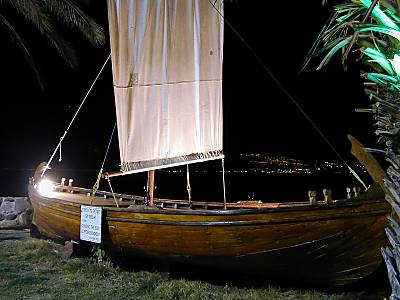
The Jesus Boat

http://img262.imageshack.us/img262/4781/boat2czyzy.jpg

In 1986, an ancient boat was pulled from the mud along the northwestern shore of the Sea of Galilee. The boat appeared due to a great drought during which the waters of the lake receded and was discovered by the brothers Moshe and Yuval Lufan, second-generation fishermen from Kibbutz Ginosar with an interest in archeology. The subsequent dig was undertaken by members of the kibbutz, the Antiquities Authority, and many volunteers. There was a rumor that the boat was full of gold, so the site of the dig had to be guarded night and day. Pulling the boat from the mud without damaging it - yet quickly enough to extract it before the water rose again - was a delicate process, lasting 12 days and nights. The boat then had to be submerged in a chemical bath for 7 years. This so-called “Jesus boat” (termed only because the boats Jesus’ disciples would have used were probably similar to this one) is now displayed in the Yigal Allon Museum (named after a politician who joined the kibbutz), 6km north of Tiberias.

The boat has been dated to 40 BC (plus or minus 80 years) based on radiocarbon dating, and 50 BC to 50 AD based on the pottery (including a cooking pot and lamp) and nails found in the boat, as well as hull construction techniques. The evidence of repeated repairs shows the boat was used for several decades, perhaps nearly a century. When its fishermen owners thought it was beyond repair, they removed all useful wooden parts and the hull eventually sank to the bottom of the lake.

The boat is made of 12 different types of wood and measures about 27 feet (8.27 meters) long and 7.5 feet (2.3 meters) wide, with a maximum preserved height of 4.3 feet (1.3 meters). It would have had a crew of five (four rowers and a helmsman) and could carry about 15 additional persons.

 
I’ve heard of that. While the story may make great sermon material, it is unfortunately just a rather old pious legend (it was already known in some form to Shakespeare since he makes a reference to it in Richard II [Act V, Scene 5]!) intended to explain what in the world Jesus was talking about; very much like the folded napkin story.

For one, there is no evidence in nonbiblical sources or in ancient commentaries that there was a narrow gate or a gorge in Jerusalem - or in any other ancient Near Eastern city - called “[eyes of the] needles”. Secondly, the metaphor of a big animal entering something small such as a needle’s eye is actually quite known and oft-used in Jewish literature - where it is understood as it is with no city gates are in view, a sort of paradoxical humor. For example, in a discussion of dreams in the Talmud, to explain that dreams reveal the thoughts of a man’s heart, the product of reason rather than the absence of it, a rabbi said (Berakoth 55b):

R. Samuel b. Nahmani said in the name of R. Jonathan: “A man is shown in a dream only what is suggested by his own thoughts, as it says, ‘As for you, O king, your thoughts came into your mind upon your bed.’ Or if you like, I can derive it from here: ‘That you may know the thoughts of the heart.’ (Daniel 2:29; 30)Rava said: “This is proved by the fact that a man is never shown in a dream a date palm of gold, or an elephant going through the eye of a needle.

As an aside, the Jerome Biblical Commentary explicitly denies it: “the figure of the camel and the eye of the needle means exactly what is said; it does not refer to a cable or a small gate of Jerusalem.” The ‘cable’ refers to a textual variant found in some late manuscripts (579, 1424 etc.) where kamilon (“cable, rope”; the one used to secure ships when docking) is substituted for kamēlon (“camel”), either accidentally, because the two words are quite homophonic, or on purpose, to soften the perceived difficulty of Jesus’ words.

Also, the apocryphal Acts of Peter and Andrew contains a reference to the parable, making it the setting for a rather humorous miracle:

There was a rich man named Onesiphorus who said: “If I believe, shall I be able to do wonders?” Andrew said: “Yes, if you forsake your wife and all your possessions.” He was angry and put his garment about Andrew’s neck and began to beat him, saying, “You are a wizard, why should I do so?
Peter saw it and told him to leave off. He said, “I see you are wiser than he. What do you say?” Peter said, “I tell you this It is easier for a camel to go through a needle’s eye than for a rich man to enter the kingdom of God.” Onesiphorus was yet more angry and took his garment off Andrew’s neck and cast it on Peter’s and haled him along, saying, “You are worse than the other! If you show me this sign, I and the whole city will believe but if not you shall be punished.
Peter was troubled and stood and prayed, “Lord, help us at this hour, for you have entrapped us by your words.” The Savior appeared in the form of a boy of twelve years, wearing a linen garment ‘smooth within and without’, and said, “Do not fear! Let the needle and the camel be brought.” There was a huckster in the town who had been converted by Philip; and he heard of it, and looked for a needle with a large eye, but Peter said, “Nothing is impossible with God; rather bring a needle with a small eye.” When it was brought, Peter saw a camel coming and stuck the needle in the ground and cried, “In the name of Jesus Christ crucified under Pontius Pilate I command you, camel, to go through the eye of the needle.” The eye opened like a gate and the camel passed through; and yet again, at Peter’s bidding.
Well, then it looks like Father Anthony Mary has it all wrong.

Can you unpack the “folded napkin story”?
 
Well, then it looks like Father Anthony Mary has it all wrong.

Can you unpack the “folded napkin story”?
Well, there are quite a lot of variations on the story, but one common version goes like:

The Gospel of John (20: 7) tells us that the napkin, which was placed over the face of Jesus, was not just thrown aside like the grave clothes. The Bible takes an entire verse to tell us that the napkin was neatly folded, and was placed at the head of that stony coffin. Is that important? You’d better believe it! Is that significant? Absolutely! Is it really significant? Yes!

In order to understand the significance of the folded napkin, you have to understand a little bit about Hebrew tradition of that day. The folded napkin had to do with the Master and Servant, and every Jewish boy knew this tradition. When the servant set the dinner table for the master, he made sure that it was exactly the way the master wanted it. The table was furnished perfectly, and then the servant would wait, just out of sight, until the master had finished eating, and the servant would not dare touch that table, until the master was finished.

Now if the master was done eating, he would rise from the table, wipe his fingers, his mouth, and clean his beard, and would wad up that napkin and toss it onto the table. The servant would then know to clear the table. For in those days, the wadded napkin meant, “I’m done”. But if the master got up from the table, and folded his napkin, and laid it beside his plate, the servant would not dare touch the table, because the servant knew that the folded napkin meant, “I’m not finished yet.” The folded napkin meant, “I’m coming back!”

He is Coming Back!

This purported Jewish custom has been debunked time and time again on the internet (some within the walls of this very forum! ;)) so I won’t go into lengths about it, but would just list a few of the problems with this story:
  • The story links the soudarion in Jesus’ tomb with a table napkin (also known as a serviette).
The story is based partly on the wording of the KJV and other older English translations, which render the Greek soudarion (from Latin sudarium, ‘sweat cloth’) as “napkin”. While the verb entylisso (‘to roll up’, ‘to twist’) is rendered “wrapped together”, two modern translations (the New King James and the New International) do use “folded” for the verb.
  • Despite what the story says (“every Jewish boy knew this tradition”), apparently no modern-day Jew has heard of or practices an equivalent custom, nor do we have any evidence for such a practice in ancient times! The closest thing one gets to it is an ancient custom in Jerusalem - according to the Talmud - where a cloth is hung over the door to let guests know that it was mealtime.
  • There’s also common sense: why would Jesus confuse a piece of cloth used to wipe sweat off the face or to cover/bind the face of the dead with a serviette (table napkin)?
 
Well, there are quite a lot of variations on the story, but one common version goes like:

The Gospel of John (20: 7) tells us that the napkin, which was placed over the face of Jesus, was not just thrown aside like the grave clothes. The Bible takes an entire verse to tell us that the napkin was neatly folded, and was placed at the head of that stony coffin. Is that important? You’d better believe it! Is that significant? Absolutely! Is it really significant? Yes!

In order to understand the significance of the folded napkin, you have to understand a little bit about Hebrew tradition of that day. The folded napkin had to do with the Master and Servant, and every Jewish boy knew this tradition. When the servant set the dinner table for the master, he made sure that it was exactly the way the master wanted it. The table was furnished perfectly, and then the servant would wait, just out of sight, until the master had finished eating, and the servant would not dare touch that table, until the master was finished.

Now if the master was done eating, he would rise from the table, wipe his fingers, his mouth, and clean his beard, and would wad up that napkin and toss it onto the table. The servant would then know to clear the table. For in those days, the wadded napkin meant, “I’m done”. But if the master got up from the table, and folded his napkin, and laid it beside his plate, the servant would not dare touch the table, because the servant knew that the folded napkin meant, “I’m not finished yet.” The folded napkin meant, “I’m coming back!”

He is Coming Back!

This purported Jewish custom has been debunked time and time again on the internet (some within the walls of this very forum! ;)) so I won’t go into lengths about it, but would just list a few of the problems with this story:
  • The story links the soudarion in Jesus’ tomb with a table napkin (also known as a serviette).
The story is based partly on the wording of the KJV and other older English translations, which render the Greek soudarion (from Latin sudarium, ‘sweat cloth’) as “napkin”. While the verb entylisso (‘to roll up’, ‘to twist’) is rendered “wrapped together”, two modern translations (the New King James and the New International) do use “folded” for the verb.
  • Despite what the story says (“every Jewish boy knew this tradition”), apparently no modern-day Jew has heard of or practices an equivalent custom, nor do we have any evidence for such a practice in ancient times! The closest thing one gets to it is an ancient custom in Jerusalem - according to the Talmud - where a cloth is hung over the door to let guests know that it was mealtime.
  • There’s also common sense: why would Jesus confuse a piece of cloth used to wipe sweat off the face or to cover/bind the face of the dead with a serviette (table napkin)?
Yes, I have heard the " I am coming back" back version of the story many times and have read that it has been debunked.

I just wondered if you knew the " rest of the story"?

What is the REAL significance? Was it really not folded? Just left with the rest of the burial cloth? Just an error in translation?
 
Yes, I have heard the " I am coming back" back version of the story many times and have read that it has been debunked.

I just wondered if you knew the " rest of the story"?

What is the REAL significance? Was it really not folded? Just left with the rest of the burial cloth? Just an error in translation?
John tells us:

So the two were running together, and the other disciple ran ahead faster than Peter and came first to the tomb. And bending down, he sees the linen cloths (othonia) lying, but he did not go in. And then comes Simon Peter following him, and goes into the tomb; and he sees the linen cloths lying and the soudarion which had been on His head, not lying with the linen cloths, but apart - rolled up (entetyligmenon) - in one place.

The condition of the graveclothes indicated was that the body of Jesus had not been stolen by thieves. Anyone who had come to remove the body would not have bothered to unwrap it before carrying it off. And even if one could imagine that they had, they would certainly not have bothered to take time to roll up the soudarion and leave the other wrappings in an orderly fashion - since Jesus was wrapped in expensive fine linen, they would probably have carried it off.

Some suggest that the linen cloths were still arranged just as they were when around body Jesus’ body (i.e. the bandages were still tied, etc.). In this case the reference to the soudarion being rolled up does not refer to its being folded, but collapsed in the shape it had when wrapped around the head. Sometimes in defense of this view the Greek preposition meta (which normally means “with”) is said to mean “like” so that the comparison with the other graveclothes does not involve the location of the soudarion but rather its condition (rolled up rather than flattened). However, it seems more probable that the phrase describing the face cloth should be understood to mean it was separated from the other graveclothes in a different place inside the tomb. This seems consistent with the different conclusions reached by Peter and the beloved disciple (vv. 8-10).

One of the major significance of the cloths, however, is the following contrast between Jesus and Lazarus. We read in the raising of Lazarus that (John 11:44):

And he who had died came out bound hand and foot with bands (keiriais), and his face tied around with a soudarion. Jesus says to them, “Loose him and let him go.

Note that while the raised Lazarus comes out of his grave, still covered and bound with his grave clothes (in fact, some, following St. Basil, think that Lazarus’ being able to go out in such a condition is a miracle in itself; but one need not imagine that the bindings were so restrictive) needing assistance, the raised Jesus just passed through His; His soudarion was even tidily rolled up and set aside on a corner as if there was no longer a use for it!

As an aside, in 2000, archaeologist Shimon Gibson found the remains of a man who suffered Hansen’s Disease (as well as tuberculosis) in the Hinnom Valley area who apparently died just around a few decades before Jesus. One of the reason why this discovery stands out is because the man is preserved in the condition in which he was interred; his bones were not collected by his family and put in an ossuary (as was customary at the time of Jesus) because he suffered leprosy, and people did not want to get infected. The bones were discovered bound in linen bandages; fragments of decomposed wool were also found, suggesting that the man was wrapped in a woolen shroud and then tied with the linen strips around the head, arms and legs (corresponding to the accounts of Lazarus’ and Jesus’ burial cloths).
 
John tells us:

So the two were running together, and the other disciple ran ahead faster than Peter and came first to the tomb. And bending down, he sees the linen cloths (othonia) lying, but he did not go in. And then comes Simon Peter following him, and goes into the tomb; and he sees the linen cloths lying and the soudarion which had been on His head, not lying with the linen cloths, but apart - rolled up (entetyligmenon) - in one place.

The condition of the graveclothes indicated was that the body of Jesus had not been stolen by thieves. Anyone who had come to remove the body would not have bothered to unwrap it before carrying it off. And even if one could imagine that they had, they would certainly not have bothered to take time to roll up the soudarion and leave the other wrappings in an orderly fashion - since Jesus was wrapped in expensive fine linen, they would probably have carried it off.

Some suggest that the linen cloths were still arranged just as they were when around body Jesus’ body (i.e. the bandages were still tied, etc.). In this case the reference to the soudarion being rolled up does not refer to its being folded, but collapsed in the shape it had when wrapped around the head. Sometimes in defense of this view the Greek preposition meta (which normally means “with”) is said to mean “like” so that the comparison with the other graveclothes does not involve the location of the soudarion but rather its condition (rolled up rather than flattened). However, it seems more probable that the phrase describing the face cloth should be understood to mean it was separated from the other graveclothes in a different place inside the tomb. This seems consistent with the different conclusions reached by Peter and the beloved disciple (vv. 8-10).

One of the major significance of the cloths, however, is the following contrast between Jesus and Lazarus. We read in the raising of Lazarus that (John 11:44):

And he who had died came out bound hand and foot with bands (keiriais), and his face tied around with a soudarion. Jesus says to them, “Loose him and let him go.

Note that while the raised Lazarus comes out of his grave, still covered and bound with his grave clothes (in fact, some, following St. Basil, think that Lazarus’ being able to go out in such a condition is a miracle in itself; but one need not imagine that the bindings were so restrictive) needing assistance, the raised Jesus just passed through His; His soudarion was even tidily rolled up and set aside on a corner as if there was no longer a use for it!

As an aside, in 2000, archaeologist Shimon Gibson found the remains of a man who suffered Hansen’s Disease (as well as tuberculosis) in the Hinnom Valley area who apparently died just around a few decades before Jesus. One of the reason why this discovery stands out is because the man is preserved in the condition in which he was interred; his bones were not collected by his family and put in an ossuary (as was customary at the time of Jesus) because he suffered leprosy, and people did not want to get infected. The bones were discovered bound in linen bandages; fragments of decomposed wool were also found, suggesting that the man was wrapped in a woolen shroud and then tied with the linen strips around the head, arms and legs (corresponding to the accounts of Lazarus’ and Jesus’ burial cloths).
Thank you.
 
And He is saying to [Avram], “I am YHWH who brought you out from Ur Kasdim to give you this land to possess.” But he is saying, “Lord YHWH, by what can I know that I will possess her?” And He is saying to him, “Bring me a heifer of three years, and a she-goat of three years, and a ram of three years, and a turtledove and a young pigeon.” And he is bringing to Him all these and is cutting them in two - in the middle - and putting each piece to meet his neighbor, but the birds he did not cut in two; and the birds of prey are coming down on the carcasses, and Avram is driving them away.

And the sun is going in, and a deep sleep fell upon Avram, and behold! Terror, a great darkness was falling on him; and He is saying to Avram, “Knowing you will know that your seed will be sojourners in a land not theirs, and they will serve them and they will oppress them for four hundred years; and the nation also whom they serve I will judge; and afterward they will come out with great possessions. And you - you will go to your fathers in peace; in peace you will be buried, in good grey-haired age. But in the fourth generation they will return here, for the sin of the Amorites is not yet complete.

And the sun went in and there was a thick darkness, and behold, a smoking firepot and a torch of fire which passed between these pieces. In that day YHWH cut with Avram a covenant, saying, “To your seed I give this land, from the river of Miztraim to the great river, the river Perat*, and the Qenite and the Qenizzite and the Qadmonite and the Hittite and the Perizzite and the Refayim and the Emorite and the Canaanite and the Girgashite and the Yevusite.*”

*Miztraim: Egypt.
*Perat: The Euphrates.

(Genesis 15:7-21)

Note that the Hebrew term for making a covenant is to “cut” one (karat berit). This derives from the common practice, common in Near Eastern cultures, of “cutting” one or more animals to ratify an agreement, such as in the treaty between Naram-Suen of Akkad (ca. 2190 – 2154 BC) and the Elamites (this treaty involved two doves and a bull). As a matter of fact, the Amorite expression for making a covenant (attested from Mari in Syria) is hayarum qatalum, “kill a donkey.” This was used in a treaty between the people of Hana and the people of Idamaraz (ca. 18th century BC):

I went…in order to kill a donkey foal between the Haneans and Idamaraz. They brought me a puppy and a goat, but out of respect for my lord I would not allow a puppy or a goat, so I insisted on sacrificing a donkey foal, the offspring of a female donkey. Thus I made peace between the Haneans and Idamaraz.

One Amorite site was even discovered to have sacrificial remains of birds, puppies (killed by breaking their necks), and donkeys. Texts from the Amorite city of Alalakh also talk of a curse taken while holding a torch, “the oath of furnace, grill, kiln, stove, brazier, or bellows”, as well as “an oath sworn by slaughtering a sheep and touching the wound”. In later periods, the practice eventually also came to include a ritual in which both parties would invoke a curse on themselves that if one of them failed to keep up with the agreement, they should be like the slaughtered animals (cf. Jeremiah 34:17-18).
 
Here are two interviews of interest with archaeological architect Dr. Leen Ritmeyer: What Did Calvary Look Like? and What Did Jesus’ Tomb Look Like?

I can do no better but to quote an excerpt about Joseph’s tomb here:

The fact that the tomb was a new one is hugely significant for the way in which archaeologists would try to understand the tomb layout. Tombs of the New Testament period usually consisted of several rock-cut chambers, which had burial and arched niches cut into the side walls. The first chamber was an entrance porch, while the other chambers had burial niches cut into the side walls for the burying of the dead. But multiple chambers would contradict the description of the tomb of Jesus in the gospels, for the women involved with the burial could apparently see the body from outside the tomb (cf. Matt. 22:61 and Luke 23:55). And John, while being outside the tomb and stooping to look inside, saw the linen grave clothes lying (John 20:5).

Over 1,000 tombs have been studied around Jerusalem, and we know now that the first stage in tomb construction is the cutting out of a single chamber with benches arranged along the three sides, leaving a pit in the middle, so that the workmen could stand upright while working. A tomb could be left like this for a while, until the other chambers were added.

Such a newly hewn tomb could be used for the first phase of burial, the so-called “primary burial,” where the body was laid out on a bench. A year or so later, when only bones were left, these were placed in “ossuaries” or bone boxes. This was called “secondary burial.”

As an answer to the question as to why the illustration for the ESV does not show niches carved on the wall of Joseph of Arimathea’s tomb:

The second phase in the development of a family tomb was the cutting out of a proper burial chamber. Such chambers had loculi (burial niches) where the body was put in. These niches were narrow and about 6 feet deep, so that a complete body could be put inside and the opening sealed off by a large stone. Higher up the wall, arched niches (arcosolia) were carved for the placing of the ossuaries. Once the tomb had reached this stage of construction, it could no longer be called a “newly hewn tomb.” It would be wrong therefore to portray burial niches in the Tomb of Joseph of Arimathea.
 
Here’s a really short, minor nitpick:

God did not punish the Israelites with forty years’ wandering because of the sin of the Golden Calf - contrary to Cecil B. DeMille! (At least, it was not the main reason for that).
 
Taken from another thread, with additions. This one’s going to be long, so it’s going to be a series.

About the Pharisees, Sadducees, Zealots, and Essenes

1.)
The Pharisees (Hebrew P’rushim, “those set apart”) were most likely one of the outgrowths of the Chasidim/Hasideans, an anti-Hellenistic Jewish movement that formed in the time of the Seleucid king, Antiochus Epiphanes (175–163 BC). The Pharisees were teachers who functioned as interpreters who made commentaries on the Law or copied Scripture.

Having members from different levels of society, including those from the unschooled humble origins, they dedicated their lives to the study and interpretation of the Tanakh. The social standing and beliefs of the Pharisees changed over time, such that the role, significance, and meaning of the Pharisees evolved as political and social conditions in Judea changed.

The Pharisees and their opponents the Sadducees were two of the earliest sects to emerge in the Second Temple period, as political factions during the Hellenist Hasmonean rule. At no time did any of these sects constitute a majority; most Jews were non-sectarian. However, Josephus indicates that the Pharisees received the backing and good-will of the common people, apparently in contrast to the more elite Sadducees associated with the ruling classes.

They enjoyed popular support and fame from the masses, because of their commitment and the fact that they could identify with them. Many Pharisees were normal commoners who live in simple homes and hold normal jobs for a living (St. Paul’s tentmaking or Shammai’s carpentry, for example), knowing well the daily toil and labor of other common folk. That, and the fact that they often distanced themselves from their rivals, the Sadducees - which the lower classes dislike due to their collaboration with Rome and due to the fact that the Sadducees were kind of like an exclusive club of the elite higher-ups in Jewish society. The Pharisees were a “people’s party”, so to speak: a party made up of common men for the common man, more open to the average joe (as evidenced by Jesus dining in the house of Simon the Pharisee) than the Sadducees are.

According to Josephus, the Pharisees also used this advantage of having the greater part of the population on their side to gain political influence and even to stir up the people against the higher authority. Because of all these they were thorns in the flesh for the aristocrats in Judea.

The Pharisees have a rather bad reputation in Christian history due to the sometimes-unflattering references to them in the Gospels, augmented by the fact that one possible meaning of the name is “those set apart”. They are often thus stereotyped in popular wisdom as pitiless, holier-than-thou people who keep aloof from the ‘commoners’ and do not have any shred of genuine goodness in them except for show - as the custom of calling a hypocrite ‘pharisee’ shows.

They were called “separatists”, but it is not entirely clear whom or what they are separated from. In a good or neutral sense the term could mean that the Pharisees were ‘set apart’ from normal society in order to observe the Law more rigorously, or that the Pharisees separated themselves from the (priestly/Sadducean) interpretation of the Law. In a negative sense, this could mean “heretics”: that is, people who ‘separated’ themselves from society because their practices were deemed illegimitate (in this case, the title is therefore a sort of slur or pejorative). Another hypothesis for the meaning of the word (based on the reasoning that the Aramaic root prsh could both mean “separate” or “interpret”) is that the name actually means “interpreters”, which fits in with the Pharisees having their own interpretation of the Law and were considered accurate interpreters of it.

Note that the Pharisees did not call themselves such. No Jewish group explicitly called themselves ‘Pharisees’. The authors of Rabbinic literature referred to themselves and their forebears as hakamim (“sages”, “scholars”) or - in post-70 AD Judaism - rabbis*. They appear to have no actual, formal name for their movement, but just called themselves Israel because they consider themselves to be simply more proper Jews.

It is common for groups to have a name used within their group, and another name used by those outside the group - this is why Christians originally referred to themselves as ‘the Way’, only adopting ‘Christian’ when they were labelled as such. The term ‘Pharisee’ is actually the term used by outsiders for the group (such as Josephus - taking the stance of a Hellenistic historian - and the NT), as mentioned above originally used either as a pejorative (kind of like how “Mormon” was originally a derogatory term for Joseph Smith’s new movement and its successors), or a popular designation which grew by chance, or a descriptive name more recognizable for outsiders.
 
The Pharisees believed in the following ideas:
  • All of the children of Israel were to be like priests. This was expressed elsewhere in the Torah, for example, when the Law itself was transferred from the sphere of the priesthood to every man in Israel (Exodus 19: 29-24; Deuteronomy 6: 7, 11: 19). The Pharisees believed that all Jews in their ordinary life, and not just the Temple priesthood or Jews visiting the Temple, should observe rules and rituals concerning purification. This idea explains why some Pharisees were such sticklers for the Law that Jesus criticized them for it!
  • There are two Torahs, one in conjunction with the other. In addition to the Torah recognized by both the Sadducees and Pharisees and believed to have been written by Moses, the Pharisees believed that there was another Torah. They referred to the five books of Moses as the “Written Torah,” (Torah Shebiktav) and the corpus of oral laws and traditions as the “Oral Torah,” (Torah She’Baal Peh) because it was not written down but was rather transmitted by God to Moses orally (note: this is not understood in a literal sense; only that the origins of the Oral Law, which Jewish thought puts in “the days of yore” were revered as if they were Mosaic), and was then memorized and then passed down orally by Moses and his successors over the generations. In other words, they did not interpret the Written Torah word-for-word; rather, they asserted that the Scriptures were not complete and could therefore not be understood on their own terms, understanding that if one attempts to follow the Law of Moses literalistically, Jewish society could not exist. The Oral Torah functioned to elaborate and explicate what was written; it is unclear whether or not the Pharisees and later rabbis believed they were interpreting the Torah. Without the Oral Torah, the Written Torah would make no sense whatsoever. For example, the lex talionis, “eye for eye, tooth for tooth” is understood to mean that the value of an eye was to be sought by the perpetrator rather than literally putting off his eye in payment. In this way, the principle of retribution is maintained, but implemented in a way that society could function.
The sages of the Talmud believed that the Oral law was simultaneously revealed to Moses at Sinai, and the product of debates among rabbis. Thus, one may conceive of the Oral Torah not as a fixed text but as an ongoing process of analysis and argument; this is an ongoing process in which God is actively involved; it was this ongoing process that was revealed at Sinai, and by participating in this ongoing process rabbis and their students are actively participating in God’s ongoing revelation. That is, “revelation” is not a single act, and “Torah” is not a single or fixed text. It is this ongoing process of analysis and argument that is itself the substance of God’s revelation. There was a midrash which illustrates the process:

Rabbi Akiva was teaching Torah in heaven. One time, Moses comes into the class and finds that he understood nothing of what Rabbi Akiva taught, so he decided to complain to God about his lack of understanding. However, he heard Akiva finish his lecture that “all this we know by virtue of the Oral Law given to Moses at Sinai”, at which Moses is immediately satisfied and ceased to protest.

This story is remarkable in that it (1) acknowledges significant development within the Oral Law from the Written Torah. If the Oral Torah was literally Mosaic in origin, Moses would not have had a hard time comprehending it; (1) asserts an authority for the Oral Torah as if it were given to Moses. In effect, the statement is made in that we do not know the precise origin of these: the only things we know about it that it is ancient in character, and is revered as if they were Mosaic. Finally, when Moses hears all this, he is gratified that so much was accomplished in his name.

Unlike the Sadducees, the Pharisees also believed in the resurrection of the dead in a future, messianic age. However, their eschatology was strongly tempered by religious pragmatism. Their emphasis lay on the existing world - on the creation of a living Judaism which bore the stamp of their scriptural interpretations rather than on the imminency of a Messiah or the appearance of a divine revolutionary. Because of this, the Romans considered them very much politically benign.
 
Here are two interviews of interest with archaeological architect Dr. Leen Ritmeyer: What Did Calvary Look Like? and What Did Jesus’ Tomb Look Like?

I can do no better but to quote an excerpt about Joseph’s tomb here:

The fact that the tomb was a new one is hugely significant for the way in which archaeologists would try to understand the tomb layout. Tombs of the New Testament period usually consisted of several rock-cut chambers, which had burial and arched niches cut into the side walls. The first chamber was an entrance porch, while the other chambers had burial niches cut into the side walls for the burying of the dead. But multiple chambers would contradict the description of the tomb of Jesus in the gospels, for the women involved with the burial could apparently see the body from outside the tomb (cf. Matt. 22:61 and Luke 23:55). And John, while being outside the tomb and stooping to look inside, saw the linen grave clothes lying (John 20:5).

Over 1,000 tombs have been studied around Jerusalem, and we know now that the first stage in tomb construction is the cutting out of a single chamber with benches arranged along the three sides, leaving a pit in the middle, so that the workmen could stand upright while working. A tomb could be left like this for a while, until the other chambers were added.

Such a newly hewn tomb could be used for the first phase of burial, the so-called “primary burial,” where the body was laid out on a bench. A year or so later, when only bones were left, these were placed in “ossuaries” or bone boxes. This was called “secondary burial.”

As an answer to the question as to why the illustration for the ESV does not show niches carved on the wall of Joseph of Arimathea’s tomb:

The second phase in the development of a family tomb was the cutting out of a proper burial chamber. Such chambers had loculi (burial niches) where the body was put in. These niches were narrow and about 6 feet deep, so that a complete body could be put inside and the opening sealed off by a large stone. Higher up the wall, arched niches (arcosolia) were carved for the placing of the ossuaries. Once the tomb had reached this stage of construction, it could no longer be called a “newly hewn tomb.” It would be wrong therefore to portray burial niches in the Tomb of Joseph of Arimathea.
There was an article in BAR about an archaeological study done on the tombs around Jerusalem and environs. What they discovered was this- that the stone in front of Jesus tomb would not have been round(as depicted so many times) but square.first century tombs were sealed with a square stone-this doesn’t contradict scripture -words for"roll away" can also mean “remove”.
 
And He is saying to [Avram], “I am YHWH who brought you out from Ur Kasdim to give you this land to possess.” But he is saying, “Lord YHWH, by what can I know that I will possess her?” And He is saying to him, “Bring me a heifer of three years, and a she-goat of three years, and a ram of three years, and a turtledove and a young pigeon.” And he is bringing to Him all these and is cutting them in two - in the middle - and putting each piece to meet his neighbor, but the birds he did not cut in two; and the birds of prey are coming down on the carcasses, and Avram is driving them away.

And the sun is going in, and a deep sleep fell upon Avram, and behold! Terror, a great darkness was falling on him; and He is saying to Avram, “Knowing you will know that your seed will be sojourners in a land not theirs, and they will serve them and they will oppress them for four hundred years; and the nation also whom they serve I will judge; and afterward they will come out with great possessions. And you - you will go to your fathers in peace; in peace you will be buried, in good grey-haired age. But in the fourth generation they will return here, for the sin of the Amorites is not yet complete.

And the sun went in and there was a thick darkness, and behold, a smoking firepot and a torch of fire which passed between these pieces. In that day YHWH cut with Avram a covenant, saying, “To your seed I give this land, from the river of Miztraim* to the great river, the river Perat*, and the Qenite and the Qenizzite and the Qadmonite and the Hittite and the Perizzite and the Refayim and the Emorite and the Canaanite and the Girgashite and the Yevusite.”

*Miztraim: Egypt.
*Perat: The Euphrates.

(Genesis 15:7-21)

Note that the Hebrew term for making a covenant is to “cut” one (karat berit). This derives from the common practice, common in Near Eastern cultures, of “cutting” one or more animals to ratify an agreement, such as in the treaty between Naram-Suen of Akkad (ca. 2190 – 2154 BC) and the Elamites (this treaty involved two doves and a bull). As a matter of fact, the Amorite expression for making a covenant (attested from Mari in Syria) is hayarum qatalum, “kill a donkey.” This was used in a treaty between the people of Hana and the people of Idamaraz (ca. 18th century BC):

I went…in order to kill a donkey foal between the Haneans and Idamaraz. They brought me a puppy and a goat, but out of respect for my lord I would not allow a puppy or a goat, so I insisted on sacrificing a donkey foal, the offspring of a female donkey. Thus I made peace between the Haneans and Idamaraz.

One Amorite site was even discovered to have sacrificial remains of birds, puppies (killed by breaking their necks), and donkeys. Texts from the Amorite city of Alalakh also talk of a curse taken while holding a torch, “the oath of furnace, grill, kiln, stove, brazier, or bellows”, as well as “an oath sworn by slaughtering a sheep and touching the wound”. In later periods, the practice eventually also came to include a ritual in which both parties would invoke a curse on themselves that if one of them failed to keep up with the agreement, they should be like the slaughtered animals (cf. Jeremiah 34:17-18).
What is really interesting is that a covenant was usually between a greater and a lesser. with the greater having the upper hand and setting conditions.Here YHWH is acting as a vassal-He asks Avram to make the covenant.It is YHWH who walks through the pieces.
 
To give many people a break from the oft-heated (fiery!) debates of this subforum, I’d like to open this thread. Now by “minor stuff” I mean the small, ‘trivial’ things related to the Bible that never make it in serious high discussion; say, things like “how were Biblical Jews clothed?” or “What was a Roman soldier’s armor like?” or “How did houses look like?” or even “Were there already tallitot in those days?”
I think the writings of Flavius Josephus should shed some light on a good deal of the “what did folks look like?” line of questions. His collected works can be bought cheaply, but, aside from the interesting tidbit here or there, it’s a lot like reading the phonebook in most parts.

Otherwise, the Talmud says that even Moses wore tallis, since it was one of the Sinaitic Mitzvot.

I also read a book abut Mary, written by an E. Orth., I think, which goes into some detail as to how the Holy Family likely lived from day to day. PM me if you’re interested, and I’ll dig it up and find the title & author.

Anyway, here’s my minutia: how good of a carpenter was Jesus, anyway?
 
There was an article in BAR about an archaeological study done on the tombs around Jerusalem and environs. What they discovered was this- that the stone in front of Jesus tomb would not have been round(as depicted so many times) but square.first century tombs were sealed with a square stone-this doesn’t contradict scripture -words for"roll away" can also mean “remove”.
I’ve just noticed that one National Geographic episode discussing how Jesus may have been buried also reports the same (I don’t agree with their rather quick dismissal of the Turin shroud and some details of the Gospels, but it was rather informative from a historical POV nonetheless). 🙂

Apparently, tombs that have round blocking stones are not unknown (some examples shown on this page), but such tombs are rather few compared to those which have, or had, squarish/rectangular ones which ‘plugged’ the entrance; in fact, only two examples exist in Jerusalem! (round stones were actually rather difficult and time-consuming to manufacture, which would explain why such stones were only found for the sepulchres of royalty) And of course, they also talk about the Greek verb proskylio (“to roll”), demonstrating that a rectangular stone can be ‘rolled’, in a sense.
 
Status
Not open for further replies.
Back
Top