The Minor, Trivial Stuff Thread

  • Thread starter Thread starter patrick457
  • Start date Start date
Status
Not open for further replies.
You’re welcome! This thread has also been a great help to me personally; it really drove me to research quite a lot of stuff and make me realize and learn, well, how much I do not know, as the saying goes.

Now for the footwashing. We’ll have to distinguish between a number of functions.
Thank you for all that background information. It really makes me appreciate all of the nuances and of your in-depth research. Does footwashing still fulfill these functions in the present day in the MidEast?
 
Thank you for all that background information. It really makes me appreciate all of the nuances and of your in-depth research. Does footwashing still fulfill these functions in the present day in the MidEast?
Well, personally I don’t know if people still wash the feet of guests today in the Middle East, what with the arrival of shoes and cars and whatnot. However, the element of hospitality towards a visiting guest is still very much present, based on what I’ve read! After all, the guest is to be treated as if he is God himself - his needs are to be gladly supplied (even if the family had to go without), and is assured of protection by his host if he has eaten in the host’s home.
 
Just a tidbit about Solomon’s Temple. We are given a description of the building and its furnishings in 1 Kings 6-7 and 2 Chronicles 3-4. Now, the Temple’s architecture, design-wise, was not really unique: it follows templates common among the temples and the iconographies of the Ancient Near Eastern cultures, much more so since Solomon hired workers and craftsmen from Tyre (a major Phoenician seaport from about 2000 BC onwards) for construction of various buildings - the Temple included - since the Israelites apparently lacked the necessary technology to build such grand edifices.

One of the most obvious is of course the layout, well attested in many cultures: the adyton, called debir in Hebrew, which was the private, innermost sanctuary usually containing the cult image of the deity being worshipped inside the edifice (in the case of the Israelites, the one contained inside the the Holy of Holies is a box which also served as the ‘throne’ of their unseen God), a rectangular room called the cella (heikal), and a pronaos (aka ulam) or an outer hallway. The courtyard surrounding the god’s house, marked with stones, is also one common feature.

Also, we read that “on the walls all around the temple, in both the inner and outer rooms, he carved cherubim, palm trees and open flowers.” This motif seemed to be one of the common ones at that time, based on surviving evidence. The cherubim, as we have noted before on the post about the Ark (BTW, for the interested, I have a ‘polished’ form of that on my blog), maybe would have been depicted at this period of time to be something similar to the well-known hybrid guardian beasts (winged humans or winged human-animals) of ANE iconography, which are shown to protect a ‘sacred tree’, which was either a stylized palm tree or a lotus-papyrus hybrid:

http://img707.imageshack.us/img707/7743/mvc046s.jpg
From an ivory box found at the Assyrian city of Nimrud (8th century BC), south of Nineveh.

(Please Note: This uploaded content is no longer available.)
Carving from a stone stela from the Yemen (5th century BC) bearing a Sabaean inscription, Note the trees behind the winged sphinxes.

(Please Note: This uploaded content is no longer available.)
Ivory plaque from Samaria, ca. 9th-8th century BC.

http://img268.imageshack.us/img268/2676/34000y.jpg

http://img522.imageshack.us/img522/8420/griffonz.jpg
An Neo-Assyrian ivory plaque (of Phoenician make), dating from the 8th-7th century BC showing a griffin nibbling on a sacred tree.
 
Another quick one here.

Then Jeroboam built Shechem in the mountains of Ephraim, and dwelt there. Also he went out from there and built Penuel. And Jeroboam said in his heart, “Now the kingdom may return to the house of David: If these people go up to offer sacrifices in the house of the LORD at Jerusalem, then the heart of this people will turn back to their lord, Rehoboam king of Judah, and they will kill me and go back to Rehoboam king of Judah.
Therefore the king asked advice, made two calves of gold, and said to the people, “It is too much for you to go up to Jerusalem. Here are your gods, O Israel, which brought you up from the land of Egypt!” And he set up one in Bethel, and the other he put in Dan. Now this thing became a sin, for the people went to worship before the one as far as Dan. He made shrines on the high places, and made priests from every class of people, who were not of the sons of Levi.

1 Kings 12:25-31 (NKJV)

Note Jeroboam’s words here: Hinneh 'eloheika, Yisraelhere are your gods, O Israel”. Jehu’s sin could be interpreted in two ways here:

http://img208.imageshack.us/img208/8764/god20cherubimz.jpg
  • Taking 'eloheika to refer to YHWH here, as it does in a number of other passages in the OT, yielding the translation “here is your God, O Israel”, Jeroboam’s sin would then be more that of building illicit places of worship other than the one the Lord willed for and chose Himself. In this interpretation, the calves would be either a representation of God Himself - the Canaanite god El, for example, was sometimes depicted in bovine form - or a representation of His throne, mount or pedestal, signifying the deity indirectly (yes, like the cherubim of the Ark!)
  • Following the traditional interpretation of “gods” here, Jeroboam’s sin would probably that of introducing ‘foreign’ gods usually depicted with bovine forms, such as El or Baal - the calves would either be a representation of these gods or their thrones or mounts.
 
Just to continue where we left in post number 50-51:

In light of all this, as well as the fact that at Passover season concerns about propriety would have been heightened (failure to bury Jesus would be an offense against everything good and decent), it is thus not impossible that someone like Joseph approached the prefect for the purpose of taking the corpse and burying it before sunset.

The Mishnah records a law (Sanhedrin 6:6) that condemned criminals must be granted obscure burials in designated common places “kept in readiness by the court”, but expects the bones to be collected one year later to be given the secondary burial (i.e. placing the bones in an ossuary) in the family tomb - the rotting of the flesh served to purge the victim of his sin. If this actually reflects 1st-century Jewish practice, this would show that the corpses and bones were kept track of and not merely thrown or scattered. Since Jesus was executed not for criminal charges, but for political insurrection - claiming to be ‘King of the Judeans’ - He would not come under the strictures of the crucified guilty but could be given a decent burial in an honored tomb.

http://img228.imageshack.us/img228/1893/josepharimatheabodyjesu.jpg

It is now another question whether the burial of Jesus itself is actually ‘shameful’. Some propose that the Gospels actually paint Jesus being buried in such a manner - being interred in a new, unused sepulchre that did not belong to His family. In fact, it is thought that such a tomb would still hold the stigma of being a shameful place of interment (this in a culture which buried family members communally); aside from the common graves stipulated in the Mishnah, it is the only possible alternative for an executed criminal. By being alone in death, Jesus was apparently separated from His people with a boundary of shame. The descriptions of Jesus’ burial is so bare-bone and so simple:

And having taken the body, Joseph wrapped it in clean linen and placed it in his new tomb that he had cut in the rock; and having rolled a great stone to the door of the tomb, he went away.
-Matthew 27:59-60

Some who espouse this thinking go further and think that Joseph was merely a council member who did his duty - the Gospel accounts of him as being “a disciple” being later interpretations and glamorizations, an attempt to make Jesus’ burial a more honorable one. In fact, it is even doubted that the tomb was actually owned by Joseph - it could simply have been one of those designated burial areas for criminals. However, it is also possible that a sympathetic Joseph more in line with the Gospel descriptions of him used this obligation to his advantage to get Jesus’ body before someone else from the Sanhedrin with less respect to Jesus did so. These even find John’s account with its more grander burial rather ‘problematic’, concluding that John represented the final stage in the embellishment of the burial accounts in order to make it less shameful. Still, it could also be easily interpreted as an attempt by two secret sympathizers/disciples to add a small honor to an unavoidably dishonorable burial.

The discovery of Yehohanan’s bones (the crucified man found in Giv’at ha-Mivtar in 1968) in his family’s tomb may show that it is entirely possible that Jesus was granted a quick but at least decent burial in Joseph’s sepulchre as was possible - however, a reply to this was that it could also be entirely possible that Yehohanan was only transferred to his ancestral tomb after his corpse has rotted in the criminals’ gravesite. Finally, one og the answers raised against this ‘burial in disgrace’ argument was that stigma was only attached if the criminal was executed under charges of violating Jewish law; if the criminal, say, was executed under Roman law, then one could be buried in a decent manner.

Still, even if Joseph made these attempts to entomb Jesus with some honors (the clean linen, the spices and all that), a part of the shame would indeed still linger - as Jesus was executed in a dishonorable way and buried all alone in a newly-made sepulchre, miles away from His family tomb, without anyone who could mourn Him.

Other possibilities as to why there were probably no mourners at Jesus’ burial, aside from the ‘dishonor’ theory, was because (1) it was the festival period, and according to the Mishnah (Moed Katan 3:7-9) mourning was prohibited to all but the next of kin during such seasons of joy; and (2) gathering around or even coming near Jesus’ body would have been rather unwise in the climate - it could have been turned into an excuse to arrest more of His followers.

By coercion and by judgment he was taken; and his generation, who considers?
For he was cut off from the land of the living, for the transgression of my people was the stroke upon him.
And one assigned his grave with criminals, and with the rich in his deaths,
Although he had done no violence; nor was deceit in his mouth.

-Isaiah 53:8-9
 
Since no one has suggested a topic yet…

In Mark 1:32-33, we read that (NASB):

When evening came, after the sun had set, they began bringing to Him all who were ill and those who were demon-possessed. And the whole city had gathered at the door.

Some might find this a little problematic. Does this mean literally that ALL the inhabitants of Capernaum were at the doorstep, bringing each and every sick and infirm person present in the town? What gives here?

The answer lies in the concept of “looking at the bigger picture”. According to Abraham Mitrie Rihbany (1869-1944), a Lebanese Presbyterian minister who authored the classic work The Syrian Christ in 1916, it is the bigger picture which is more important in Middle-Eastern thought, while the little details are usually set aside. Thus, for them there is no essential difference between, say, nine o’clock sharp or at half-past nine, or whether a conversation happened at the rooftop or inside the house. “The main thing that is important is the substance of what happened, with as many of the supporting details as may be conveniently remembered.” (p. 109) Some things may be overstated or understated, but not because it was the speaker’s intention to deceive or to lie to the listener, but to impress him with its in/significance. Rihbany goes on (pp. 109-110):

If a sleeper who had been expected to rise at sunrise should oversleep and need to be awakened, say half an hour or an hour later than the appointed time, he is then aroused with the call, “Arise, it is noon already - qûm sar edh-hir.” Of a strong and brave man it is said, “He can split the earth - yekkid el-aridh.” The Syrians suffer from no misunderstanding in such cases. They discern one another’s meaning. So many Scriptural passages need to be discerned. The purpose of the Oriental speaker or writer must be sought often beyond the letter of his statement, which he uses with great freedom.

Hence, Rihbany suggests that Mark’s emphasis here is not to determine how many people were at the doorstep or to give a ‘true to facts’ narrative:

The swiftness with which the poor people in Eastern communities bring their sick to a healer, be he a prophet or only a physician, is proverbial. Because of the scarcity of physicians, as well as of money with which to pay for medical attendance, when a healer is summoned to a home many afflicted persons come or are brought to him. The peoples of the East have always believed also in the healing of diseases by religious means. When a prophet arises the first thing expected of him is that he should heal the sick. Both the priest and the physician are appealed to in time of trouble. To those who followed and believed in him Jesus was the healer of both the soul and the body. But note the account of the incident before us. The place was the city of Capernaum, and we are told that “all the city was gathered together at the door” of the house where Jesus was bestowing the loving, healing touch upon the sick. Was the whole city at the door? Were all the sick in that large city brought into that house for Jesus to heal them? Here we are confronted by a physical impossibility. An Anglo-Saxon chronicler would have said, “Quite a number gathered at the door,” which in all probability would have been a correct report.
But to the Oriental writer the object of the report was not to determine the number of those who stood outside, nor to insist that each and every sick person in Capernaum was brought into the humble home of Simon and Andrew. It was rather to glorify the Great Teacher and his divine work of mercy, and not to give a photographic report of the attendant circumstances. The saying, “Quite a number gathered at the door,” may be correct, but to an Oriental it is absolutely colorless and tasteless, an inexcusably parsimonious use of the imagination.

Again, everyone is welcome to comment or to add or to ask.

 
Wow, it’s too silent! 😃

Then the LORD God said, “Behold, the man has become like one of us, knowing good and evil; and now, lest he put forth his hand and take also of the tree of life, and eat, and live for ever” – therefore the LORD God sent him forth from the garden of Eden, to till the ground from which he was taken. He drove out the man; and at the east of the garden of Eden he placed the cherubim, and a flaming sword which turned every way, to guard the way to the tree of life.

Genesis 3:22-24 (RSV)


Since we’ve talked quite a bit about the cherubim, their possible depictions in iconography, and their function as guardians of sacred things, places or persons, let’s now dwell on this “sword”. The text does not seem to give any indication that this revolving sword of fire was wielded by one of the cherubs - despite countless works of art showing a cherub brandishing this weapon. Rather, it is pictured as moving from side to side to prevent anyone from passing or as whirling around, ready to cut to shreds anyone who tries to pass into “the way to the tree of life”.

One interpretation, present in some Targumim (Aramaic translations/paraphrases of the Hebrew Bible), posits this “sword” as the Divine Glory, the Shekinah. Translating the verb vayashken (here rendered “and He placed”) as “and He dwelt” - the verb here is shakan ‘to settle down’ or ‘to dwell’ - the verse would appear as “And He dwelt in the east of the garden of Eden, [between] the cherubim…to keep the way to the tree of life.” Indeed, the Jerusalem Targum paraphrases the verse as, “He expelled Adam and placed His glorious Shekinah from of old, or from the first, on the east of the garden of Eden, between the two cherubim.” The Targum Jonathan, meanwhile, expresses this also: “and He drove out the man from thence where He had made to dwell the glory of His Shekinah at the first between the two cherubim.

http://stevegoodyear.com/images/adam_eve_driven_out.jpg

Another support presented for this theory is the word translated as “flaming”, lahat (which only appears here and in Psalm 104:4) connotes something that gleams or flashes - in the Bible, other words with very much the same connotations are used to indicate God’s Glory; God’s presence is sometimes indicated with fire and flames. Therefore, this idea proposes that after expelling man from Eden, God then established a sort of sign of His presence east of the garden, and whoever would worship God then must approach this prototype of the lid, the kapporet or the mercy-seat, that was atop the Ark of the Covenant by way of sacrifice (cf. 4:3 and 16, where Cain went out “from the presence of the LORD”). Thus, the now-fallen man still had some (partial?) access to the Lord through the presence of His glory there.

Another opinion holds that the ‘sword’ is merely a poetic description of the cherubim themselves, citing the similarities between the words keruv and cherev (‘sword’, from charav ‘to attack’, ‘to smite’, or ‘to slay’). According to this idea, the narrator is here indulging in a sort of wordplay, using two similar-sounding words to describe the same creatures.
 
Since it hasn’t yet any mention in this thread:

(Please Note: This uploaded content is no longer available.)

Many of us grew up with Cecil B. DeMille’s 1956 film The Ten Commandments (a remake of his 1923 silent film with the same title), to the point that whenever we hear about Moses, we sometimes automatically see the bearded, robed Chuck Heston toting a staff in our minds. One of the most memorable sequences in the film that has been copied ad nauseum ever since is of course the parting of the sea. In both versions of the film, Moses raises his staff/hands over the sea, the sea starts to open from the side where the Israelites are standing. The Bible (Exodus 14:21-22), however, paints a quite different picture:

And Moses stretched out his hand toward the sea, and YHWH drove the sea back by a strong east wind (v’ruach qadim 'azah) by a strong east wind all night, and made the sea into dry ground, and the water was split, and the sons of Israel went into the midst of the sea on dry ground, and the waters were for them a wall on their right and on their left.

While there is still some disagreement on the route the Israelites took, the results would have been pretty much the same. The Israelites were going eastward towards Canaan. If the parting of the sea happened like DeMille depicted it (opening up dramatically), the sea would have been split from the other side first, rather opposite to what his idea - since an east wind, as common sense tells us, comes from the east and blows west. One other tiny blunder that DeMille commits - also understandable from a cinematic viewpoint - is that the parting of the sea in his film apparently happened at daylight (the Biblical account implies that it was at night). Understandable, because admittedly, among a few reasons, it would have been hard to see the characters and it would have been less dramatic if DeMille shot the film at nightfall!

Once again, I hate to advertise but if anyone is interested, please by all means feel free to post! Admittedly I’ve been running out of ideas on what to tackle next here and would like people to lob whatever they like to see here. :o
 
This post is an addition to posts 15-16 (The Nails: Three or Four?).

In this image, let’s observe how Jesus’ crucifixion was depicted from the earliest days up to the at least the 14th century (1300’s). I can’t (and haven’t) included as many images as I liked, but I think these are good enough representatives.

Column 1 (from left to right):
  • Alexamenos Graffito (late 1st - late 3rd century AD)
  • The Pereire Jasper from Gaza (late 2nd-3rd century)
  • A cornelian gem (c. 4th century AD)
  • Panel from the door of the Santa Sabina in Rome (c. 430)
Column 2 (from left to right):
  • Jasper gem (4th-5th century AD)
  • Panel from an ivory casket, probably from Rome (c. 420-430)
  • A pilgrim’s ampulla from Palestine (6th century AD)
  • From the Rabbula Gospels (6th century AD)
Column 3 (from left to right):
  • From the cover of a reliquary from Palestine, aka the Lateran/Sancta Sanctorum Reliquary (6th-7th century AD)
  • Illumination from the Durham Gospels (late 7th century AD)
  • Illumination from the St. Gall Gospel Book (8th century AD)
  • Fresco from Santa Maria Antiqua in Rome (c. 741-752 AD)
Column 4 (from left to right):
  • Icon from St. Catherine at Mt. Sinai (8th century AD)
  • From the Gellone Sacramentary (c. 780)
  • The Athlone Crucifixion Plaque (c. mid-8th century AD)
  • A reliquary of the True Cross from Constantinople (late 8th-early 9th century AD)
Column 5 (from left to right):
  • From the Chludov Psalter (mid-9th century AD)
  • From the Sacramentary of Metz (c. 870)
  • Icon from St. Catherine at Mt. Sinai (10th century AD)
  • Ivory plaque from Constantinople (mid-10th century AD)
Column 6 (from left to right):
Column 7 (from left to right):
  • The San Damiano Cross (12th century AD)
  • A 13th century crucifix by Coppo di Marcovaldo (c. 1225-c. 1276)
  • Mosaic from St. Mark’s Basilica in Venice (c. 1200-1220)
  • Marble relief from pulpit of the Cathedral of Pisa (c. 1302-1310)
It was at around the 13th-14th centuries that the artistic convention of showing the crucified Jesus being pierced with three nails began to gradually appear and become dominant in Western art. A few examples are:

Crucifixion with Two Roundels (c. 1230) by an unknown German master
Crucifixion (c. 1245) in the Cathedral of Nuremberg, by an unknown German sculptor
Crucifixion (c. 1308) by Pietro Cavallini, from San Domenico Maggiore in Naples
Crucifixion by Giotto (c. 1267-1337), from the Cappella Scrovegni in Padua (1304-06)
Crucifixion by Duccio di Buoninsegna (c. 1255/1260-c. 1318/1319), from the Maestà Altarpiece (1308-1311)
Crucifixion by Simone Martini (c. 1284-1344), from the Orsini Polyptych (1333)
Crucifixion (c. 1400-1410) by the Master of Saint Veronica (active c. 1395-1420)
Crucifix (1412-13) by Filippo Brunelleschi (1377-1446)
Crucifixion (c. 1455) by Andrea del Castagno (c. 1421 – 1457)
Christ on the Cross with Mary and St John (c. 1460) by Rogier van der Weyden (1399/1400-1464)
Crucifixion (1475) by Antonello da Messina (c. 1430-1479)

And so on and so forth.
 
(continued)

However, as mentioned previously, Eastern iconography has generally preserved the convention of using four nails. Here are a handful of examples:

An icon from St. Catherine’s at Sinai (12th century)
A 15th century Russian icon
Late 15th or early 16th century icon by Dionysius (ca.1440-ca. 1510)
Fresco by Theophanes the Cretan at the Monastery of Stavronikita in Mount Athos (mid-16th century)
Icon by the same artist (16th century)
A 16th century Russian icon

Also, despite the three-nails depiction winning over and becoming the dominant way for Western iconography, the four-nails convention has not totally disappeared, as we can see from the following:

The Merciful Christ (c. 1603), Juan Martínez Montañés (1568-1649)
Crucifixion (1622) by Simon Vouet (1590-1649)
Crucifixion by the same artist
The Three Crosses (1624-1626) by Peter Paul Rubens (1577-1640)
Christ on the Cross (1627), by Francisco de Zurbarán (1598-1664)
Crucifixion (1635-1640), by the same artist
Crucifixion (c. 1630-1640), by the same artist
Crucifixion (1631) by Diego Velázquez (1599-1660)
Crucifixion (1632) by the same artist
The Raising of the Cross (ca. 1633), by Rembrandt van Rijn (1606-1669)
Christ on the Cross by Jan Lievens (1607-1674)
Christ on the Cross (1780) by Francisco de Goya (1746-1828)
Crucifixion (1822) by Pierre-Paul Prud’hon (1758-1823)
[Crucifixion](http://z.about.com/d/arthistory/1/0/P/Q/amer(name removed by moderator)ar_19.jpg) (1880) by Thomas Eakins (1844-1916)
Compassion (1895) by William-Adolphe Bouguereau (1825-1905)
Crucifixion by unknown artist

Even so, there are indeed a number of icons which do show three nails, which however can mostly be explained as being due to Western influence:

A 13th century icon from St. Catherine’s in Sinai, probably executed by a Venetian artist. Note the inscriptions in Latin.
A 17th century icon from Crete (in 1204, Crete was eventually acquired by Venice, which held it for more than four centuries; during that time, the Greek population of Crete was exposed to and was influenced by Renaissance culture)
A late 15th century Cretan icon by Andreas Pavias
 
Let’s do something a little more timely: ashes.

In ancient Near Eastern culture, to sit on or be covered with ashes was a sign of grief, mourning, humiliation, or penitence. Back in those days, ashes were usually found aplenty outside the city limits in the town dump, where human and animal dung, as well as other refuse, were piled up and burnt at intervals (so no, these are not really ‘clean’ or ‘sanitary’ ashes…;)) In the Near East, it was common for the outcasts of society to gather and dwell there, as well as dogs and wild birds who are trying to find something to eat. Mourners would sometimes sit there, place ashes and dust on their head, or at times even rend their clothes and lacerate themselves while doing so. The Greeks also had a similar custom: Achilles puts dust on his head while mourning Patroclus (Iliad 18.23-27), while Priam rolled in the dung heap in grief for Hector’s death (24.163-164). Also in the Odyssey (24.316): “a dark cloud of grief enwrapped Laertes, and with both his hands he took the dark dust and strewed it over his grey head with ceaseless groaning.

In the Bible, ashes sometimes symbolize utter destruction and death, due to the practice of laying waste to enemy cities and burning them (cf. Jeremiah 31:40; Ezekiel 28:18; Malachi 4:3). Because of its association with complete waste, ashes also became a symbol of weakness transience, and emptiness (Job 13:12; Psalm 142:6; Isaiah 44:20). This same connotation underlies the use of ashes and sackcloth in cases of extreme grief, loss and humiliation. These are also related to another symbolism of ashes: a sign of human mortality and humility (Job 42:6). In Biblical instances of repentance and confession (Daniel 9:3-5; Matthew 11:21; Luke 10:13) and petition (Genesis 18:27), ashes are a reminder of the human’s status compared to that of God.

Which brings us to another: the cultic use of ashes. The ashes from the burnt sacrifices were commanded to be swept from the altar and taken to “a clean place” (Exodus 27:3; Leviticus 1:16, 4:12, 6:10-11; Numbers 14:3; 2 Kings 23:3). These would then be employed under certain circumstances in purification rituals to wash those who are ritually impure (Numbers 19:9-10, 17; Hebrews 9:13).

We now go to the various words used for ‘ashes’ in Hebrew:
  • ’ēpher: The main word for ‘ashes’ both literal and figurative, occuring twenty-two times in the OT (Genesis 18:27; Numbers 19:9, 10; 2 Samuel 13:9; Esther 4:13; Job 2:8, 13:12, 30:19, 42:6; Psalm 102:9, 147:16; Isaiah 44:20, 58:5, 61:3; Lamentations 3:16; Ezekiel 27:30, 28:18; Daniel 9:13; Jonah 3:6; Malachi 4:3).
  • piyaḥ: A noun found only in Exodus 9:8, 10 probably denoting ashes or soot from a furnace.
  • dāshēn (verb) and deshen (noun): The verb has the underlying sense of ‘to grow fat’, or figuratively, ‘to prosper’, in nine out of eleven instances. In both Exodus 27:3 and in Numbers 4:13, however, the word is rendered usually as ‘to remove ashes’ from the altar of sacrifices. Deshen meanwhile has the double meaning of ‘ashes’ and ‘choice food/fat’ - or figuratively ‘fatness’ or ‘abundance/bounty’ (Judges 9:9; Job 36:16; Psalm 36:8, 63:5, 65:11; Isaiah 55:2; Jeremiah 31:14). The meaning ‘ashes’ is evident in ritual contexts denoting the remains of the sacrifices on the altar (Leviticus 1:16, 4:12, 6:10ff.; 1 Kings 13:3, 5) - where the ‘ashes’ are apparently composed of the charred remains mixed with the animal’s fat. In Jeremiah 31:40 the term is used in relation to human remains incinerated in the Kidron Valley.
  • ’āphār: Related to 'ēpher. Occurs about a hundred times with the primary meaning of ‘dust’. In a couple of contexts however 'āphār denotes ashes in relation to sacrificial offerings (Numbers 19:17) and the remains of the utensils used in Baal worship, destroyed in the cleansing of the Temple by Josiah (2 Kings 23:4).
Now for the Greek:
  • spodos: The word that usually answers to the Hebrew 'ēpher in the New Testament and in the Septuagint (where it is also used for deshen in Leviticus and 'āphār in Numbers 19:17). It is found in Matthew 11:21, Luke 10:13 (in the context of ‘ashes and sackcloth’) and Hebrews 9:13 (in the context of the sacrificial ashes).
  • piotēs: ‘richness’ or ‘fatness’. Used for the instances of deshen in 1 Kings 13:3, 5.
  • aithalē: ‘Soot’, used for the Hebrew piyaḥ.
  • chous: The usual equivalent for 'āphār, ‘dust’.
  • tephroō: ‘To reduce to ashes’. Used in 2 Peter 2:6: “and turning the cities of Sodom and Gomorrah into ashes condemned them with an overthrow…
 
Going back to the subject of crucifixion for a moment:

In recent years, it has become common knowledge that crucifixion victims may not have carried the whole cross - because it is so heavy to begin with; rather, they may have carried only the crossbeam (aka patibulum), which was then attached to the vertical post (aka stipes), making a cross.

http://img230.imageshack.us/img230/4800/patibuluml.png

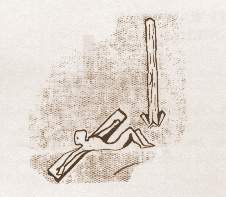
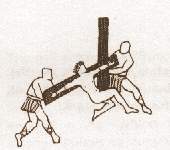
Now we go over to the question: how exactly do we fix the crossbeam to the stipes? Mainly, we have two possible ways of doing so:

(1) Have the whole cross on the ground.

This is the way we commonly see it in art. In this method, the vertical post would first lie flat on the ground. The patibulum would then be fixed into it, and the victim would be affixed to the cross. After that, the cross would be raised up.

http://img526.imageshack.us/img526/9379/tissottheraisingofthecrb.jpg

There are, however, quite a few problems with this approach that we need to consider:
  • If you fix the patibulum onto the stipes with the victim still bound into it (assuming that he was tied when carrying the crossbeam as in the illustration above), the victim’s head would get in the way if you’re trying to make a Latin cross.
  • Fixing the patibulum to the stipes with nails would be practical only if it was laid totally flat on the ground - assuming the terrain was rough, there would be a bit of a difficulty driving the nails.
  • The weight of the victim PLUS the weight of the cross should be taken into consideration when raising it. Such a load would require quite a lot of manpower: you’d need men who will (1) push the cross up into the vertical position, (2) who will pull ropes that are attached to the side of the cross (see the picture above), and (3) fill in the hole with things such as dirt and rocks to stabilize the cross. At a minimum, one would require somewhere around five to six men to do the job.
  • Another thing is that once the cross is fixed onto the ground, you’ve got to take the ropes that were used to lift it. If the cross used wasn’t that tall, there would be little problem taking these off compared to when a more taller cross was employed (as in popular artworks, where at the largest the crosses were like 5-6 feet off the ground).
  • Crucifixions were not rare events - on the contrary they were so common, and the Romans liked efficiency and thriftiness. Most nails from the crucifixion were probably reused over and over again due to the cost of iron; the same may have happened with crosses - they were also probably used and reused until they were no longer serviceable. Considering this, it is rather impractical to dig up, take down, and dismantle a cross just to reassemble, erect, and fix it to the ground once again later.
Which brings us to possibility number 2:

(2) Have the vertical post already fixed to the ground.


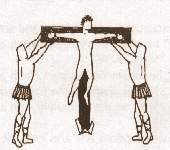
The victim would carry his crossbeam up to the place of execution, where a stipes is already erected in place. The victim’s hands/arms would then be affixed to the patibulum first either by nails or by ropes. Afterwards, the patibulum is attached to the vertical post, and the victim’s feet would be then affixed to the stipes (as elaborated upon earlier, based on the iconographic evidence we have, I tend to believe that the feet were affixed separately instead of one foot placed over the other).

As for fixing the crossbar to the erect post, one of the more convenient methods with which this may have been accomplished is the mortise-and-tenon joint. In this idea, the patibulum would have a mortise (a hole) in the middle, which fitted snugly to the stipes’ tenon (a projection on the end of a timber for insertion into a mortise). Assembled together, this would yield a tau (T-shaped) cross.

http://img62.imageshack.us/img62/4594/stipespatibulum.jpg

This renders the use of nails or ropes or any other device to keep the crossbeam in place unnecessary, as well as giving the benefit of enabling the cross to be reused easily.

Compared to idea number 1, attaching the patibulum and the victim to the vertical post is also more efficient in that it requires less manpower: two to three men would suffice for the job. This makes it ideal for routine executions and repeated use. Since crosses were probably not that tall (maybe around six-to-seven feet), everything could be done at arm’s length - no need for ladders or webs of ropes.


And Nicodemus also came, who came to Jesus by night at the first, carrying a mixture of myrrh and aloes, about a hundred litra.

…One argument even says that the mixture would have probably been enough to be used on two hundred bodies!

…the simplest answer to this problem that I have encountered actually lies in the Greek text: the word litra should refer to the Roman pound.

Since one Roman libra weighed about approximately 11.5 to 12 ounces - approximately 325 grams, “a hundred litra” would be equivalent to the more mundane amount of around 75 English pounds (approx. 32.5 kilograms). Indeed, this is exactly the amount that some modern translations give it!
Hi Patrick, thank you for an excellent thread. These minor details can really help to bring the Word to life! One thing I have been helped with (not in this thread though;)) is the account of Peter walking on the water towards Jesus and then starting to sink. It seemed strange to me that Peter would slowly start to sink, until a friend offered the explanation that he went plunk into the water, and flailed about.

Unfortunately, I do not have a better explanation to the “100 litra” that Nicodemus brought, but it seems to me that your explanation is “not quite there”. By having 75 English pounds of aloes, that would still be more than enough to encase a body in. If 100 English pounds is enough for 200 bodies, 75 is still enough for 150. Was litra perhaps a measure of money?

On a somewhat tangential note, I have always wondered at the 10, 5, and 1 “talents” given by the Master to three of his slaves, and how we have a homonym for that in English.
 
Thanks, Spirithound for the comment! 🙂
Hmm, you’ve given me quite a lot to tackle there - more than my time now allows. Let’s start with the last one first, shall we?
On a somewhat tangential note, I have always wondered at the 10, 5, and 1 “talents” given by the Master to three of his slaves, and how we have a homonym for that in English.
Well, the word ‘talent’ in English comes from the Latin talentum, which in turn was from Greek τάλαντον talanton ‘scale, balance’. It was one of several ancient units of mass, as well as corresponding units of value equivalent to these masses of a precious metal - in fact, it was Biblically the largest weight. Because of this usage, ‘talent’ has somewhat become a monetary term (kind of like shekel). Of course, there were variances among each culture and time period on how much what a ‘talent’ exactly weighs: for example, a Greek talent weighed 26 kilograms, a Roman talent was 32.3 kilos, an Egyptian talent was 27 kg, and a Babylonian talent was 30.3 kg.

The Babylonians, Sumerians, and Hebrews divided a talent into 60 mina, each of which was subdivided into 60 shekels. The Greek also used the ratio of 60 mina to one talent. A Greek mina was approximately 434 ± 3 grams. A Roman talent was 100 libra. A libra is exactly three quarters of a Greek mina, so a Roman talent is 1.25 Greek talents.

http://upload.wikimedia.org/wikipedia/en/thumb/6/60/Talents.jpg/250px-Talents.jpg

Things are a bit complicated somewhat by the fact that there were different versions of the talent in use; a royal and a common version. In addition, each of these forms had a heavy and a light version, with the heavy version being exacly twice the weight of the lighter form. Ancient weights were sometimes shaped in the form of animals to make them more easily recognizable: it is said that the light royal talent was often represented in the form of a duck, while the heavy royal talent often took the form of a lion.

I’ve read that the mina for the heavy royal talent weighed 1.01 kg, while that for the heavy common talent weighed only 0.9824 kg; accordingly the heavy common shekel would be about 16 g. According to Josephus, it was the heavy common talent, and its mina and shekel, that was the normal measure of weight in Syria and Judea; Josephus also mentions an additional unit - the bekah - which was exactly half a shekel. Thus, one heavy common talent would have weighed somewhere around 58.9 kilograms while a heavy royal talent would have been ca. 60.6 kg. In any case, the master was apparently giving very large, almost exorbitant, sums of money to his servants. It is impossible to be completely exact about their value in light of the above information, but it would seem that even the lowest value for a talent puts it as worth several thousand denarii, and a denarius was the usual payment for a day’s labor.

Interestingly though, the term “talent” in English only acquired its meaning of ‘gift’ or ‘skill’ today through this parable, from the common interpretation that we are under a moral obligation to use our ‘talents’, rather than bury them.

Just wait; I ain’t done yet! 😃
 
Hi Patrick, thank you for an excellent thread. These minor details can really help to bring the Word to life! One thing I have been helped with (not in this thread though;)) is the account of Peter walking on the water towards Jesus and then starting to sink. It seemed strange to me that Peter would slowly start to sink, until a friend offered the explanation that he went plunk into the water, and flailed about.
I think your friend has made a good point there.

And Peter answered Him and said, “Lord, if it is you, command me to come to You on the water.” And He said, “Come.” And when Peter had come down out of the boat, he walked on the water and came towards Jesus. But seeing the wind, he became afraid, and having started to sink (katapontizesthai), he cried out, saying, “Lord, save me!

Our Bibles render the verb as a mundane ‘to sink’. Broken down, katapontizo (‘to plunge, to sink into the sea’) yields kata- ‘down’ and pontos ‘the sea’. The image would indeed seem to be rather close to Peter just going plunk into the lake. After all, Peter’s call for help would not have made much sense in my opinion if he was just slowly being submerged in the manner of those Hollywood movies showing people slowly sinking into quicksand (and while we’re at it, no folks, apparently it’s impossible to sink completely into quicksand because of its higher density - it’s actually harmless on its own). 😉
 
Unfortunately, I do not have a better explanation to the “100 litra” that Nicodemus brought, but it seems to me that your explanation is “not quite there”. By having 75 English pounds of aloes, that would still be more than enough to encase a body in. If 100 English pounds is enough for 200 bodies, 75 is still enough for 150. Was litra perhaps a measure of money?
Actually there’s only two instances of the word litra in the NT (the other is in John 12:3, where Mary “took a litra of perfume of pure nard”), and both seem to refer to the volume of the items described - especially since in the earlier instance, Judas estimates the cost, saying that the perfume could have been sold for three hundred denarii.

By the way, I came upon the ‘two hundred bodies’ claim from an 1825 KJV with Commentary and Critical notes by Rev. Adam Clarke, where he gives it as one example of criticisms on the Biblical account. I can’t vouch for the accuracy of this (also considering its age!), but I won’t deny that the amount was indeed a bit too much for one body. Aside from interpretations which states that these were just exaggerated numbers or were just flat-out invented by John (or whoever wrote the gospel), some interpret the amount of the spices positively as an act of devotion, an attempt to give Jesus a ‘royal’ burial that He deserves, or negatively as a misunderstanding on Nicodemus’ part about who Jesus is - he has not understood that Jesus’ kingdom is “not of this world” and that the Son of Man must be lifted up.

Now, I’d like to point out something: the Jews at that time in one sense did not really ‘embalm’ their dead, say like the Egyptians. For a body to be embalmed incisions needed to be made - which was not apparently done by the Jews. They did wash and anoint their dead, but preserving the body intact was not the main priority. On the contrary, it was apparently expected that the corpse would rot within one year (there’s a custom of secondary burial, where the bones of the deceased would be collected a year after the burial and placed in a box called an ossuary), given the climate of the Holy Land.

So what were the myrrh and aloes doing? These were employed to counteract and mask the stench of putrefaction. The stench caused by decomposition was a major problem - especially since many tombs in Jesus’ day were family affairs and thus used for more than one body (we’ve noted before how Jesus’ being buried alone in a new, unused tomb would have been rather shameful in a way; Jews expected people to be buried in their respective family graves); people would have returned periodically inside to place a new corpse on the shelf or perform secondary burial.

Now there came also Nicodemus, who came to Him at night at the first, carrying a mixture (migma)* of myrrh and aloes, about a hundred litra. They took then the body of Jesus and bound it with linen cloths with the aromatics, as the custom is of the Judeans to prepare for burial.

*The majority of manuscripts give this reading. Some MSS read either eligma ‘bundle’, smigma or smēgma (both of which are variants of smēma) ‘ointment’, or (in one Vetus Latina translation) malagmani ‘emollient’.

Aside from sprinkling or wrapping the body with aromatics with the burial cloths, other ways in which these were used were burning them before the funeral procession (at Herod the Great’s funeral procession, there were “five hundred of his domestic servants and freed-men” carrying burning spices, according to Josephus) or sprinkling them on the bier under the corpse.
 
As an addendum to post number 43 (the flagrum):

The Romans apparently had three forms of corporal punishment: beating (fustigatio), flogging (flagellatio), and scourging (verberatio), each one more worse than the last: fustigatio is administered for light offences and accompanied by a severe warning (‘try anything funny and I’ll issue a stern warning and beat you’? :p), while the flagellatio practiced in cases of more serious crimes is a bit more severe. The verberatio, associated with other punishments such as crucifixion, is the most terrible.

Roman citizens once received punishments inflicted by rods (virgis) - however, the beating of citizens was eventually forbidden by the provisions of Valerian, Porcian, and Julian laws (6th-1st centuries BC), which exempted them from such degrading and shameful forms of punishment. The Roman military had a form of execution by clubbing the culprit to death with staves or cudgels (fustis), known as fustuarium. For non-Romans, criminals, or slaves, meanwhile, the favored instrument was the flagrum/flagellum - which we have talked about before.

Their use was allowed in at least four occasions: as a means of torture to make the victim tell the truth in interrogations, as a self-standing punishment, as a capital punishment (death by beating), or as a prelude to execution. Josephus (Jewish War 2.21.5 [602]; VI.5.3 [304]) records how on some occasions these beatings could get so severe that the bones and the organs would be exposed. It is often said that people have sometimes died because of the oftentimes intensity of the beatings.

Now, we sometimes hear that Jesus was scourged thirty-nine times (for those familiar with it, Jesus Christ Superstar even has the Trial Before Pilate (Including The 39 Lashes)!). Whence come this?

In Deuteronomy 25:1-3, there is an injunction that (ESV):

If there is a dispute between men and they come into court and the judges decide between them, acquitting the innocent and condemning the guilty, then if the guilty man deserves to be beaten, the judge shall cause him to lie down and be beaten in his presence with a number of stripes in proportion to his offense. Forty stripes may be given him, but not more, lest, if one should go on to beat him with more stripes than these, your brother be degraded in your sight.

To drift a bit off-topic here, other Ancient Near Eastern cultures also had similar stipulations that people be whipped for various crimes: the maximum limit for the beating may be as low as twenty or as high as sixty, as per the Code of Hammurabi. The number forty may have been chosen due to its symbolic meaning or the degree of mutilation and personal humiliation permissible for an Israelite to bear without being permanently excluded from religious and social activities (there was apparently no prolonged or indefinite beating; if forty lashes is the maximum penalty, judges may have usually sentenced offenders less than that number).

Now to go back. By the New Testament we then have St. Paul saying (2 Corinthians 11:24 ESV), “five times I received at the hands of the Jews the forty lashes less one.” Note that the limit was only a Jewish custom (it is usually explained that in order not to break the maximum limit as written in Deuteronomy, the number was lowered down to thirty-nine) - the Romans obviously would not have been subject to this. Now we don’t know exactly how many times Jesus got whipped because of that reason: the Romans apparently were not limited to a number of blows.
 
Status
Not open for further replies.
Back
Top