The Minor, Trivial Stuff Thread

  • Thread starter Thread starter patrick457
  • Start date Start date
Status
Not open for further replies.
I think the writings of Flavius Josephus should shed some light on a good deal of the “what did folks look like?” line of questions. His collected works can be bought cheaply, but, aside from the interesting tidbit here or there, it’s a lot like reading the phonebook in most parts.

Otherwise, the Talmud says that even Moses wore tallis, since it was one of the Sinaitic Mitzvot.
Yep, Josephus is actually a very valuable source. I’d agree with that.
Now, about the tallit/tallis: the mitzvot in Numbers 15:38-40 refers to having tassels at the four corners of one’s garment. Indeed, based on the examples of clothing found in the Cave of Letters, Jews of the NT-Bar Kochba period wore them on the one piece of clothing that actually had four corners: their cloaks. (the tassels on Jesus’ cloak would probably be the ‘edges’ which the woman touched!)

The tallit as we know it today, a prayer shawl of sorts is actually a descendant of the cloak devised later than the time of Moses or Jesus so that the commandment would not be lost to oblivion. So yes, Moses and the Israelites would have worn the tassels, but I doubt that they had to go to the trouble of making a special garment for that, since they already have a piece of garment with four corners in it.
I also read a book abut Mary, written by an E. Orth., I think, which goes into some detail as to how the Holy Family likely lived from day to day. PM me if you’re interested, and I’ll dig it up and find the title & author.
Anyway, here’s my minutia: how good of a carpenter was Jesus, anyway?
Now that we’re talking about it, a related question: how good of a woodworker/stonemason (the word tekton could mean all of it, since the word essentially meant “someone who works in hard materials”) was Joseph?

Nazareth was probably too small to support a woodworker due to the fact that good wood was rather rare and expensive in that part of the world: high-quality timber (like Lebanon cedar) was actually an imported commodity and often used as building materials by the rich; there would be few, if any, of that floating around in Nazareth. Scrap wood and local trees could churn out some basic necessities such as yokes, plows or some simple furniture, but that would not give one enough money to feed the family!
Stone and abode, meanwhile, were rather big in the village since they were used as building materials: a stonemason could make a decent living by constructing houses and such. It is thus probable that Joseph and Jesus were actually stonemasons of sorts rather than woodworkers.

Nazareth was only one hour’s walk from Sepphoris, “the ornament of all Galilee”. Herod Antipas was actually busy enlarging and fortifying the city around the time of Jesus, making it this capital until he built Tiberias in 19 AD. Some even think it probable that father and Son helped in its construction and did most of their work there since that is where the all the opportunity is. Jesus may have gotten His first exposure of urban life and other cultures there; it may have been the city He had in mind when He said, “A city that is set on a hill cannot be hid” (Sepphoris was built on a hill; the cooking fires and the lights would have been visible for miles at night).

Now if we could just find something in Sepphoris that we could trace as being by the hand of Joseph/Jesus…😛
 
To continue:

Moses received the Torah from Sinai, and he passed it to Joshua, and Joshua to the Elders, and the Elders to the Prophets, and the Prophets passed it to the men of the Knesset ha’Gedolah. They would say three things: Be deliberate in judgment, and establish many pupils, and make a fence around the Torah (sayag la’Torah)*.

Pirkei Avot 1:1

*make a fence around the Torah: i.e. make a law, a gezeirah, that would prevent people from accidentally violating a Torah mitzvah. For example, the commandment only mentions that one must not work on the Sabbath, but there is a gezeirah which forbids even moving a object only used to perform prohibited work, because someone handling the implement might forget that it was the Sabbath and perform prohibited work.

In some respects such as in political matters, the Pharisees leant towards the conservative side of things. Yet they were also innovative and ‘liberal’ in religious respects than the Sadducees, which were more likely to be actually in the ‘traditional’ end of the spectrum, contrary to what popular piety believes: they professed a belief in resurrection (a notion which is believed to have only developed in Judaism around the post-Exilic period, only taking firm root for some more time after that), accepted more books other than the Torah when judging other matters of the Law (there was little to no idea of a fixed canon at the time of Jesus; all Jews universally considered the five books of Moses as Scripture, yet there was widespread disagreement as to what books are ‘Scripture’ after that, a problem which would not be definitely solved in Judaism until a few centuries later). Another is their placing emphasis more on the Law rather than the Temple itself, which was one element which helped them survive its destruction in 70 AD and enabled them to give birth to modern-day Judaism.

Finally, we must note that the explicit teaching of an Oral Torah in contrast to a Written one does not appear until the 3rd century AD, though the idea is certainly implicit earlier. Of course, in a sense, all Jews had an ‘oral Torah’ of their own of sorts - each locale and probably each sub-group or class probably had their own customs and specific rules for how to live Judaism. These laws had developed over decades and centuries and were common to all groups. The Pharisees promoted one version, their version, of such customs with an underlying vision of the Jewish way of life.

When one talks of Sadducees rejecting an ‘oral Torah’ it implies that they accept no other observance and interpretation apart from their own rather sola Scriptura-esque observance and interpretation of the Law; that serves as their ‘oral Torah’ for them. In this the two groups, the Pharisees and the Sadducees, were like all the other Jewish groups of the period, each with their own distinct traditions, social and religious goals and laws. Judaism was yet to become truly unified and homogenous; diversity in many respects was the rule then.
 
I’m sure that many readers are now aware of how Jesus - and, well, everyone else who were crucified throughout the long history of the Roman Empire - were scourged brutally, as is standard practice; we have Mel Gibson to thank for that. The whips believed to have been used in such cases were called flagrum: usually described as having leather thongs, often with bits and pieces of metal (iron or lead) or glass or bone added for effectiveness.

Here’s the catch: while contemporary written records give us some idea of the horror of Roman flogging, we have, as of now, no surviving specimen of a flagrum, not even a fragment. Archeologists have never found one, and most likely will not (the leather, the metal, the glass, and the bone would have wasted away or fell to pieces to the point that you won’t recognize them as being from a whip, after all). So, pretty much every flagrum you see are actually just, at best, conjectural reconstructions (usually based either on written records or/and the wounds of the man of the Shroud of Turin), since no one knows how exactly they looked like. Here are some of these reconstrutions:

(Please Note: This uploaded content is no longer available.)

http://www.carm.org/images/flagrum.gif

http://img4.imageshack.us/img4/2086/romanflagrum.jpg

The following reconstructions, meanwhile, have a rather unique appearance (it significantly deviates from the cat-o’-nine-tails-ish appearance of other reconstructions), and according to its creator (who did a very good research and experimentation on the subject!) can actually deal some damage:

http://img4.imageshack.us/img4/2693/cofntbig.jpg
 
In Exodus 25:17-20 we read:

And you shall make a kapporet of pure gold: two cubits and a half its length, and a cubit and a half its breadth; and you shall make two cherubim of gold, of beaten work you shall make them at the two ends of the kapporet; and make one cherub at the end on this side, and one cherub at the end on that; from the kapporet you shall make the cherubs on its two ends. And the cherubim shall stretch out their wings upward, overshadowing the kapporet with their wings, and their faces a man to his brother - towards the kapporet the faces of the cherubim shall be.

How the cherubim look like has been a very intriguing question. Even in Josephus’ time, no Jew can no longer recall exactly what they look like. Traditional Christian art has almost quite uniformly depicted the cherubim as something that looks like sterotypical angels, a form which has stuck into the popular mind as the well-known diorama in Indiana Jones shows:

http://breakthroughtogod.files.wordpress.com/2009/02/211.jpg

However, many modern scholars follow archeologist Prof. William F. Albright’s (1891-1971) opinion that to discern how the cherubim of the Ark looked like, we need to investigate the art and culture of the neighbors of the Israelites:

Since the veil of the Tabernacle was decorated with embroidered cherubim, and the walls and the religious objects of Solomon’s temple lavishly adorned with them. we ought to be able to identify them in contemporary Syro-Palestinian art. The account of the Ark of the Covenant shows that only a creature with wings can be considered. If, therefore, we study all known representations of animals and hybrid creatures, partly animal, we find one which is much more common than any other winged creature, so much so that its identification with the cherub is certain: that is the winged sphinx or winged lion with human head. In Egypt the wingless sphinx and the griffin appear; in Babylonia and Assyria the winged bull with a human head prevails; but in Syria and Palestine it is the winged sphinx which is dominant in art and religious symbolism.

The God of Israel was often designated as “He who sitteth (on) the cherubim” (I Sam. 4:4, etc.). The conception underlying this designation is well illustrated by representations of a king seated on a throne supported on each side by cherubim, which have been found at Byblus [Byblos], Hamath, and Megiddo, all dating between 1200 and 800 B.C. One shows King Hiram of Byblus (period of the Judges) seated upon his cherub throne. Pottery incense altars found at Taanach and Megiddo are archaeological parallels to the wheeled lavers (“bases”) of Solomon’s temple, which were decorated with lions and cherubs, according to I Kings 7:36.

The primary function of the cherub in Israelite religious symbolism is illustrated by two biblical passages. A very ancient hymn, found twice in the Bible, has the words, “And He rode upon a cherub and did fly” (II Sam. 22:11, Ps. 18:11); the second is Ezek. 10:20. The conception of the deity as standing or as enthroned on an animal or hybrid creature was exceedingly common in the ancient Near East, but it was most common in Syria and Northern Mesopotamia between 2000 and 700 B.C. In Babylonia the figure of a deity is replaced in certain cases by a winged shrine and later by a thunderbolt. So in Israelite symbolism between 1300 and 900 B.C., the invisible Glory (Jehovah) was conceived as enthroned upon the golden cherubim or standing on a golden bull.

-William Albright, What Were the Cherubim?

http://img248.imageshack.us/img248/703/450pxahiram.jpg
Detail from the sarcophagus of King Ahiram/Hiram/Ahirom(11th-10th century BC).


Ivory plaque found at Megiddo, dating from ca. 11th century BC.

Side view of the statue of King Idrimi of Alalakh (reigned 15th century BC), now in the British Museum.

Phoenician scarab depicting a royalty or deity sitting on a sphinx-throne (more examples here).
Since the cherubim on the Ark probably served as (a representation of) the Divine throne with the kapporet/‘mercy-seat’ and the Ark below serving as the footstool, it is therefore quite likely that they shared the same basic form as the winged sphinx-thrones, prevalent in Ancient Near Eastern and Hellenistic cultures.

Of course, there are some other opinions. There are two opinions in Jewish tradition about the cherubim’s appearance: one holds that the cherubim looked like birds, due to the fact that the wings are characteristic of the cherubim; they are one of the only two things we are certain the cherubim possessed (Rashbam to Exodus 25:17-22). The Ark as reconstructed by the controversial Temple Institute may follow this opinion in its depiction. Another is that the each of the cherubim had the face of a man and woman or a boy and girl (based on the folk etymology connecting kheruv with the Aramaic ravia, “child”).
 
(Continued)

According to lore, the cherubim are entwined on a marital embrace, symbolic of the union between God and Israel, when Israel is faithful to God; on other times, the cherubim turned their faces away from each other (Bava Bathra 99a). It has been suggested that this was devised to explain an apparent ‘discrepancy’ between the cherubim on the Tabernacle, which faced each other (Exodus 25:20) and the cherubim on Solomon’s Temple, which faced the building (II Chronicles 3:13).

There was also a legend recounting how in feasts, the priests would draw back the curtain of the Holy of Holies, exposing the embracing cherubim to the people and saying, “See how beloved you are before the Almighty, like the love of a male and female!” (Talmud, Tractate Yoma 54a) Some sages of course objected to the idea that the common people would be allowed to gaze at the Holy of Holies. The story continues how when the gentiles mocked Israel as being lewd when they conquered the Temple and found the Ark, with the cherubim in this position (Yoma 54b).

There is still another modern scholarly opinion which proposes that cherubim are actually depicted similar to griffins - with the body of a lion and the head and wings of an eagle. A few scholars have even suggested tentatively that the word gryphos may be cognate to cherub.

(Please Note: This uploaded content is no longer available.)
a 13th-century B.C. carved relief of a griffin excavated at Megiddo.
 
The lid of the Ark is called the kapporet, a rather obscure term, the precise meaning of which is uncertain. Various attempts are made to link it with the Egyptian kp n rdwj (“sole of the feet”), the Hebrew kaphar (literally “to cover”, figuratively “to wipe out” or "to atone; note cognate Arabic term kaffarat, used in modern legal contexts to refer to any mechanism of rectifying illegality and the term Yom ha-Kippurim/Yom Kippur), or even the Akkadian kapāru (“to purify cultically”).

The Greek Septuagint seems to have followed the ‘atonement’ interpretation with its rendering of the term as the oft-debated hilasterion, “propitiatory” or “[place of] atonement”. St. Jerome renders kapporet both as propitiatorium and oraculum:

17: Facies et propitiatorium de auro mundissimo: duos cubitos et dimidium tenebit longitudo ejus, [et] cubitum ac semissem latitudo.
18: Duos quoque cherubim aureos et productiles facies, ex utraque parte oraculi.
19: Cherub unus sit in latere uno, et alter in altero.
20: Utrumque latus propitiatorii tegant expandentes alas, et operientes oraculum, respiciantque se mutuo versis vultibus in propitiatorium quo operienda est arca,
21: in qua pones testimonium quod dabo tibi.

17: Thou shalt make also a propitiatory of the purest gold: the length thereof shall be two cubits and a half, and the breadth a cubit and a half.
18: Thou shalt make also two cherubim of beaten gold, on the two sides of the oracle.
19: Let one cherub be on the one side, and the other on the other.
20: Let them cover both sides of the propitiatory, spreading their wings, and covering the oracle, and let them look one towards the other, their faces being turned towards the propitiatory wherewith the ark is to be covered,
21: in which thou shalt put the testimony that I will give thee.

(Douay-Rheims Challoner)

Meanwhile, the term is rendered “mercy seat” traditionally in English Bibles, though looking at the Ark’s design, it is obviously not something that one would sit on (if anything, God is visualized as being “over” the cherubim; the kapporet therefore would serve the function of a footstool!) So, how did we come by this rendering? The answer lies within the Bible translation into German by Martin Luther. Luther translated the kapporet with the phrase gnadenstuhl/gnadenstuel (“seat of grace”), a term also used to a type of Trinitarian art showing the crucified Christ being supported by a seated God the Father:

25:17: DV solt auch einen Gnadenstuel machen von feinem golde / Drithalb ellen sol seine lenge sein / vnd anderthalb ellen seine breite.
18: Vnd solt zween Cherubim machen von tichtem golde / zu beiden enden des Gnadenstuels /
19: das ein Cherub sey an diesem ende / der ander an dem andern ende / Vnd also zween Cherubim seien an des Gnadenstuels enden.
20: Vnd die Cherubim sollen jre Flügel ausbreiten oben vber her / das sie mit jren flügeln den Gnadenstuel bedecken / vnd eins jglichen Andlitz gegen dem andern stehe / Vnd jre Andlitz sollen auff den Gnadenstuel sehen.

-1545 Last Hand Edition Luther Bible

In 1535, Myles Coverdale published the first complete printed English translation of the Bible, the so-called Coverdale Bible. As he was not proficient in Hebrew or Greek, he used ‘five soundry interpreters’ in Latin, English and ‘Douche’ (German) as source text - including Luther’s Bible and the Swiss-German version (Zürich Bible) of Huldrych Zwingli and Leo Jud. Coverdale followed Luther in his rendering of kapporet as gnadenstuel and came up with Mercyseate, and the rest is history:

17: Thou shalt make a Mercyseate also of pure golde, two cubytes and a half longe, and a cubyte & a half brode.
18: And thou shalt make two Cherubyns of beaten golde vpo both ye endes of the Mercyseate,
19: yt the one Cherub maye be vpon the one ende, & the other vpon the other ende, & so to be two Cherubyns vpon the endes of the Mercyseate.
20: And the Cherubyns shall sprede out their wynges ouer an hye, yt they maye couer ye Mercyseate wt their wynges: & yt either their faces maye be right ouer one agaynst another, and their faces shal loke vnto the Mercyseate.
 
The Sadducees

Representing the upper-class priestly personnel of the Temple and the wealthy families of Judea were the Sadducees. Historically, the question of the derivation and meaning of the name has been closely tied to the issue of the nature of the group. Ever since Abraham Geiger argued that the Sadducees were the priestly aristocracy, the majority of scholars have held that their name was derived from “Zadok,” the name of the high priest during Solomon’s reign (I Kings 2:35; cf. Ezek. 44:15; 48:11). Thus the Sadducees are thought to have been the party of the Zadokite priestly elite.

Some think there are problems with this idea. The “Zadok” etymology does not explain the doubling of the “d”. Moreover, when the Sadducees appeared on the scene, the ruling priests were Hasmoneans, not Zadokites. It is unlikely that the Hasmoneans would have allied themselves with a rival priestly group whose very name called into question the legitimacy of the Hasmonean high priesthood. More recently, many scholars have argued that the Sadducees were essentially a loose confederation of wealthy and powerful men (this would include members of the priestly aristocracy) who took a secular-pragmatic, rather than a religious-ideological, stance with regard to the nation and its laws.

Along with this view, new etymologies for “Sadducees” have been offered. T. W. Manson proposed that behind the name stood the Greek title syndikoi, meaning “fiscal officials.” R. North suggested that the Sadducees saw themselves as administrators of justice and that their name was derived from an otherwise unattested Piel adjective sadduq (“just”). These and other etymologies solve some problems, but raise new ones; at bottom, they all remain speculative. In light of the total absence of Sadducean sources, it would seem wise to admit that both the precise nature of the Sadducees and the derivation of their name remain uncertain.

The Sadducees solidified as a group soon after the Maccabean revolt (167-160 B.C.). They were heirs to a persistent tendency within the Jewish aristocracy to see Judaism as a temple-centered religion rather than a law-centered way of life. Because they supported the Hasmonean policy of military and economic expansion, they gradually came to exercise tremendous influence in John Hyrcanus’s court (134-104 B.C.). Their influence predominated until the end of Alexander Jannaeus’s reign (76 B.C.). Under Queen Alexandra (76-67 B.C.) the Sadducees lost their power, and their numbers were greatly reduced. They fared little better under Herod the Great (37-4 B.C.), who deeply mistrusted the native Jewish aristocracy. With the imposition of direct Roman rule (A.D. 6), Sadducean fortunes revived. Between A.D. 6 and 66 the Sadducees not only became a major power within the Sanhedrin, but, for many years, they were able to control the high priesthood as well.

Both the Pharisees and the Sadducees were “liberal” while at the same time being “conservative”: while claiming to preserve the older customs against Pharisaic innovation, the upper-class Sadducees aped Greco-Roman dress and customs and ‘went with the flow’ in order to preserve the status quo. They had a two-way agreement with Rome: they’ll keep the peace for the Romans, and Rome will let them be on their merry way.

For short, the Pharisees were politically conservative while being religiously liberal (they allowed for new ways and developments in Jewish thinking, welcoming ideas which came into fruition only in the post-exilic period such as the resurrection of the dead), while the politically liberal Sadducees were actually religiously conservative - and probably more scrupulous about ritual than the Pharisees, as we shall see in the next post.
 

The Temple of Jerusalem.

The Sadducees were primarily concerned for the traditions that protected the central role of the Temple, its sacrifices and cult, that they were sometimes painted in modern scholarship as ‘being too preoccupied with ritual that they cared little about morality or the hereafter’. In this they actually preserved a more older belief than the Pharisaic doctrine, which developed gradually within the climate of the exilic and post-exilic period and evolved and became elastic as times and needs changed.

Because of this conservative reflex to ‘preserve the old ways’ and the fact that they virtually are the ruling majority over the Temple (note however that there were priests on both sides, though the Sadducees were technically more Temple-oriented than the Pharisees, who tended to downplay its role) they were naturally wary of the ‘new-fangled’, democratic Pharisaic ideas which placed huge emphasis on the Jewish laity (“a kingdom of priests and a holy nation”) and did not center itself on Temple ritual.

To sum: while the Sadducees believed in a pre-prophetic Judaism: Priest-Temple-Sacrifice,
the Pharisees believed in a post-prophetic concept of Judaism: Teacher-Synagogue-Prayer.

The Sadducees accepted only the Torah and a literal interpretation of it (all of the laws MUST be followed as it is written, to-the-letter), placing lesser value on other writings accepted by various sectors of Judaism. The five books of Moses are to be the only authority on all things. Because of this rather narrow, limited stand, they generally rejected any notion of resurrection or an afterlife, these things not being explicitly spelled out or affirmed in the Torah.

[T]he Sadducees say that there is no rising again, nor angel, nor spirit; but the Pharisees confess both.

-Acts 23:8

Even so, some believe that evidence is present that an internal schism happened among the group - between those who rejected Angels, the Soul, and Resurrection and some which accepted these teachings. These believe that the authors of the Dead Sea Scrolls were actually such a Sadducean branch, basing themselves on the fact that in various places the writers identify themselves as “Zadokites"/"Sons of Zadok”, as well as citing interpretations of the purity regulations which closely parallel Sadducean views recorded by the spiritual heirs of the Pharisees, who authored the Talmud.

As with the Pharisees (who were associated with the working-class average joe), the Sadducees were more popular among those who are its members - the upper-class aristocrats and priestly families, as well as local landlords, merchants and people who married their way into such clans. This put them into very hot water with the common people because of their compromise with foreign powers as well as their iron-fisted reign of abuse.

Jesus and the Sadducees
The Sadducees are shown to meet with Jesus only twice in the Gospels, making them pale in comparison with the Pharisees (who are often named specifically and pitted against Jesus). However, though many readers may not realize it, the Sadducean shadow actually looms large over the pages of Holy Writ, especially in the Passion narratives. Note that whenever the chief priests-scribes-elders combination appear, it is most likely referring to Sadducees (we know that a majority of the people who filled in these posts belong to the party, and Caiaphas and Annas are both linked to it, cf. Acts 4:1; 5:17). Based on this, the Sadducees actually had a hand on Jesus’ death much more than the oft-maligned Pharisees:

And they brought Jesus to the high priest; and all the priests and the scribes and the ancients assembled together…And the chief priests and all the council sought for evidence against Jesus, that they might put him to death, and found none.

Mark 14:53, 55 (Douay-Rheims Challoner)

And straightway in the morning, the chief priests holding a consultation with the ancients and the scribes and the whole council, binding Jesus, led him away, and delivered him to Pilate…

Mark 15:1 (Douay-Rheims Challoner)

…In like manner also the chief priests mocking, said with the scribes one to another: “He saved others; himself he cannot save. Let Christ the king of Israel come down now from the cross, that we may see and believe.

Mark 15:31-32 (Douay-Rheims Challoner)

Jesus was hated essentially by the Sadducees for political reasons: they thought He was stirring up the people and aiming for a revolution, which could lead to an upsetting of the status quo. As the oft-repeated wisdom goes, His followers would crown Him as the Messiah and would attempt to oust the Romans, which would have severe repercussions - they might lose their political power and, most importantly, the Temple:

Then one of them, Caiaphas, high priest that year, said to them, “You know nothing at all, nor consider that it is good for us that one man should die for the people, and not the whole nation should perish.” And this he said not from himself, but being high priest that year, he prophesied that Jesus was about to die for the nation, and not for the nation only, but that also the children of God who have been scattered abroad He might gather together into one.

-John 11:49-52

Of course, Jesus causing a ruckus, upsetting the Temple market would not have helped, either. As well as the fact that despite Jesus’ often sharp criticism of the Pharisees’ play-acting, He is still more doctrinally closer to them than He was to the Sadducees!
 
Aside from the Pharisee-Sadducee-Essene-Zealot series, are there anything else people would like to see on this thread? :confused:
 
Roman crucifixions were used not only as a punishment but also a deterrent. The impact of crucifixion could go on for days at a time, as the corpse would be left hanging to rot under the sun, while birds would peck away on its flesh. Several writers mention that criminals were sometimes denied decent burial, as in the cases of Brutus and his supporters (Suetonius, Augustus 13.1-2) and Sejanus and company (Tacitus, Annals 6.29). Petronius in the Satyricon (111) writes a comedic story about a soldier who was tasked to guard the body of some crucified criminals from theft. The soldier manages to lose one of the corpses, however, when he diverts his attention from the crosses in order to pursue an amorous interlude with a widow mourning for the loss of her husband, who was buried near the execution site:

…Thus it came about that the relatives of one of the malefactors, observing this relaxation of vigilance, removed his body from the cross during the night and gave it proper burial. But what of the unfortunate soldier, whose self-indulgence had thus been taken advantage of, when next morning he saw one of the crosses under his charge without its body! Dreading instant punishment, he acquaints his mistress with what had occurred, assuring her he would not await the judge’s sentence, but with his own sword exact the penalty of his negligence. He must die therefore; would she give him sepulture, and join the friend to the husband in that fatal spot?

But the lady was no less tender-hearted than virtuous. ‘The gods forbid,’ she cried, ‘I should at one and the same time look on the corpses of two men, both most dear to me. I had rather hang a dead man on the cross than kill a living.’ So said, so done; she orders her husband’s body to be taken from its coffin and fixed upon the vacant cross. The soldier availed himself of the ready-witted lady’s expedient, and next day all men marveled how in the world a dead man had found his own way to the cross.

Beyond the bawdiness and light-heartedness of the anecdote lies the seriousness with which Romans could take the matter of guarding victims: the soldier guards the crosses for three nights, and fears for his life when the theft is discovered.

Death rituals are social processes that heal the wounds that death inflicts on the social group. By burying the dead and doing the proper ceremonies, members of a given society are affirming that someone significant has departed. When the Romans prevented the burial of a crucified criminal, they were making a graphic display of the power of the Roman Empire: by not allowing the victims even a decent burial, it is declared that the loss of these victims is not a loss to society, but far from it, they actually served to strengthen Rome, ridding her of her enemies and maintaining the status quo and preserving law and order.

For the Romans, then, it would have been rather natural if Jesus was left to rot on the cross unless there was an intervention: His dead, rotting flesh serving as food for carrion birds would have been a strong symbol of how Rome easily crushed ‘the King of the Judeans’. This explains why Joseph of Arimathea “dared” or “went boldly” (tolmēsas, ‘to be bold’, ‘to dare’) to approach Pilate to ask for Jesus’ body (Mark 15:43).

However, such a request may not have been too out of place: we have some literary evidence that Roman officials did allow the removal of dead bodies. Philo (Flacc. 10.83-84) tells us that:

I actually know of instances of people who had been crucified and who, on the moment that such a holiday was at hand, were taken down from the cross and given back to their relatives in order to give them a burial and the customary rites of the last honors. For it was (thought to be) proper that even the dead should enjoy something good on the emperor’s birthday and at the same time that the sanctity of the festival should be preserved. Flaccus, however, did not order to take down people who had died on the cross but to crucify living ones, people for whom the occasion offered amnesty, to be sure only a short-lived not a permanent one, but at least a short postponement of punishment if not entire forgiveness.
 
Josephus (Jewish War 4.5.2) relates that Jews took down the bodies of those who were crucified during the Great Revolt, as is the command in Deuteronomy 21:22-23 (“When someone is convicted of a crime punishable by death and is executed, and you hang him on a tree, his corpse must not remain all night upon the tree; you shall bury him that same day, for anyone hung on a tree is under God’s curse”). In Jewish thought, giving a proper interment for someone - even the dead of their enemies - was considered to be ritual piety (2 Sam. 21:12-14):

…But the rage of the Idumeans was not satiated by these slaughters; but they now betook themselves to the city, and plundered every house, and slew every one they met; and for the other multitude, they esteemed it needless to go on with killing them, but they sought for the high priests, and the generality went with the greatest zeal against them; and as soon as they caught them they slew them, and then standing upon their dead bodies, in way of jest, upbraided Ananus with his kindness to the people, and Jesus (ben Ananias) with his speech made to them from the wall.

Nay, they proceeded to that degree of impiety, as to cast away their dead bodies without burial, although the Jews used to take so much care of the burial of men, that they took down those that were condemned and crucified, and buried them before the going down of the sun. I should not mistake if I said that the death of Ananus was the beginning of the destruction of the city, and that from this very day may be dated the overthrow of her wall, and the ruin of her affairs, whereon they saw their high priest, and the procurer of their preservation, slain in the midst of their city…

There is also one other physical evidence from 1st century Jerusalem that giving burial to crucifixion victims was not unheard of: the bones of a victim found in 1968 in Giv’at ha-Mivtar (Ras el-Masaref) who died of crucifixion within an ossuary inside a tomb, named Yehohanan. Yehohanan was crucified probably between 7 A.D., the time of the census revolt, and 66 A.D., the beginning of the war against Rome.


Yehohanan’s right heel bone, pierced by an iron nail 11.5 centimetres in length.
In Jesus’ case, such an allowance was possible, since Jesus was apparently not caught up in a mass crucifixion and His death did not come in a time of public revolt against Rome (as in the events of AD 70). The Judean authorities generally cooperated with the Romans in maintaining public order in Jerusalem, and Jesus’ death fell on a Jewish religious holiday. It may have taken a little nerve, but it is not entirely impossible that someone like Joseph could expect that Pilate would grant permission for the burial of Jesus.

The question now is, would a Judean leader have approached Pilate to ask for the body of Jesus? Or would the authorities been just content to let the Romans do whatever they wish with the body? The evidence, based on what we know from Jewish culture, points out that they would not have wanted Jesus’ body to remain on the cross.

Funeral rites began immediately after death. In fact, it was so hasty that there were anecdotes about how people were mistakenly buried before they were actually dead. In a normal scenario, as soon as death occurred, the eyes were closed, the corpse was washed, the orifices were stopped, and a linen sheet and/or strips of cloth were wrapped and tied around (parts of) the body. The corpse was placed on a bier or a coffin to be carried in procession to the family tomb; there, eulogies were spoken and the corpse was placed inside, either on a niche or shelf. The funeral was conducted without delay, and in most cases the body is already buried on sunset at the day of death.

We have also noted Deuteronomy 21:22-23. Jewish writings testify to the continuing vitality of this cultural norm (aside from Josephus’ anecdote above, the Temple Scroll from Qumran quotes this passage); cf. Joshua 8:29; 10:27; Tobit 1:16; 2:4. These norms continued to have currency after Jesus’ death: the Mishna tractate Sanhedrin 6.4 quotes this passage verbatim and notes that Jews did not customarily leave the bodies of victims past sunset on the day of death. In other words, Jews in Palestine regarded quick burial as the normal and decent way to treat the dead.

Still, this does not mean that the Judean authorities wished Jesus a normal, ‘decent’ burial; some Jews were buried in shame and dishonor because of the crimes they committed in life (1 Kings 13:21-22; Jeremiah 22:18-19; Antiquities 5.1.14, cf. Joshua 7; Mishnah, Sanhedrin 6.6; Semakhot 2.6). What exactly constituted a dishonorable burial is not clearly spelled out in these sources, but we can infer that it constituted of two things: burial away from the family tomb, and burial without proper mourning rites (the family of the deceased is discouraged to mourn for the victim in public). These two are actually important parts of an honorable burial: throughout the Near East, it was a given that all members of a given family were interred together in a single tomb from generation to generation (hence the Biblical idiom “to be gathered to one’s fathers”), and mourning emphasized family and kinship ties.

For the Jews, who emphasized and valued belonging to an extended family group (after all, their ancestor was a man who was given a promise that his seed were to be more numerous than the stars, and their law emphasized respect for the family: “Honor thy father and thy mother”), to be buried far away from one’s own kin by design is to be dislodged from a place in the family, and to be unmourned by one’s own relatives was a great shame - and in a culture that emphasized the ideas of honor and shame, it would be a severe, mortal blow.
 
Bumping this thread for the interested. If anyone has a comment, a criticism, a question or even an addition for this thread, now is the time to post! 🙂

Here’s a minor one (the most minor of the minor things? :p) to restart the thread. In John 19:39, we read that:

And Nicodemus also came, who came to Jesus by night at the first, carrying a mixture of myrrh and aloes, about a hundred litra.

Now, in English it has become traditional to render the Greek word litras ekaton as a “hundred pounds”. Which often misleads some people reading the Johannine account of Jesus’ burial: a hundred pounds, they say, is too many. Jesus would have been literally been buried within the mixture (Fr. Raymond Brown, in his work The Death of the Messiah, stated that the myrrh and aloes “would fill a considerable space in the tomb and smother the corpse under a mound”), not to mention that the account would have necessitated Nicodemus carrying sacks and sacks of the mixture, almost a wagonload of them. One argument even says that the mixture would have probably been enough to be used on two hundred bodies!

There have been quite a number of proposed solutions for this, such as amending the text (for example, instead of reading ekaton one must read ekaterōn, yielding “about a litra each”) or to point out instances in other literature where extravagant amount of spices were used for the burial of important personages. However, the simplest answer to this problem that I have encountered actually lies in the Greek text: the word litra actually, and obviously should, refer to the Roman, instead of the English, pound (the Latin term is libra, from whence we get the abbreviation for pound, lb.) After all the ancients did not have the same measuring systems as we do today, we must remember that.

Since one Roman libra weighed about approximately 11.5 to 12 ounces - approximately 325 grams, “a hundred litra” would be equivalent to the more mundane amount of around 75 English pounds (approx. 32.5 kilograms). Indeed, this is exactly the amount that some modern translations give it!
 
Patrick,
Thank you so much for providing fascinating historical details that help flesh out the language of the Scripture. The more I read this thread, the more I want to know, and you seem to have a depth of knowledge that is truly amazing. One thing I’m curious about that I hope you can enlighten me on, is the anointing and washing of feet that is often specifically mentioned in the Bible. Historically, what is the background and significance? Thanks again!:thankyou:
 
Patrick,
Thank you so much for providing fascinating historical details that help flesh out the language of the Scripture. The more I read this thread, the more I want to know, and you seem to have a depth of knowledge that is truly amazing. One thing I’m curious about that I hope you can enlighten me on, is the anointing and washing of feet that is often specifically mentioned in the Bible. Historically, what is the background and significance? Thanks again!:thankyou:
You’re welcome! This thread has also been a great help to me personally; it really drove me to research quite a lot of stuff and make me realize and learn, well, how much I do not know, as the saying goes.

Now for the footwashing. We’ll have to distinguish between a number of functions.

(1) Foot-washing as a sign of hospitality

As you probably know, in ancient times most people wore sandals without socks or stockings. Of course, as is wont to happen when one wears such footwear, the feet would get tired and dirty after walking through miles and miles of dust, earth and sand in all weathers. Washing of the feet as a means to clean and refresh it was thus the first act done upon entering the tent or house after a journey; and eventually, the custom of either giving water for foot-washing purposes or having the visitor’s feet washed for them became one of hospitality.

This custom is already attested in the Old Testament. In Genesis 18:4, for example, Abraham says to his three visitors that: “Let a little water be brought, and wash your feet, and rest yourselves under the tree.” In the Hebrew, Abraham’s words imply that the guests were the ones who will wash their own feet after water was brought, yet in the Greek, the whole statement is translated as: “Let water now be brought, and let them wash your feet.” Meanwhile, in 19:2, after two of the three visitors go down to Sodom, Lot invites them to his house, saying: “My lords, please turn in to your servant’s house and spend the night, and wash your feet” The original phrase used here is identical to that of 18:4, yet the Septuagint here renders the phrase exactly as in the Hebrew. It has been thought that since the translators thought that since Abraham had servants, having those servants wash the visitor’s feet would be just natural; hence the passive rendering of 18:4. There are other two instances of foot-washing in the book (24:32; 43:24); there are also some others (Judges 19:21; 1 Samuel 25:41; 2 Samuel 11:8; Song of Songs 5:3; Psalm 58:10). As an aside, Homer’s Odyssey also has one instance of foot-washing done as a hospitable gesture, which was crucial to the plot (19.343-507).

You would note that in most of these instances, foot-washing usually precedes another form of relaxation: a meal. At times, the host or hostess would offer to wash his/her guest’s feet (cf. 1 Sam. 25:41; also cf. Testament of Abraham 3.6-9), but it is ordinarily carried out by slaves. At times, however, guests would sometimes do the act themselves.
 
(2) Foot-washing as a sign of servitude
As mentioned, foot-washing also has this element of lowliness and humility on it in Semitic and Greco-Roman culture; usually, those who get their feet washed are superiors to those who render the service. It was considered to be such a servile task to the point that in Greek literature it is extremely rare for a non-slave to wash someone’s feet and necessitates a special comment by the authors. For example, in the Odyssey again, the one who washes the disguised Odysseus’ feet is one of his maidservants, Eurykleia. Herodotus (Histories 6.19) cites a Delphic utterance while describing the fall of Miletus to the Persians:

Then shalt thou, Miletus, so oft the contriver of evil,
Be, thyself, to many a least and an excellent booty:
Then shall thy matrons wash the feet of long-haired masters -
Others shall then possess our lov’d Didymian temple.

Such a fate now befell the Milesians; for the Persians, who wore their hair long, after killing most of the men, made the women and children slaves; and the sanctuary at Didyma, the oracle no less than the temple was plundered and burnt; of the riches whereof I have made frequent mention in other parts of my History.

Again, in 1 Samuel 25:41, we read that Abigail says: “Here is your maidservant, a servant to wash the feet of the servants of my lord.” Here, the emphasis is on Abigail ready to do service to David’s servants, even to the point of lowering herself down as a ‘maidservant’. Also, the apocryphal work Joseph and Aseneth (1st century BC-2nd century AD) notes that:

And Joseph came into Pentephres’s house and sat down on a seat; and they* washed his feet, and placed a table in front of him separately, because he would not eat with the Egyptians, for this was an abomination to him.

*Some witnesses read “he” here, but the better witnesses, as well as internal evidence, support the reading given here.

Later, Aseneth prays to God (13.15 [11-12]):

But to thee, my Lord, do I entrust him; for I love him more than mine own soul. Preserve him in the wisdom of thy grace, and give me to him as a servant, so that I may wash his feet and serve him and be his slave for all the seasons of my life.

Note that here, Aseneth loves Joseph so to the point that she was willing to be his servant, washing his feet. Finally, in chapter 20:

And Aseneth said to him, “Come, my lord, come into my house;” and she took his right hand and brought him inside her house. And Joseph sat down on her father Pentephres’s seat, and she brought water to wash his feet; and Joseph said to her, “Let one of your virgins come, and let her wash my feet.” And Aseneth said to him, “No, my lord, for my hands are your hands, and your feet my feet, and no one else shall wash your feet;and so she had her way and washed his feet. And Joseph took her by the right hand and kissed it, and Aseneth kissed his head.

http://img402.imageshack.us/img402/6896/p223stonefootbath.jpg
A drawing of a stone footbath from Samaria, ca. 8th century BC.
Aseneth’s devotion to Joseph has really shown itself there. Now that being said, we now go on to other less pleasing instances of foot-washings in the Bible connected with servitude. In Psalm 60:8 (cf. 108:9), we read that: “Moab is my washbowl; upon Edom I throw my sandal.” Some think that these metaphors describe the utter humbling of these nations that they will be, in a sense, the washbowl which God will use to wash His feet and the slave to whom the Lord will fling His sandals on when He would have them removed. Psalm 58:10-11, meanwhile, engages in hyperbolic language and says:

The righteous shall rejoice when he sees the vengeance; his feet he shall wash in the blood of the wicked,
So that men will say, “Surely there is fruit for the righteous; surely there is a God who judges on earth!

Here the image is that of the righteous man washing his feet in the very life’s blood of the subdued evildoers. The imagery of the feet is also used in Isaiah 49:23, where foreign kings and queens will not only bow before Zion but “will lick the dust of their feet”. There however it is difficult to determine whether the image is that of a very graphic foot-cleansing or a simple emphasizing on the humbling of these foreign leaders.
 
(3) Foot-washing as personal hygiene

Evidence is also present that individuals washed their feet for hygienic purposes and relaxation. For example, in 2 Samuel 11:8:

And David said to Uriah, “Go down to your house and wash your feet.” So Uriah departed from the king’s house, and a gift of food from the king followed him.

There have been quite a number of interpretations about what this foot-washing means. It is thought by some that this should be read in context of regulations governing purity for Holy War (cf. Deuteronomy 23:10-15; Numbers 31:16-24), hence they imagine that either David was implying that Uriah should go and cohabit with Bathsheba, thereby making Uriah impure, or that Uriah should was his feet after the act to regain his ritual purity.

However, given that while ‘feet’ may be used in a euphemistic fashion in the OT foot-washing being a metaphor for intercourse is unattested, and one must wonder why David would speak so freely in light of the king’s plan to conceal his previous actions. Hence, the simplest answer is proposed to be that Uriah should go home and relax, and probably (literally) wash his feet in the process. After all, footwashing was a comfort hard to come by during military service.

Another one is from Song of Songs 5:3:

(The Lover) “Open for me, my sister, my love, my dove, my perfect one;
For my head is covered with dew, My locks with the drops of the night.

(The Beloved) “I have taken off my robe; how can I put it on again?
I have washed my feet; how can I defile them?


Despite the frequent use of double entendre in the book a fairly literal way of understanding of this verse would suffice. The beloved has already retired, which includes washing her feet.

By the 1st century washing the feet came to be such an expected part of personal hygiene that to approach a task without adequate preparation is commonly described as acting with ‘unwashed feet’ (this is right up with ‘unwashed hands’). Philo (Questions and Answers on Genesis 4.60) and Lucian (Demonax 4) are but two of the various writers who reference this metaphor:

Why does Abraham again say, concerning his wife, “She is my sister”?
Always and everywhere it was a kind of counsel of homage, that among strangers he called his wife “sister”. Wherefore anyone who says that this was done through levity of character with unwashed feet and with a changed countenance and with complete practice is deserving of condemnation…

[Demonax] lived a life which was throughout upright, wholesome, and blameless, and his judgment and philosophical honesty were an example to all who saw and heard him. Certainly he did not rush into this with unwashed feet, as they say…

Juvenal in the 2nd century once wrote of the hazards of walking about in Rome at night in a way that suggests that footwashing was normal part of hygiene (Satires 3.271-277):

And now regard the different and diverse perils of the night. See what a height it is to that towering roof from which a potsherd comes crack upon my head every time that some broken or leaky vessel is pitched out of the window! See with what a smash it strikes and dints the pavement! There’s death in every open window as you pass along at night; you may well be deemed a fool, improvident of sudden accident, if you go out to dinner without having made your will. You can but hope, and put up a piteous prayer in your heart, that they may be content to pour down on you the contents of their slop-basins!
 
(4) Foot-washing in religious ritual

In the Torah, priests are required to wash their hands and feet before entering the Tabernacle to offer sacrifice upon the altar on a bronze basin (Exodus 30:17-21; 40:30-32; cf. 1 Kings 7:38; 2 Chronicles 4:6). The practice still continued in later ages, in theory; the Mishnah (tractate Yoma 3.2-4, 6; 4.5; 7.3) records that the High Priest must wash his hands and feet on the Day of Atonement. In addition, a priest’s meal offering could be rendered invalid if offered with unwashed hands and feet (Menakhot 1.2).


The purpose of these washings is connected to one aspect of the consecration that priests have to undergo: the consecration of priests included a bathing in water (Exodus 29:4; Leviticus 8:6), a symbol of putting away of the filth of sin. This cleansing seems to have been held to be valid for life since there is no command that this bath is to be repeated; however, the hands and feet were washed constantly due to their constant exposure and possible contamination. Bodily purity was connected to spiritual purity; being bodily clean makes one cultically acceptable to God. Philo once wrote:

The maker then thought it well to accept these offerings, and to melt them down, and to make nothing except the laver of them, in order that the priests who were about to enter the temple might be supplied from it, with water of purification for the purpose of performing the sacred ministrations which were appointed for them; washing their feet most especially, and their hands, as a symbol of their irreproachable life, and of a course of conduct which makes itself pure in all kinds of praiseworthy actions, proceeding not along the rough road of wickedness which one may more properly call no road at all, but keeping straight along the level and direct path of virtue.
Let him remember, says he, let him who is about to be sprinkled with the water of purification from this laver, remember that the materials of which this vessel was composed were mirrors, that he himself may look into his own mind as into a mirror; and if there is perceptible in it any deformity arising from some agitation unconnected with reason or from any pleasure which would excite us, and raise us up in hostility to reason, or from any pain which might mislead us and turn us from our purpose of proceeding by the straight road, or from any desire alluring us and even dragging us by force to the pursuit of present pleasures, he seeks to relieve and cure that, desiring only that beauty which is genuine and unadulterated.
For the beauty of the body consists in symmetry of parts, and in a good complexion, and a healthy firmness of flesh, having also but a short period during which it is in its prime; but the beauty of the mind consists in a harmony of doctrines and a perfect accord of virtues, which do not fade away or become impaired by lapse of time, but as long as they endure at all are constantly acquiring fresh vigour and renewed youth, being set off by the preeminent complexion of truth, and the agreement of its words with its actions, and of its actions with its words, and also of its designs with both.

In a list of things inappropriate for entry into the Temple, the Mishnah (Berakhot 9.5) prohibits those who carry walking sticks, money bags, overshoes and dust on their feet from entering the Temple (other prohibited things are spitting within the precincts, using the Temple Mount as a shortcut, as well as acting silly while facing the Eastern Gate - because it faces toward the Holy of Holies).

The act of ritual footwashing also appears in other cultures: among the Greeks, it is also customary to wash the feet before entering into a sacred precinct, whether oracle or temple (cf. Iliad 6.235; Strabo’s Geography 7.238). Fabius Pictor, in the 3rd century BC, also preserves testimony that Roman priests participated in ritual footwashing (De Iure Sacerdotis 16). Even today, Muslims still customarily perform wudu (ritual ablution using water) before prayer. Latin-Rite Catholics sign themselves with Holy Water upon entering a church building. The idea behind these practices is that one must be clean, purified before entering into the presence of the deity.
 
Foot-washing in the New Testament

We hear of three explicit instances of foot-washing in the Bible. I shall treat it here as different from anointing; anointing the feet was actually not really that common a gesture as washing it; in fact, anointing the feet with costly perfume was indeed an extravagant act (which explains why Judas and others complained when they saw Jesus’ feet being anointed in such a manner).

(1) Luke 7:36-50: Jesus’ feet gets washed by a sinful woman’s tears, dried them with her hair, and anointed them with ointment in Simon the Pharisee’s home. Simon gets uppity about it, but Jesus reminds him that this woman did all of the things that Simon did not. Simon was technically not obligated to greet Jesus or to wash His feet or anoint Him, but he could have at least provided some water!

http://cavemanart.com/osroene/images/Washing.jpg

(2) John 13:1-17: The famous story of Jesus washing the disciples’ feet. There is a twofold significance for Jesus’ actions: one is that it was a symbolic prophecy of Jesus’ death, which would cleanse from sin and make it possible for His disciples to inherit eternal life (13:8); second of course is that it is a lesson in humility. Jesus, who is technically the ‘master’ and should be the one who is getting His feet washed, did not find it repugnant to humble Himself and take on the task of washing the feet of those present in the supper:

Then after he had washed their feet, and taken his garments, being set down again, he said to them: “Know you what I have done to you? You call me Master, and Lord; and you say well, for so I am. If then I being your Lord and Master, have washed your feet; you also ought to wash one another’s feet. For I have given you an example, that as I have done to you, so you do also. Amen, amen I say to you: The servant is not greater than his lord; neither is the apostle greater than he that sent him. If you know these things, you shall be blessed if you do them.

John 13:12-17

(3) 1 Timothy 5:10: St. Paul lists among the qualifications of a woman to be enlisted as a widow that a woman must have “washed the feet of saints”. Hospitality was expected of all Christians, but most especially widows, who were charged with accomodating travelers - of whom there were many, since the gospel was preached and carried around on foot. Following the example of the Lord, the widow was to give evidence of her humility by performing even the most menial tasks.
 
The Horns of the Altar

In 1 Kings 1:50-52 and 2:28-34, we read that (NKJV):

Now Adonijah was afraid of Solomon; so he arose, and went and took hold of the horns of the altar. And it was told Solomon, saying, “Indeed Adonijah is afraid of King Solomon; for look, he has taken hold of the horns of the altar, saying, ‘Let King Solomon swear to me today that he will not put his servant to death with the sword.’” Then Solomon said, “If he proves himself a worthy man, not one hair of him shall fall to the earth; but if wickedness is found in him, he shall die.” So King Solomon sent them to bring him down from the altar. And he came and fell down before King Solomon; and Solomon said to him, “Go to your house.

======

Then news came to Joab, for Joab had defected to Adonijah, though he had not defected to Absalom. So Joab fled to the tabernacle of the LORD, and took hold of the horns of the altar. And King Solomon was told, “Joab has fled to the tabernacle of the LORD; there he is , by the altar.” Then Solomon sent Benaiah the son of Jehoiada, saying, “Go, strike him down.
So Benaiah went to the tabernacle of the LORD, and said to him, “Thus says the king, ‘Come out!’” And he said, “No, but I will die here.” And Benaiah brought back word to the king, saying, “Thus said Joab, and thus he answered me.
Then the king said to him, “Do as he has said, and strike him down and bury him, that you may take away from me and from the house of my father the innocent blood which Joab shed. So the LORD will return his blood on his head, because he struck down two men more righteous and better than he, and killed them with the sword––Abner the son of Ner, the commander of the army of Israel, and Amasa the son of Jether, the commander of the army of Judah––though my father David did not know it. Their blood shall therefore return upon the head of Joab and upon the head of his descendants forever. But upon David and his descendants, upon his house and his throne, there shall be peace forever from the LORD.” So Benaiah the son of Jehoiada went up and struck and killed him; and he was buried in his own house in the wilderness.

Ever wondered what these horns are? The International Standard Bible Encyclopedia defines the horns of the altar as:

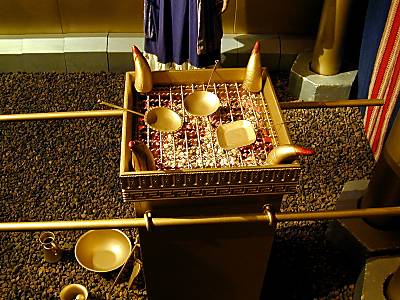
Projections at each of the four corners of the altar of burnt offering (Ex. 27:2; 38:2; Ezk. 43:15) and of the altar of incense (Ex. 30:2f.; 37:25f.). In both cases they were to be of one piece with the altar. Blood was smeared on the horns of the altar of burnt offering for the consecration of Aaron and his sons (Ex. 29:12), in the sin offering for a ruler (Heb. nasi’), and on the Day of Atonement (Lev. 16:18). The horns of the altar of incense were smeared with blood in the case of sin offerings for the high priest and the congregation of Israel (Lev. 4:17,18). Fugitives seeking asylum would cling to the horns, thus putting themselves under the divine protection (cf. 1 K. 1:50-53; 2:28; an addition to the LXX [2:29] reads, “I fled to the Lord”), though not in the case of wilful murder (1 K. 2:31-34; cf. Ex. 21:14); the horns appear to epitomize the holiness of the altar. The cutting off of the horns in Am. 3:14 signifies the removal of Israel’s last refuge from God’s judgment.


As noted, in Exodus 27:1-2 and 30:1-3, God commands Moses (NKJV):

You shall make an altar of acacia wood, five cubits long and five cubits wide—the altar shall be square—and its height shall be three cubits. You shall make its horns on its four corners; its horns shall be of one piece with it. And you shall overlay it with bronze…

You shall make an altar to burn incense on; you shall make it of acacia wood. A cubit shall be its length and a cubit its width—it shall be square—and two cubits shall be its height. Its horns shall be of one piece with it. And you shall overlay its top, its sides all around, and its horns with pure gold; and you shall make for it a molding of gold all around…
 
Note, however, that the horned altar was hardly unique to the Israelites, as other neighboring cultures also had similar items.

(Please Note: This uploaded content is no longer available.)
An altar at Beersheba, probably connected to a temple or cult center in the city. When Tel Be’er-Sheva was first excavated, archeologists discovered sandstone blocks in the walls of storehouses - most of the blocks used in the ancient city was made of limestone. They eventually took these blocks and reconstructed the altar, as shown here. It is thought that the altar was dismantled during the reforms of King Hezekiah in circa 8th century BC.

ADMIN: IMAGE REMOVED
An altar from Megiddo, dating 1000-900 BC and discovered in 1926 near a four-chambered gate and a casemate wall dated to the 10th century BC. This altar is too small for animal sacrifices and must have been used for sacrifices of wine, incense, or grain mixed with oil.


An altar from the temple complex at Tel Dan.

http://img690.imageshack.us/img690/1504/ekronironiihornedaltars.jpg
Some horned altars from Iron Age-II (10th-6th centuries BC) Ekron, modern-day Tel Miqne.

In Ancient Near Eastern culture, altars were thought of (obviously) to be the god’s ‘table’ and as a representation or a symbol of the deity himself (cf. Psalms 26:6-7; 43:4; 118:27). Now, it was actually unclear what the horns’ - to which an extreme degree of holiness were attached - exact origins are and the exact symbolism and purposethey had in ANE societies. We can infer that some altars had their horns used to latch the sacrificial animals on, but it seems to not be a universal practice.
Some have interpreted these horns as being descendants of massebahs (“standing stones”) which were originally placed in the altar but was gradually moved farther into the corners as time passed. Others interpret them more mundanely as censer-holders.
Later, these horns were interpreted as symbols of the concepts of strength and protection that are present in the word “horns” (qeren); hence the reason why Adonijah and Uriah clutched the projctions of the holy altar: they are seeking the protection of the Lord for themselves - and the Semitic idea that one ‘contracts’ holiness and impurity by touching either a holy or impure person or item. Also note that many deities throughout the ancient Near East were either portrayed with horns or are associated with horned animals, such as bulls, perhaps as a symbol of virility and strength. Jeremiah meanwhile denied the horns expiatory power as they too are infected with the sin that is engraved on the heard (Jer. 17:1). And as mentioned, cutting off the horns (Amos 3:14) apparently made an altar useless and unfit, signifying “the removal of Israel’s last refuge from God’s judgment”.
 
Status
Not open for further replies.
Back
Top