The Mozarabic Thread

  • Thread starter Thread starter patrick457
  • Start date Start date
Status
Not open for further replies.
Hey, how about clips of a Mozarabic Rite Mass?

I found on clip from the Western Orthodox Church, here…youtube.com/watch?v=xyR3le87AHA
Here’s a few more:
1.) one celebrated apparently in the Cathedral of Tarragona.
2.) The Offertory and the Sanctus.
3.) One celebrated in Bologna.

And, two videos (for the moment) of Mozarabic Chant:

1.) The Credimus (another version here)
2.) Libera nos, Filius Dei Salvator noster (the Officium for Easter Sunday)
3.) Gloria in Excelsis Deo (another version by Ensemble Organum and here)
4.) Per Gloriam Nominis Tui
 
I have been watching this “thread” for sometime now, and I must say that I am very impressed with the knowledge presented and the civility of the posters. Congratulations. I have truely enjoyed it.
 
Te Deum laudámus; te Dóminum confitémur.
Te ætérnum Patrem omnis terra venerátur.
Tibi omnes Ángeli, tibi cæli, et univérsæ potestátes.
Tibi Chérubim ac Séraphim incessábili voce proclámant:
Sanctus, Sanctus, Sanctus, Dóminus Deus Sábaoth.
Pleni sunt cæli et terra glória maiestátis tuæ.


Te gloriósus Apostolórum chorus;
Te Prophetárum laudábilis númerus;
Te Mártyrum candidátus laudat exércitus.
Te per orbem terrárum sancta confitétur Ecclésia:
Patrem imménsæ maiestátis;
Ad venerándum tuum verum unigénitum Fílium;
Sanctum quoque Paráclitum Spíritum.

Tu es rex glóriæ, Christe.
Tu, Patris sempitérnus es Fílius.
Tu, ad liberándum susceptúrus hóminem, non horruísti Vírginis úterum.
Tu, devicto mortis acúleo, aperuísti credéntibus te regna cælórum.
Tu ad déxteram Dei sedes in glória Patris.
Iudex créderis esse ventúrus.
Te ergo quæsumus tuis fámulis súbveni, quos pretióso Sánguine redemísti.
Ætérna fac cum Sanctis tuis in glória numerári.

Salvum fac pópulum tuum, Dómine, et bénedic hæreditáti tuæ:
Et rege eos et extólle illos usque in sæculum et in sæcula sæculórum. Amen.

Per síngulos dies benedícimus te:
Et laudámus nomen tuum in ætérnum et in sæculum sæculi.
Dignáre, Dómine, die isto sine tribulatióne et peccáto nos custodíre.
Miserére nobis, Dómine, miserére nobis.
Fiat misericórdia tua, Dómine, super nos sicut sperávimus in te.
In te Dómine sperávi, non confúndar in ætérnum.
Parce, Dómine, parce pópulo tuo, et ne des in oppróbrium hereditátem tuam.

The Mozarabic version of Te Deum
 
I’m afraid not, at the moment. 😦
By which I mean, I’ve been checking through stuff available on the net pertaining to the rite lately and couldn’t find anything yet pertaining as to a Pontifical Mass. Perhaps the fact that subsequent Archbishops of Toledo - where the Rite is celebrated now - were generally ‘Roman’ and the fact that the celebration of the Rite was, for about six centuries now, only relegated to a few areas (say, a chapel in the Cathedral of Toledo) - and before that was decrepit almost to the point of extinction? 😦
 
Salve Regina

In the old rite, it was the custom at the end of every Mass, before the Blessing was given, to recite/sing the Salve Regina. This is the form of the prayer as given in the Missale Mixtum (1755 edition):

http://books.google.com/books?id=mr...lvn_C9dcrmIANwhEy0g&ci=538,385,391,249&edge=0

One noticeable thing is that the word Mater is absent in the first phrase: hence, “Hail, Queen of Mercy!” The original form of the Salve Regina actually lacked the word, as all medieval chant and manuscript traditions testify to: Mater was a later (around 16th century) addition. It might be of interest to note that the Carthusians also sing the Salve Regina absentMater (also note the 14th century Dominican [Poissy Antiphonal](Poissy Antiphonal)). Interestingly though, it would seem that Mater has also later crept into Mozarabic usage.

http://books.google.com/books?id=wd...GIcKDq2qVyqomASgzyVg&ci=38,378,776,459&edge=0
http://books.google.com/books?id=xd...0efuK6q3C1WTAaNo6xA&ci=229,463,647,523&edge=0
  • From Rubricas Generales de la Missa Gothica-Muzarabe y El Omnium Offerentium (1772)
http://img180.imageshack.us/img180/2351/0921.jpg
The second is “Virgo semper”. The Old Catholic Encyclopedia says that, “Similarly, the word “Virgo” in the last verse [of the Salve Regina] seems to date back only to the thirteenth century.” And indeed, the aforementioned Carthusians also do not include it in their version. The Missa Gothica and the Rubricas Generales agree with the Missale Mixtum here, but the Missale minus illuminatum agrees with the ‘standard’ Roman form (i.e. it merely has Virgo).
 
Great posts! I have a great interest in learning more about the Mozarabic rite. I sometimes feel sad that a great deal of wonderful liturgical traditions were lost when the West homogenized into the Roman Rite. A few people here and there have tried reviving these “lost” rites and its great to see the Ambrosian and Mozarabic rite getting more widely known. Something that may be of interest, if I’m not mistaken the Episcopal Church in Spain uses the Mozarabic rite. It would be interesting to see an Protestant church celebrating this ancient rite.

A question, does anyone know if this rite made it to the America’s during colonization? Or did most of Spain already adopt the Roman rite by the 1500’s before Trent?
 
A question, does anyone know if this rite made it to the America’s during colonization? Or did most of Spain already adopt the Roman rite by the 1500’s before Trent?
As mentioned here earlier (I again quote from the Catholic Encyclopedia):

When King James of Aragon conquered Valencia in 1238, he found there Mozarabic Christians using the old rite, and the same apparently happened when Murcia and all Andalusia except Granada were conquered by Ferdinand III in 1235-51. When Ferdinand and Isabella took Granada in 1492, there were certainly some Mozarabic Christians there, as well as Christian merchants and prisoners from non-Moorish countries, but whether the Mozarabic Rite was used by them does not appear. With the discouragement which began with Alfonso VI came the period of decadence. The civil privileges (fueros) of the Toledo Mozarabes, which, though in 1147 Pope Eugene III had definitely put them under the jurisdiction of the bishop of the diocese, included a certain amount of independence, were confirmed by Alfonso VII in 1118, by Peter in 1350, by Henry II in 1379, and by Ferdinand and Isabella in 1480 (later also by Philip II in 1564, by Charles II in 1699, and by Philip V in 1740). But in spite of this the Roman Rite prevailed so much that it was introduced even into Mozarabic churches, which only used the old rite for certain special days, and that in a corrupted form from old and imperfectly understood MSS. This and the dying out of many Mozarabic families gradually brought the rite very low. There was a spasmodic attempt at a revival, when in 1436 Juan de Todesillas, Bishop of Segovia, founded the college of Aniago (originally a Benedictine house, a little to the southwest of Valladolid), where the priests were to use the Gothic Rite. The foundation lasted five years and then became Carthusian. Thus, when Francisco Ximenes de Cisneros became Archbishop of Toledo in 1495, he found the Mozarabic Rite in a fair way to become extinct.

So yeah, a good majority of Spain were using the Roman Rite.

Aside from the corrupt manuscripts in use, another factor which led into the decay of the rite - at least in the case of the city of Toledo - was the discrimination against it. Mozarabic clergy could not ascend the hierarchical ladder unless they abandon their liturgy. All was well at first - the Mozarabs defended their traditional rite with much vigor - but by the end of the twelfth century, they began to obtain appointments in the Cathedral of Toledo. Because before Cardinal Ximenes instituted the Mozarabic Chapel, the liturgy in use within the boundaries of the cathedral was that of the Roman, Mozarabic priests were required to switch rites. Their influence, however, began to alter the cathedral’s liturgy: for example, Mozarabic saints were introduced into the local form of the Roman calendar.

Between 1142 and 1170 there were in Toledo sixty Mozarabic parishes and 304 Hispano-Roman. Five centuries later, only six Mozarabic parishes remained - with a population of approximately 335 in the best-attended parishes of Santa Justa and Santa Eulalia. By 1594, there were only 537 Mozarabs - this includes those who went to the Americas!

It was because by this time, a lot of Mozarabic Christians who intermarried with ‘Romans’ also abandoned their native liturgy, which stimulated the influx of people into Roman parishes. Thus, the number of Mozarabic parishes declined, and the remaining ones became impoverished*. With the gradual extinction of many Mozarab clans came the corruption of their liturgy, and by the 15th century, those who still used it found themselves unable to perform legitimate ceremonies.

During this time, some people attempted to help save the rite from oblivion, including the aforementioned Bishop of Segovia Juan Vázquez de Cepeda of Tordesillas, Alfonso Carrillo de Acuña, Archbishop of Toledo (1446-1482), and Archbishop Carrillo’s successor Pedro VI Gonzalez de Mendoza (1482-1495) - the efforts of which were recognized by Pope Innocent II. But the rite itself continued to decline until Mendoza’s successor, the (in-)famous Cardinal Francisco I Ximénes de Cisneros happened to find Mozarabic manuscripts in the cathedral’s library and had to inquire what its nature was, or so an apocryphal story relates.
  • In 1480, the ‘Catholic Monarchs’, Ferdinand II of Aragon and Isabella of Castille confirmed the privileges of Mozarabic clerics in the form of money owed them by parishioners with residences outside Toledo. The problem is, those who were in charge of distributing the funds apparently withheld sending them to Mozarabic parishes for some time (at a time when they were badly needed), until the king and queen ordered a stop to this abuse.
 
That said, some Mozarabic customs did enter into former Spanish colonies along with the Roman Rite according to some authors, such as the use of the veil, the lazo (where the couple are bound together with a cord, and are then veiled together), and the arras at weddings*. By the way, the 1770 Missa Gothica seù Mozarabica, et officium itidem Gothicum I posted in passing earlier was actually published by Francisco Antonio Cardinal de Lorenzana in Mexico (where he was archbishop back then)! Lorenzana was himself a bibliophile and a writer; and being a former canon at Toledo, he would have been familiar with the rite. Also, the Benedictine abbey at Montserrat published a Roman Missal with Mozarabic chant and an appendix containing selections from the Manual of Toledo in 1795; copies were known in several Mexican colonial libraries.
  • This custom is still apparently alive and well in Latin America and the Philippines.
 
Now here’s one article that might be of interest: The Mozarabic Rite, a Clue to the Shroud of Turin?

This is the Inlatio/Illatio in question (for Easter Saturday). As you would see, it’s very long! I admit I kind of pity the priest who has to chant all of this… 😃 :eek:

Part 1 - Part 2 - Part 3

BTW, here’s the relevant phrase in Latin: “Ad monumentum Petrus cum Johanne concurrit: recentiaque in linteaminibus defuncti: et resurgentis vestigia cernit.
 
Assisting these chaplains during Mass and the Offices was a sacristán, also required to be a priest himself), who in turn was assisted by two altar boys (aka clerizones, monaguillos, mazos sirvientes) - all of whom were (obviously) required to attend the daily Mass.
I just realized something - the Catholic Encyclopedia has mazos, but it seems to be a typo - the correct term is actually mozos (sing. mozo)!
Back in the old days, mozos were usually boys or young men who wished to pursue an ecclesiastical career and were thus tonsured at a young age - they were thus also called clericuli, ‘little clerics’. So yeah, they were indeed, in a sense, the altar-boys: they assisted the priest and sung at the liturgy. The seises* also belong in this category.

The seises is a select group of (high-caliber, as required) choirboys, one of the functions of whom was apparently to dance during certain feastdays, say that of the Immaculate Conception or Corpus Christi (there are some historians who take the seises as a sort of proof that the Mozarabic liturgy may have included dance at some point in its history, but other evidence pointing toward such a conclusion is lacking).

http://www.formacioncofrade.org/curiosidades/seises/01.jpg
Seises in the Cathedral of Seville
 
Let me devote a moment here to delve into the controversial ‘Roman vs. Mozarabic’ topic further.

In the 30th of April in the year 1073, the freshly-elected Hildebrand of Sovana (Pope St. Gregory VII) authorised a new crusade against the Muslims in Spain. In the bull, addressed to “all the princes [rulers] in the land of Spain”, Gregory asserted that: “we believe the kingdom of Spain to have been from antiquity the rightful property of Saint Peter.” At the time when this declaration was made, there was already a gradual change of attitude towards other liturgies that happened to be not Roman in the part of the folks at Rome. Whereas before, the Hispanic liturgy was highly regarded and considered legitimate - and even bandied as a symbol of Christian triumph over Islam - now, the rite was seen as full of Arian, Priscillian, Adoptionist, and Muslim taint (despite the fact that Pope John X recognized it as error-free a century earlier!)

In a bull to Alfonso VI (dated 27 June of 1080), Gregory declared: “We must correct those in error within our lands” (correctionem regni vestri quod diu in herrore persisterat). In another bull to Alfonso, Gregory went further, declaring that this “Toletan superstition” (superstitio Toletana) was an impediment to the salvation of the church in Spain; the only step towards liberty was to implement the Roman Rite within Spanish lands. And thus, true to his character (his reign was characterized by reform), the Pope attempted to convince Spanish kings and prelates to switch liturgies.

Given the differences between the Roman and the Hispanic rites, Gregory seemed to have decided just to drop it wholesale - since it could not be fitted into the Roman mold easily. By replacing the Hispanic liturgy with the Roman, liturgical orthodoxy and uniformity, as well as a more fuller control of the Church in Spain - something that is apparently a point of concern given the various issues that have been plaguing the Western Church as a whole in those troubled times (i.e. the Muslim invasions, disputes with the East, to name a few) - can be secured.

And first steps were indeed made. In 22 March 1071, the first Roman Mass was sung in the presence of Cardinal Hugo Candidus and the king in the Monastery of San Juan de la Peña near Jaca, at the foot of the Pyrenees. This was followed by the introduction of the Roman Rite into Aragon, Navarre, Jaca, Leon, and Castille between 1071 and 1076, and into Cataluña a little later. In 15 October 1076, the Hispanic liturgy was officially repudiated within these lands by a papal bull. In the following year (28 June of 1077), Spain has been officially claimed for the Holy See. Alfonso meanwhile proclaimed himself “Emperor of all Spain”.

Obviously Mozarab Christians were not happy about this - here they were trying to preserve their Christian identity for almost four hundred years by the only way they know how, and even this is being taken away from them - and protests began to be vociferous. The institution of the Roman Rite would not be so easy.

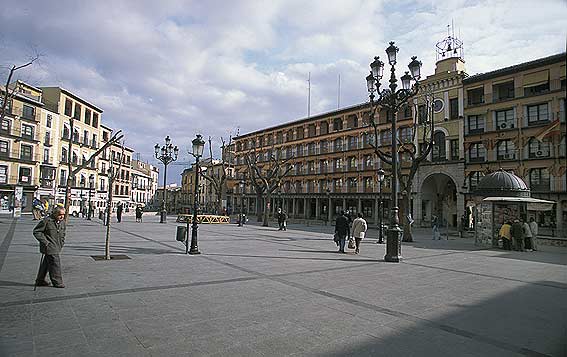
Thinking that things could be settled in a duel, an enactment was ordered at the Plaza de Zocodover in Toledo in Palm Sunday of 1077 (the “El Juicio de Dios” mentioned in the Catholic Encyclopedia article). Of course, the duel was not to the death: it was merely a courtly exercise wherein the loser has to submit to the will of the victor. Two knights fought - one (whose name is not recorded) for the Roman liturgy, another (Juan Ruiz de Matanzas) championing the Hispanic rite. Much to the dismay of the Roman supporters, De Matanzas won the duel, prompting them to seek other means.
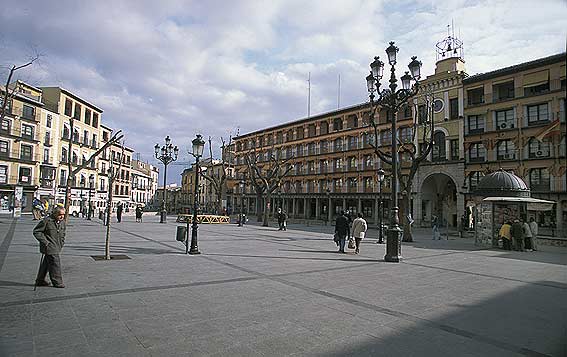

The Plaza de Zocodover today.

In the same plaza, a bonfire was lit up, and two books - one Roman, another Mozarabic - were thrown into it. According to the chronicles, the Roman book, when it caught fire, leapt out of the flames, while the Mozarabic book stood perfectly still, seeming unconsumed (the Catholic Encyclopedia article of course attributes this to the fact that the vellum used in Mozarabic manuscripts were often thick and solid). Once more, this was hailed as a victory for Spain - with an apparent miracle to back it up. Until supporters insisted that the Roman book leaping out of the bonfire was (also) a divine sign that the Roman Rite should be implemented in Toledo, that is. So they did, and the protests continued on as a result, until a compromise was finally reached by Alfonso. All new churches were to use the Roman Rite, but in six old churches within Toledo (Sts. Justa and Ruffina, St. Eulalia, St. Sebastian, St. Mark, St. Luke, and St. Torquatus) Mozarabs could continue to practice their old rite and hand it on to their descendants.

In the spring of 1080, a council was held in Burgos. We no longer have the council’s acts, but a diploma issued by Alfonso in April or May of that year states that the ‘most dignified Roman office’ (dignissimum Romane officium) is to be used within his realm.

…Quod ego, Ildefonsus rex, rationabili mente pertractans, cum Deus et Dominus noster michi suppeditavit ut is Hispanie partibus, dominio meo ab eodem commissis, dignissimum Romane institucionis Officium celebrari preciperem et precipiendo fideliter complerem. Omnium Xpti Ecclesiarum predia et posesiones pro uiribus meis locupletaui…

 
I just realized something - the Catholic Encyclopedia has mazos, but it seems to be a typo - the correct term is actually mozos (sing. mozo)!
Back in the old days, mozos were usually boys or young men who wished to pursue an ecclesiastical career and were thus tonsured at a young age - they were thus also called clericuli, ‘little clerics’. So yeah, they were indeed, in a sense, the altar-boys: they assisted the priest and sung at the liturgy. The seises* also belong in this category.
Actually, the Catholic Encyclopedia correctly has “mozos sirvientes.” It’s just the online HTML versioin that has “mazos,” presumably due to bad OCR.
 
Status
Not open for further replies.
Back
Top