Let me devote a moment here to delve into the controversial ‘Roman vs. Mozarabic’ topic further.
In the 30th of April in the year 1073, the freshly-elected Hildebrand of Sovana (Pope St. Gregory VII) authorised a new crusade against the Muslims in Spain. In the bull, addressed to “
all the princes [rulers] in the land of Spain”, Gregory asserted that: “
we believe the kingdom of Spain to have been from antiquity the rightful property of Saint Peter.” At the time when this declaration was made, there was already a gradual change of attitude towards other liturgies that happened to be
not Roman in the part of the folks at Rome. Whereas before, the Hispanic liturgy was highly regarded and considered legitimate - and even bandied as a symbol of Christian triumph over Islam - now, the rite was seen as full of Arian, Priscillian, Adoptionist, and Muslim taint (despite the fact that Pope John X recognized it as error-free a century earlier!)
In a bull to Alfonso VI (dated 27 June of 1080), Gregory declared: “We must correct those in error within our lands” (
correctionem regni vestri quod diu in herrore persisterat). In another bull to Alfonso, Gregory went further, declaring that this “Toletan superstition” (
superstitio Toletana) was an impediment to the salvation of the church in Spain; the only step towards liberty was to implement the Roman Rite within Spanish lands. And thus, true to his character (his reign was characterized by
reform), the Pope attempted to convince Spanish kings and prelates to switch liturgies.
Given the differences between the Roman and the Hispanic rites, Gregory seemed to have decided just to drop it wholesale - since it could not be fitted into the Roman mold easily. By replacing the Hispanic liturgy with the Roman, liturgical orthodoxy and uniformity, as well as a more fuller control of the Church in Spain - something that is apparently a point of concern given the various issues that have been plaguing the Western Church as a whole in those troubled times (i.e. the Muslim invasions, disputes with the East, to name a few) - can be secured.
And first steps were indeed made. In 22 March 1071, the first Roman Mass was sung in the presence of Cardinal Hugo Candidus and the king in the Monastery of San Juan de la Peña near Jaca, at the foot of the Pyrenees. This was followed by the introduction of the Roman Rite into Aragon, Navarre, Jaca, Leon, and Castille between 1071 and 1076, and into Cataluña a little later. In 15 October 1076, the Hispanic liturgy was officially repudiated within these lands by a papal bull. In the following year (28 June of 1077), Spain has been officially claimed for the Holy See. Alfonso meanwhile proclaimed himself “Emperor of all Spain”.
Obviously Mozarab Christians were not happy about this - here they were trying to preserve their Christian identity for almost four hundred years by the only way they know how, and even this is being taken away from them - and protests began to be vociferous. The institution of the Roman Rite would not be so easy.
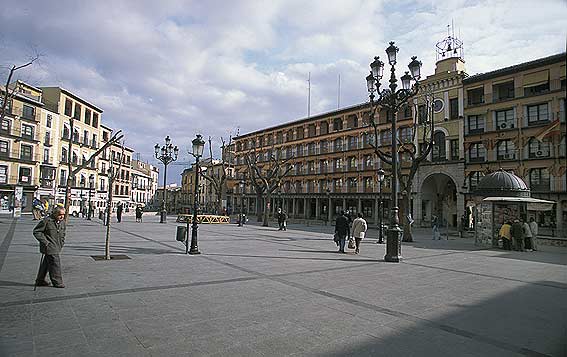
Thinking that things could be settled in a duel, an enactment was ordered at the Plaza de Zocodover in Toledo in Palm Sunday of 1077 (the “El Juicio de Dios” mentioned in the Catholic Encyclopedia article). Of course, the duel was not to the death: it was merely a courtly exercise wherein the loser has to submit to the will of the victor. Two knights fought - one (whose name is not recorded) for the Roman liturgy, another (Juan Ruiz de Matanzas) championing the Hispanic rite. Much to the dismay of the Roman supporters, De Matanzas won the duel, prompting them to seek other means.
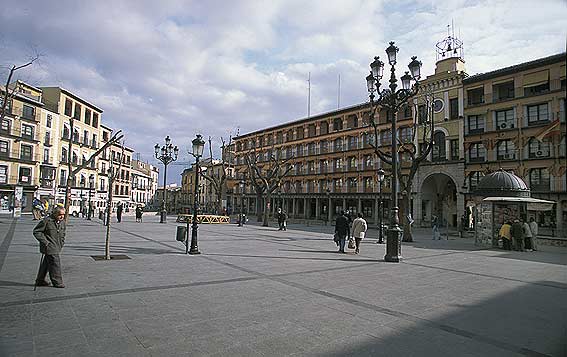
The Plaza de Zocodover today.
In the same plaza, a bonfire was lit up, and two books - one Roman, another Mozarabic - were thrown into it. According to the chronicles, the Roman book, when it caught fire, leapt out of the flames, while the Mozarabic book stood perfectly still, seeming unconsumed (the Catholic Encyclopedia article of course attributes this to the fact that the vellum used in Mozarabic manuscripts were often thick and solid). Once more, this was hailed as a victory for Spain - with an apparent miracle to back it up. Until supporters insisted that the Roman book leaping out of the bonfire was (also) a divine sign that the Roman Rite should be implemented in Toledo, that is. So they did, and the protests continued on as a result, until a compromise was finally reached by Alfonso. All new churches were to use the Roman Rite, but in six old churches within Toledo (Sts. Justa and Ruffina, St. Eulalia, St. Sebastian, St. Mark, St. Luke, and St. Torquatus) Mozarabs could continue to practice their old rite and hand it on to their descendants.
In the spring of 1080, a council was held in Burgos. We no longer have the council’s acts, but a diploma issued by Alfonso in April or May of that year states that the ‘most dignified Roman office’ (
dignissimum Romane officium) is to be used within his realm.
…Quod ego, Ildefonsus rex, rationabili mente pertractans, cum Deus et Dominus noster michi suppeditavit ut is Hispanie partibus, dominio meo ab eodem commissis, dignissimum Romane institucionis Officium celebrari preciperem et precipiendo fideliter complerem. Omnium Xpti Ecclesiarum predia et posesiones pro uiribus meis locupletaui…