The newest Cathedral

  • Thread starter Thread starter strugglingalong
  • Start date Start date
Status
Not open for further replies.
Sister, I just read on their website that yes the Cathedral was built with Earthquakes in mind. But does the Cathedral provide for the Extra-Ordinary form of the Mass and the rubrics. Altar Rails etc…
No, no altar rails, and no possibility for a high altar.

Luckily the EF is offered at another parish in Oakland, (St. Margaret Mary’s Parish.

Whenever I don’t have to work on Sunday I attend here, but unfortunately the High Mass is offered at 12:30 making it nearly impossible to attend (so I usually stick to my home parish across the bay in San Francisco).
 
Looks practical as it appears to have a low centre of gravity- pretty important feature in a building that is definitely going to be hit by an earthquake sooner or later- cathedral lifespans are measured in centuries.

I’m sure the architect considered the needs of the customer, as well as the lot that he had to work with and the amount of investment available in designing the building.

Really can’t judge this just from pictures, particularly as the alternatives that the architect presented aren’t here.
Yeah, but would it have killed him to at least put some stained glass in there?
 
Of course there was extensive earthquake protection; it would be silly and irresponsible in the extreme to build a cathedral in this part of the country after having lost a cathedral to a major quake without such planning and engineering. The Diocese of Oakland offers the extraordinary form of Mass regularly at another parish. As far as I know the diocese does not intend to do so at the Cathedral itself, nor is the Cathedral set up for it if there MUST be altar rails. Again, NO ALTAR RAILS at Christ the Light Cathedral. Personally, I don’t see how altar rails are a make or break issue in this matter.
Sister. Altar rails are needed for the Extra-Ordinary Form of the Holy Mass. So does this make it or break it. Yes, since both forms are equal!. Cathedrals should be providing for both forms of the Roman Rite. If not than it is diminishing the equality of the Extra-Ordinary form with the Ordinary form. And according to Summorum Pontificum that is unacceptable. If liberal clergy just think that tradition and the 1962 Mass are just going to float away. Than they are sadly mistaken!. One of the best places to have a High Mass is in a Cathedral.
 
No, no altar rails, and no possibility for a high altar.

Luckily the EF is offered at another parish in Oakland, (St. Margaret Mary’s Parish.

Whenever I don’t have to work on Sunday I attend here, but unfortunately the High Mass is offered at 12:30 making it nearly impossible to attend (so I usually stick to my home parish across the bay in San Francisco).
It should also be made available in Cathedrals as well!. Not just some local parish.
 
As a member of the “great unwashed” who simply likes what I like and don’t like what I don’t like, I am sure those cognoscenti who do understand modern architecture will either tell me I’m wrong or ignore me, and either is okay.

I can’t see a building like this without thinking about two things:
First, Tom Wolfe’s “From Bauhaus to Our House”, his essay/book on modern architecture. He explores the origins of modern architecture and traces it back to a passion for “worker housing” in the early part of the last century. It was supposed that workers, being used to mechanical things and plain factories, and being marxists at heart, would want things plain and simple and functional. Trouble is, they didn’t, and rejected it all, including the very avant garde but very uncomfortable “Barcelona chair” that was imagined to suit their functional tastes to a “T”. It didn’t, but one can still find one here and there. Workers wanted overstuffed easy chairs with flowers and such on them instead. But whatever.

Because many architects saw themselves as “artists” notwithstanding the romance with Ayn Rand’s “form follows function” way of interpreting the architectural world, and, following the Bauhaus school, worker housing concepts and all, started designing buildings according to their tastes rather than those of the client. And, as Wolfe expressed it, the client had to “take it like a man”. There is often a tension between architect and client, because the architect is fundamentally addressing his “message” to other architects. “This means this” “That is symbolic of that”. The client has to be educated by the architect in all of that because it isn’t immediately apparant. It isn’t immediately apparent because it’s a language all its own. You’re either educated to it or you aren’t. The client, of course, is embarrassed to express ignorance in the face of the sublime tastes of the architect, even less prepared to argue with it, because, after all, failure to understand and appreciate simply marks one as a Phillistine. And, of course, Client “A” doesn’t want to express his ignorance or dismay to Client “B” who might be building across the street or across town, and so the architects get their way and have this steel and concrete conversation going among themselves. Among their fraternity, “boldness” and “innovation” are rewarded by recognition and honors, and so their conversation goes on and on. The clients pay for it, and “take it like a man”.

Now, among the Church elites who have time to study enough of the “language”, this is all marvelous. Why, this represents this, and that represents that, and the play of light upon this is symbolic of that. Parishioners, who are not educated to the language see puzzling things to which they simply adapt, and the band plays on.

Second, “modern” and “innovative” are relative things. What’s modern today is old hat tomorrow. I was intrigued by the statement that there is some manner of “fish” symbolism in the shape of something in the cathedral. I recall, in the 1950s, when some architect persuaded a parish in Kansas City to build what came to be called the “Fish Church” and is called that today. Of course, it’s no longer innovative and it’s no longer modern, and the whole thing would not gain the admiration of anyone now. (Then, too, it’s excruciatingly ugly to one who was not into the language of the architects circa 1958 or so. It was then, and is now.) But the parish is stuck with it, at least until it can be knocked down and replaced with something “modern” and “innovative” all over again.

Now, those who defend modern church architecture are quick to tell us that, well, Gothic was “new” when it was new, and replaced stodgy old Romanesque or Norman or whatever. Well, it was. No doubt about it. But it was still something that was within the “language” of the “clients” who, after all, are the parishioners. So the stained glass windows were massively larger, true. But they still represented scenes or images known to the parishioners, and were realistic unless quite obviously symbolic. The materials were still beautiful and fine. The artwork was more “natural” and had more depth. But it was still all recognizable, and the meanings were approachable. The ceiling was much higher, but still had a majesty about it and a symmetry that was familiar and knowable.

That is my problem with modern architecture. It’s an elite language that does not resonate with people or even give itself to immediate comprehension. To the extent it contains “messages”, they are purposely obscure and require a “playbook” to understand. The materials are almost always plain and rather dowdy. “Worker housing” filled with “Barcelona chairs”. The cognoscenti object “why, no parish or diocese could afford the stuff that’s in the traditional cathedrals”. But some of that plain stuff costs staggering sums. It’s all custom designed and usually so odd that it requires an incredible amount of labor to build.(Not to mention hours and hours and hours of architect and designer time) I don’t buy the “we can’t afford it” argument.

As I said, I like what I like and I don’t like what I don’t like. I like the traditional styles, that are immediately comprehensible. The “Fish Church” notwithstanding, I can’t help but think someday they’ll knock all those no-long-modern buildings down and wonder what on earth people were thinking in the late 20th and early 21st centuries.

 
As a member of the “great unwashed” who simply likes what I like and don’t like what I don’t like, I am sure those cognoscenti who do understand modern architecture will either tell me I’m wrong or ignore me, and either is okay.

I can’t see a building like this without thinking about two things:
First, Tom Wolfe’s “From Bauhaus to Our House”, his essay/book on modern architecture. He explores the origins of modern architecture and traces it back to a passion for “worker housing” in the early part of the last century. It was supposed that workers, being used to mechanical things and plain factories, and being marxists at heart, would want things plain and simple and functional. Trouble is, they didn’t, and rejected it all, including the very avant garde but very uncomfortable “Barcelona chair” that was imagined to suit their functional tastes to a “T”. It didn’t, but one can still find one here and there. Workers wanted overstuffed easy chairs with flowers and such on them instead. But whatever.

Because many architects saw themselves as “artists” notwithstanding the romance with Ayn Rand’s “form follows function” way of interpreting the architectural world, and, following the Bauhaus school, worker housing concepts and all, started designing buildings according to their tastes rather than those of the client. And, as Wolfe expressed it, the client had to “take it like a man”. There is often a tension between architect and client, because the architect is fundamentally addressing his “message” to other architects. “This means this” “That is symbolic of that”. The client has to be educated by the architect in all of that because it isn’t immediately apparant. It isn’t immediately apparent because it’s a language all its own. You’re either educated to it or you aren’t. The client, of course, is embarrassed to express ignorance in the face of the sublime tastes of the architect, even less prepared to argue with it, because, after all, failure to understand and appreciate simply marks one as a Phillistine. And, of course, Client “A” doesn’t want to express his ignorance or dismay to Client “B” who might be building across the street or across town, and so the architects get their way and have this steel and concrete conversation going among themselves. Among their fraternity, “boldness” and “innovation” are rewarded by recognition and honors, and so their conversation goes on and on. The clients pay for it, and “take it like a man”.

Now, among the Church elites who have time to study enough of the “language”, this is all marvelous. Why, this represents this, and that represents that, and the play of light upon this is symbolic of that. Parishioners, who are not educated to the language see puzzling things to which they simply adapt, and the band plays on.

Second, “modern” and “innovative” are relative things. What’s modern today is old hat tomorrow. I was intrigued by the statement that there is some manner of “fish” symbolism in the shape of something in the cathedral. I recall, in the 1950s, when some architect persuaded a parish in Kansas City to build what came to be called the “Fish Church” and is called that today. Of course, it’s no longer innovative and it’s no longer modern, and the whole thing would not gain the admiration of anyone now. (Then, too, it’s excruciatingly ugly to one who was not into the language of the architects circa 1958 or so. It was then, and is now.) But the parish is stuck with it, at least until it can be knocked down and replaced with something “modern” and “innovative” all over again.

Now, those who defend modern church architecture are quick to tell us that, well, Gothic was “new” when it was new, and replaced stodgy old Romanesque or Norman or whatever. Well, it was. No doubt about it. But it was still something that was within the “language” of the “clients” who, after all, are the parishioners. So the stained glass windows were massively larger, true. But they still represented scenes or images known to the parishioners, and were realistic unless quite obviously symbolic. The materials were still beautiful and fine. The artwork was more “natural” and had more depth. But it was still all recognizable, and the meanings were approachable. The ceiling was much higher, but still had a majesty about it and a symmetry that was familiar and knowable.

That is my problem with modern architecture. It’s an elite language that does not resonate with people or even give itself to immediate comprehension. To the extent it contains “messages”, they are purposely obscure and require a “playbook” to understand. The materials are almost always plain and rather dowdy. “Worker housing” filled with “Barcelona chairs”. The cognoscenti object “why, no parish or diocese could afford the stuff that’s in the traditional cathedrals”. But some of that plain stuff costs staggering sums. It’s all custom designed and usually so odd that it requires an incredible amount of labor to build.(Not to mention hours and hours and hours of architect and designer time) I don’t buy the “we can’t afford it” argument.

As I said, I like what I like and I don’t like what I don’t like. I like the traditional styles, that are immediately comprehensible. The “Fish Church” notwithstanding, I can’t help but think someday they’ll knock all those no-long-modern buildings down and wonder what on earth people were thinking in the late 20th and early 21st centuries.
You said what I was thinking but didn’t know how to say. A thousand amens.
 
Sister. Altar rails are needed for the Extra-Ordinary Form of the Holy Mass. So does this make it or break it. Yes, since both forms are equal!. Cathedrals should be providing for both forms of the Roman Rite. If not than it is diminishing the equality of the Extra-Ordinary form with the Ordinary form. And according to Summorum Pontificum that is unacceptable. If liberal clergy just think that tradition and the 1962 Mass are just going to float away. Than they are sadly mistaken!. One of the best places to have a High Mass is in a Cathedral.
I don’t believe it would be a liturgical abuse per se if communicants received communion while standing if it was due to facility limitations.

Then again they can always position some portable kneelers.
 
Sister. Altar rails are needed for the Extra-Ordinary Form of the Holy Mass. So does this make it or break it. Yes, since both forms are equal!. Cathedrals should be providing for both forms of the Roman Rite. If not than it is diminishing the equality of the Extra-Ordinary form with the Ordinary form. And according to Summorum Pontificum that is unacceptable. If liberal clergy just think that tradition and the 1962 Mass are just going to float away. Than they are sadly mistaken!. One of the best places to have a High Mass is in a Cathedral.
Why is the altar rail necessary except as a functional matter? One can still kneel to receive Eucharist on the first step at CTL. For that matter a prie dieux or three or four (at the head of each aisle, for instance) could be put up for people to use if they need assistance in standing up again and the cathedral decided to offer this form of Mass. The Mass can still be said facing away from the people. Latin and the EF can still be used. All the other smells and bells (etc) can be included easily. Nope, I still don’t see this as a make or break issue unless the EF per se is not really the issue, and there is instead an theological agenda (like separating ordained from non-ordained and preventing the laity from moving beyond the rail to serve in various ministries.)

If the EF can ONLY be celebrated in Gothic (or similiar) cathedrals with those specific accoutrements at issue for some then it is truly an anachronism. Consider situations of war, convent chapels, or contemporary cathedrals: it could not be celebrated in the majority of churches that exist and, if your interpretation is valid, was apparently invalid or should never have been celebrated when offered in concentration camps, prison cells and many non-Gothic churches in the history of monastic life: no altar rails, no high altar built into a reredos, etc, etc.

Please don’t make something like an altar rail essential to the extraordinary form of the Mass. You will only ensure it is truly outdated and unable to serve the contemporary world or be celebrated anywhere liturgy is normally celebrated. To do that would also implicitly criticize the validity and quality of the ordinary form, and of course, that is no more acceptable than the converse would be.
 
As a member of the “great unwashed” who simply likes what I like and don’t like what I don’t like, I am sure those cognoscenti who do understand modern architecture will either tell me I’m wrong or ignore me, and either is okay.

I can’t see a building like this without thinking about two things:
First, Tom Wolfe’s “From Bauhaus to Our House”, his essay/book on modern architecture. He explores the origins of modern architecture and traces it back to a passion for “worker housing” in the early part of the last century. It was supposed that workers, being used to mechanical things and plain factories, and being marxists at heart, would want things plain and simple and functional. Trouble is, they didn’t, and rejected it all, including the very avant garde but very uncomfortable “Barcelona chair” that was imagined to suit their functional tastes to a “T”. It didn’t, but one can still find one here and there. Workers wanted overstuffed easy chairs with flowers and such on them instead. But whatever.

Because many architects saw themselves as “artists” notwithstanding the romance with Ayn Rand’s “form follows function” way of interpreting the architectural world, and, following the Bauhaus school, worker housing concepts and all, started designing buildings according to their tastes rather than those of the client. And, as Wolfe expressed it, the client had to “take it like a man”. There is often a tension between architect and client, because the architect is fundamentally addressing his “message” to other architects. “This means this” “That is symbolic of that”. The client has to be educated by the architect in all of that because it isn’t immediately apparant. It isn’t immediately apparent because it’s a language all its own. You’re either educated to it or you aren’t. The client, of course, is embarrassed to express ignorance in the face of the sublime tastes of the architect, even less prepared to argue with it, because, after all, failure to understand and appreciate simply marks one as a Phillistine. And, of course, Client “A” doesn’t want to express his ignorance or dismay to Client “B” who might be building across the street or across town, and so the architects get their way and have this steel and concrete conversation going among themselves. Among their fraternity, “boldness” and “innovation” are rewarded by recognition and honors, and so their conversation goes on and on. The clients pay for it, and “take it like a man”.

Now, among the Church elites who have time to study enough of the “language”, this is all marvelous. Why, this represents this, and that represents that, and the play of light upon this is symbolic of that. Parishioners, who are not educated to the language see puzzling things to which they simply adapt, and the band plays on.

Second, “modern” and “innovative” are relative things. What’s modern today is old hat tomorrow. I was intrigued by the statement that there is some manner of “fish” symbolism in the shape of something in the cathedral. I recall, in the 1950s, when some architect persuaded a parish in Kansas City to build what came to be called the “Fish Church” and is called that today. Of course, it’s no longer innovative and it’s no longer modern, and the whole thing would not gain the admiration of anyone now. (Then, too, it’s excruciatingly ugly to one who was not into the language of the architects circa 1958 or so. It was then, and is now.) But the parish is stuck with it, at least until it can be knocked down and replaced with something “modern” and “innovative” all over again.

Now, those who defend modern church architecture are quick to tell us that, well, Gothic was “new” when it was new, and replaced stodgy old Romanesque or Norman or whatever. Well, it was. No doubt about it. But it was still something that was within the “language” of the “clients” who, after all, are the parishioners. So the stained glass windows were massively larger, true. But they still represented scenes or images known to the parishioners, and were realistic unless quite obviously symbolic. The materials were still beautiful and fine. The artwork was more “natural” and had more depth. But it was still all recognizable, and the meanings were approachable. The ceiling was much higher, but still had a majesty about it and a symmetry that was familiar and knowable.

That is my problem with modern architecture. It’s an elite language that does not resonate with people or even give itself to immediate comprehension. To the extent it contains “messages”, they are purposely obscure and require a “playbook” to understand. The materials are almost always plain and rather dowdy. “Worker housing” filled with “Barcelona chairs”. The cognoscenti object “why, no parish or diocese could afford the stuff that’s in the traditional cathedrals”. But some of that plain stuff costs staggering sums. It’s all custom designed and usually so odd that it requires an incredible amount of labor to build.(Not to mention hours and hours and hours of architect and designer time) I don’t buy the “we can’t afford it” argument…

[EDITED FOR SPACE]
You said what I was thinking but didn’t know how to say. A thousand amens.
Amen!

First of all, let me make clear that I am not anti-Vatican II or anti-NO.

That being said, I’ve always maintained that whomever it was who decided to strip our churches bare of statutes and stained glass so as to focus our attention on the Lord, forgot one very simple fact: We are sensate creatures. These seeming “distractions” *are * what focus our attention.

Unfortunately, the Old World artists and artisans are long dead, and it is questionable if an old style cathedral could even be built in today’s day and age.

😦
 
Amen!

First of all, let me make clear that I am not anti-Vatican II or anti-NO.
Nor am I. Just as Ridgerunner said, just a man of my tastes.
That being said, I’ve always maintained that whomever it was who decided to strip our churches bare of statutes and stained glass so as to focus our attention on the Lord, forgot one very simple fact: We are sensate creatures. These seeming “distractions” are what focus our attention.
And in some cases, the lack thereof become the distractions themselves.
Unfortunately, the Old World artists and artisans are long dead, and it is questionable if an old style cathedral could even be built in today’s day and age.
I think it might just be an issue of locale. We’re known for having a very “progressive” taste in music, art, architechture, etc here in the SF Bay Area (though there are still sticklers like me who favor antiquity in certain respects). I was in Modesto a couple months ago and noticed a quasi-modern Cathedral being built. I say quasi-modern because there were aspects of it that made you know it was from this millenium, yet it still kept many traditional features (such as the outline of a cross, a large vaulted dome, etc).

The colors were a little strange, but the overall shape yet from even a mile up the road I could tell that it was a Catholic Cathedral.
 
Why is the altar rail necessary except as a functional matter? One can still kneel to receive Eucharist on the first step at CTL. For that matter a prie dieux or three or four (at the head of each aisle, for instance) could be put up for people to use if they need assistance in standing up again and the cathedral decided to offer this form of Mass. The Mass can still be said facing away from the people. Latin and the EF can still be used. All the other smells and bells (etc) can be included easily. Nope, I still don’t see this as a make or break issue unless the EF per se is not really the issue, and there is instead an theological agenda (like separating ordained from non-ordained and preventing the laity from moving beyond the rail to serve in various ministries.)

If the EF can ONLY be celebrated in Gothic (or similiar) cathedrals with those specific accoutrements at issue for some then it is truly an anachronism. Consider situations of war, convent chapels, or contemporary cathedrals: it could not be celebrated in the majority of churches that exist and, if your interpretation is valid, was apparently invalid or should never have been celebrated when offered in concentration camps, prison cells and many non-Gothic churches in the history of monastic life: no altar rails, no high altar built into a reredos, etc, etc.

Please don’t make something like an altar rail essential to the extraordinary form of the Mass. You will only ensure it is truly outdated and unable to serve the contemporary world or be celebrated anywhere liturgy is normally celebrated. To do that would also implicitly criticize the validity and quality of the ordinary form, and of course, that is no more acceptable than the converse would be.
Sister. “The Contemporary World” is what is destroying the Catholic Church today!. What about the quality and validity of the Extra-Ordinary form?. God forbid if we separated our clergy from the laity during The Holy Sacrifice of the Mass. Good thing we have no iconostasis or altar screens in modern churches or cathedrals. We may look to Catholic!.
 
Sister. “The Contemporary World” is what is destroying the Catholic Church today!. What about the quality and validity of the Extra-Ordinary form?. God forbid if we separated our clergy from the laity during The Holy Sacrifice of the Mass. Good thing we have no iconostasis or altar screens in modern churches or cathedrals. We may look to Catholic!.
Especially the border-line wacky culture of the SF Bay Area.

One of these is the Cathedral for the Archdiocese of San Francisco (Catholic Church) and the other, the Cathedral for the Episcopalian Church in SF. Would you like to take a guess at which one is which?

(Please Note: This uploaded content is no longer available.)


If you guessed that the cathedral looking like an oversized washing machine(which us locals have dubbed “Our Lady of Maytag”) is the Catholic one, you guessed right!

Of the three diocese here in the San Francisco Bay Area (SF, Oakland, and San Jose) only one traditionally designed cathedral remains:

(Please Note: This uploaded content is no longer available.)

I need to make it a point to drive the mere 20 minutes to go visit this cathedral before (God forbid) a natural disaster takes this one out too.
 
“If the EF can ONLY be celebrated in Gothic (or similiar) cathedrals with those specific accoutrements at issue for some then it is truly an anachronism.”

You sound like you don’t care at all for Pope Benedict XVI and Summorum Pontificum.

“Consider situations of war, convent chapels, or contemporary cathedrals: it could not be celebrated in the majority of churches that exist and, if your interpretation is valid, was apparently invalid or should never have been celebrated when offered in concentration camps, prison cells and many non-Gothic churches in the history of monastic life: no altar rails, no high altar built into a reredos, etc, etc”

Sounds like an excuse to me for not having the Extra-Ordinary Form in a Cathedral. It’s a Cathedral were talking about Sister, not a camp, or convent chapel (which did have altar rails before they were taken away).

Sister you are aware that a document from the Vatican will probably be coming out in Jan 2009, which will lay out the law in regards to the EF of the Holy Mass. Those who are opposed to it, may not like what they hear.

From RORATE CAELI

" Summorum Pontificum clarification document
We acknowledge the ongoing rumor about a possible publication of the clarification document of the motu proprio Summorum Pontificum in January 2009. Gregor Kollmorgen, of The New Liturgical Movement, offers a translation of the text published in the Italian religious news website Pontifex (Bruno Volpe):
Code:
The Instruction on the Motu Proprio Summorum Pontificum of 7 July 2007 which liberalized Holy Mass according to the ancient Roman rite, has been ready for some time already and is now being examined by Pope Benedict XVI. This Pontifex has learned from authoritative sources. The text, signed by Cardinal Darío Castrillón Hoyos, President of the Pontifical Commission Ecclesia Dei, will be signed most likely by the Pope in late December and published in the first days of January 2009. In its most important parts the document, which had become indispensable after the many problems in the application of the Motu Proprio and forms of outright recalcitrance on the part of not a few bishops (incidentally appropriately denounced in September by the Vice President of the Commission Ecclesia Dei, Monsignor Camille Perl), addresses two crucial topics: the interpretation of the term "stable group of faithful" within an ordinary parish and the problem of personal parishes. It was even considered to list and to indicate a minimum number of faithful, but this solution has been discarded.

According to the document, the traditionalist faithful present in a parish will have the full protection of the law to ask for the old Mass, and if the bishop refuses (here is the news), saying that there are no priests capable of celebrating according to the ancient rite in that place, the Commission Ecclesia Dei will authoritatively ("di imperio") send a priest able to do so to that diocese. In short, the bishops will no longer be able to refuse a priori to have the old Mass celebrated, because in such cases, the Commission Ecclesia Dei will send a delegated priest of its own.

The document then analyzes the case of personal parishes in which the traditionalists want to celebrate the Christmas Mass or the Easter Triduum according to the ancient rite, also in cases of an absence of priests, or a prohibition by the bishop. The possibility of a shortage of priests could be envisaged, and also in this case, Ecclesia Dei will take care. The Holy See, therefore, wants to establish definitive clarity regarding the application of the Motu Proprio, and for this reason also the powers and prerogatives of the Pontifical Commission Ecclesia Dei will be better defined and strengthened."
 
Especially the border-line wacky culture of the SF Bay Area.

One of these is the Cathedral for the Archdiocese of San Francisco (Catholic Church) and the other, the Cathedral for the Episcopalian Church in SF. Would you like to take a guess at which one is which?

http://www.earth(name removed by moderator)ictures.com/world/usa/san_francisco/grace_cathedral_-_notre_dame_of_san_francisco.jpg

http://farm1.static.flickr.com/3/2332576_02a3cd72aa.jpg

If you guessed that the cathedral looking like an oversized washing machine(which us locals have dubbed “Our Lady of Maytag”) is the Catholic one, you guessed right!

Of the three diocese here in the San Francisco Bay Area (SF, Oakland, and San Jose) only one traditionally designed cathedral remains:

http://www.terragalleria.com/images/us-ca/usca30094.jpeg

I need to make it a point to drive the mere 20 minutes to go visit this cathedral before (God forbid) a natural disaster takes this one out too.
Let me see?:confused:
The first one looks like Rheims to me!. So the first one is Catholic:D 😃

Darn went to Wikipedia it’s the second one :eek: :crying:
 
Let me see?:confused:
The first one looks like Rheims to me!. So the first one is Catholic:D 😃

Darn went to Wikipedia it’s the second one :eek: :crying:
Get this:

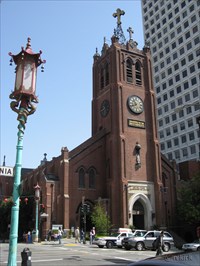
This was the original cathedral for SF which is still standing:


It’s over in the Chinatown, and for the life of my I can’t figure out why our archdiocese doesn’t use it as the Cathedral if it’s still standing!

I’ve never attended Mass in the new Cathedral (yet) but I did go as a tourist a few years back. While taking a photo of its gaudy exterior, a person approached me and asked if it was the local Church of Scientology.

Come to think of it, it does look rather space-agey.
 
“If the EF can ONLY be celebrated in Gothic (or similiar) cathedrals with those specific accoutrements at issue for some then it is truly an anachronism.”

You sound like you don’t care at all for Pope Benedict XVI and Summorum Pontificum.]]

Actually, my point was the Mass should be able to be celebrated effectively and reverently in ANY Church, gothic or not or else it has proved ITSELF to be anachronistic. I see that you are not responding to the issue of altar rails being absolutely necessary to celebrate the EFM. My point was that if it is a functional issue, then other arrangements could be used at Christ the Light which would allow the EF to be celebrated. My comments had nothing to do with either the Pope (whose theology of the cross, and eschatology are among the best I have read) or for Summorum Pontificum.

“Consider situations of war, convent chapels, or contemporary cathedrals: it could not be celebrated in the majority of churches that exist and, if your interpretation is valid, was apparently invalid or should never have been celebrated when offered in concentration camps, prison cells and many non-Gothic churches in the history of monastic life: no altar rails, no high altar built into a reredos, etc, etc”

[Sounds like an excuse to me for not having the Extra-Ordinary Form in a Cathedral. It’s a Cathedral were talking about Sister, not a camp, or convent chapel (which did have altar rails before they were taken away).]]

Actually my point was simple and just the opposite: altar rails were not always present nor were even the barest semblance of a gothic (or similar) cathedral. The Mass was celebrated — and effectively and reverently so — in such spaces. In fact, in some of the settings I mentioned the reverence was far more striking than in some more “traditional” settings. We learn that there is a difference between Tradition and historical accretion in such cases, and we certainly see what is essential (the essence of the matter) and what is superficial and either expendable or replaceable. If the EFM CANNOT be celebrated in the new cathedral SIMPLY because there are no altar rails (that is, if altar rails are a “make or break issue” as was argued), then the EFM is anachronistic. I argued the opposite because I affirmed that it is not the case that the new cathedral is inadequate in this regard; altar rails are NOT a make or break issue since prie dieuxs could well be used for those who need them to assist in kneeling and rising.

In any case, my own participation in this thread is at an end because it has moved from the symbolism of the new cathedral further afield. The original argument had to do with the lack of Catholic symbolism, or the three dimensions which should be present according to Michael Rose, etc. That was what I chose to respond to, and what I have chosen to limit my responses to. I wish you Christ’s peace.
 
Sr. Laurel is correct.

This thread is to discuss the Cathedral, not to argue about the EF.

It seems that every thread at CAF, no matter what the topic, degenerates into an argument which somehow centers around the EF. I swear, we can start out discussing the merits of which peanut butter is best - Jif or Skippy - and somehow along the line, it becomes an argument involving the EF.

I’m actually beginning to think that there must be something fundamentally divisive about the EF itself for it to generate such dissension.

Christianity is fractured enough - Catholicism doesn’t need to become broken once again.

Now, let’s talk about the Cathedral.

I, for one, if I ever get to the West Coast, would like to see the new Cathedral in person. It seems that those who have actually seen it have fewer complaints about it than those of us who have only seen it in photos.
 
Sr. Laurel is correct.

…] I swear, we can start out discussing the merits of which peanut butter is best - Jif or Skippy - and somehow along the line, it becomes an argument involving the EF.
Psh! Everyone knows that Skippy is an invalid peanut butter, especially the non-crunchy kind! That’s what you get when you let Protestants mess with peanut butter.

No sir-eee I want a peanut butter with substance! 😛
I, for one, if I ever get to the West Coast, would like to see the new Cathedral in person. It seems that those who have actually seen it have fewer complaints about it than those of us who have only seen it in photos.
I’ll admit, so far pictures have not done it justice. In person it is a nice looking building, but still far from what one would expect a religious building to look like (save for Evangelical Megachurches).

Because the outside is almost entirely made of glass, I thought the interior might be spectacular. I was disappointed.

Honestly, just too plain for my taste, looks like a condo (or a megachurch) and lacks that distinct “Catholicity” so to speak.
 
I’ve just come into this discussion after having read most of the posts here. Also, after having read Pope John Paul II letter to artists, www.vatican.va/holy_father/john_paul_ii/letters/documents/h I fail to see how a lot of the churches art (including architecture) falls so short of this.

It’s not necessary to always go ‘big’ and ‘grand’ and ‘opulent’, but one would somehow feel that it should reflect the theology of the church. I would agree on the whole with a number of posters here about the fact that so many new church buildings have simply adopted a post-modernist feel to them - that is, break it down to the bare essentials to convey the message in its most simplistic form. Here is where the ‘mystery’ is lost in these buildings, the mystery that we enter into with the Trinity during the course of our lifetimes, as well as in worship in these buildings.

As an artist, I feel a sense of grief when walking into these kinds of buildings, but I try not to focus on it, but rather the communion of people with Christ present there. Our little church building has glass everywhere, nowhere to hang much at all! Our priest likes it this way, as he feels it’s a distraction otherwise - he has only allowed the crucifix to hang behind the alter, attached with magnets from the outside, to the metal poles running through the center. His reason for all the glass is because he wants to show the larger community that lives here, we have nothing to hide and all are welcome to come. I understand his reasoning, but can’t help but be distracted as I see activity occurring outside, behind the alter.

The other thing that comes to mind, is a crucifix that was commissioned by our city cathedral to an old art lecturer of mine, it is bronze and is suspended over the alter with stainless steel wire. I personally don’t like the crucifix as a work of art, because frankly it doesn’t look much different from his other works, which weren’t of the religious nature shall we say, and leave it at that. My main objection was the shock I received in walking back into this cathedral for the first time since I had ‘reverted’ and seeing that hanging above the alter. Remembering the copious discussions we’d had on matters of religion etc,. I was absolutely appalled to see that he had been asked to do this work! He had no time for religion and was quite vocal in his sarcasm to say the least. I can barely bring my eyes to it when in that cathedral, knowing how he felt.

Art must reflect the faithful.

And if what I am seeing in these new contemporary buildings going up is reflective of that,then you bet I worry about the ‘faithful’!!!
 
Status
Not open for further replies.
Back
Top