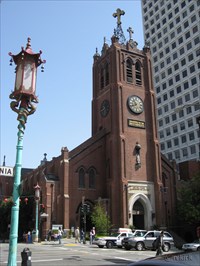
As a member of the “great unwashed” who simply likes what I like and don’t like what I don’t like, I am sure those cognoscenti who do understand modern architecture will either tell me I’m wrong or ignore me, and either is okay.
I can’t see a building like this without thinking about two things:
First, Tom Wolfe’s “From Bauhaus to Our House”, his essay/book on modern architecture. He explores the origins of modern architecture and traces it back to a passion for “worker housing” in the early part of the last century. It was supposed that workers, being used to mechanical things and plain factories, and being marxists at heart, would want things plain and simple and functional. Trouble is, they didn’t, and rejected it all, including the very avant garde but very uncomfortable “Barcelona chair” that was imagined to suit their functional tastes to a “T”. It didn’t, but one can still find one here and there. Workers wanted overstuffed easy chairs with flowers and such on them instead. But whatever.
Because many architects saw themselves as “artists” notwithstanding the romance with Ayn Rand’s “form follows function” way of interpreting the architectural world, and, following the Bauhaus school, worker housing concepts and all, started designing buildings according to their tastes rather than those of the client. And, as Wolfe expressed it, the client had to “take it like a man”. There is often a tension between architect and client, because the architect is fundamentally addressing his “message” to other architects. “This means this” “That is symbolic of that”. The client has to be educated by the architect in all of that because it isn’t immediately apparant. It isn’t immediately apparent because it’s a language all its own. You’re either educated to it or you aren’t. The client, of course, is embarrassed to express ignorance in the face of the sublime tastes of the architect, even less prepared to argue with it, because, after all, failure to understand and appreciate simply marks one as a Phillistine. And, of course, Client “A” doesn’t want to express his ignorance or dismay to Client “B” who might be building across the street or across town, and so the architects get their way and have this steel and concrete conversation going among themselves. Among their fraternity, “boldness” and “innovation” are rewarded by recognition and honors, and so their conversation goes on and on. The clients pay for it, and “take it like a man”.
Now, among the Church elites who have time to study enough of the “language”, this is all marvelous. Why, this represents this, and that represents that, and the play of light upon this is symbolic of that. Parishioners, who are not educated to the language see puzzling things to which they simply adapt, and the band plays on.
Second, “modern” and “innovative” are relative things. What’s modern today is old hat tomorrow. I was intrigued by the statement that there is some manner of “fish” symbolism in the shape of something in the cathedral. I recall, in the 1950s, when some architect persuaded a parish in Kansas City to build what came to be called the “Fish Church” and is called that today. Of course, it’s no longer innovative and it’s no longer modern, and the whole thing would not gain the admiration of anyone now. (Then, too, it’s excruciatingly ugly to one who was not into the language of the architects circa 1958 or so. It was then, and is now.) But the parish is stuck with it, at least until it can be knocked down and replaced with something “modern” and “innovative” all over again.
Now, those who defend modern church architecture are quick to tell us that, well, Gothic was “new” when it was new, and replaced stodgy old Romanesque or Norman or whatever. Well, it was. No doubt about it. But it was still something that was within the “language” of the “clients” who, after all, are the parishioners. So the stained glass windows were massively larger, true. But they still represented scenes or images known to the parishioners, and were realistic unless quite obviously symbolic. The materials were still beautiful and fine. The artwork was more “natural” and had more depth. But it was still all recognizable, and the meanings were approachable. The ceiling was much higher, but still had a majesty about it and a symmetry that was familiar and knowable.
That is my problem with modern architecture. It’s an elite language that does not resonate with people or even give itself to immediate comprehension. To the extent it contains “messages”, they are purposely obscure and require a “playbook” to understand. The materials are almost always plain and rather dowdy. “Worker housing” filled with “Barcelona chairs”. The cognoscenti object “why, no parish or diocese could afford the stuff that’s in the traditional cathedrals”. But some of that plain stuff costs staggering sums. It’s all custom designed and usually so odd that it requires an incredible amount of labor to build.(Not to mention hours and hours and hours of architect and designer time) I don’t buy the “we can’t afford it” argument.
As I said, I like what I like and I don’t like what I don’t like. I like the traditional styles, that are immediately comprehensible. The “Fish Church” notwithstanding, I can’t help but think someday they’ll knock all those no-long-modern buildings down and wonder what on earth people were thinking in the late 20th and early 21st centuries.



 :crying: