The Old Liturgy of Rome

  • Thread starter Thread starter patrick457
  • Start date Start date
Status
Not open for further replies.
And now, back to our regular programming.

11. The Offertory

http://www.sacred-destinations.com/italy/ravenna-san-vitale-photos/slides/xti_6456pae2.jpg
Mosaic of Abel and Melchizedek, San Vitale (Ravenna). Note the altar in the middle.

The deacon goes back to the sanctuary, and along with another deacon, spreads the corporal (which at that time was a very large piece of cloth) over the altar:

The deacon in the meantime returns to the altar, where a collet stands holding a chalice with a corporas (corporale) lying on it; raising the chalice in his left arm, he offers the corporas to the deacon, who takes it off the chalice and lays it on the right part of the altar, throwing the other end of it over to the second deacon in order to spread it. Then there go up to the throne the chancellor and the secretary, and the chief counsellor, with all the district-officials and notaries: but the subdeacon with the empty chalice follows the archdeacon.

In the Ambrosian Rite of Milan, there is actually a prayer said at this point of the Liturgy called Oratio super Sindonem (over the ‘shroud’; i.e. corporal), the Priest having laid out the corporal beforehand as the choir sings the antiphon post Evangelium. Some liturgists are actually of the opinion that the mysterious gap after the Oremus in the old Roman liturgy - which is actually not followed by any prayer! - may have once been occupied by the Roman equivalent of the Ambrosian super sindonem (the other opinion, also mentioned here in this thread a few posts ago, is that the Prayer of the Faithful was once located here).

Of the Corporal the Old Catholic Encyclopedia says:

Although formal evidence is wanting, it may fairly be assumed that something in the nature of a corporal has been in use since the earliest days of Christianity. Naturally it is difficult in the early stages to distinguish the corporal from the altar-cloth, and a passage of St. Optatus (c. 375), which asks, “What Christian is unaware that in celebrating the Sacred Mysteries the wood [of the altar] is covered with a linen cloth?” (ipsa ligna linteamine coo periri, Optatus, VI, ed. Ziwsa, p. 145), leaves us in doubt which he is referring to. This is probably the earliest direct testimony; for the statement of the “Liber Pontificalis”, “He [Pope Sylvester] decreed that the Sacrifice should not be celebrated upon a silken or dyed cloth, but only on linen, sprung from the earth, as the Body of our Lord Jesus Christ was buried in a clean linen shroud” (Mommsen, p. 51), cannot be relied upon. Still, the ideas expressed in this passage are found in an authentic letter of St. Isidore of Pelusium (Ep. i, 123) and again in the “Expositio” of St. Germanus of Paris in the sixth century (P.L., LXXII, 93). Indeed they lasted through the Middle Ages, as the verses attributed to Hildebert (P.L., CLXXI, 1194) sufficiently show:

Ara crucis, tumulique calix, lapidisque patena, Sindonis officium candida byssus habet.

It is quite probable that in the early centuries only one linen cloth was used which served both for altar-cloth and corporal, this being of large size and doubled back to cover the chalice. Much doubt must be felt as to the original use of certain cloths of figured linen in the treasury of Monza which Barbier de Montault sought to identify as corporals. The corporal was described as palla corporalis, or velamen dominicae mensce, or opertorium dominici corporis, etc.; and it seems generally to have been of linen, though we hear of altar-cloths of silk (Greg. of Tours, “Hist. Franc.”, VII, 22; X, 16), or of purple (Paulus Silentiarius, “Descr. S. Sophi”, p. 758; a colored miniature in the tenth-century Benedictional of St. Al thelwold also seems to show a purple altar-covering), or of cloth-ofgold (Chrysostom in Matt., Horn. 1). In some of these cases it seems difficult to decide whether altar-cloth or corporal is meant. However, there is no doubt that a clear distinction had established itself in Carlovingian times or even earlier. Thus, in the tenth century, Regino of Pram (De Disc. Eccl., cap. exviii) quotes a council of Reims as having decreed “that the corporal [corporals] upon which the Holy Sacrifice was offered must be of the finest and purest linen without admixture of any other fibre, because Our Savior’s Body was wrapped not in silk, but in clean linen”. He adds that the corporal was never to remain on the altar, but was to be put in the Missal Sacramentorum libro] or shut up with the chalice and paten in some clean receptacle. And when it was washed, it was to be washed first of all by a priest, deacon, or subdeacon in the church itself, in a place or a vessel specially reserved for this, because it had been impregnated with the Body and Blood of Our Lord. Afterwards it might be sent to the laundry and treated like other linen. The suggestion as to keeping the corporal between the leaves of the Missal is interesting because it shows that it cannot, even in the tenth century, have always been of that extravagant size which might be inferred from the description in the “Second Roman Ordo” (cap. ix), where the deacon and an assistant deacon are represented as folding it up between them. Still it was big enough at this period to allow of its being bent back to cover the chalice, and thus serve the purpose of our present pall. This is done by the Carthusians to this day, who use no pall and have no proper elevation of the chalice. As regards the size of the corporal, some change may have taken place when it ceased to be usual for the people to bring loaves to the altar, for there was no longer need of a large cloth to fold back over them and cover them.​
 
E.G. Atchley also writes thus on the altar:

http://img200.imageshack.us/img200/745/santapollinaremosaic.jpg
Melchizedek, Abel, and Abraham. Mosaic in Sant’ Apollinare in Classe (Ravenna)

We are not told anything of the altar frontal in Ordo I, but in that of St. Amand the deacon, who has read the gospel, is directed on his return to the altar: si fuerit pallium super altare, replicat eum in una parte ad orientem, et expanditur corporate super altare a diaconibus: ‘if there should be a pallium on the altar, to fold it on one side towards the east, and then the corporas is spread on the altar by the deacons.’ Apparently it was not general for there to be a pallium on the altar, about the year 800, in the Roman churches.
This pallium was probably more like the ‘decent carpet’ of the 82nd canon of 1603, than the altar frontal of the Ornaments Rubric. There is a mosaic in the church of St. Apollinaris-in-Classe at Ravenna, said to be of the seventh century, which shows a four-legged square altar, having upon it an ornamented cloth falling down on and covering all four sides. Set thereon is a two-handled chalice between two patens, each of which appears to have a loaf thereon.
Little can be gathered from the Liber Pontificalis to throw any light on the question. In the eighth century there are many benefactions recorded in the Lives of the Popes of vestes altaris or vestis super altare. These are contrasted with vela, the veils of the ciborium in the Life of Gregory III, so that they were most probably altar pallia. In the Life of Vitalian (658-672) it is recorded that the Emperor Constantine offered upon the altar of St. Peter’s a pallium woven with gold.
It appears from the Ordo of St. Amand that the pallium was partially removed before the corporas was spread on the altar, so that the linen cloth lay directly upon the stone slab without any other fabric intervening.
 
After the corporal is spread by the deacons, the offertory proper begins. The Ordo relates that:

http://img249.imageshack.us/img249/8392/800pxtrc3a9sordegourdon.jpg
Chalice with handles and paten, part of the Treasure of Gourdon, Saône-et-Loire (ca. 6th century AD)

The pontiff now goes down to the place where the notables sit, the chancellor holding his right hand and the chief counsellor his left: and he receives the loaves (oblationes ‘offerings’) of the princes (principum) in the order of their ‘promotion’ (?) (per ordinem archium, i.e. arche ‘beginning’; Atchley takes it to mean the date of their promotion to their rank). The archdeacon next receives the flasks (amulas) of wine, and pours them into the greater chalice which is carried by a district-subdeacon, and a collet follows him holding a bowl outside his planet, into which the chalice when full is emptied. A district-subdeacon takes the loaves from the pontiff and hands them to the subdeacon-attendant, who places them in a linen cloth (sindonem) held by two collets. An hebdomadary bishop receives the rest of the loaves after the pontiff, so that he may, with his own hand, put them into the linen cloth which is carried after him. Following him the deacon-attendant receives the flasks of wine, and pours them into the bowl (scyphum) with his own hand, after the archdeacon. Meanwhile the pontiff, before passing over to the women’s side, goes down before the Confession, and there receives the loaves of the chancellor, the secretary, and the chief counsellor. For on festivals they offer at the altar after the deacons. In like manner the pontiff goes up to the women’s side, and performs there all things in the same order as detailed above. And the presbyters do likewise, should there be need, either after the pontiff or in the presbytery.
After this, the pontiff returns to his throne, the chancellor and the secretary each taking him by the hand, and there washes his hands. The archdeacon stands before the altar and washes his hands at the end of the collection of the offerings. Then he looks the pontiff in the face, signs to him, and, after the pontiff has returned his salutation, approaches the altar.
Then the district-subdeacons, taking the loaves from the hand of the subdeacon-attendant, and carrying them in their arms, bring them to the archdeacon, who arranges them on the altar. The subdeacons, by the bye, bring up the loaves on either side. Having made the altar ready, the archdeacon then takes the pontiff’s flask of wine from the subdeacon-oblationer, and pours it through a strainer into the chalice; then the deacons’ flasks, and, on festivals, those of the chancellor, the secretary, and the chief counsellor as well.
Then the subdeacon-attendant goes down into the choir, receives a ewer of water (fontem) from the hand of the ruler of the choir and brings it back to the archdeacon, who pours it into the chalice, making a cross as he does so. Then the deacons go up to the pontiff: on seeing which, the chancellor, the secretary, the chief of the district-counsellors (sic), the district notaries, and the district-counsellors come down from their ranks to stand in their proper places.
Then the pontiff, arising from his throne, goes down to the altar and salutes it, and receives the loaves from the hands of the hebdomadary presbyter and the deacons. Then the archdeacon receives the pontiff’s loaves from the subdeacon-oblationer, and gives them to the pontiff. And when the latter has placed them on the altar, the archdeacon takes the chalice from the hand of a district-subdeacon and sets it on the altar on the right side of the pontiff’s loaf, the offertory-veil being twisted about its handles (involutis ansis cum offertorio). Then he lays the veil on the end of the altar, and stands behind the pontiff, and the latter bows slightly to the altar and then turns to the choir and signs to them to stop singing.
 
Taboo in what way? In Europe in the past, they don’t errect Churches of another patrimony in the territory of the other. So there are no Roman Catholic parishes in the Eastern Roman Empire, and there are no Eastern Catholic parishes in Western Rome. Its not so much a taboo as its respecting each others borders. Of course after the Great Schism because the Orthodox Church were no longer “Catholic”, Rome felt it was right to intrude into their territory and errect Catholic churches. Also the Roman Church grew in territory and political influence while the Eastern Churches became sandwiched between the expanding Roman Church territory and the expanding Islamic territory further East. They didn’t get to expand and evangelize the same way the Roman Church did, which thanks to the age of exploration was brought to all corners of the world. Its only recently that Eastern Churches have started to expand beyond their traditional borders as immigrants move to other lands of opportunities like the US and Canada. If not for these immigrants, we couldn’t attend Eastern Liturgies even if we wanted to because there would be no Eastern parishes here.
A nice ideal, but factually in error. Since not long after their reaffirmation of union, in the 11th C, a maronite presence has been extant in Rome; at some point, it became a formal parish of the Patriarchate.

Further, the Italo-Albanians have never been out of union, and were in fact established by clerics and faithful relocating to the Italian Peninsula from the Byzantine areas of the Roman Empire. In the 6th century or so.

Further still, there have been Roman parishes in the Balkans intermingled with Eastern parishes since dawn of the 2nd millennium… and not all out of union.

And Moscow made a choice between Roman and Byzantine expressions. The Russian Court was impressed by both; the Tsar moreso by the Byzantine worship… and hence, Russia was Christianized by the East, not by happenstance nor geography, but by he choice of the Tsar.

And also, Crusaders took priests with them, and established parishes in the East for the Crusaders; some did convert the Muslims. And in Jerusalem, they and the local Orthodox shared a patriarch. For about a century.

There is a long history of parishes outside the patrimonial lands of their origin, side by side with local parishes… going back to at least the 11th C.

And local to the Byzantine East: Antioch was the source of the Syrian Rite; the outlying parishes remained Syrian even when the Patriarchal Cathedral and the cities were Byzantine Rite, Byzantine bishops with mixed Byzantine and Syrian rite parishes. The Armenians fled to what is now Turkey, as well… And retained not only their rite, but also their separate hierarchy.
 
E.G. Atchley writes of the Offertory (I quote here only a portion of it):

The preparation of the offering and its presentation belongs to the deacons, as their peculiar share in the royal priesthood. Some have seen an allusion to this duty in St. Paul’s Epistle to the Colossians, wherein he tells them that Christ’s body is the Church, whereof he has been made a deacon (διάκονος), to fulfil the word of God, that is, the mystery concealed from the ages and from generations, and his purpose as such is to present every man perfect in Christ Jesus. St. Ignatius describes deacons as ‘being ministers of the mysteries of Jesus Christ,’ in his Epistle to the Trallians.

The purpose of this preparation is to make the offering representative of the Church united in herself as one body, and conjoined and united to Christ her Head. The deacons, then, selected a certain number of the loaves and set them in rows upon the altar, and mixed a little water with the wine. With the large number of offerers and communicants the altar was, as it were, ‘loaded with loaves’ an expression which we find in some of the ancient prayers appointed for use after the offertory, and called either Secreta or Super Oblata.

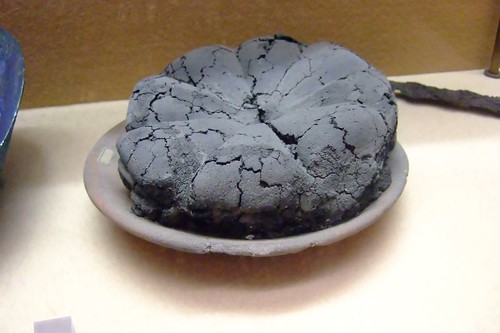
The bread that was offered was in the form of solid loaves, which the author of the Life of Zephyrinus (203-221) in the Liber Pontificalis, and St. Gregory the Great describe as coronae, crowns. The anonymous author of the treatise De Sacramentis (who wrote, according to Duchesne, somewhere in the north of Italy, perhaps at Ravenna, about the year 400) describes the bread as usitatus, in common use. A story told in the Life of St. Gregory points to the same conclusion. A certain noble lady of Rome laughed when the Saint was about to communicate her one day at a stational mass; and when afterwards asked the reason, said: ‘I recognized the fragment to be of the same oblation-loaf which I made myself with my own hands and offered to you; and when I understood you to call it the Lord’s Body, I smiled.

The Offering of the Church must always be a pure offering; and hence those who were known to be in a state of sin were debarred from offering until they had been restored to the body of the faithful. This feeling lasted long after penitents had been allowed to communicate before their term of penance was over; they might communicate, but no offering was accepted from them.


Carbonated loaf of bread from Pompeii


Fresco of a Roman bakery, from the House of the Baker, Pompeii

Dom Fernand Cabrol meanwhile speaks of the offering (from The Mass of the Western Rites):

The offering was made in the following way: each person offered a small flagon of wine and a loaf; the wine was emptied into a great chalice, and the bread placed in a white cloth held by two acolytes. It goes without saying that as yet there was no question of unleavened bread; that offered here is the usual leavened bread. This distinction between leavened and unleavened did not then exist; it was only much later, and especially about the eleventh century, that a quarrel, which in our own opinion was unnecessary, arose between the Eastem and Westem churches on this subject.

The most important thing to notice is that the offering as we have just described it is a Roman custom, also followed in Africa and at Milan. In the Gallican, Mozarabic, and Greek liturgies the preparation of the offering was made before Mass.
 
12. The Offertory Anthem

While all these preparations are underway, the choir sings the Offertory anthem of the day’s Mass and stops when all these are done with a signal from the Pope.

x. The Offertory Anthem.

Walafrid Strabo (c. 840) states that we do not clearly read who it was that introduced either the anthem at the offertory, or that at the communion; but in his opinion it was the ancient custom to offer and communicate in silence, as was still done on Easter Even. St. Austin tells us that one Hilary, a catholic layman of tribunal rank, was annoyed at a custom which at that time had begun to obtain in Carthage, that hymns should be said at the altar from the book of Psalms, both before the oblation and when that which had been offered was distributed to the people; and apparently expressed his disapproval in no measured terms. St. Austin, by general request, was deputed to answer him; but his defence of the practice has not come down to us.
Originally the offertory-anthem was antiphonal and not responsorial; that is to say, it was performed by two semi-choirs and not by a solo voice and chorus. It is generally considered that by the time of Ordo I it had come to be sung by solo voice and chorus: thus the anthem was begun by the choir, and sung through, then the solo voice sang the first verse of the psalm, after which the choir repeated the anthem; and so on for each verse.

Terra Tremuit, sung by Ensemble Organum from Chants de L’Eglise de Rome: Période Byzantine (Old Roman Chant)


Detail of the apse mosaic in the Basilica of Santa Prassede, Rome

V.: Terra tremuit et quievit, dum resurgeret in iudicio Deus, alleluia.
R.: Notus in Iudaea Deus; in Israel magnum nomen eius, alleluia.
V.: Dum resurgeret
R.: Et factus est in pace locus eius, et habitatio eius in Sion, alleluia.
V.: Dum resurgeret
R.: Ibi confregit cornua arcum, scutum, gladium et bellum; iluminans tu mirabiliter a montibus aeternis, alleluia.
V.: *Terra tremuit *…
 
13. The Secret

The original and, for a long time, the only offertory prayer. Of this Dom Cabrol writes:

What, first of all, does this word mean? More than any other it has given rise to discussions. Is it a substantive or an adjective? Very naturally it has been compared with analogous terms like “Missa” for “Missio,” “Oblata” for “Oblatio.” Thus, it is asked, is not “Secreta” for “Secretio?” Bossuet, who was the first to risk this interpretation, did so with circumspection; the “Secretio,” or “separation,” meaning the separation of the oblations. Others have taken it to be an adjective qualifying the word “Oratio” understood; thus it would mean a secret prayer, or one said in a low voice. Each interpretation presents serious difficulties. In our own opinion, and that of others, “Secreta” is a substantive synonymous with “Mysteria.” Thus we sometimes find the expression “Oratio super Secreta;” aud again, the whole canon is called “Secreta,” the “Mysteries.”

At the epoch of which we are speaking this was the only prayer made over the oblations, “super oblata.” The Offertory prayers in the present Missal, “Suscipe sancte Pater” and the rest (cf. Chap. IX), are of more recent introduction, and probably of Gallican origin. There was then no question of censing the “oblata” at Rome. Doubtless at the “Introit” and the “Gospel” a golden censer was carried (thymiamaterium aureum), but this was merely a vase of perfume which was not used for censing; it was not the “thuribulum.” This custom is of Gallican origin, and was not introduced at Rome until after the eleventh century.

The “Secret,” the only "Offertory "prayer, had thus at that time a special importance; and its formulas should be carefully studied in our Missal. In its composition, and it may be said in its functions, it corresponds to the “Collect” and the “Post-communion.” Each of the three, as the principal prayers of the Romau Mass, has its own “role,” but all three correspond; they are fashioned in the same mould and follow the same laws of composition and rhythm. Attention has often been called to the sobriety, simplicity, firmness, and elegance of the purely Roman style, which has so well preserved the chief qualities of the best classical manner. These characteristics will be noted all the more clearly if we compare these prayers with the corresponding composition of the other Latin liturgies, of which some examples are quoted in Chapters VI The Mass in Spain] and VII The Mass in Gaul]. But what is especially remarkable is less the literary quality than the depth and certainty of the teaching given us in these Roman prayers. Here, above all, appear the mastery and the superiority of the liturgy of that Church which is Mother and Mistress. To speak only of the “Secrets,” we find that more than one affirms the faith of the Roman Church in Transubstantiation; and Bossuet has made good use of this fact against the Protestants in his explanations of the prayers of the Mass.


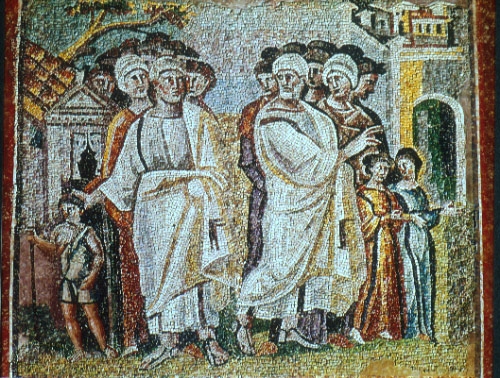
Lot and Abraham, 5th-century mosaic in St. Mary Major

Pope: Suscipe, quaesumus Domine, preces populi tui cum oblationibus hostiarum: ut paschalibus initiata mysteriis, ad aeternitatis nobis medelam, te operante, proficiant. Per Dominum nostrum Iesum Christum Filium tuum, qui tecum vivit et regnat in unitate Spiritus Sancti, Deus, (aloud) per omnia saecula saeculorum.
R.:
Amen.
 
14. The Preface

Ordo I continues:

The offertory being finished, the bishops stand behind the pontiff, the senior in the midst, and the rest in their order; the archdeacon standing on the right of the bishops, the second deacon on their left, and the rest in order arranged in a line. And the district-subdeacons go behind the altar at the end of the offertory and face the pontiff, so that when he says, For ever and ever, or, The Lord be with you, or, Lift up your hearts, or, Let us give thanks (Per omnia saecula, aut Dominus vobiscum, aut Sursum corda, aut Gratias), they may be there to answer, standing upright, until the time when the choir begin to sing the angelical hymn, that is, Holy, holy, holy (hymnum angelicum, id est Sanctus).

(Please Note: This uploaded content is no longer available.)
A Late 3rd-century mosaic depicting Christ as the sun god Helios or Sol Invictus, from the Mausoleum of the Julii (aka Tomb M or The Tomb of “Cristo Sole”), the Necropolis under St. Peter’s Basilica, Vatican

Pope: Dominus vobiscum.
R.: Et cum spiritu tuo.
Pope: Sursum corda.
R.: Habemus ad Dominum.
Pope: Gratias agamus Domino Deo nostro.
R.: Dignum et iustum est.
Pope: Vere dignum et iustum est, aequum et salutare, nos tibi semper, et ubique gratias agere: Domine sancte, Pater omnipotens, aeterne Deus: te quidem omni tempore, sed in hoc praecipue die laudare benedicere et praedicare, quod Pascha nostrum immolatus est Christus: per quem in aeternam vitam filii lucis oriuntur, fidelibus regni caelestis atria reserantur, et beati lege commercii divinis humana mutantur. Quia nostrorum omnium mors cruce Christi redempta est, et in resurrectione eius omnium vita resurrexit: quem in susceptione mortalitatis Deum maiestatis agnoscimus, et in divinitatis gloriam Deum et hominem confitemur: qui mortem nostram moriendo destruxit et vitam resurgendo restituit, Iesus Christus Dominus noster.
Et ideo, cum Angelis et Archangelis, cum Thronis et Dominationibus, cumque omnia milita caelestis exercitus, hymnum gloriae tuae canimus, sine fine dicentes:*
Choir: Sanctus, Sanctus, Sanctus:
Dominus Deus Sabaoth.
Pleni sunt coeli et terra gloria tua: [Hosanna in excelsis.
Benedictus sunt qui veni in nomine Domini; Hosanna in excelsis.]

  • the older Preface for Easter Sunday, from the Gelasian Sacramentary. The EF Preface for Easter is much shorter:
Vere dignum et iustum est, aequum et salutare, te quidem Domine omni tempore, sed in hoc potissimum die gloriosis praedicare, cum Pascha nostrum immolatus est Christus. Ipse enim verus est Agnus qui abstulit peccata mundi. Qui mortem nostram moriendo destruxit, et vitam resurgendo reparavit. Et ideo cum Angelis et Archangelis…​
 
Taking a temporary break here, but I guess y’all have noticed two rather curious passages in the Ordo:

Each district, therefore, will have its proper position both in procession and in church, or wherever a particular day may constrain them to go or to minister by reason of its rank, according to the ancient constitution; nor can the district-clergy be absent from attendance on the pontiff without incurring some sentence of excommunication or disciplinary censure.

And after this no change may be made in either reader or singer: but if this should be done, the ruler of the choir (i.e. the fourth of the choir) shall be excommunicated by the pontiff.

Really tells you how seriously the ancients took the Liturgy. 😃
 
xi. The Preface.

Justin Martyr tells us that, after the offertory, the bishop offered ‘prayers and thanksgivings to the best of his ability.’ Just before, he describes these as ‘sending up praise and glory to the Father of the universe,’ and as ‘a lengthened thanksgiving.’ It appears from this that the long Eucharistic Prayer, whereby the oblations become that of which before they were but a mystic representation, namely, the Body and Blood of Christ, was not a fixed form in the second century. We might gather the same from a consideration of the number of different anaphoras in the Eastern, and the great variety of prefaces in the Western rites. Had there been a fixed form handed down from apostolic times, we may be sure that no variations would have been allowed.
In the Leonine Sacramentary, for instance, we find more than one preface for many days, and the internal evidence shows that individual presbyters had considerable latitude in composing prefaces, even to the extent of allowing their personal feelings to colour their public prayers. Their liberty degenerated into license when they declaimed, in this portion of the mass, against bad monks, against false brethren who penetrate into houses and lead silly women captive, false confessors mingled with the true, and so on. As time went on, the number of prefaces was steadily curtailed, until by the end of the twelfth century we find only ten in use.
But with all the liberty of improvisation which was allowed in the early ages of the Church, we find that there was a certain fixed outline, with definite fixed points to which every priest recurred. To begin with, there was the preliminary invitation to the people to lift up their hearts and give thanks to God, and the priest generally took up the words of their second response, It is meet and right, and began the eucharistic preface with them in more or less developed form. At the end of this, he always worked round to some acknowledgment of the angels’ worship of the Most High and our participation in it, joining with them in singing the seraphic hymn, Holy, holy, holy, etc. In most liturgies the celebrant again takes up what the people sing, this time the Sanctus, and develops it at more or less length, leading finally to a commemoration of the institution of this Sacrament, of the Passion, the Resurrection, and the Ascension, concluding with some prayer that the Holy Spirit may change the offering into the Body and Blood of Christ. Some intercession for the living and the dead was included as well, if it had not been offered at an earlier moment.
The seraphic hymn was brought into use at a very early period. St. Sixtus (107-116) is credited with having introduced it into the Church at Rome. Tertullian seems to allude to it in his tract, De Oratione.

*xii. Sanctus and Benedictus. *

After the pope has finished the preface, the choir then sing the angelical hymn, i.e. the Sanctus. The words, which are common to all liturgies (with small variations) except the Anaphora of the Ethiopic Church Ordinances, are adapted from Isaiah vi, 3; where we read that the Seraphim cried unto one another and said, Holy, holy, holy, is the Lord of Hosts; the whole earth is full of His glory. The name ‘the angelical hymn’ implies that the anthem Benedictus with its Hosannas had not yet attached itself to it; and this is made more sure because, in the Gallicanized recension of this Ordo, printed by Mabillon as Ordo Romanus II, there is added to this passage the phrase, ‘in which Hosanna is twice repeated.’
It is evident upon examination of all liturgies, Eastern or Western, that the verse of the psalm, wherewith the populace of Jerusalem saluted our Lord on the first Palm Sunday, is here an interpolation of comparatively late date. In those of the Egyptian rite, and in that of the ‘Apostolic Constitutions,’ it does not appear at this liturgical moment at all; and in other liturgies wherein it does here appear, it is not an original constituent of the form, for the post-sanctus eucharistic prayer ignores it entirely (with a very few exceptions and those of comparatively late date), and begins by taking up the words of the seraphic hymn, and developing them at greater or less length. Moreover, with the exception of Benedictus (and, in the West, of Agnus Dei, which was brought in c. 700) all the prayers and hymns of early rites are addressed solely to God the Father, or to the Holy Trinity, and not to the Second Person alone.
In the account given by ‘St. Silvia of Aquitaine’ (385-388) of the procession on Palm Sunday as she saw it at Jerusalem, we meet with a curious use of the anthem Benedictus. About eleven o’clock at night, after reading on Mount Olivet the gospel account of our Lord’s entry into Jerusalem,

‘the Bishop arises, and all the people depart, every one on foot, from the top of Mount Olivet. And all the people go before him with hymns and anthems, crying continually: Blessed is he that cometh in the name of the Lord. And every child in the place (even down to those who by reason of their tender age cannot walk on their feet, but are carried on their parents’ shoulders) carries branches, some of palms, some of olive: and thus the Bishop is brought in triumph, in a way typical of the manner in which our Lord was then led.’​
 
The same greeting appears in her account of the midnight mass on the Epiphany, apparently sung in the procession back to Jerusalem. At Jerusalem, then, at the latter part of the fourth century, Benedictus was used to greet the bishop, who (for the time) represented our Lord.
It probably was not, however, used in the Liturgy after Sanctus, for St. Cyril of Jerusalem in 348, not only makes no mention of it in his Catechetical Lectures, but like Ordo I, refers the hymn to the angels.
In the Liturgy of St. Chrysostom, as now used, the Eisodikón) or anthem sung at the Little Entrance which is the point at which the bishop first intervenes in the service begins on the Epiphany and Palm Sunday with the words, Blessed is he that cometh in the name of the Lord. God is the Lord, and hath appeared to us, etc. A little further on, after the Trisagion, the celebrant and the deacon go towards the throne; and on the way the
former says, Blessed is he that cometh in the name of the Lord.
Then, on the Epiphany, the reader says for the Prokeimenon of the Apostle (i.e. a short anthem before the epistle), Blessed is he that cometh in the name of the Lord.
After the consecration is over and the clergy have communicated, the deacon comes to the opened doors of the bema, and shows the chalice to the people, saying: With the fear of God, faith and love, approach! and then the choir sing: Blessed is he that cometh in the name of the Lord. God is the Lord, and hath appeared to us.
When the paten is brought down to communicate the women, the deacon, in the Liturgy of the Coptic Jacobites, says Benedictus, without Hosanna.
In some churches, and on some days, amongst the Armenians, at the Great Entrance, after the celebrant receives the gifts from the hands of the deacons, he makes the sign of the cross with them towards the people, saying: Blessed is he that cometh in the name of the Lord, and the clerks reply: Alleluia.
When Charles the Great visited Rome in the time or Pope Hadrian, he was received in full state, and escorted to the basilica of St. Peter by the Pope and his Court.

'And so they entered into the same venerable court of blessed Peter the prince of the apostles, the whole clergy and all the religious servants of God singing praise to God and to his Excellency, crying out with a loud voice, Blessed is he that cometh in the name of the Lord.’

And, some years later, his successor Ludwig was received in like manner, and greeted with the same anthem, when he visited Sergius II.
Pope Stephen is said to have ordered all the inhabitants of Paris to meet Pippin and Karlomann with flowers and branches of palm, when they brought back the supposed
relics of SS. Benedict and Scholastica: and they received them in that fashion, crying out, Blessed is he that cometh in the name of the Lord. With which we may compare the account which St. Gregory of Tours gives of the dedication of the oratory, wherein the relics of SS. Saturninus, Martin, Illidius, and others were placed. As they were about to enter the church with the relics, a terrific flash of lightning occurred, which St. Gregory at once interpreted as a manifestation of St. Martin’s power and presence. They all thereupon magnified God, saying, Blessed is he that cometh in the name of the Lord. God is Lord, and hath enlightened us.
Upon a consideration of the instances of the use of Benedictus given above, it seems possible that the anthem was at first used, without its Hosannas, as a greeting of the bishop in the solemn procession on Palm Sunday and on the Epiphany, when he typified our Lord. Some such idea prevailed in a modified form at Rome in the eighth and ninth centuries, where Benedictus was sung as a greeting to the emperors; and in Paris, where it was used in the like manner at the reception of the relics of SS. Benedict and Scholastica, unless perhaps it was sung for the sake of the play on the name, Benedict. Such, too, would be the explanation of its use as the Eisodikón for Epiphany and Palm Sunday at Constantinople: the anthem was there originally a greeting of the bishop on his first intervention in the service: such, again, might explain its use, just as the bishop is about to come forth out of the Holy Place in order to communicate the people, in the Liturgy of St. Chrysostom, and the similar instance in the Liturgy of the Coptic Jacobites​
 
If this was so, the intention of the anthem afterwards passed from the bishop who was bringing out the Eucharist, to the Eucharist itself, by a natural and easy transition; and when that happened the verse of the psalm was some times augmented by what followed, so that they sang in addition God is the Lord, and hath appeared to us; and sometimes by the twofold Hosannas.
In the neighbourhood of Antioch about the year 375 the Benedictus anthem was referred to the Eucharist, when the bishop came out to communicate the people, and called out Sancta sanctis. The people are directed to respond with One holy, one Lord Jesus Christ, to the glory of God the Father, blessed for ever. Amen. Glory to God in the highest, and on earth peace, towards men of good-will. Hosanna to the Son of David. Blessed is he that cometh in the name of the Lord. God is Lord, and hath appeared unto us. Hosanna in the highest. The compiler of this liturgy, the so-called Clementine, evidently wished the whole response to be referred to our Lord, as present in the Eucharist. But whether he here represents current Church opinion or not is another matter. In working up material for his liturgy, he dealt most freely with it; and the prayers in particular are substantially his own work. Hence it is probable that this response is his own composition also. It almost seems as though the compiler wished to alter a prevailing idea of the use of Benedictus as a welcome to the bishop, and to divert its intention to the Eucharist, accentuating this idea by the addition of the people’s cry to our Lord, Hosanna; by the angels’ Christmas song Glory to God; and by the direct apostrophe in the beginning. Furthermore, there is no evidence, and very little probability, that the Liturgy of the ’ Apostolic Constitutions ’ was ever used anywhere or at any time.
When the intention of Benedictus was directed towards the Eucharist, we can understand the singing of it just after the consecration. After a while it would seem that the time of singing it was shifted further back until, with its Hosannas, it became appended to the Sanctus. Then came a change. Benedictus with the second Hosanna was shifted forwards again to the elevation in the West and the corresponding moment in the East, as a greeting to our Lord in the Eucharist, where at the present time it remains in actual practice.
Of the date when Rome first adopted this anthem, nothing is clear: the silence of Micrologus in the eleventh century hardly helps the question one way or the other; but probably it was absorbed together with other Gallicanisms in the course of the eleventh century.
 
Correction:

Pope: Suscipe, Domine, propitius, munera famulorum tuorum, ut confessione tui nominis et baptismate renovati, sempiternam beatitudinem consequantur. Per Dominum nostrum Iesum Christum Filium tuum, qui tecum vivit et regnat in unitate Spiritus Sancti, Deus, (aloud) per omnia saecula saeculorum.
R.:
Amen.

Here’s the ‘correct’ version of the Secret as per the Gelasian Sacramentary. I posted the EF Secret for the Vigil and Easter Sunday (which in the Gelasian is for the Easter Vigil Mass only) there. Sorry for the mistake.

15. The Canon

http://www.sacred-destinations.com/italy/images/ravenna/san-apollinare-nuovo/resized/xti_6926p.jpg
The Last Supper (6th c.), Sant’Apollinare Nuovo, Ravenna

After the Sanctus, the Ordo relates that:

And when they have finished it, the pontiff rises alone and enters on the canon. The bishops, however, and the deacons, subdeacons, and presbyters remain in the presbytery, and bow themselves down.

In those days, a ciborium (a canopy or covering supported by columns, freestanding in the sanctuary), aka altar canopy, often covered the altar in a basilica. Often the purpose of this canopy, in its early forms, was a sort of frame upon which lights, wreaths, curtains, or any other sort of decoration could be hung. It also served to protect the altar from dust or other matter falling upon it from the ceiling, which, being usually very high, cannot be conveniently or easily cleaned.


The high altar of present-day St. Mary Major, under a ciborium.

When first the altar was covered with a canopy or ciborium is not definitely known; nor when curtains were hung between the pillars of the ciborium. St. John Chrysostom speaks of the curtains, but at Rome we have to wait till a later date before we get any definite inform ation about them. Thus Pope Sergius (687-701) set up eight tetravela round about the altar of the Lateran Basilica, four red and four white: and Leo III (795-816) set up four white silk veils round about the altar of the basilica of St. Mary Major, hanging them in the arches of the ciborium. Hadrian I and Leo III were the largest benefactors of the Roman churches in the matter of gifts of curtains and veils and the like; the Liber Pontificalis contains long lists of their good deeds. It does not follow, however, that ciborium curtains were not in use at Rome before the time of Sergius: they certainly existed in other places at the beginning of the fifth century, and so may have at Rome; but their material may have been inexpensive, and so not worth recording.
The first notice of the erection of a canopy over the altar at Rome occurs in the Life of St. Symmachus (498-514), who is said to have made a ciborium and confession of silver, at the basilica of St. Andrew near St. Peter’s, weighing 120 Ibs., and at the church of SS. Silvester and Martin a ciborium of silver over the altar, weighing also 120 Ibs. St. Gregory the Great (590-604) is recorded to have set up a ciborium with four columns, of pure silver,
at St. Peter’s. Honorius (626-638) built the church of St. Agnes in the Via Numentana, and set over her tomb, which presumably was under the altar, a brazen ciborium, gilded, of wonderful size; and in the church of St. Pancras in the Via Aurelia, which he also founded, he placed a silvern ciborium over the altar, which weighed 287 Ibs. Bennet II (684) set up ciboriums of various materials at the churches of St. Valentine, St. Mary ad Martyres, and St. Laurence. Sergius (687-701) set up an ambo and a ciborium in the basilica of SS. Cosmas and Damian; and, at the basilica of St. Susanna, replaced the old one, which was of wood, with one of marble. Gregory III (731-742) renovated that at St. Chrysogonus and adorned it with silver. Hadrian (722-795) did the same by that of St. Andrew near St. Peter’s, using 135 Ibs. of silver. Leo III (795-816) set up or rebuilt several ciboriums. At St. Pancras he made one of silver weighing 367 Ibs. At St. Paul’s basilica he erected a ciborium with its columns over the altar, of wondrous size and beauty, decorated with the purest silver to the weight of 2015 Ibs. At St. Andrew’s the ciborium over the high altar weighed 305 Ibs, and at the Lateran Basilica it had four columns, depicted with divers stories, and screens and little pillars (apparently between the four great columns) of wondrous beauty and size, decorated with the purest silver, to the weight of 1227 Ibs.
Here, again, we can see that ciboriums may be of much earlier date in Rome than the end of the fifth century: there is no record, for instance, of the erection of the old wooden one at St. Susanna’s: and had not Pope Sergius replaced it with one of marble, we might never have known of its existence.
 
Sometimes between the columns ran rods, holding rings to which were fastened curtains which according to the rubrics of the individual churches, were drawn around the altar at certain parts of Mass - say, the Canon - thus hiding it, and the celebrant, from view. These curtains were styled tetravela altaris and were made of linen, silk, gold cloth, or other precious material. Those once found in the Hagia Sophia at Constantinople were made of silk enriched by gold thread, embroidered with various images.

http://cleansingfiredor.com/wp-content/uploads/2010/09/curtained.jpg
Ciborium with closed curtain; after a mosaic in the church of Hagios Georgios (aka the Rotunda of Galerius), Thessaloniki

http://img72.imageshack.us/img72/4669/img0609zk7.jpg
A modern-day example from Rome of veils hanging in a ciborium

As for the history, shape, and form of the altar itself, I could only but give links:
 
http://img440.imageshack.us/img440/530/491pxsantamariaantiqua2.jpg
The Crucifixion, Santa Maria Antiqua, Rome (ca. 741-752)

TE IGITUR clementissme Pater per Iesum Christum Filium tuum Dominum nostrum supplices rogamus et petimus uti accepta habeas et benedicas haec dona, haec munera, haec sancta sacrificia illibata.
(name removed by moderator)rimis quae tibi offerimus pro Ecclesia tua sancta catholica, quam pacificare, custodire, adunare, et regere digneris toto orbe terrarum: una cum omnibus una cum famulo tuo papa nostro Illo et antistite nostro Illo episcopo.

MEMENTO, Domine, famulorum, famularumque tuarum, et omnium circumadstantium, quorum tibi fides cognita est, et nota devotio, qui tibi offerunt hoc sacrificium laudis pro se suisque omnibus, pro redemptione animarum suarum, pro spe salutis et incolumitatis suae, tibi reddunt vota sua aeterno Deo vivo et vero.

COMMUNICANTES et diem sacratissimum celebrantes Resurrectionis Domini nostri Iesu Christi secundum carnem: sed et memoriam venerantes (name removed by moderator)rimis gloriosae semper virginis Mariae genitricis Dei et Domini nostri Iesu Christi, sed et beatorum apostolorum ac martyrum tuorum Petri et Pauli, Andreae, Iacobi, Ioannis, Thomae, Iacobi, Philippi, Bartholomaei, Matthaei, Simonis et Thaddei, Lini, Cleti, Clementis, Xysti, Cornelii, Cypriani, Laurentii, Chrysogoni, Ioannis et Pauli, Cosmae et Damiani, [Dionysii, Rustici], et Eleutherii, [Hilarii, Martini, Augustini, Gregorii, Hieronymi, Benedicti] et omnium sanctorum tuorum, quorum meritis precibusque concedas ut in omnibus protectionis tuae muniamur auxilio. Per Christum Dominum nostrum.

HANC IGITUR oblationem servitutis nostrae, sed et cunctae familiae tuae, quaesumus, Domine, ut placatus accipias, diesque nostros in tua pace disponas, atque ab aeterna damnatione nos eripi et in electorum tuorum iubeas grege numerari. Per Christum Dominum nostrum.

QUAM OBLATIONEM tu Deus, in omnibus quaesumus, benedictam, adscriptam, ratam, rationabilem, acceptabilemque facere digneris, ut nobis corpus, et sanguis fiat dilectissimi Filii tui Domini Dei nostri Iesu Christi.

QUI PRIDIE quam pateretur accepit panem in sanctas ac venerabiles manus suas, elevatis oculis in caelum ad te Deum Patrem suum omnipotentem, tibi gratias agens, benedixit, fregit, dedit discipulis suis, dicens, Accipite, et manducate ex hoc omnes. Hoc est enim corpus meum. Simili modo, posteaquam coenatum est, accipiens et hunc praeclarum calicem in sanctas ac venerabiles manus suas, item tibi gratias agens, benedixit, dedit discipulis suis, dicens, Accipite, et bibite ex eo omnes: hic est enim calix sanguinis mei novi et aeterni testamenti, mysterium fidei, qui pro vobis et pro multis effundetur in remissionem peccatorum. Haec quotiescumque feceritis in mei memoriam facietis.

(Nope, Elevation of the Species hereno, folks)

UNDE ET MEMORES SUMUS, Domine, nos servi tui, sed et plebs tua sancta, Christi Filii tui Domini Dei nostri tam beatae passionis necnon et ab inferis resurrectionis sed et in caelis gloriosae ascensionis: offerimus praeclarae maiestati tuae de tuis donis ac datis hostiam puram, hostiam sanctam, hostiam immaculatam, panem sanctum vitae aeternae, et calicem salutis perpetuae.

SUPRA QUAE propitio ac sereno vultu respicere digneris, et accepta habere, sicuti accepta habere dignatus es munera pueri tui iusti Abel, et sacrificium patriarchae nostri Abrahae, et quod tibi obtulit summus sacerdos tuus Melchisedech, sanctum sacrificium, immaculatam hostiam.

SUPPLICES TE ROGAMUS, omnipotens Deus, iube haec perferri per manus angeli tui in sublime altare tuum in conspectu divinae maiestatis tuae, ut quotquot ex hac altaris participatione sacrosanctum Filii tui corpus et sanguinem sumpserimus omni benedictione caelesti et gratia repleamur. Per Christum Dominum nostrum. Amen.


Paten (ca. late 4th-early 5th c.), measuring 9 1/2 inches in diameter

The Ordo speaks of an acolyte holding the paten at this point:

We have, by the bye, omitted something about the paten. When the pontiff begins the canon, a collet comes near, having a linen cloth thrown around his neck, and holds the paten before his breast on the right side [of the altar ?] until the middle of the canon. Then the subdeacon-attendant holds it outside his planet, and comes before the altar, and waits there with it until the district-subdeacon takes it from him.
 
Ah, how I love Ordo Romanus primus and the Ordo of St. Amand…

It seems that if the reformers had truly wanted to go back to ancient ways, OR 1 would have been a great start. That’s my :twocents:. Anyway, it’s still interesting to study, from a liturgiological perspective.
 
http://www.alamo.edu/sac/vat/arthistory/arts1303/Ec7.jpg
Carved book cover from the 5th Century

NOBIS QUOQUE PECCATORIBUS, (the subdeacons rise up) famulis tuis, partem aliquam societatis donare digneris cum tuis sanctis apostolis et martyribus, cum Ioanne, Stephano, Matthia, Barnaba, Ignatio, Alexandro, Marcellino, Petro, Felicitate, Perpetua, Agathe, Lucia, Agne, Caecilia, Anastasia, et cum omnibus sanctis tuis, intra quorum nos consortium non aestimator meriti, sed veniae, quaesumus, largitor admitte. Per Christum Dominum nostrum. Per quem haec omnia, (the archdeacon rises up) Domine, semper bona creas, santificas, vivificas, benedicis, et praestas nobis.

At this part of the Canon the Ordo says that:

When the pontiff says, By him, and with him, the archdeacon lifts up the chalice with the offertory-veil passed through its handles (cum offertorio calicem per ansas), and, holding it, raises it towards the pontiff. Then the latter touches the side of the chalice with the loaves, saying, By him, and with him, as far as, For ever and ever. Amen. Then the pontiff sets the loaves down again in their place, and the archdeacon puts the chalice down by them, and removes the offertory-veil from the handles of the same.

PER IPSUM, et cum ipso, et in ipso est tibi Deo Patri omnipotenti in unitate Spiritus Sancti omnis honor et gloria, per omnia saecula saeculorum, Amen.

But at the end of the canon, the district-subdeacon stands behind the archdeacon with the paten.

16. Our Father

Pope: Oremus. Praeceptis salutaribus moniti et divina institutione formati audemus dicere:

Pater noster, qui es in caelis,
sanctificetur nomen tuum.
Adveniat regnum tuum.
Fiat voluntas tua, sicut in caelo et in terra.
Panem nostrum quotidianum da nobis hodie.
Et dimitte nobis debita nostra, sicut et nos dimittimus debitoribus nostris.
Et ne nos inducas in tentationem,
Sed libera nos a malo.

The Ordo then goes:

And when the pontiff says, And safe from all unquiet (et ab omni perturbatione securi), the archdeacon turns round, and after kissing the paten, takes it and gives it to the second deacon to hold.

Pope: Libera nos, quaesumus, Domine, ab omnibus malis praeteritis, praesentibus, et futuris, et intercedente beata et gloriosa semper virgine Dei genitrice Maria, et sanctis apostolis tuis Petro et Paulo, atque Andrea, da propitius pacem in diebus nostris, ut ope misericordiae tuae adiuti, et a peccatis simus liberi semper, et ab omni perturbatione securi. Per eundem Dominum nostrum Iesum Christum Filium tuum, qui tecum vivit et regnat in unitate Spiritus Sancti Deus, per omnia saecula saeculorum. Amen.​
 
Accipite, et bibite ex eo omnes: hic est enim calix sanguinis mei novi et aeterni testamenti, mysterium fidei, qui pro vobis et pro multis effundetur in remissionem peccatorum. Haec quotiescumque feceritis in mei memoriam facietis
There was probably an older Roman Rite where those words (highlighted) are not found.
 
There was probably an older Roman Rite where those words (highlighted) are not found.
I believe Pope Leo made the addition, so by the time of this Ordo, they would have been fairly ancient.
 
There was probably an older Roman Rite where those words (highlighted) are not found.
The most striking phenomenon in the Roman text is the augmentation of the words of consecration said over the chalice. The mention of the New Testament is turned into an acknowledgment of its everlasting duration: novi et aeterni testamenti. And then, in the middle of the sacred text, stand the enigmatic words so frequently discussed: mystertum fidei. Unfortunately the popular explanation (that the words were originally spoken by the deacon to reveal to the congregation what had been performed at the altar, which was screened from view by curtains) is poetry, not history.

(Note: The explanation advanced by K. J. Merk, according to which the words are intended to exclude the epiklesis and accentuate the fact that the consecration was already completed by the preceding words, is without foundation. The explanation given by T. Schermann is no better; according to this the mysterium fidei originally belonged only to the Mass of Baptism, inserted to call the attention of the newly baptized to an action that was entirely strange to them.)

The phrase is found inserted in the earliest texts of the sacramentaries, and mentioned even in the seventh century. It is missing only in some later sources. (E.g., in the Milanese Sacramentary of Biasca (9-10th century.)

(Note: As the Expositio of the Gallican Mass shows, it was already contained in the 7th century chalice formula, which was taken over from the Roman into the Gallican liturgy. Such a general diffusion can be explained only by postulating a Roman origin.)

Regarding the meaning of the words mysterium fidei, there is absolutely no agreement. A distant parallel is to be found in the Apostolic Constitutions, where our Lord is made to say at the consecration of the bread: “This is the mystery of the New Testament, take of it, eat, it is My Body.” Just as here the mysterium is referred to the bread in the form of a predicate, so in the canon of our Mass it is referred to the chalice in the form of an apposition.

It has been proposed that the words be taken as relating more closely to what precedes, so that in our text we should read: novi (et aeterni) testamenti mysterium (fidei). But such a rendering can hardly be upheld, particularly because of the word fidei that follows, but also because the whole phrase dependent on the word mysterium would then become a man-made insertion into the consecrating words of our Lord.

(Note: Despite all studies of philological possibilities, it still remains difficult to conceive the genitive novi et aterni testamenti as dependent upon the mysterium immediately following, which is already associated with a genitive [fidei]; whereas Paul-Luke combine the words sanguis [meus novi] testamenti into a unit, at least as to sense, and Matthew-Mark do so even in form. Nevertheless the idea gains some support from the curious fact that it is precisely this group of words that is missing in the Sacramentarium Rossianum.)

Mysterium fidei is an independent expansion, superadded to the whole self-sufficient complex that precedes.

(Note: The intrusion of such an addition into the very core of the words of consecration could be more easily explained, if, like the aeterni [testamenti] they were of Scriptural origin. The expression is in fact found in I Tim. 3: 9, where the deacons are admonished to preserve the mystery of faith in a pure conscience: habentes mysterium fidei in conscientia pura. Of course, something quite different is here meant, namely, the Christian teaching, and thus it becomes quite difficult to understand how the phrase was seized upon in this connection. Brinktrine tries to establish points of contact; the passage at times was understood in a Eucharistic sense, and the naming of the deacons, to whom the chalice pertained, could have led to this chalice formula. Florus Diaconus had already drawn I Tim. 3:9 into the exposition of this passage.)

What is meant by the words mysterium fidei? Christian antiquity would not have referred them so much to the obscurity of what is here hidden from the senses, but accessible (in part) only to (subjective) faith. Rather it would have taken them as a reference to the grace-laden sacramentum in which the entire (objective) faith, the whole divine order of salvation is comprised.

(Note: That the identification of mysterium and sacramentum is justified for the time that comes under consideration is clear from the fact that the series of catechetical instructions handling this matter is called in one case by Ambrose De mysteriis and then again De sacramentis. Opinions will differ, however, with regard to a narrower limitation of the idea mysterium. O. Casel, who in agrees with Hamm, prefers in to take the “mystery of the faith” as the new mysterium in opposition to the mysterium of the Gnosis. But it is still questionable whether the Gnosis is to be taken into account for this interpolation.)
 
Status
Not open for further replies.
Back
Top