P
patrick457
Guest
And now, back to our regular programming.
11. The Offertory
http://www.sacred-destinations.com/italy/ravenna-san-vitale-photos/slides/xti_6456pae2.jpg
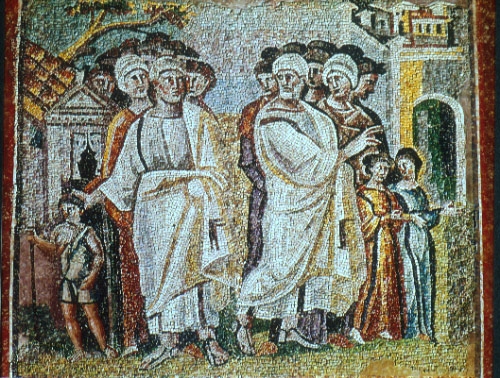
Mosaic of Abel and Melchizedek, San Vitale (Ravenna). Note the altar in the middle.
The deacon goes back to the sanctuary, and along with another deacon, spreads the corporal (which at that time was a very large piece of cloth) over the altar:
The deacon in the meantime returns to the altar, where a collet stands holding a chalice with a corporas (corporale) lying on it; raising the chalice in his left arm, he offers the corporas to the deacon, who takes it off the chalice and lays it on the right part of the altar, throwing the other end of it over to the second deacon in order to spread it. Then there go up to the throne the chancellor and the secretary, and the chief counsellor, with all the district-officials and notaries: but the subdeacon with the empty chalice follows the archdeacon.
In the Ambrosian Rite of Milan, there is actually a prayer said at this point of the Liturgy called Oratio super Sindonem (over the ‘shroud’; i.e. corporal), the Priest having laid out the corporal beforehand as the choir sings the antiphon post Evangelium. Some liturgists are actually of the opinion that the mysterious gap after the Oremus in the old Roman liturgy - which is actually not followed by any prayer! - may have once been occupied by the Roman equivalent of the Ambrosian super sindonem (the other opinion, also mentioned here in this thread a few posts ago, is that the Prayer of the Faithful was once located here).
Of the Corporal the Old Catholic Encyclopedia says:
Although formal evidence is wanting, it may fairly be assumed that something in the nature of a corporal has been in use since the earliest days of Christianity. Naturally it is difficult in the early stages to distinguish the corporal from the altar-cloth, and a passage of St. Optatus (c. 375), which asks, “What Christian is unaware that in celebrating the Sacred Mysteries the wood [of the altar] is covered with a linen cloth?” (ipsa ligna linteamine coo periri, Optatus, VI, ed. Ziwsa, p. 145), leaves us in doubt which he is referring to. This is probably the earliest direct testimony; for the statement of the “Liber Pontificalis”, “He [Pope Sylvester] decreed that the Sacrifice should not be celebrated upon a silken or dyed cloth, but only on linen, sprung from the earth, as the Body of our Lord Jesus Christ was buried in a clean linen shroud” (Mommsen, p. 51), cannot be relied upon. Still, the ideas expressed in this passage are found in an authentic letter of St. Isidore of Pelusium (Ep. i, 123) and again in the “Expositio” of St. Germanus of Paris in the sixth century (P.L., LXXII, 93). Indeed they lasted through the Middle Ages, as the verses attributed to Hildebert (P.L., CLXXI, 1194) sufficiently show:
11. The Offertory
http://www.sacred-destinations.com/italy/ravenna-san-vitale-photos/slides/xti_6456pae2.jpg
Mosaic of Abel and Melchizedek, San Vitale (Ravenna). Note the altar in the middle.
The deacon goes back to the sanctuary, and along with another deacon, spreads the corporal (which at that time was a very large piece of cloth) over the altar:
The deacon in the meantime returns to the altar, where a collet stands holding a chalice with a corporas (corporale) lying on it; raising the chalice in his left arm, he offers the corporas to the deacon, who takes it off the chalice and lays it on the right part of the altar, throwing the other end of it over to the second deacon in order to spread it. Then there go up to the throne the chancellor and the secretary, and the chief counsellor, with all the district-officials and notaries: but the subdeacon with the empty chalice follows the archdeacon.
In the Ambrosian Rite of Milan, there is actually a prayer said at this point of the Liturgy called Oratio super Sindonem (over the ‘shroud’; i.e. corporal), the Priest having laid out the corporal beforehand as the choir sings the antiphon post Evangelium. Some liturgists are actually of the opinion that the mysterious gap after the Oremus in the old Roman liturgy - which is actually not followed by any prayer! - may have once been occupied by the Roman equivalent of the Ambrosian super sindonem (the other opinion, also mentioned here in this thread a few posts ago, is that the Prayer of the Faithful was once located here).
Of the Corporal the Old Catholic Encyclopedia says:
Although formal evidence is wanting, it may fairly be assumed that something in the nature of a corporal has been in use since the earliest days of Christianity. Naturally it is difficult in the early stages to distinguish the corporal from the altar-cloth, and a passage of St. Optatus (c. 375), which asks, “What Christian is unaware that in celebrating the Sacred Mysteries the wood [of the altar] is covered with a linen cloth?” (ipsa ligna linteamine coo periri, Optatus, VI, ed. Ziwsa, p. 145), leaves us in doubt which he is referring to. This is probably the earliest direct testimony; for the statement of the “Liber Pontificalis”, “He [Pope Sylvester] decreed that the Sacrifice should not be celebrated upon a silken or dyed cloth, but only on linen, sprung from the earth, as the Body of our Lord Jesus Christ was buried in a clean linen shroud” (Mommsen, p. 51), cannot be relied upon. Still, the ideas expressed in this passage are found in an authentic letter of St. Isidore of Pelusium (Ep. i, 123) and again in the “Expositio” of St. Germanus of Paris in the sixth century (P.L., LXXII, 93). Indeed they lasted through the Middle Ages, as the verses attributed to Hildebert (P.L., CLXXI, 1194) sufficiently show:
Ara crucis, tumulique calix, lapidisque patena, Sindonis officium candida byssus habet.
It is quite probable that in the early centuries only one linen cloth was used which served both for altar-cloth and corporal, this being of large size and doubled back to cover the chalice. Much doubt must be felt as to the original use of certain cloths of figured linen in the treasury of Monza which Barbier de Montault sought to identify as corporals. The corporal was described as palla corporalis, or velamen dominicae mensce, or opertorium dominici corporis, etc.; and it seems generally to have been of linen, though we hear of altar-cloths of silk (Greg. of Tours, “Hist. Franc.”, VII, 22; X, 16), or of purple (Paulus Silentiarius, “Descr. S. Sophi”, p. 758; a colored miniature in the tenth-century Benedictional of St. Al thelwold also seems to show a purple altar-covering), or of cloth-ofgold (Chrysostom in Matt., Horn. 1). In some of these cases it seems difficult to decide whether altar-cloth or corporal is meant. However, there is no doubt that a clear distinction had established itself in Carlovingian times or even earlier. Thus, in the tenth century, Regino of Pram (De Disc. Eccl., cap. exviii) quotes a council of Reims as having decreed “that the corporal [corporals] upon which the Holy Sacrifice was offered must be of the finest and purest linen without admixture of any other fibre, because Our Savior’s Body was wrapped not in silk, but in clean linen”. He adds that the corporal was never to remain on the altar, but was to be put in the Missal Sacramentorum libro] or shut up with the chalice and paten in some clean receptacle. And when it was washed, it was to be washed first of all by a priest, deacon, or subdeacon in the church itself, in a place or a vessel specially reserved for this, because it had been impregnated with the Body and Blood of Our Lord. Afterwards it might be sent to the laundry and treated like other linen. The suggestion as to keeping the corporal between the leaves of the Missal is interesting because it shows that it cannot, even in the tenth century, have always been of that extravagant size which might be inferred from the description in the “Second Roman Ordo” (cap. ix), where the deacon and an assistant deacon are represented as folding it up between them. Still it was big enough at this period to allow of its being bent back to cover the chalice, and thus serve the purpose of our present pall. This is done by the Carthusians to this day, who use no pall and have no proper elevation of the chalice. As regards the size of the corporal, some change may have taken place when it ceased to be usual for the people to bring loaves to the altar, for there was no longer need of a large cloth to fold back over them and cover them.
It is quite probable that in the early centuries only one linen cloth was used which served both for altar-cloth and corporal, this being of large size and doubled back to cover the chalice. Much doubt must be felt as to the original use of certain cloths of figured linen in the treasury of Monza which Barbier de Montault sought to identify as corporals. The corporal was described as palla corporalis, or velamen dominicae mensce, or opertorium dominici corporis, etc.; and it seems generally to have been of linen, though we hear of altar-cloths of silk (Greg. of Tours, “Hist. Franc.”, VII, 22; X, 16), or of purple (Paulus Silentiarius, “Descr. S. Sophi”, p. 758; a colored miniature in the tenth-century Benedictional of St. Al thelwold also seems to show a purple altar-covering), or of cloth-ofgold (Chrysostom in Matt., Horn. 1). In some of these cases it seems difficult to decide whether altar-cloth or corporal is meant. However, there is no doubt that a clear distinction had established itself in Carlovingian times or even earlier. Thus, in the tenth century, Regino of Pram (De Disc. Eccl., cap. exviii) quotes a council of Reims as having decreed “that the corporal [corporals] upon which the Holy Sacrifice was offered must be of the finest and purest linen without admixture of any other fibre, because Our Savior’s Body was wrapped not in silk, but in clean linen”. He adds that the corporal was never to remain on the altar, but was to be put in the Missal Sacramentorum libro] or shut up with the chalice and paten in some clean receptacle. And when it was washed, it was to be washed first of all by a priest, deacon, or subdeacon in the church itself, in a place or a vessel specially reserved for this, because it had been impregnated with the Body and Blood of Our Lord. Afterwards it might be sent to the laundry and treated like other linen. The suggestion as to keeping the corporal between the leaves of the Missal is interesting because it shows that it cannot, even in the tenth century, have always been of that extravagant size which might be inferred from the description in the “Second Roman Ordo” (cap. ix), where the deacon and an assistant deacon are represented as folding it up between them. Still it was big enough at this period to allow of its being bent back to cover the chalice, and thus serve the purpose of our present pall. This is done by the Carthusians to this day, who use no pall and have no proper elevation of the chalice. As regards the size of the corporal, some change may have taken place when it ceased to be usual for the people to bring loaves to the altar, for there was no longer need of a large cloth to fold back over them and cover them.