The Power of Music

  • Thread starter Thread starter EmmaSowl
  • Start date Start date
Status
Not open for further replies.
ā€œWhatever he wantsā€ is an exaggeration. He does have authority to make decisions concerning the liturgy though. From the GIRM
  1. The Diocesan Bishop, who is to be regarded as the High Priest of his flock, from whom the life in Christ of his faithful in some sense derives and upon whom it depends,[147] must promote, regulate, and be vigilant over the liturgical life in his diocese. It is to him that in this Instruction is entrusted the regulating of the discipline of concelebration (cf. nos. 202, 374) and the establishing of norms regarding the function of serving the Priest at the altar (cf. no. 107), the distribution of Holy Communion under both kinds
This is the second time you have posted a quote which (to my reading) completely refutes your position (the first time was your quote about when paraphrasing is allowed).

I read this quote as saying that a bishop must enforce the GIRM. That is his job.

You seem to read it differently, and I would like to know what you are seeing in these words which I am not.

My fave YouTube journalist, Tim Pool, sometimes refers to ā€œone screen; two different movies seen.ā€

Perhaps that is what we are experiencing - reading the same words and interpreting them differently.

Also, the quote seems to deal with non-musical aspects of the liturgy (concelebration, distribution), so it’s not really on point.

Furthermore, the fact that many parishes in the same diocese are doing different things, suggests to me that some bishops are not being ā€œvigilant over the liturgical lifeā€ but letting each parish do what it wants.

If I’m missing something in the quote, please break it down for me.
 
I, too, also believe that the quality of music is important, but I am tired of arguing with people over it. So, I simply voted with my feet.
I know that you are not alone with that kind of vote, and I have been struggling for some time about doing the same.

But the apologist (whom Cardinal Mahoney knighted as a benemerenti) and who shaped my thinking years ago had a different take. He lived in Inglewood, CA, and when White Flight took hold in that community, he chose to stay and do what he could to uplift it no matter who the residents were. His wife worked with Cesar Chavez.

In short, at the moment, I feel called to correct the wrongs in my community rather than run to another.

However, as you said, it is tiring (spiritually draining, in fact) to argue with people who outright tell you that they don’t care about obedience. Especially when those people are not bishops and don’t seem to really care what their bishop thinks.
 
Last edited:
Thanks! But I actually know where I’ll go if I leave my home parish. There’s an FSSP parish right across the street from my work (but a pain to drive to from home on a Sunday).
Although I would like to, at least once, experience a Latin Mass, I’m still a V2 Gal. I would like to belong to an obedient V2 Mass in the vernacular.

Unfortunately, I have yet to find one in my diocese.
 
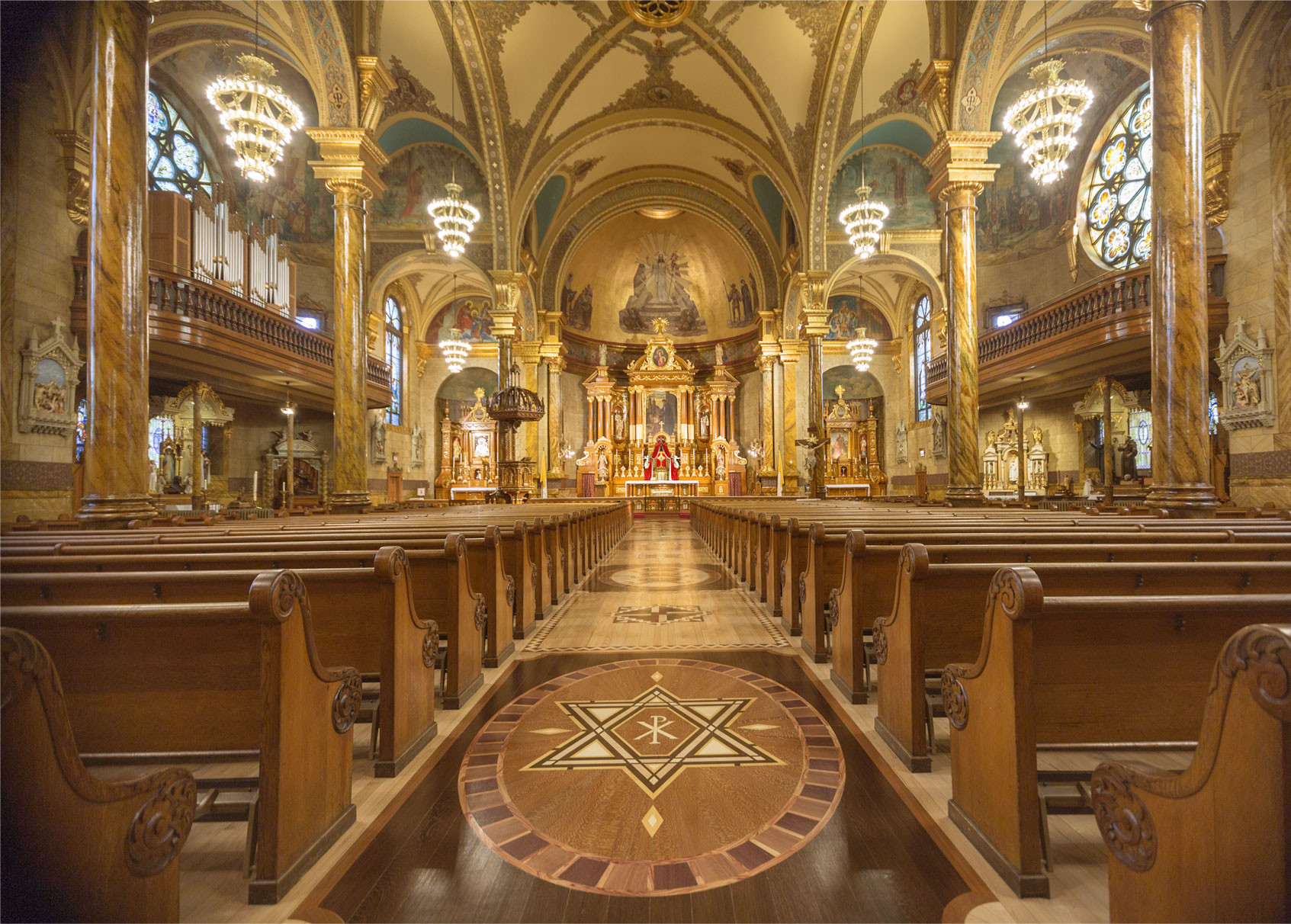
Do you ever go to Chicago? The Masses here are lovely. ā€œNovus Ordoā€ done right. Ordinary Form in English or Latin, plus EF.

 
Last edited:
I have a lot of relatives in Chicago!

Unfortunately, the last time I attended Mass there, a nun gave the homily. 😦

Fortunately, that was 2 decades ago. I’m very glad to hear things are so good now.

I was last in Chicago for my grandmother’s funeral. All my atheist (late) father’s family are Lutheran, and I got a surprise. At the funeral, I sang a song I wrote (ā€œTriumph!ā€ - lyrics waaaay above) because although it is an Easter song, it works very well for funerals (triumphing over death). Well, one of my cousins asked me for a copy to give to her pastor because she liked it so much.

Lol, it’s kind of funny that so many Catholic parishes are embracing Protestant music, but when a Protestant heard a very Catholic song, she went nuts for it!
 
Last edited:
For more information, see: GIRM, Chapter IX: Adaptations within the Competence of Bishops and Bishops’ Conferences. There is a defined process.
Chapter IX: Adaptations within the Competence of Bishops and Bishops’ Conferences
  1. The renewal of the Roman Missal carried out in our time in accordance with the decrees of the Second Vatican Ecumenical Council has taken great care that all the faithful may display in the celebration of the Eucharist that full, conscious, and active participation that is required by the very nature of the Liturgy and to which the faithful, in virtue of their status as such, have a right and duty.[146]
However, in order that such a celebration may correspond all the more fully to the norms and the spirit of the Sacred Liturgy, certain further adaptations are set out in this Instruction and in the Order of Mass and entrusted to the judgment either of the Diocesan Bishop or of the Conferences of Bishops.
  1. The Diocesan Bishop, who is to be regarded as the High Priest of his flock, from whom the life in Christ of his faithful in some sense derives and upon whom it depends,[147] must promote, regulate, and be vigilant over the liturgical life in his diocese. It is to him that in this Instruction is entrusted the regulating of the discipline of concelebration (cf. nos. 202, 374) and the establishing of norms regarding the function of serving the Priest at the altar (cf. no. 107), the distribution of Holy Communion under both kinds
    (cf. no. 283), and the construction and ordering of churches (cf. no. 291). It is above all for him, moreover, to nourish the spirit of the Sacred Liturgy in the Priests, Deacons, and faithful.
  2. Those adaptations spoken of below that necessitate a wider degree of coordination are to be decided, in accord with the norm of law, in the Conference of Bishops.
  3. It is the competence, in the first place, of the Conferences of Bishops to prepare and approve an edition of this Roman Missal in the authorized vernacular languages, so that, once their decisions have been accorded the recognitio of the Apostolic See, the edition may be used in the regions to which it pertains.[148]
The Roman Missal, whether in Latin or in legitimately approved vernacular translations, is to be published in its entirety.

More coming…
 
Last edited:
  1. It is for the Conferences of Bishops to formulate the adaptations indicated in this General Instruction and in the Order of Mass and, once their decisions have been accorded the recognitio of the Apostolic See, to introduce them into the Missal itself. They are such as these:
• the gestures and bodily posture of the faithful (cf. no. 43);

• the gestures of veneration toward the altar and the Book of the Gospels (cf. no. 273);

• the texts of the chants at the Entrance, at the Presentation of the Gifts, and at Communion (cf. nos. 48, 74, 87);

• the readings from Sacred Scripture to be used in special circumstances (cf. no. 362);

• the form of the gesture of peace (cf. no. 82);

• the manner of receiving Holy Communion (cf. nos. 160, 283);

• the materials for the altar and sacred furnishings, especially the sacred vessels, and also the materials, form, and color of the liturgical vestments (cf. nos. 301, 326, 329, 339, 342-346).

It shall be permissible for Directories or pastoral Instructions that the Conferences of Bishops judge useful to be included, with the prior recognitio of the Apostolic See, in the Roman Missal at an appropriate place.
  1. It is for the same Conferences of Bishops to attend to the translations of the biblical texts that are used in the celebration of Mass, exercising special care in this. For it is out of the Sacred Scripture that the readings are read and are explained in the Homily and that Psalms are sung, and it is by the influence of Sacred Scripture and at its prompting that prayers, orations, and liturgical chants are fashioned in such a way that it is from Sacred Scripture that actions and signs derive their meaning.[149]
More coming…
 
Language should be used that corresponds to the capacity for understanding of the faithful and is suitable for public proclamation, while maintaining those characteristics that are proper to the different ways of speaking used in the biblical books.

More coming…
 
  1. It shall also be for Conferences of Bishops to prepare with care a translation of the other texts, so that, even though the character of each language is respected, the meaning of the original Latin text is fully and faithfully rendered. In accomplishing this task, it is desirable that the different literary genres used at Mass be taken into account, such as the presidential prayers, the antiphons, the acclamations, the responses, the litanies of supplication, and so on.
It should be borne in mind that the primary purpose of the translation of the texts is not for meditation, but rather for their proclamation or singing during an actual celebration.

Language should be used that is accommodated to the faithful of the region, but is noble and marked by literary quality, even though there will always be a necessity for some catechesis on the biblical and Christian meaning of certain words and expressions.

Moreover, it is preferable that in regions that share the same language, the same translation be used in so far as possible for liturgical texts, especially for biblical texts and for the Order of Mass.[150]
  1. Bearing in mind the important place that singing has in a celebration as a necessary or integral part of the Liturgy,[151] all musical settings for the texts of the Ordinary of Mass, for the people’s responses and acclamations, and for the special rites that occur in the course of the liturgical year must be submitted to the Secretariat of Divine Worship of the United States Conference of Catholic Bishops for review and approval prior to publication.
While the organ is to be accorded pride of place, other wind, stringed, or percussion instruments may be admitted into divine worship in the Dioceses of the United States of America, according to longstanding local usage, in so far as these are truly suitable for sacred use, or can be made suitable.
  1. Each diocese should have its own Calendar and Proper of Masses. For its part, the Conference of Bishops should draw up a proper Calendar for the nation or, together with other Conferences, a Calendar for a wider territory, to be approved by the Apostolic See.[152]
In carrying out this task, to the greatest extent possible the Lord’s Day is to be preserved and safeguarded, as the primordial feast day, and hence other celebrations, unless they are truly of the greatest importance, should not have precedence over it.[153] Care should likewise be taken that the liturgical year as revised by decree of the Second Vatican Council not be obscured by secondary elements.

In the drawing up of the Calendar of a nation, the Rogation Days and Ember Days should be indicated (cf. no. 373), as well as the forms and texts for their celebration,[154] and other special measures should also be kept in mind.

It is appropriate that in publishing the Missal, celebrations proper to an entire nation or territory be inserted at the proper place among the celebrations of the General Calendar, while those proper to a region or diocese should have a place in a special appendix.

More coming…
 
  1. Finally, if the participation of the faithful and their spiritual welfare require variations and profounder adaptations in order for the sacred
    celebration to correspond with the culture and traditions of the different nations, then Conferences of Bishops may propose these to the Apostolic See in accordance with article 40 of the Constitution on the Sacred Liturgy for introduction with the Apostolic See’s consent, especially in the case of nations to whom the Gospel has been more recently proclaimed.[155] The special norms handed down by means of the Instruction on the Roman Liturgy and Inculturation[156] should be attentively observed.
As regards the procedures in this matter, these should be observed:

Firstly, a detailed preliminary proposal should be set before the Apostolic See, so that, after the necessary faculty has been granted, the detailed working out of the individual points of adaptation may proceed.

Once these proposals have been duly approved by the Apostolic See, experiments should be carried out for specified periods and at specified places. When the period of experimentation is concluded, the Conference of Bishops shall decide, if the case requires, upon pursuing the adaptations and shall submit a mature formulation of the matter to the judgment of the Apostolic See.[157]
  1. However, before proceeding to new adaptations, especially profounder ones, great care shall be taken to promote due instruction of the clergy and the faithful in a wise and orderly manner, so as to take advantage of the faculties already foreseen and to apply fully the pastoral norms in keeping with the spirit of the celebration.
More coming…
 
  1. The principle shall moreover be respected, according to which each particular Church must be in accord with the universal Church not only regarding the doctrine of the faith and sacramental signs, but also as to the usages universally received from apostolic and unbroken tradition. These are to be kept not only so that errors may be avoided, but also so that the faith may be handed on in its integrity, since the Church’s rule of prayer (lex orandi) corresponds to her rule of faith (lex credendi).[158]
The Roman Rite constitutes a notable and precious part of the liturgical treasure and patrimony of the Catholic Church; its riches are conducive to the good of the universal Church, so that their loss would gravely harm her.

This Rite has in the course of the centuries not only preserved the liturgical usages that arose in the city of Rome, but has also in a deep, organic, and harmonious way integrated into itself certain other usages derived from the customs and culture of different peoples and of various particular Churches whether of the West or the East, so acquiring a certain supra-regional character. As to our own times, the identity and unitary expression of this Rite is found in the typical editions of the liturgical books promulgated by authority of the Supreme Pontiff, and in the liturgical books corresponding to them approved for their territories by the Conferences of Bishops and endowed with the recognitio of the Apostolic See.[159]
  1. The norm established by the Second Vatican Council, namely that in the liturgical renewal innovations should not be made unless required by true and certain usefulness to the Church, nor without exercising caution to ensure that new forms grow in some sense organically from forms already existing,[160] must also be applied to implementation of the inculturation of the Roman Rite as such.[161] Inculturation, moreover, requires a necessary length of time, lest the authentic liturgical tradition suffer hasty and incautious contamination.
Finally, the pursuit of inculturation does not have as its purpose in any way the creation of new families of rites, but aims rather at meeting the needs of a particular culture, though in such a way that adaptations introduced either into the Missal or coordinated with other liturgical books are not at variance with the proper character of the Roman Rite.[162]
  1. And so, the Roman Missal, though in a diversity of languages and with some variety of customs,[163] must in the future be safeguarded as an instrument and an outstanding sign of the integrity and unity of the Roman Rite.[164]
 
The solution is simple.

If you don’t like the music in your parish, then get trained in the style of music you like then after about 15 years, if you have the cognitive ability, go back and volunteer your time like those in the music ministry now do. 😃

Jim
 
The solution is simple.

If you don’t like the music in your parish, then get trained in the style of music you like then after about 15 years, if you have the cognitive ability, go back and volunteer your time like those in the music ministry now do. 😃

Jim
Well, and gee, be thankful you’re happy with the architecture…
 
For more information, see: GIRM, Chapter IX: Adaptations within the Competence of Bishops and Bishops’ Conferences. There is a defined process.
Phew! I finally read and pondered this section. I also put it up for all to see and read for themselves (in parts, due to word length). I hope I pasted it all. If I screwed up, anyone can view the text at http://www.usccb.org/prayer-and-wor...uction-of-the-roman-missal/girm-chapter-9.cfm

As I read, it became clear that the section was really about Bishop Conferences more than individual bishops (who seem to be charged with obeying the Bishop Conferences - after they’ve been approved by Rome).

I know that an individual bishop can decide whether or not his flock stands or kneels after the Agnus Dei. I’m still waiting to see what else he has latitude with. I can’t find anything in the above text.

Can you?

Basically, as far as texts and postures go, I find the Misalette to be trustworthy. It seems to be the one book in our pews which can be trusted to express the GIRM accurately.

It tells us when to bow during the Creed.
It tells us when a paraphrased musical setting for sacred scripture is allowed, and it provides it.
It tells us not to stand until AFTER the priest has finished saying, ā€œPray Brethren, that my sacrifice and yoursā€¦ā€

If you (or anyone else) sees something in the GIRM text posted above that I am missing, I beg anyone to point it out.

I cannot overemphasize that I don’t give two hoots about personal preference - especially my own. I care about obedience to the bishops in everything they have authority over.

There were two or three points in the quoted section of the GIRM which really interested me. I will comment further in a moment.
 
The solution is simple.

If you don’t like the music in your parish, then get trained in the style of music you like then after about 15 years, if you have the cognitive ability, go back and volunteer your time like those in the music ministry now do. 😃
I have been active in music since the age of 8 and have been writing songs since my teens. I have volunteered my time in music ministry for 26 years (I was once paid $80 to cantor at a different parish - my husband chastised me for not giving it back, but I wanted to be able to say ā€œI’ve been a paid cantorā€ šŸ™‚) . At the request of my first choir director, I have written songs sung at Mass for special occasions (like ā€œGood Friday Ponderedā€). I got shoved out of Music Ministry for refusing to sing anything which was not approved by the bishops (like unauthorized tropes during the Lamb of God).

The off-key garage band which performs at our local Mission Mass takes a lot of time off. Parishioners (who can hear me from the back because no one else can sing the hyped-up band songs) begged me to fill in. I did for awhile, singing solemn hymns and chants. After one Mass, an old lady screamed out, ā€œWe finally have someone who can sing!ā€

But when I went to the pastor to ask for some forewarning as to when I’d cantor (sometimes I’m asked when I walk in the door), I ended up being 86ed by our Director of Liturgy.

Please let me know if you have further suggestions. I’d appreciate them.
 
There are people NOW who can competently play authentic Catholic liturgical music. A lot of priests don’t seem to want that. Shrug!
 
Last edited:
It’s just this one parish is especially awesome. St. John Cantius.
 
Status
Not open for further replies.
Back
Top
