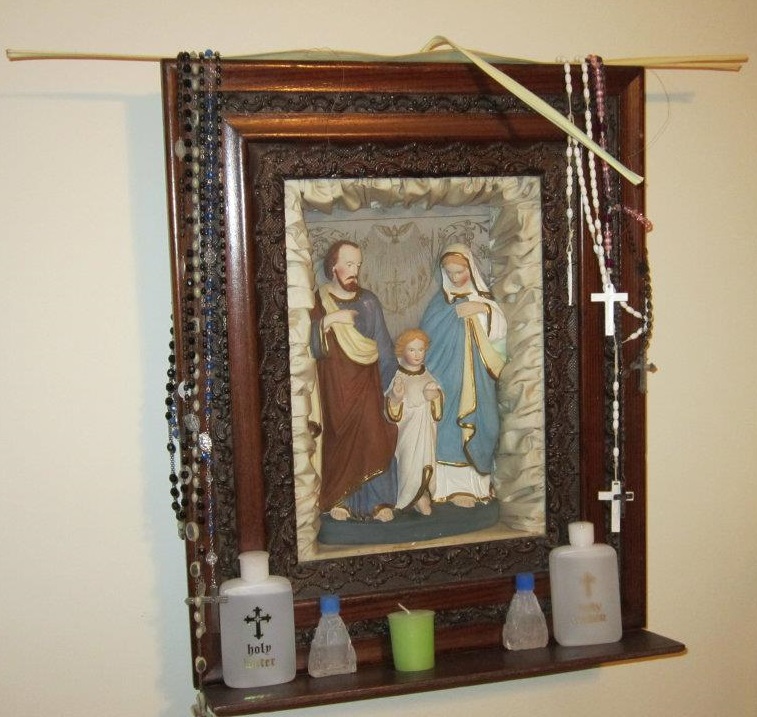
And eventually if the rosary is said properly, it does become a meditative form of prayer and not just a recitation.
That’s true, but the CCC said Christian prayer “should” go further, than either vocal or meditative.
CCC 2708
Meditation engages thought, imagination, emotion, and desire. This mobilization of faculties is necessary in order to deepen our convictions of faith, prompt the conversion of our heart, and strengthen our will to follow Christ. Christian prayer tries above all to meditate on the mysteries of Christ, as in lectio divina
or the rosary. This form of prayerful reflection is of great value, but Christian prayer should go further: to the knowledge of the love of the Lord Jesus, to union with him.
So according to the CCC, the Rosary isn’t the be-all and end-all of prayer. Of value, but not far enough. That’s why Dave and I, along with St. Teresa and St. John of the Cross, and others, are suggesting contemplative prayer, which the CCC discussed starting in 2709, and cites that this form of prayer does reach true union with the prayer of Christ. In fact, the CCC article
Expressions of Prayer has more to say about contemplative prayer than vocal and meditative combined. But do you hear threads saying everybody “should” do contemplative prayer – and if they don’t we question whether they honor Mary of “properly mimic” certain saints or apparitions or the CCC itself for that matter? OTOH, do you see in the CCC where it says Christian prayer “should” include a daily Rosary? Or any Rosaries for that matter? Then why is it that the “Rosary police” are so vocal when they are not backed the CCC?
To me, this is one reason Jesus says that the road to destruction is wide. If you have a group mentality, that you are going to follow the crowd into heaven, you will be mistaken. God calls each of us on our individual paths through the Holy Spirit, and that’s why our path is narrow – it is just us and God on that path. But we have to have the courage to let go of our group activities. That’s why contemplative prayer can be so powerful – it is all about “letting go” or our wills, not reinforcing our wills to follow a regimen of some sort.
I don’t want to hear another person tell me there is something wrong with me or my relationship with God or Mary for not saying Rosary, until they’ve done contemplative prayer for, let’s say, at least a year. Not that time limits mean anything on contemplative prayer, but I’m trying to make a point. The wide path isn’t the one that will get you to heaven. It can be valuable to have a wide path to follow others, until such time as God shows you where you are to branch off. But if you’re fixed on following the others, you will miss your turn and follow the others like lemmings, or pigs into the sea. Maybe this is your turn. Is God calling you right now to a new form of prayer. Not even a “form” of prayer really but a mentality of getting our own thinking and actions out of the way so the Holy Spirit, aka the Divine Therapist, can touch our hearts and minds directly. He seldom does this without either direct invitation (which is what contemplative prayer is) or through suffering and calamity or even addictions or other problems. Contemplative prayer obviates the need for God to hit us with a stick to get our attention, because the whole point is to have a loving gaze toward God, without our jaws flapping.
A few other paragraphs about contemplative prayer:
2709 What is contemplative prayer? St. Teresa answers: “Contemplative prayer [oracion mental] in my opinion is nothing else than a close sharing between friends; it means taking time frequently to be alone with him who we know loves us.” Contemplative prayer seeks him “whom my soul loves.” It is Jesus, and in him, the Father. We seek him, because to desire him is always the beginning of love, and we seek him in that pure faith which causes us to be born of him and to live in him. In this inner prayer we can still meditate, but our attention is fixed on the Lord himself.
2710 The choice of the time and duration of the prayer arises from a determined will, revealing the secrets of the heart.
One does not undertake contemplative prayer only when one has the time: one makes time for the Lord, with the firm determination not to give up, no matter what trials and dryness one may encounter. One cannot always meditate, but one can always enter into inner prayer, independently of the conditions of health, work, or emotional state. The heart is the place of this quest and encounter, in poverty and in faith.
2711 Entering into contemplative prayer is like entering into the Eucharistic liturgy: we “gather up:” the heart, recollect our whole being under the prompting of the Holy Spirit, abide in the dwelling place of the Lord which we are, awaken our faith in order to enter into the presence of him who awaits us. We let our masks fall and turn our hearts back to the Lord who loves us, so as to hand ourselves over to him as an offering to be purified and transformed.
2718 Contemplative prayer is a union with the prayer of Christ insofar as it makes us participate in his mystery. The mystery of Christ is celebrated by the Church in the Eucharist, and the Holy Spirit makes it come alive in contemplative prayer so that our charity will manifest it in our acts.
But I don’t expect anybody to change their behavior just because the CCC says they “should.” It is a calling from God. If you are not so called, then do as you will. Stand on what you already believe, and remain in the Cloud of the Knowing, and may God judge you favorably at the end of your earthly life.
Alan



 And that itself is a devotion to Mary … even if you don’t feel drawn to say the words. I’m reminded of Psalm 63 at such times: “My soul clings to you…”