The Rosary: not for EVERY Catholic?

Status
Not open for further replies.
I am still reading this thread, despite it becoming the “AlanfromWitchita/SaintsAlive Show”. 😛

I just wanted to chime in. I am a convert to Catholicism, of 3 years. I have yet to figure out the Rosary. I don’t like saying the prayers. I have trouble with understanding what I am supposed to be doing. I have an emotional and intellectual resistance to the idea of a daily Rosary. And yet I find myself collecting beautiful Rosary beads and having them blessed. I have them draped over my bedside lamp, just waiting for me to pick them up. I like holding the beads, and counting them during prayers, more than I like saying the actual prayers themselves. Weird.
I figure some day I will develop a daily practice of praying the Rosary, but with my life being what it is now, and still being so new to the Church, I am still trying to learn how to keep the Commandments and the Precepts of the Church, and remember the holy days of obligation. :o
Funny. I am convert too and have had a similar experience. I have many rosaries, but don’t pray the rosary that much. I often hold them when I am praying in my own way and almost always when driving! Moving the beads through my hands helps to put me in a prayerful mood. I read somewhere in the catechism that w/blessed sacramentals you have the prayers of the church with you when you pray with the object. I do use my rosary to say the Divine Mercy Chaplet virtually every day, although I only manage to do the rosary a couple of times a week at best. So, I think rosaries are good even for those of us who aren’t good with the rosary.
 
I have many rosaries, but don’t pray the rosary that much. I often hold them when I am praying in my own way and almost always when driving!
Me too. 🙂 And that itself is a devotion to Mary … even if you don’t feel drawn to say the words. I’m reminded of Psalm 63 at such times: “My soul clings to you…”

On a seperate note to anyone who might be interested …

Here are some general counsels that came to mind from reading this thread. They’re drawn from the teachings of St. Teresa of Jesus and St. John of the Cross, Doctors of the Church for their teaching on prayer.

First, Sts. Teresa and John say precious little about devotions (actually next to nothing). Their whole focus is to lay out the framework for prayer, where it leads and how it transforms us. They purposely steer clear of recommendations on “methods” (devotions) in order to not intrude on the working of the Holy Spirit who is our true teacher and guide. They clearly realize that what works for one may not be appropriate for another … there’s no one size fits all approach to prayer. In fact the only devotion St. John preaches is to the Holy Spirit Himself … who teaches us to enter into personal relationship with each Person of the Trinity as separate individuals. Imagine for a moment being invited to the kitchen table as the 4th wheel to those Three! And we’d want to use a method? No, all that is required to communicate at such times is an unfettered heart. Better still … silence.

Second, it’s typical of pious individuals to be enthusiastic about their particular path. Perhaps they even feel drawn to share, witness and encourage. That’s all well and good … provided the encouragement doesn’t cross the line into insistence. Insistence, as St. Teresa teaches, is a hallmark of “imprudent zeal” … a truly noxious evil: an imperfection of beginners who think they have all the answers because they’ve found something that works for them. We see this from time to time on these forums. And when it occurs in spiritual direction it can be extremely harmful. We can look to the experience of St. Teresa herself whose own Dark Night was marked by the spiritual trials born of freely obeying bad advice and cookie-cutter approaches to prayer.

Lastly, an enthusiastic soul is often an attached soul. And it can be particularly shocking to such individuals to come face-to-face with the realization that growth and moving forward only comes from letting go of what we most cling to … and that means our devotions. So much of St. John and Teresa’s teaching is focused on this one central issue: discerning when and how to let go of discursive meditation. And that, dear readers, even means the Rosary! What such individuals fail to realize is that such methods are means to an end … not the end itself. So many of us get it backwards. It’s not the Rosary … but where it leads us. It’s not the chaplet … it’s where it leads us. It’s not Lectio, novena’s or anything else … it’s where they lead us.

Relationship in the form of contemplation.

Dave 🙂
 
Dave, thank you for your reply.
You mentioned,
“Sts. Teresa and John say precious little about devotions (actually next to nothing).”

There are many other devotions and other religious acts of fervor these saints said nothing about. But then that wasn’t their forte. They were instructing on the spiritual life and not on which tools one may use to get there.

There were some really great saints who advocated praying the rosary, and very strongly.
The Cure of Ars was only one but a pastor of a flock of his own, hearing confessions from 16 to 20 hours each day. I would think he would know as a pastor of his people.

Devotions develope over time and were started by other great saints, viz., St. Margret Mary.
The church has actually endorsed private devotions to help us in our prayer, viz., the brown scapular.

Should all devotions not mentioned by Sts. Teresa and John be ignored?

If anyone dosen’t wish to say the rosary, then I respect that, if the time is to be used in a higher form of prayer. But why do I see the Popes, Bishops, Priests, and Religious say it then?
Pope John II said the whole rosary every day, the joyful, sorrowful, and glorious mysteries.

There are higher forms of prayer but saying the rosary dosn’t exclude them.
These are great and should be aimed at. But meanwhile, the ranch is burning to the ground for so many. We need to address what will help so many others in a simple yet understandable way. Something that can be a attained realistically by those that are struggling to get to Mass on Sunday.

And eventually if the rosary is said properly, it does become a meditative form of prayer and not just a recitation.

Be at peace.​

“One in body, heart and mind, we are one by love united.” Hymn
 
Should all devotions not mentioned by Sts. Teresa and John be ignored?
Hi Fred -
Not saying that at all 🙂 My only point is that they are means to an end.
There are higher forms of prayer but saying the rosary dosn’t exclude them.
Absolutely! 🙂 A rosary well prayed can certainly lead an individual to moments of infused contemplation. And that’s where St. John of the Cross in particular comes in. He helps us discern when the Spirit is calling us to something more … namely simple resting in His presence. At such times the Rosary has done it’s work … and we should follow where the Spirit leads. However, resistence is often the natural reaction … to try and continue with the words when they’re no longer helpful (at least for that particular time of prayer). This resistence is a hallmark of what he describes as the passive night of sense … a spiritual trial many, many souls go through. And most simply do not know what to do at such times.

Again, all prayer methods are means to an end … and we often lose sight of that.

But first step is simply to begin!!

Blessings,
Dave 🙂
 
And eventually if the rosary is said properly, it does become a meditative form of prayer and not just a recitation.
That’s true, but the CCC said Christian prayer “should” go further, than either vocal or meditative.

CCC 2708
Meditation engages thought, imagination, emotion, and desire. This mobilization of faculties is necessary in order to deepen our convictions of faith, prompt the conversion of our heart, and strengthen our will to follow Christ. Christian prayer tries above all to meditate on the mysteries of Christ, as in lectio divina or the rosary. This form of prayerful reflection is of great value, but Christian prayer should go further: to the knowledge of the love of the Lord Jesus, to union with him.

So according to the CCC, the Rosary isn’t the be-all and end-all of prayer. Of value, but not far enough. That’s why Dave and I, along with St. Teresa and St. John of the Cross, and others, are suggesting contemplative prayer, which the CCC discussed starting in 2709, and cites that this form of prayer does reach true union with the prayer of Christ. In fact, the CCC article Expressions of Prayer has more to say about contemplative prayer than vocal and meditative combined. But do you hear threads saying everybody “should” do contemplative prayer – and if they don’t we question whether they honor Mary of “properly mimic” certain saints or apparitions or the CCC itself for that matter? OTOH, do you see in the CCC where it says Christian prayer “should” include a daily Rosary? Or any Rosaries for that matter? Then why is it that the “Rosary police” are so vocal when they are not backed the CCC?

To me, this is one reason Jesus says that the road to destruction is wide. If you have a group mentality, that you are going to follow the crowd into heaven, you will be mistaken. God calls each of us on our individual paths through the Holy Spirit, and that’s why our path is narrow – it is just us and God on that path. But we have to have the courage to let go of our group activities. That’s why contemplative prayer can be so powerful – it is all about “letting go” or our wills, not reinforcing our wills to follow a regimen of some sort.

I don’t want to hear another person tell me there is something wrong with me or my relationship with God or Mary for not saying Rosary, until they’ve done contemplative prayer for, let’s say, at least a year. Not that time limits mean anything on contemplative prayer, but I’m trying to make a point. The wide path isn’t the one that will get you to heaven. It can be valuable to have a wide path to follow others, until such time as God shows you where you are to branch off. But if you’re fixed on following the others, you will miss your turn and follow the others like lemmings, or pigs into the sea. Maybe this is your turn. Is God calling you right now to a new form of prayer. Not even a “form” of prayer really but a mentality of getting our own thinking and actions out of the way so the Holy Spirit, aka the Divine Therapist, can touch our hearts and minds directly. He seldom does this without either direct invitation (which is what contemplative prayer is) or through suffering and calamity or even addictions or other problems. Contemplative prayer obviates the need for God to hit us with a stick to get our attention, because the whole point is to have a loving gaze toward God, without our jaws flapping.

A few other paragraphs about contemplative prayer:

2709 What is contemplative prayer? St. Teresa answers: “Contemplative prayer [oracion mental] in my opinion is nothing else than a close sharing between friends; it means taking time frequently to be alone with him who we know loves us.” Contemplative prayer seeks him “whom my soul loves.” It is Jesus, and in him, the Father. We seek him, because to desire him is always the beginning of love, and we seek him in that pure faith which causes us to be born of him and to live in him. In this inner prayer we can still meditate, but our attention is fixed on the Lord himself.

2710 The choice of the time and duration of the prayer arises from a determined will, revealing the secrets of the heart. One does not undertake contemplative prayer only when one has the time: one makes time for the Lord, with the firm determination not to give up, no matter what trials and dryness one may encounter. One cannot always meditate, but one can always enter into inner prayer, independently of the conditions of health, work, or emotional state. The heart is the place of this quest and encounter, in poverty and in faith.

2711 Entering into contemplative prayer is like entering into the Eucharistic liturgy: we “gather up:” the heart, recollect our whole being under the prompting of the Holy Spirit, abide in the dwelling place of the Lord which we are, awaken our faith in order to enter into the presence of him who awaits us. We let our masks fall and turn our hearts back to the Lord who loves us, so as to hand ourselves over to him as an offering to be purified and transformed.

2718 Contemplative prayer is a union with the prayer of Christ insofar as it makes us participate in his mystery. The mystery of Christ is celebrated by the Church in the Eucharist, and the Holy Spirit makes it come alive in contemplative prayer so that our charity will manifest it in our acts.

But I don’t expect anybody to change their behavior just because the CCC says they “should.” It is a calling from God. If you are not so called, then do as you will. Stand on what you already believe, and remain in the Cloud of the Knowing, and may God judge you favorably at the end of your earthly life.

Alan

 
Thank you for your replay Alan.
I would like to make a brief answer to your good comments.

Why do I see the Popes, Bishops, Priests, and Religious say the rosary?
Pope John II said the whole rosary every day, the joyful, sorrowful, and glorious mysteries.
They are our leaders. Are they mis-leading us?

Is it because they unvalued contemplative prayer?

Or is it because one does not outlaw the other?

Priests say the divine office every day. They don’t seem to be in contemplation. Should they give that prayer up? And just as a sidebar, how many sermons has anyone heard on contemplation lately?

To me it isn’t a case of either/or, but both. But one is really necessary.

And in addition, how many people know anything at all about contemplation? Or for that matter, how many of our Catholics have a regular daily diet of prayer? Many do not understand and even tho they should take the time to learn, how many do or will? So many need something in their lives that is simple enough to use on a regular basis to help them.

The Cure of Ars once said that unless a person prays at least 20 minutes a day, they are in danger of losing their eternal life. He was also a man who loved the rosary.
Padre Pio is another who loved the rosary and recommended it.

How many people do I know among my relatives that pray 20 minutes each day? I’m not with them every moment of the day to say for sure, but I would guess at least more than half of them rarely pray, except when they are in some sort of trouble and need help. Many have trouble just going to Mass on Sunday. I’m not saying this in criticism but in observation.

Mary gave us a practical way to think and use our faith on thoughts about the life of her Son.
To think about him in the way he loved us is about as good as it will get. And right now there are so many who do not even know him. In the past, there were many who made the stations of the cross. The sorrowful mysteries are the stations of the cross. And the stations of the cross are the sorrowful mysteries of the rosary.

Just some thoughts.​

“We are companions on the journey, breaking bread and sharing life, and in the love we bear is the hope we share for we believe in the love of our God” (hymn)
 
Is it because they unvalued contemplative prayer?
This is a good question. That said, contemplative prayer can be done in groups but it really isn’t a group activity like vocal prayer IMO.
Priests say the divine office every day. They don’t seem to be in contemplation. Should they give that prayer up? And just as a sidebar, how many sermons has anyone heard on contemplation lately?
Amen! We ask priests to do all this discursive prayer, and not contemplative prayer. You would think they would be expected to follow the CCC on how they should pray. I find that in our Catholic schools and in our seminaries there is a disturbing lack of attention to the entire apophatic tradition of the Church. I’ve heard from those more studied than me that this has largely been the case since the Reformation, at which time Christianity began to focus on head knowledge and distinguishing ourselves from others.
To me it isn’t a case of either/or, but both. But one is really necessary.
And in addition, how many people know anything at all about contemplation? Or for that matter, how many of our Catholics have a regular daily diet of prayer? Many do not understand and even tho they should take the time to learn, how many do or will? So many need something in their lives that is simple enough to use on a regular basis to help them.
This is a problem I’m doing everything I personally can to solve; that this prayer type the Church says we “should” do is made known.
The Cure of Ars once said that unless a person prays at least 20 minutes a day, they are in danger of losing their eternal life. He was also a man who loved the rosary.
Padre Pio is another who loved the rosary and recommended it.
Is the one from Ars the same person referred to in CCC 2715?

2715 Contemplation is a gaze of faith, fixed on Jesus. “I look at him and he looks at me”: this is what a certain peasant of Ars in the time of his holy curé used to say while praying before the tabernacle. This focus on Jesus is a renunciation of self. His gaze purifies our heart; the light of the countenance of Jesus illumines the eyes of our heart and teaches us to see everything in the light of his truth and his compassion for all men. Contemplation also turns its gaze on the mysteries of the life of Christ. Thus it learns the “interior knowledge of our Lord,” the more to love him and follow him.
How many people do I know among my relatives that pray 20 minutes each day? I’m not with them every moment of the day to say for sure, but I would guess at least more than half of them rarely pray, except when they are in some sort of trouble and need help. Many have trouble just going to Mass on Sunday. I’m not saying this in criticism but in observation.
Yes, there are many who are not completely gone from the faith, but are lukewarm in it. 😦
Mary gave us a practical way to think and use our faith on thoughts about the life of her Son.
If this was from an apparition, that might explain why I wasn’t aware that Mary herself told us to do this. I don’t generally accept others’ visions as a literal mandate for me to follow; I accept them as miracles that were to be experienced by those who experienced it. I don’t understand anyway, since I thought that many centuries back the Church declared there would be no more revelation in her teachings. I don’t know, but it’s not something I’m inclined to pursue; I’ve been gifted with my own visions so I don’t feel left out in this regard.
To think about him in the way he loved us is about as good as it will get. And right now there are so many who do not even know him. In the past, there were many who made the stations of the cross. The sorrowful mysteries are the stations of the cross. And the stations of the cross are the sorrowful mysteries of the rosary.
I hope you don’t think I’m trying to dissuade anyone from doing the Rosary, or any other form of prayer. That is not my intent here. My intent is to stand up for those of us who don’t often use this particular prayer form, against those who make us feel like we are messing up by not doing so.

I honestly pray with each breath, sincerely, no joke. I am constantly aware of God and have learned how to allow my mind to “relax” into a contemplative state even when doing active things. But the more traditional forms of contemplative prayer such as sitting quietly with eyes closed, are a logical starting point.

But what I want to know is why some people lay guilt trips upon others because they don’t do the same devotions. This is the problem, and that’s what annoys me – because even when challenged these people cannot just admit it is optional without adding emotional baggage. The reason I brought up contemplative prayer was that here’s a prayer form that the CCC says we “should” do and yet, as you have witnessed, darn few Catholics even know about it much less do it. But those same people will tell me I’m wrong for not adopting/promoting their devotions.
Just some thoughts.
Yes, thank you. :tiphat:
“We are companions on the journey, breaking bread and sharing life, and in the love we bear is the hope we share for we believe in the love of our God” (hymn)
:amen:
 
Me too. 🙂 And that itself is a devotion to Mary … even if you don’t feel drawn to say the words. I’m reminded of Psalm 63 at such times: “My soul clings to you…”

On a seperate note to anyone who might be interested …

Lastly, an enthusiastic soul is often an attached soul. And it can be particularly shocking to such individuals to come face-to-face with the realization that growth and moving forward only comes from letting go of what we most cling to … and that means our devotions. So much of St. John and Teresa’s teaching is focused on this one central issue: discerning when and how to let go of discursive meditation. And that, dear readers, even means the Rosary! What such individuals fail to realize is that such methods are means to an end … not the end itself. So many of us get it backwards. It’s not the Rosary … but where it leads us. It’s not the chaplet … it’s where it leads us. It’s not Lectio, novena’s or anything else … it’s where they lead us.

Relationship in the form of contemplation.

Dave 🙂
Hi Dave, I like what you said here! I experience his quite often with the Chaplet. I start saying it, but invariably it leads me other places in my prayer, often before I am even finished with it. God bless you!
 
This is a good question. That said, contemplative prayer can be done in groups but it really isn’t a group activity like vocal prayer IMO.

Amen! We ask priests to do all this discursive prayer, and not contemplative prayer. You would think they would be expected to follow the CCC on how they should pray. I find that in our Catholic schools and in our seminaries there is a disturbing lack of attention to the entire apophatic tradition of the Church. I’ve heard from those more studied than me that this has largely been the case since the Reformation, at which time Christianity began to focus on head knowledge and distinguishing ourselves from others.

This is a problem I’m doing everything I personally can to solve; that this prayer type the Church says we “should” do is made known.

Is the one from Ars the same person referred to in CCC 2715?

2715 Contemplation is a gaze of faith, fixed on Jesus. “I look at him and he looks at me”: this is what a certain peasant of Ars in the time of his holy curé used to say while praying before the tabernacle. This focus on Jesus is a renunciation of self. His gaze purifies our heart; the light of the countenance of Jesus illumines the eyes of our heart and teaches us to see everything in the light of his truth and his compassion for all men. Contemplation also turns its gaze on the mysteries of the life of Christ. Thus it learns the “interior knowledge of our Lord,” the more to love him and follow him.

Yes, there are many who are not completely gone from the faith, but are lukewarm in it. 😦

If this was from an apparition, that might explain why I wasn’t aware that Mary herself told us to do this. I don’t generally accept others’ visions as a literal mandate for me to follow; I accept them as miracles that were to be experienced by those who experienced it. I don’t understand anyway, since I thought that many centuries back the Church declared there would be no more revelation in her teachings. I don’t know, but it’s not something I’m inclined to pursue; I’ve been gifted with my own visions so I don’t feel left out in this regard.

I hope you don’t think I’m trying to dissuade anyone from doing the Rosary, or any other form of prayer. That is not my intent here. My intent is to stand up for those of us who don’t often use this particular prayer form, against those who make us feel like we are messing up by not doing so.

I honestly pray with each breath, sincerely, no joke. I am constantly aware of God and have learned how to allow my mind to “relax” into a contemplative state even when doing active things. But the more traditional forms of contemplative prayer such as sitting quietly with eyes closed, are a logical starting point.

But what I want to know is why some people lay guilt trips upon others because they don’t do the same devotions. This is the problem, and that’s what annoys me – because even when challenged these people cannot just admit it is optional without adding emotional baggage. The reason I brought up contemplative prayer was that here’s a prayer form that the CCC says we “should” do and yet, as you have witnessed, darn few Catholics even know about it much less do it. But those same people will tell me I’m wrong for not adopting/promoting their devotions.

Yes, thank you. :tiphat:

:amen:
Alan, thanks for your fine response.

You asked,
Is the one from Ars the same person referred to in CCC 2715?

2715 Contemplation is a gaze of faith, fixed on Jesus. “I look at him and he looks at me”: this is what a certain peasant of Ars in the time of his holy curé used to say while praying before the tabernacle. This focus on Jesus is a renunciation of self. His gaze purifies our heart; the light of the countenance of Jesus illumines the eyes of our heart and teaches us to see everything in the light of his truth and his compassion for all men. Contemplation also turns its gaze on the mysteries of the life of Christ. Thus it learns the “interior knowledge of our Lord,” the more to love him and follow him.

Yes, that is what he said. Especially the part “Contemplation also turns its gaze on the mysteries of the life of Christ. Thus it learns the ‘interior knowledge of our Lord,’ the more to love him and follow him.” Which resembles the rosary. Maybe we are talking about the same thing.

Your point is well taken by saying that it is wrong to make someone think they must pray the rosary. But is it wrong to tell them to give it a real try?

Even if Mary hadn’t appeared and said to pray the rosary, it is a great prayer centering on the life of Jesus, especialy in the sorrowful mysteries there is the heart to heart contact.

Just some more thoughts.​

“Out of the depths I cry to you, I cry to you, O lord. Open your ears and hear my voice, attend to the sound of my plea.” (hymn)
 
Your point is well taken by saying that it is wrong to make someone think they must pray the rosary. But is it wrong to tell them to give it a real try?
It seems like a natural enough question to go with the answer. “No, it isn’t required, but would you like to hear some ideas that may make it better for you?” Something to that nature.

When it became annoying for me in this particular thread was when a poster came in and started throwing out words like “hate” in reference to those of us who were trying to convey that yes, it is optional and you need not feel guilty about not doing it, as claiming we’re trying to dissuade others from saying the Rosary. Basically painting those who were telling the truth without extra information, as someone who would turn the OP against this devotion.

That’s when the trouble began. The poster went on to complain about hating “these threads,” and “wincing” when he/she sees them, because of people [like me and a couple others] who inevitably show up and discourage others from saying it.

And then another sycophant poster had to come in and ratify the “hate” talk. :rolleyes:

In essence, it gets me going whenever somebody tells another person they shouldn’t be posting their truth or their opinion, unless it goes against forum rules or misstates another poster, Church teachings, etc.
Even if Mary hadn’t appeared and said to pray the rosary, it is a great prayer centering on the life of Jesus, especialy in the sorrowful mysteries there is the heart to heart contact.
Sure it is. My wife likes it. My son likes it; like I said he started the tradition of saying it before Knights meetings. And since Knights are focused on the Rosary, I’m proud of him for doing it – bringing prayer to a meeting more than just a quick Our Father and Pledge of Allegiance at the beginning.

It’s just something I never enjoyed and don’t remember many times if any when I was alone doing it and made it through. I’m more drawn to other methods of prayer that have helped me connect with God to the point He healed a severe psychosis in me that the doctors said couldn’t be healed. And like I mentioned I will do one June 1 because it’s an activity of the Franciscans. I’m none too anxious to go hang around an abortion clinic for a half hour, but I go to be supportive. I’m hardly one who dissuades others from saying the Rosary, and I got annoyed at the poster who insinuated that I was.

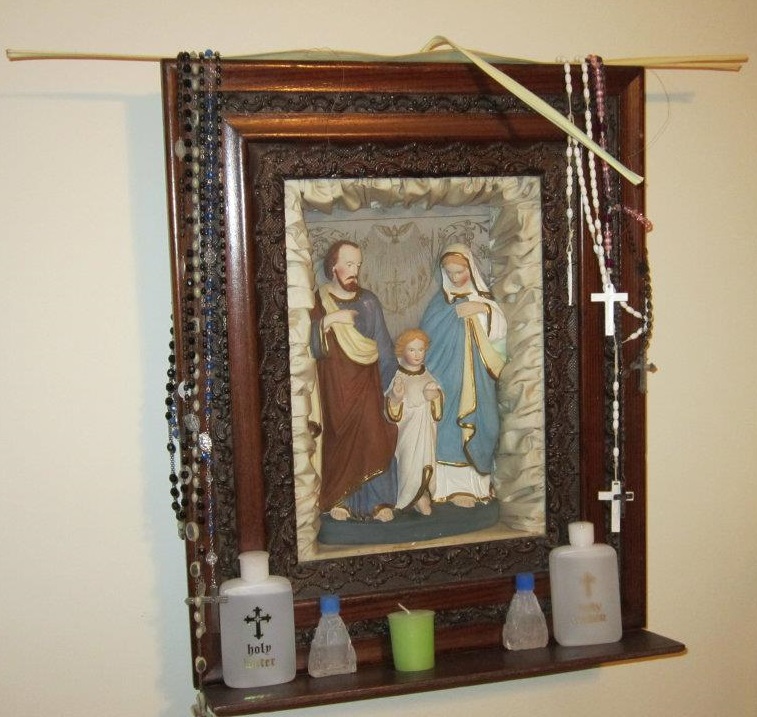
I actually like Rosaries, and having them around. I have one blessed by B16 that my son brought from Rome, and I have a couple over a hundred years old that were passed along to me starting from at least my great-grandmother along with a beautiful heirloom 3-D wall hanging of the Holy Family. Check it out:


Hardly the wall decoration of someone who avoids the Rosary, isn’t it? 😛

Truth be told, even this is pride. I should rejoice and be glad when others say these things about me for my honest thoughts about prayer, but emotionally I was looking out for Truth. Telling someone a prayer is optional is not equivalent to trying to stop them from doing it; those who claim it is are manipulating if not just plain lying.

I don’t have a problem with you, personally, Fred. :cool:

Peace and joy,
Alan
 
In reading many of these posts I am having a hazy recollection of a DVD presentation held in our parish a year or two ago.
One thing I recall is some talk about the ‘stages of prayer’. I think that St. Therese may have been one person who spoke of this. (?)
Does this sound familiar to anyone?
This is a goal to work towards. To go beyond reciting prayers to meditation and contemplation to the point that we ‘loose ourselves’ in prayer. Not everyone is given that gift of prayer, but the DVD suggested that it is a goal to try to work towards.

Maybe that’s a topic for another thread some day. I’d have to give it some thought so that I can word it clearly.

It’s getting late.:yawn:
 
It is hard, sometimes, to keep focused during prayer. Life can be hard and we are only human at the end of the day.

I for one do try very hard. But I don’t always succeed in being humble at prayer.

I am sure it is something I will hopefully learn to do as I grow in my faith and love of God.

I love the rosary.
 
It took me years to hear God’s “still voice” though I said the Rosary periodically for a few years before because I felt a certain presence and peace when I did so and always miracles abounded when I did.
I was in private prayer when God spoke to me. The sense of His words drove me to joyful tears. I had just had my first son and had postpartum depression, though I didn’t know it yet. I thought I was depressed about being a poor mother, which really I wasn’t.
During a brutal depression I lay in bed spilling my heart to the Father in prayer. What I can best describe as a sudden, powerful thought I knew was NOT my own because what it said and the grammar used were uncharacteristic of me.
“I didn’t stop loving you because your son was born,” it said. In a way I can’t “logically” explain I KNEW God’s voice by the truth, love, and power that carried the thought.
After reading scripture about as veraciously as you pray the Rosary for a few years now I can identify and recognize that same voice through the words of the Bible.
“God reveals Himself to those who do not disbelieve Him”-Scripture
and “Seek and ye shall find”
Everybody gets distracted often when praying the Rosary. From my understanding contemplative prayer like mystics do is persistent, intimate original prayer from one’s own heart.
To help I’ll pray for God to speak to you SOON. It’s amazing. Worth waiting for if you must!
 
I was in private prayer when God spoke to me. The sense of His words drove me to joyful tears. I had just had my first son and had postpartum depression, though I didn’t know it yet. I thought I was depressed about being a poor mother, which really I wasn’t.
I am very familiar with post partum depression. After our second son was born, it made my wife very psychotic. After many years, between her and then me with severe psychosis, we were healed by the Lord and now I can look back and it all makes sense. Don’t give up trusting in the Lord’s goodness – it sounds like you already know that but I join you in the sentiment. Being healed by the Lord has been far greater than not being sick in the first place. 🙂
Everybody gets distracted often when praying the Rosary. From my understanding contemplative prayer like mystics do is persistent, intimate original prayer from one’s own heart.
To help I’ll pray for God to speak to you SOON. It’s amazing. Worth waiting for if you must!
Sometimes I think that having psychiatric issues help open our minds to the Lord because it takes us out of our “normal” ways of thinking. Also when one is being transformed by the Lord, there is some “under construction” time when we have extreme odd experiences and behave in ways that make us social lepers – adding to our union with the sufferings and insults Jesus endured and had compassion for. Contemplative prayer was wonderfully described by an anonymous author in the classic book of Catholic mysticism “the Cloud of the Unknowing.” If you decide to read it (and it isn’t for everybody) I recommend the William Johnston edition. Some translations are hard to read. I also recommend you read some of Dark Night of the Soul, by St. John of the Cross, who describes purgative contemplation – which sounds a bit like what you might be experiencing based on this thread plus one other thread I saw of yours. If you can find a spiritual director that would be ideal. Meanwhile you can read the Dark Night here on EWTN website. It tells the story of a soul going to seek its lover in the Dark Night of contemplation.

Contemplative prayer is not us speaking to God with the mind or the heart, in terms of conveying information. It is an open invitation by the mind and heart, its normal activity and business being still, for the Holy Spirit to enter in. It is done in many forms, but typically involves sitting comfortably in a chair with eyes closed, thinking of nothing in particular. No mantra, nothing. There is a “sacred word” described by the Cloud, but it doesn’t mean anything literally during prayer; you just use it when conscious thoughts start popping up and getting your attention, use the word to gently get back to an openness to the Lord. It is a surrendering of self, and is like when Jesus said, “go to your inner rooms and pray.” There were no literal “inner rooms” in the houses then that were typically one room houses; He meant go into a place where you can safely let go of your attention to worldly things and outside influences.

So really contemplative prayer isn’t a thing to do and think, as it is to not think. This is weird for us especially in the west where we are taught to constantly Pay Attention! In fact, “contemplation” itself is a gift from God, which He gives in different amounts and in different forms to different people at different times – based on His will and schedule. So we are inviting contemplation, and the Lord is good to supply it from time to time. The person praying may or may not notice it. The test of the prayer is not what you think or feel during the prayer, but in improved relationships with other people, especially those closest to you.

Back to the Dark Night, the “stanzas of the soul” poem by St. John of the Cross summarizes the experience of a soul leaving its “house” and finding its lover in divine union. It’s at the EWTN link, but in your condition I’m thinking it just might speak to you so I’ll repeat it here. I don’t want to hijack this thread entirely, but since you and the OP were both interested in contemplation I wanted to get a few thoughts out there. If we want to discuss it in detail we can start a new thread. There are many on this forum who know a lot about contemplative prayer and the Dark Night, so the title will bring in people who can state all this way better than I can.

STANZAS OF THE SOUL
Code:
	1. One dark night,
	fired with love's urgent longings
	  -- ah, the sheer grace! -- 
	I went out unseen,
	my house being now all stilled.
	
	2. In darkness, and secure,
  	by the secret ladder, disguised,
	 -- ah, the sheer grace! -- 
	in darkness and concealment,
	my house being now all stilled.

	3. On that glad night,
  	in secret, for no one saw me,
	nor did I look at anything,
	with no other light or guide
	than the one that burned in my heart.

	4. This guided me
     	more surely than the light of noon
	to where he was awaiting me
	 -- him I knew so well -- 
	there in a place where no one appeared.

	5. O guiding night!
  	O night more lovely than the dawn!
	O night that has united
	the Lover with his beloved,
	transforming the beloved in her Lover.

	6. Upon my flowering breast
  	which I kept wholly for him alone,
	there he lay sleeping,
	and I caressing him
	there in a breeze from the fanning cedars.

	7. When the breeze blew from the turret,
  	as I parted his hair,
  	it wounded my neck
	with its gentle hand,
	suspending all my senses.

	8. I abandoned and forgot myself,
  	laying my face on my Beloved;
	all things ceased; I went out from myself,
	leaving my cares
	forgotten among the lilies.
Peace and joy,
Alan
 
In reading many of these posts I am having a hazy recollection of a DVD presentation held in our parish a year or two ago.
One thing I recall is some talk about the ‘stages of prayer’. I think that St. Therese may have been one person who spoke of this. (?)
Does this sound familiar to anyone?
This is a goal to work towards. To go beyond reciting prayers to meditation and contemplation to the point that we ‘loose ourselves’ in prayer. Not everyone is given that gift of prayer, but the DVD suggested that it is a goal to try to work towards.

Maybe that’s a topic for another thread some day. I’d have to give it some thought so that I can word it clearly.

It’s getting late.:yawn:
Reg, yes St. Teresa of Avila talks about different stages of prayer. She covers this in her autobiography and Interior Castles and explains how one can prepare themselves for later stages if the Lord chooses to give that gift. She has other books as well. Another poster mentioned “Fire Within” by Father Dubay. That book explains her teachings and those of St. John of the Cross, bringing them into the modern day. I found it easier to understand what the Saints were talking about after reading it.
 
This has been a very illuminating thread, and I want to thank everyone for their contribution. I just want to add a few more words to a post I made earlier on this thread (Post #12). In particular I want to remind everyone that although the rosary is also a vocal-meditative prayer, it is truly and primarily meant to be a contemplative prayer. In this connection let me quote John Paul II’s Apostolic Letter, Rosarium Virginis Mariae, #12:
The Rosary, precisely because it starts with Mary’s own experience, is an exquisitely contemplative prayer. Without this contemplative dimension, it would lose its meaning, as Pope Paul VI clearly pointed out: “Without contemplation, the Rosary is a body without a soul, and its recitation runs the risk of becoming a mechanical repetition of formulas, in violation of the admonition of Christ: ‘In praying do not heap up empty phrases as the Gentiles do; for they think they will be heard for their many words’ (Mt 6:7). By its nature the recitation of the Rosary calls for a quiet rhythm and a lingering pace, helping the individual to meditate on the mysteries of the Lord’s life as seen through the eyes of her who was closest to the Lord. In this way the unfathomable riches of these mysteries are disclosed”.(14)
It is worth pausing to consider this profound insight of Paul VI, in order to bring out certain aspects of the Rosary which show that it is really a form of Christocentric contemplation.
vatican.va/holy_father/john_paul_ii/apost_letters/documents/hf_jp-ii_apl_20021016_rosarium-virginis-mariae_en.html
One might start the rosary by speaking a lot of words – Our Father’s, Hail Mary’s and Glory Be’s. And one might in the beginning exert a good deal of mental effort just to concentrate and focus on the meditation of the mysteries. The “meditation” itself is not yet what the saints call “contemplation.” For it is a prayer where the mind still actively engages in a lot of “recollection and thinking.” Actually, this activity may not be too difficult at first, but time comes when this exercise becomes increasingly difficult. When that happens, then instead of being frustrated and guilty, and instead of fighting this tendency to stop by persevering in your repetitive prayers and noisy meditation, I suggest that you just be peaceful and quiet, and allow God to enjoy your nearness and the love in your heart. You may not be aware, but God is inviting you to a higher form of prayer – the “core” of the rosary, where God is active and you are passive. As I said in Post #12, the rosary is not an ordinary prayer. In this contemplative prayer that we call the “rosary”, we celebrate Christ’s life, and the fruits of His Passion, much as we would do if we simply sat down and quietly relish (with the heart’s sighs and longings) the life of someone whom we don’t see but whom we love with all our heart.

The rosary is not an obligation. It is an invitation to contemplation – the Marian way, by pondering all things in her heart. There are other ways by which a person can attain to the heights of contemplation. But the rosary is our Mother Mary’s way.
 
This has been a very illuminating thread, and I want to thank everyone for their contribution. I just want to add a few more words to a post I made earlier on this thread (Post #12). In particular I want to remind everyone that although the rosary is also a vocal-meditative prayer, it is truly and primarily meant to be a contemplative prayer. In this connection let me quote John Paul II’s Apostolic Letter, Rosarium Virginis Mariae, #12:

One might start the rosary by speaking a lot of words – Our Father’s, Hail Mary’s and Glory Be’s. And one might in the beginning exert a good deal of mental effort just to concentrate and focus on the meditation of the mysteries. The “meditation” itself is not yet what the saints call “contemplation.” For it is a prayer where the mind still actively engages in a lot of “recollection and thinking.” Actually, this activity may not be too difficult at first, but time comes when this exercise becomes increasingly difficult. When that happens, then instead of being frustrated and guilty, and instead of fighting this tendency to stop by persevering in your repetitive prayers and noisy meditation, I suggest that you just be peaceful and quiet, and allow God to enjoy your nearness and the love in your heart. You may not be aware, but God is inviting you to a higher form of prayer – the “core” of the rosary, where God is active and you are passive. As I said in Post #12, the rosary is not an ordinary prayer. In this contemplative prayer that we call the “rosary”, we celebrate Christ’s life, and the fruits of His Passion, much as we would do if we simply sat down and quietly relish (with the heart’s sighs and longings) the life of someone whom we don’t see but whom we love with all our heart.

The rosary is not an obligation. It is an invitation to contemplation – the Marian way, by pondering all things in her heart. There are other ways by which a person can attain to the heights of contemplation. But the rosary is our Mother Mary’s way.
Room 422 Beautiful response, very informative, helpful to the readers, and it encourages
one to fully understand the greatness of this adoration of Mary, the MOTHER of Jesus.
 
Status
Not open for further replies.
Back
Top