The Sack of Constantinople -- 800 years later

  • Thread starter Thread starter JMJ_coder
  • Start date Start date
Status
Not open for further replies.
Holding a grudge is unChristian. Letting the sun set on your anger, forbidden. Holding a grudge for centuries? …

Totally diabolical.

Historically the Orthodox resisted reunion with Rome because of a devilish lot of anti-Latin propaganda, so that even when their leaders wished to reunite and did – it was impossible because of the populous’s trained hatred and misconceptions, much like how Protestants can be raised on the idea of ‘The Whore of Babylon’, and etc.

The Orthodox mentality is a separatist mentality, it’s very easy to use that kind of atmosphere the wrong way the minute you declare something wrong, that is not in fact wrong, you can be stuck in the error –

Alexy’s behavior typifies this. And so…

Protestantism got its real start because secular rulers wanted independence from Rome… Orthodoxy started for just the same reasons, the desire for independence, and the nationalism combined with separatism. That’s how it got started after all… Not over the filoque or other spiritual matters used as excuses, but over who had control… so you see the root of the sin still persists… Desire for power over the people.
I agree with you about holding a grudge; I agree with you about the hatred and the anti-Latin propaganda. But I don’t agree with you about attributing it to Orthodoxy (perhaps to nationalism, prejudice or pride, but not to Orthodoxy itself), nor with the degree to which you attribute control as the impetus for the separation (though control may have been the issue to some, there was also a genuine perception of theological differences).

Blessings,
Marduk
 
But I trust you don’t mean to say that the sacking of Constantinople can be considered “Christian” either. Whether it was planned or “authorized” by Rome (or any of the western monarchs involved) is rather beside the point. The fact is that it happened, and no matter what one’s perspective, it was an un-Christian act in and of itself.
I am not defending the sack in any way, shape, or form. It was a horrible deed and quite un-Christian. My question is: why haven’t the Orthodox given forgiveness for this sin? That is just as un-Christian. Remember the Our Father – forgive us our trespasses as we forgive those who trespass against us. Also the countless parables and exhortations given by Christ on the need that we forgive everyone who does evil to us.
 
I should have mentioned that one of the barriers to reunion is that the EO and western histories of the sack of Contantinople, as well as other historical events, are different, as are their attitudes toward them.

The EO histories pretty much blame the Catholic Church for every evil except global warming, and possibly that as well. Some of the anti-western western histories are “over the top” as well, and are written in such a way as to incite outrage. Some histories are more even-handed, pointing out, for example, that the Byzantine massacre of Italians was deadlier than that of the Franks, in numbers if not in outrages. Some 10,000 Italians were massacred as opposed to approximately 2,000 Byzantines, including combatants.

That’s not to excuse the Franks of the Fourth Crusade. It was a rough age, in which outrages were common. It is wrong to say that only Western Christians were guilty of them, however, and totally wrong to blame the Catholic Church for the Fourth Crusade. The EO do, however, and are not about to turn loose of the resentment.

Following now will likely be another incendiary recount of some event, linked in some manner to some Catholic Churchman or other, the purpose of which will be to “prove” how evil Catholicism is.

But I think the posters can perhaps already see the hatred many EO have for the Catholic Church. Likely this thread will now descend into that endless pit, and will no longer be of real informational use or interest. That’s part of the reason the EO threads were relegated to the “non-Catholic” fora some time ago.
 
I don’t agree with the Roman Catholic authorities such as the bishop of Soissons, the bishop of Troyes, the bishop of Havestaist who declared that the Greek Orthodox are worse than Jews
]and that they are traitors and murderers. .

Now is the reason you don’t agree because nothing could be worse than Jews?🤷
 
I am not defending the sack in any way, shape, or form. It was a horrible deed and quite un-Christian. My question is: why haven’t the Orthodox given forgiveness for this sin? That is just as un-Christian. Remember the Our Father – forgive us our trespasses as we forgive those who trespass against us. Also the countless parables and exhortations given by Christ on the need that we forgive everyone who does evil to us.
… just checking 😉 Both the action and the reaction were/are unChristian. No argument from me about that.

There’s an expression used in the Levant which loosely translates “time has passed over it” and it may apply here. It’s often used to say something like:
“I remember some transgression from the past: it happened and the perpetrator is still guilty but the act itself is no longer relevant to the present, so I’m looking past it.” It may not be absolute, but it is a type of forgiveness. Something like “let bygones be bygones” but without being in the subjunctive.

Of course there are still those “devilishly long memories” to contend with as well. Plus the fact that the bulk of the Orthodox are Slavic and may not see it quite the same way as those in the Eastern Med. It often happens that those farther removed from something take a more strident position than those more directly affected.

With that in mind, coming right down to it I really don’t know if the Orthodox as a whole still “hold a grudge” about it. They may or they may not. And if they do, to what degree? Or is it merely a polemic used by a certain group within Orthodoxy to bolster their own intransigence about other matters?

Bottom line is I just don’t know the answer and am not about to try to figure it out.

Another farthing in my 2cents worth. :cool:
 
I have amazed even myself at the information i have learned in researching sacking of constantinople. One of the main reasons for the rivals and devilishing was due to language,

We must distinguish the position of the pope as visible head of all Christendom from his place as Patriarch of the West. This was in Latin and constantinople in greek so neither one would be able to understand what they were saying which in turn led to alot of arguments and rivals.

The position, sometimes now advanced by anti-papal controversialists, and that all bishops are equal in jurisdiction, was utterly unknown in the early Church.
I would assume that alot of documents were either stored away in places only the bishops and pope’s were entittled to or lost.
such in the case of the
Codex Sinaiticus. ( my theory) due to the medievil times and medic wars certain documents were moved for future reference.
Either to control property or resign allinances for rebuilding cities.

Rivary and hatred arose from several causes,Undoubtedly the first, the root of all the quarrel, was the advance of the See of Constantinople.

Now the union under constantinople made a rival church that opposed to Rome. So this is where the greek and the catholic churches had there disputes and are still contuning to this day. Hope this helps. Halos

i Used codex as a example those lost pages have been found through out europe and are available on the net. but these documents over time weren’t lost they were stolen. etc
 
Now is the reason you don’t agree because nothing could be worse than Jews?:
That is part of it, but please read the whole statement:
“Then the bishops preached to the army, the bishop of Soissons, the bishop of Troyes, the bishop of Havestaist [Halberstadt] master Jean Faicette [De Noyon, chancellor of Baldwin of Flanders], and the abbot of Loos, and they showed to the pilgrims that the war was a righteous one; for the Greeks were traitors and murderers, and also disloyal, since they had murdered their rightful lord, and were worse than Jews. Moreover, the bishops said that, by the authority of God and in the name of the pope, they would absolve all who attacked the Greeks.”…
 
How about the term for the Orthodox constantly moaning over the 800yr old incident====CRYBABIES.

Have we in our time–(many of us)–lived when the HOLACOST happened?----WHAT A MODERN HORROR!!

Do we now count the Germans as valuable allies now?

Japanese Attrocities—death marches—THE RAPE OF NANKING?—are they not our friends now?

The Orthodox bring this up & ingrain it with each passing generation as if no other cruelty the world has ever seen even comes close—ABSURD!—love that victim status so your people won’t be tempted by the logic & truths of the Roman Cath. Church.

I used to be close to a Greek Orthodox family; they loved to talk about how wonderful it was that the Crusades–in general–were a failure----(that , I do dispute). They revelled like boobs on how the Muslim hordes finally gained control again—of course it seemed NOT to matter to them that with that achievement, 95% plus in the entire Middle East became Muslims, often by the force of the sword! The logical extention–unChristian as it is STUPID-- is to the Faith of Jesus Christ!—It is better that the Muslims took control & HOLD it today in that vast area which was once one of the most fertile of the Lord’s Vineyards than the ‘LATINS’ should have had victory!!!

This montra re the Crusades in general & the ‘sack’ of Constantinople is somewhat akin to ‘cult-practices’. MOVE ON!
 
I am not defending the sack in any way, shape, or form. It was a horrible deed and quite un-Christian. My question is: why haven’t the Orthodox given forgiveness for this sin? That is just as un-Christian. Remember the Our Father – forgive us our trespasses as we forgive those who trespass against us. Also the countless parables and exhortations given by Christ on the need that we forgive everyone who does evil to us.
I am Orthodox and I never give this topic a thought. At least until someone brings it up here, which happens about annually, and almost always by someone who is not Orthodox (in fact, I don’t remember a time when this topic was brought up by an Orthodox).

I will give some assortment of thoughts on the subject and let it rest.

At my parish it is never discussed, and among my friends it is never discussed. (I don’t know any Orthodox who, for example…after a couple of beers begin spouting invectives over this issue.)

I suspect it is a Greek thing, only because it is a part of their national history. As such I would expect it to be taught even in public school history courses. The opinions people form when they learn their histories are their own and they have to deal with it.

It’s unhealthy to carry grudges, and even more importantly it is a sin. By the way so is backbiting, slandering and spreading scandal so when people publicly speculate very much about what is going on in someone else’s heads they are in danger of all of these.

As to the facts, it is all part of the historical record and anyone can see for themselves what happened from independent scholarship, we don’t need to rely on Orthodox or Catholic sources for the purpose.

For myself, I have ancestry from Gaul (and France) in the Catholic Faith for easily more one thousand years and I can say that I am far more likely to have family who participated in the sack than were victims of it. So I think what I state here should not be attributed to a purely Orthodox bias.

The basic fact is that it was planned; it was not the first Christian city to be attacked by those Crusaders. This wasn’t the first time Crusaders of any sort attacked a predominantly Christian town, or killed Christians, but it was the first time I know of for an expedition to have actually included that intent in the planning stage.

But this was not just a three day sack, which is how people seem to think of it.

It lasted (I think) seventy years and the trade in physical properties from that city (not just relics, but building materials, furniture and jewelry) became part of the economy. Ships made regular runs from east to west and back again, laden with all manner of confiscated things from Greek territories for decades. This was not limited to the great city itself, but happened all across the surrounding region.


Ironically, this happened to them at the hands of fellow Christians flying the cross, so I think the Greek people of the time and place must have felt a terrible sense of bewilderment.

Whether or not the people are holding grudges or forgiving, the only thing I can say that the episode actually seems to have been part of a longstanding historical pattern. Call it prejudice if you like, but people typically draw on their experiences when attempting to make decisions for the future.

Some say that those who forget history are bound to repeat it. So we should not kid ourselves, the Orthodox could forgive and forget the episode but will remember it as they consider future relations between the churches. The posters here might interpret that as holding a grudge, but on the other hand it could be considered just plain common sense.

Michael
 
The far more significant event is 1453, when the failure of agreements from the West to assist Constantinople resulted in the modern rise of militant Islam into Europe and formerly Christian areas of the Near East.
How about the term for the Orthodox constantly moaning over the 800yr old incident====CRYBABIES.
They revelled like boobs
I’m not sure this sort of discussion will help anything, nor lend much creedence to a poster who would presume to lecture others about what is “unChristian”.
FDRLB
 
The far more significant event is 1453, when the failure of agreements from the West to assist Constantinople resulted in the modern rise of militant Islam into Europe and formerly Christian areas of the Near East.

I’m not sure this sort of discussion will help anything, nor lend much creedence to a poster who would presume to lecture others about what is “unChristian”.
FDRLB
PLEASEbe cognicent of the words & terms which you employ—I did not ‘lecture’ others about what is unchristian; I made a statement about something I regard as unchristian!—BIG DIFFERENCE!

I stand by any phraseology that I used—we are talking about a tired-worn out subject that I have seen/heard used time & time again—we are talking about rape-pillage-murder from 800 yrs ago that is MORE common in today’s world. Ever hear of the 'Tootsie" – " Hootsie" slaughter of over 500,000 in Africa a few yrs back --or more recent—The SUDAN? If those terms which I used offend your sensibilities, perhaps some of the subject matters are a bit tooooo strong for you?

By the way----you have a strange concept of history, stating that the fall of Constantinople in 1453 was the factor re the rise of militant Islam, etc!----Please consult an historical atlas; you will see that for a long time prior to the fall, The Byzantine Empire was little more than a small nugget of land–diminishing by each year----it had virtually NO INFLUENCE on what was happening around it------ISLAM! oh yes, when it fell, a large contingent of Venetian & Genovese troops died to the last man trying to defend it.—
 
Constantinople was the last capitol of the Roman Empire, and with its fall came the onslaught of militant Muslim encursions into Western Europe.

These encursions had not happened to this degree prior to the fall of Constantinople.

No coincidence, nor a “strange” view at all - especially considering the Ottomans made Constantinople their capitol, in view of all the world, to show that even the great Roman Empire could fall to the Muslims. They could have picked any city, but they chose the greatest.

See Vladimir Soloviev, Steven Runciman, Donald Nicol and many others regarding the depth and tragedy of 1453 - my interpretation is, alas, neither unique or new. The saddest day in Christendom, in my opinion.

I also do not wish to degrade the memory of those who did come to the defense of Constantinople, but rather honor any who died defending this great city of Christendom, whether Latins or Greeks.

One of my favorite speeches of all time is the Farewell Oration of Emperor Constantine XI, and some have suggested he be considered for beatification.
The Final Oration of Emperor Constantine XI Paleologus
at the Siege of Constantinople, 1453:
Gentlemen, illustrious captains of the army, and our most Christian comrades in arms: we now see the hour of battle approaching. I have therefore elected to assemble you here to make it clear that you must stand together with firmer resolution than ever. You have always fought with glory against the enemies of Christ. Now the defence of your fatherland and of the city known the world over, which the infidel and evil Turks have been besieging for two and fifty days, is committed to your lofty spirits.
Be not afraid because its walls have been worn down by the enemy’s battering. For your strength lies in the protection of God and you must show it with your arms quivering and your swords brandished against the enemy. I know that this undisciplined mob will, as is their custom, rush upon you with loud cries and ceaseless volleys of arrows. These will do you no bodily harm, for I see that you are well covered in armour. They will strike the walls, our breastplates and our shields. So do not imitate the Romans who, when the Carthaginians went into battle against them, allowed their cavalry to be terrified by the fearsome sight and sound of elephants.
In this battle you must stand firm and have no fear, no thought of flight, but be inspired to resist with ever more herculean strength. Animals may run away from animals. But you are men, men of stout heart, and you will hold at bay these dumb brutes, thrusting your spears and swords into them, so that they will know that they are fighting not against their own kind but against the masters of animals.
You are aware that the impious and infidel enemy has disturbed the peace unjustly. He has violated the oath and treaty that he made with us; he has slaughtered our farmers at harvest time; he has erected a fortress on the Propontis as it were to devour the Christians; he has encircled Galata under a pretence of peace. Now he threatens to capture the city of Constantine the Great, your fatherland, the place of ready refuge for all Christians, the guardian of all Greeks, and to profane its holy shrines of God by turning them into stables for fits horses. Oh my lords, my brothers, my sons, the everlasting honour of Christians is in your hands.
You men of Genoa, men of courage and famous for your infinite victories, you who have always protected this city, your mother, in many a conflict with the Turks, show now your prowess and your aggressive spirit toward them with manly vigour. You men of Venice, most valiant heroes, whose swords have many a time made Turkish blood to flow and who in our time have sent so many ships, so many infidel souls to the depths under the command of Loredano, the most excellent captain of our fleet, you who have adorned this city as if it were your own with fine, outstanding men, lift high your spirits now for battle.
You, my comrades in arms, obey the commands of your leaders in the knowledge that this is the day of your glory – a day on which, if you shed but a drop of blood, you will win for yourselves crowns of martyrdom and eternal fame.
 
Constantinople was the last capitol of the Roman Empire, and with its fall came the onslaught of militant Muslim encursions into Western Europe.

These encursions had not happened to this degree prior to the fall of Constantinople.

No coincidence, nor a “strange” view at all - especially considering the Ottomans made Constantinople their capitol, in view of all the world, to show that even the great Roman Empire could fall to the Muslims. They could have picked any city, but they chose the greatest.

See Vladimir Soloviev, Steven Runciman, Donald Nicol and many others regarding the depth and tragedy of 1453 - my interpretation is, alas, neither unique or new. The saddest day in Christendom, in my opinion.
Dear Friend:

You are terribly mistaken on your entire grasp of history. For approximately 800 yrs prior to 1453 there was NOTHING ROMAN about the East. For several hundreds of yrs prior to that date there was nothing ‘EMPIRE’ about it. For the greater part of it’s existence, the Byzantine Empire was a Greek Empire----taken over by them and continued in a Greek fashion on the remnants of the former ‘EASTERN ROMAN EMPIRE’-----At times, Greek-world Surrogates–(ie: Armenians/Assyrians/etc held the throne but it was a ‘Greek Empire’ led primarily & influenced by Greeks. I suggest you look up 'BYZANTINE EMPIRE" in the New Advent–‘Catholic Encyclopoedia’

The Ottomons would/could not leave a tiny fragment of Christianity within their vast midst–thus the fight to the end and the symbolic making of the Hagia Sophia into a mosque. I THINK YOUR GROSS MISINTERPRETATIONS OF FACTUAL HISTORY ILLUSTRATE THE IMPORTANCE OF THIS ISSUE!. Perhaps to you the fall of the city was the worst day in the history of Christendom but my GOD, that falls so short of the mark. I think that your expressions alone prove the validity of my arguement.
 
Dear Friend:

You are terribly mistaken on your entire grasp of history. For approximately 800 yrs prior to 1453 there was NOTHING ROMAN about the East. For several hundreds of yrs prior to that date there was nothing ‘EMPIRE’ about it. For the greater part of it’s existence, the Byzantine Empire was a Greek Empire----taken over by them and continued in a Greek fashion on the remnants of the former ‘EASTERN ROMAN EMPIRE’-----At times, Greek-world Surrogates–(ie: Armenians/Assyrians/etc held the throne but it was a ‘Greek Empire’ led primarily & influenced by Greeks. I suggest you look up 'BYZANTINE EMPIRE" in the** New Advent–‘Catholic Encyclopoedia’**

The Ottomons would/could not leave a tiny fragment of Christianity within their vast midst–thus the fight to the end and the symbolic making of the Hagia Sophia into a mosque. I THINK YOUR GROSS MISINTERPRETATIONS OF FACTUAL HISTORY ILLUSTRATE THE IMPORTANCE OF THIS ISSUE!. Perhaps to you the fall of the city was the worst day in the history of Christendom but my GOD, that falls so short of the mark. I think that your expressions alone prove the validity of my arguement.
I am sorry but you are flat out wrong on this issue. Culturally the Eastern Empire was always GREEK even during the earliest years of the empire. The Roman empire was so vast and encompassed so many cultures that even the city of Rome itself was predominantly Greek speaking during the reigns of the Five Good emperors. The Eastern Empire was just as Roman as the empire of the classical age, as the greatest Roman legal achievement came not from Rome but from Constantinople. The levels of education and learning were entirely preserved within the Eastern Empire. Among other cultural achievements. In the west, there was an attempt to totally discredit the Eastern Empire’s claims by elevating the so called “Holy Roman Empire” and the silly idea of “translatio imperium” (sp?). The real fact is that cultures change over time, and when a government’s culture changes over a 1,470ish year time period, that does not mean that is no longer the same regime. And as for it being empire of “solely” greeks. Then you are mistaken in that regard as well. Countless slavic tribes, and other ethnic groups existed within its confines and despite being reduced in size over the years, it retained the rightful claims to many of the territories seized from it, even to the point where at times the crusader states in Palestine were willing to admit that the Emperor was their feudal lord.

Edit
Sorry I forgot to mention that New Advent is not a credible, unbiased source.
 
Now is the reason you don’t agree because nothing could be worse than Jews?🤷
You are right to question this.
It appears then from the historical record as quoted that the Catholic bishops named were not only anti-Greek Orthodox but also anti-semitic?
 
As to the facts, it is all part of the historical record and anyone can see for themselves what happened from independent scholarship, we don’t need to rely on Orthodox or Catholic sources for the purpose.

The basic fact is that it was planned; it was not the first Christian city to be attacked by those Crusaders. This wasn’t the first time Crusaders of any sort attacked a predominantly Christian town, or killed Christians, but it was the first time I know of for an expedition to have actually included that intent in the planning stage.

It lasted (I think) seventy years and the trade in physical properties from that city (not just relics, but building materials, furniture and jewelry) became part of the economy. Ships made regular runs from east to west and back again, laden with all manner of confiscated things from Greek territories for decades. This was not limited to the great city itself, but happened all across the surrounding region.

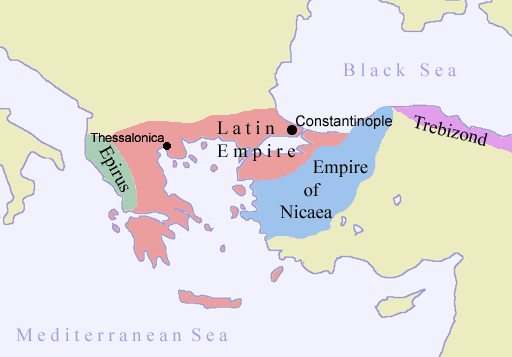
http://upload.wikimedia.org/wikipedia/commons/a/ac/Byzantium1204.png

Ironically, this happened to them at the hands of fellow Christians flying the cross, so I think the Greek people of the time and place must have felt a terrible sense of bewilderment.

Whether or not the people are holding grudges or forgiving, the only thing I can say that the episode actually seems to have been part of a longstanding historical pattern. Call it prejudice if you like, but people typically draw on their experiences when attempting to make decisions for the future.

Some say that those who forget history are bound to repeat it. So we should not kid ourselves, the Orthodox could forgive and forget the episode but will remember it as they consider future relations between the churches. The posters here might interpret that as holding a grudge, but on the other hand it could be considered just plain common sense.

Michael

My information has always been from non-Catholic, non-Orthodox sources, as I think you know. It appears clear to me that during the planning stage, the Franks were diverted from the real purpose of the crusade. Pursuant to the diversion, they were first to attack a Croatian town for the Venetians, then Constantinople for the deposed former emperor of Constantinople. This was because they did not have the funds for transport to the Holy Land. It was a “devil’s bargain” for all concerned, in that the Venetians required the attack on the Croatian town, which brought excommunication down on the Franks, and absolutely no one should have trusted the Venetian Doge, Enrico Dandolo, who had a longstanding grudge against the Byzantines and whose greed was well known, and who had narrowly escaped the massacre of Italians by Greeks years before. The emperor’s son undoubtedly wanted his father’s throne back and, one would think,should have known his countrymen were not going to want to pay for the crusaders’ supplies and send Greek soldiers to the Holy Land with the Franks. Yet he promised those things to some pretty rough people who could be counted on to take it pretty harshly if he reneged. After the Franks reinstated the Greek Emperor, the Greeks should have known better than to renege and attack the Franks outside the walls of Constantinople. Maybe they were appalled at the promised price, but it was a terrible mistake and misjudgment on their part to leave the safety of their walls and attack on the evident assumption that the Franks were so weakened by hunger that they would be slaughtered. The Franks were, as I said, rough customers, and should not have treated the Greeks the way they did when they conquered the city. Even so, in the sack, fewer Greeks were killed, combatants included, than Italians were massacred by the Greeks a few years previously.

In those days all conquerers derived what wealth they could from the conquered territories. That was the nature of both feudalism and empires at the time.

None of the principal actors was without serious blame. But it is wrong to make it out to be a gratuitous Latin attack on Orthodoxy or a religious war, and it is even more wrong to blame the Catholic Church, whose Pope forbade any attack on Christians, but was ignored. It started up as a crusade but ended up being one more awful instance of “power politics” of the time.

Had the Greeks slaughtered the Franks outside the walls of Constantinople, as could have happened, would it seem reasonable for Catholics today to consider that an issue worthy of dividing the churches today? It seems neither reasonable nor likely to me.

 
I am sorry but you are flat out wrong on this issue. Culturally the Eastern Empire was always GREEK even during the earliest years of the empire. The Roman empire was so vast and encompassed so many cultures that even the city of Rome itself was predominantly Greek speaking during the reigns of the Five Good emperors. The Eastern Empire was just as Roman as the empire of the classical age, as the greatest Roman legal achievement came not from Rome but from Constantinople. The levels of education and learning were entirely preserved within the Eastern Empire. Among other cultural achievements. In the west, there was an attempt to totally discredit the Eastern Empire’s claims by elevating the so called “Holy Roman Empire” and the silly idea of “translatio imperium” (sp?). The real fact is that cultures change over time, and when a government’s culture changes over a 1,470ish year time period, that does not mean that is no longer the same regime. And as for it being empire of “solely” greeks. Then you are mistaken in that regard as well. Countless slavic tribes, and other ethnic groups existed within its confines and despite being reduced in size over the years, it retained the rightful claims to many of the territories seized from it, even to the point where at times the crusader states in Palestine were willing to admit that the Emperor was their feudal lord.

Edit
Sorry I forgot to mention that New Advent is not a credible, unbiased source.
Excuse me—Where did I state that the Empire consisted only of Greeks?----PLEASE READ & STOP MISQUOTING!

I totally DISAGREE with your interpretations. Of course, some of them wander totally off the mark and are so tangential to the subject at hand that–though I may agree–I refuse to address these non-sequitors.
 
I don’t mean to be a “wet blanket” and put a damper on discussion, but I can’t stand it and have to say something here.

It never ceases to amaze me that what started out as a good and very civilized thread that actually stayed “on topic” for the first 40-some posts, has gone off in another direction and has degenerated along the way. Tangents are fine, and quite normal, but with Emil3 we have a new topic entirely, not to mentioned an ever increasingly adversarial tone.

The OP was about the sacking of Constantinople by the Crusaders and had nothing at all to do with the fall of Constantinople. Maybe we should try to revert to the topic. If someone wants to discuss the FALL of Constantinople, please open a new thread in a more appropriate forum.
 
Status
Not open for further replies.
Back
Top