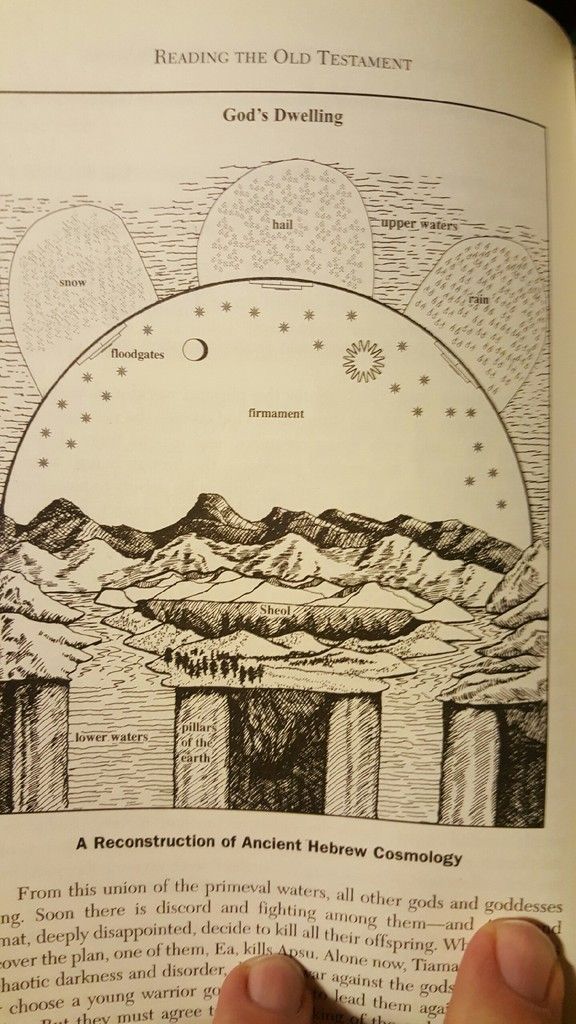
(continued)
Psalm 148 continues in verse 13:
Let them praise the name of the LORD,
for his name alone is exalted;
his glory is above earth and heaven.
If ‘and you waters above the heavens’ of verse 4 was to be understood literally in every sense, the last stanza of verse 13 should of rather had said ‘his glory is above the earth and the waters.’ The sacred scriptures uses the expression ‘heavens and earth’ numerous times as indicating the totality of God’s work of creation and of all creatures. Indeed, the bible begins with “In the beginning God created the heavens and the earth.” As St Basil the Great says, the expression ‘heavens and earth’ are as the extremes of creation. The scriptures do not speak of ‘waters and earth’ as the extremes of creation or as indicating the totality of God’s creation. Accordingly, if ‘the waters above the heavens’ in verse 4 of psalm 148 is understood as corporeal waters, than these waters I believe are to be understood to be in the heavens somewhere and not literally above all the heavens, as we read in Jeremiah 51: 16 “When he utters his [the Lord’s] voice there is a tumult of waters in the heavens.” This is obviously a reference I believe to thunder which occurs amidst storm clouds.
Assuming that the ‘waters above the heavens’ in verse 4 are corporeal waters, these waters would appear to be a reference to the waters placed above the firmament or expanse God made on the second day of creation in Genesis 1. Assuming all this, then I’m of the opinion that these ‘waters’ are simply the waters that rise in vaporous form into the air by evaporation from the waters such as the oceans on the surface of the earth and condenses in the heavens or more specifically earth’s atmosphere (the lower heaven or firmament mentioned in Gen. 1:8) and makes the clouds from which rain falls to the earth. The same goes for the waters above the heavens mentioned in Daniel 3:38 if by waters is understood corporeal elemental waters as we know it such as liquid water whether it be in the liquid or vaporous state.
Psalm 148 continues in verse 7-8:
Praise the LORD from the earth,
you sea monsters and all deeps,
fire and hail, snow and frost,
stormy wind fulfilling his command!
Here the inspired writer praises hail, snow, stormy wind (I think we could include rain here too though he does not expressly mention it) as from the earth. Hail, snow, stormy wind, rain are all atmospheric phenomenon, that is, heavenly phenomenon or at least originate in the heavens. Interestingly, the inspired writer praises these phenomenon from the earth probably to mean that these phenomenon originate or are obviously observed in that heaven immediately above the earth and not in the heavens where the sun, moon, and stars are located. The changeable atmospheric phenomenon of the clouds, rain, hail, snow, and the winds are close to the earth and so St Augustine, commenting on this psalm, says the psalmist praises these phenomenon from the earth as being in that part of the heavens closest to the earth which we call the earth’s atmosphere, which in my opinion is the firmament or heaven God made on the second day of creation in Genesis 1, unlike the seemingly unchangeable nature of the starry heavens (the firmament of the heavens – Gen. 1:14) in which are located the sun and moon as well. St Augustine also comments that the inspired writer praises the atmospheric phenomena of the hail, rain, snow, and stormy winds as from the earth “unless ye think that it raineth from above the stars.” The ‘deeps’ mentioned in verse 7, Augustine interprets as all the watery nature of not only the waters on and in the earth but also the misty nature of the earth’s atmosphere in which are formed the clouds and from which rain, hail, or snow falls to the earth.
“fire and hail, snow and frost,
stormy wind fulfilling his command!” (verse 8).
This is a teaching concerning the providence of God. Natural fires such as forest fires caused by lightening, all the atmospheric phenomena such as the winds, clouds, rain, hail and snow, all of this only occurs at the express command of God “fulfilling his command.”