The Second Day of Creation, Genesis Chapter 1

  • Thread starter Thread starter Richca
  • Start date Start date
Status
Not open for further replies.
I have also recently climbed a mountain, passing through the cloud layer and could look down on a sea of cloud. Did I break the firmament barrier? I have also recently been in an airplane, passing through the cloud layer and could look down on a sea of cloud. Did I break the firmament barrier?
If the waters above the firmament are understood as the waters in the clouds, than the firmament made on the second day which God called heaven is simply the heavens or sky under the clouds and above the earth. Such a firmament is not of the nature of a concrete dam like structure. The air is what holds up the water and water vapor in the clouds until it, i.e, the water molecules, condense to the point where the air cannot no longer support the heavier element water and the water falls to the earth. Can one pass through the air? Absolutely. If one climbs a tall mountain such as Mt. Everest, the air gets thinner and thinner to the point where one cannot survive long without oxygen tanks. And if one boarded a rocket, he/she could pass through and out of the air of the earth’s atmosphere altogether.
 
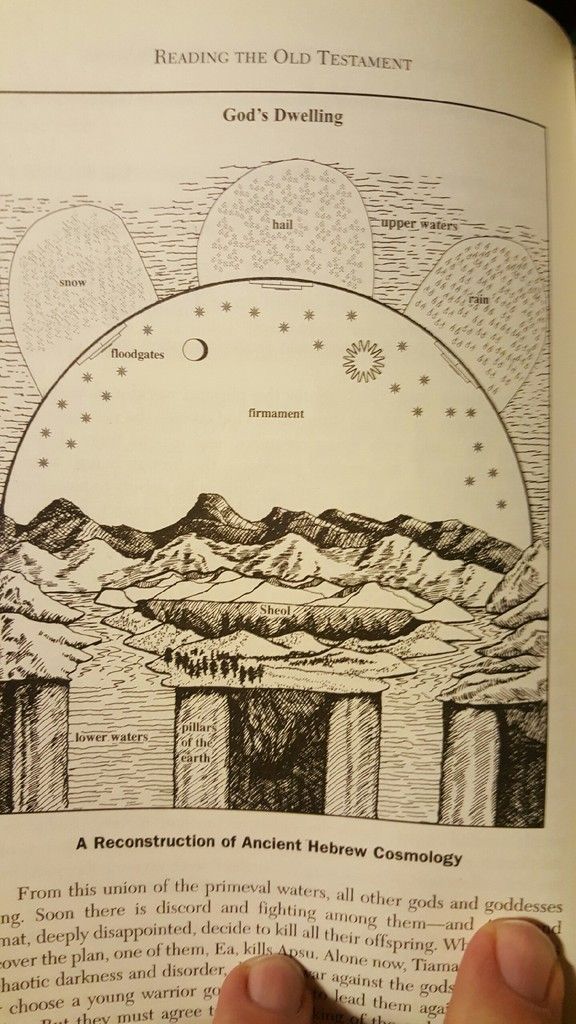
I don’t know if you guys will find this image as interesting as I did the first time I came across it. Very interesting to me when we talk about firmament etc. It is from “Reading the Old Testament” by Lawrence Boadt. Great book and resource.

http://i1328.photobucket.com/albums/w526/brian_mullins1/cosmology_zps4qkvovly.jpg
Yes, I’m familiar with such pictures and theories of ancient Hebrew cosmology. The New American Bible, which I have a copy in my possession, has a similar looking picture to the one you present here from Lawrence Boadt’s book and it is titled The World of the Hebrews. However, I’m not convinced of this hypothesis or of such an interpretation of Genesis 1 or of what can be gathered from the rest of the Sacred Scriptures.

There are a number of things I would like to express here but it would involve a very long post so I think it is best if I take them one at a time and God willing expound on other thoughts in subsequent posts.

For starters, where are the heavens in this picture that God created in Gen. 1:1? “In the beginning God created the heavens and the earth.” The picture is obviously referring to the firmament that God made on the second day – it shows waters above the firmament. As St Thomas expounds, it is the heavens created in the beginning in which it is said in verse 2 “and darkness was upon the face of the deep.” And it is these heavens which are filled with light on the first day when God said “Let there be light…and God separated the light from the darkness. God called the light Day, and the darkness He called Night.”

Now the picture from Lawrence Boadt’s book places day and night, the sun, moon, and stars in the firmament made on the second day. But the text of Genesis 1: 1-5 speaks of heavens, light and darkness, night and day before the firmament that was made on the second day. The heavens, light and darkness, day and night already existed before God made the firmament on the second day! It appears that on the second day God made another heaven for “God called the firmament heaven.” And the purpose of this firmament made on the second day was to separate the waters from the waters (not light from darkness or day from night), the waters that are mentioned in verse 2 which are under the heavens created in the beginning and covering the earth which was also created in the beginning (the waters were also created in the beginning).

“Let there be a firmament in the midst of the waters” (Gen. 1:6), that is, not in the midst of the heavens or in the midst of the earth, but in the midst of that middle or intermediate region or body, namely, the waters covering the earth and under the heavens. The picture presented in this interpretation, then, after the second day of God’s work is that we have the earth still covered by water, the firmament or heaven, waters, the heavens in which there is day and night ( and which God will place the sun, moon, and stars on the fourth day, these heavens Moses also calls the ‘firmament of the heavens’). If we take the waters above the firmament to be the waters in the clouds, then we have a picture or description that corresponds to reality, the structure of the corporeal creation as we view it from earth. This interpretation of the firmament made on the second day of creation was the view of St Basil the Great and St Hilary of Poiters. As I mentioned in an earlier post, St Augustine recommends it even though he also has an exegesis of Genesis 1 peculiarly his own. The exegesis of Gen. 1: 1-5 I have presented above is taken from St Thomas Aquinas’ Summa Theologica which in my opinion is simply what the text of Scripture says.
 
If the waters above the firmament are understood as the waters in the clouds, than the firmament made on the second day which God called heaven is simply the heavens or sky under the clouds and above the earth. Such a firmament is not of the nature of a concrete dam like structure. The air is what holds up the water and water vapor in the clouds until it, i.e, the water molecules, condense to the point where the air cannot no longer support the heavier element water and the water falls to the earth. Can one pass through the air? Absolutely. If one climbs a tall mountain such as Mt. Everest, the air gets thinner and thinner to the point where one cannot survive long without oxygen tanks. And if one boarded a rocket, he/she could pass through and out of the air of the earth’s atmosphere altogether.
I believe the firmament is the space between here and the edge of the universe. If the edge of the universe is reflective, some things would appear beyond that edge, an illusion of reflecting light. I don’t particularly like the reconstruction of Jewish thought. It is just reconstructing a preconceived notion.
 
I enjoyed St. Augustine’s thoughts in Confessions. He talks at great length about those opening words of Genesis at some point in books 10 through 13. He proposes that what was meant by Heaven* in the beginning* is the immaterial, such as angels, but what is intended by the second use is the sky. There’s much more, of course, as he basically suggests Prime Matter as what’s suggested by “earth” after* in the beginning*, and then matter with form later. And he offers alternatives and basically says if we agree on the basic dogma that God created all things and that nothing pre-existed him and are theologically correct, we shouldn’t get in angry debates over it.

But chapter one of Genesis is not a literal account of the history of creation, either.
 
Light and darkness are often symbols of good and evil in the Scriptures. When God said ‘Let there be light’ St. Augustine says that, that is when God created the angels. And when he created a division between the light and the dark, was when the fall of the angels occurred.
 
Hi,

Thank you for your exegesis. It’s rare to hear these kinds of things discussed today.

I’ll take you up here.

By “heavens” and “earth”, I think we are given to understand the angels, or the invisible things (“heavens”), and by “earth”, matter, and the visible things. To back this up, I appeal to the Nicene Creed, which declares “I believe in one God, the Father Almighty, maker of heaven and earth, of all things visible and invisible”.

By water, we are given to understand formless matter; in the same way that water fills whatever it’s contained in and takes its shape, so the formless matter takes the form of whatever God gives it. This explanation is also in perfect harmony with modern science, which holds that for about 400,000 years after the Big Bang, there were no stars, only a haze of hydrogen and helium atoms. This sufficiently explains Gen. 1:2.

Now, the Hexaemeron proper.

Light in this sense, is meant to indicate that visible things were created, since light makes things visible. Thus just as in perfect darkness nothing can be seen, so that everything is invisible, when light is created it indicates matter’s creation (as well as space).

Now, considering what was said above about waters, the waters do not mean waters as such, but implies (relatively) formless matter, which was created the day before. This formless matter of hydrogen and helium atoms is separated into nebulae, which is what we are given to understand by the separation of waters above the firmament, namely empty space, from those below, namely the nebulae.

But, you will ask, surely this can’t be the literal sense of Scripture, since there is no way that Moses (or the inspired redactor) knew about these things. I answer: indeed this is not the literal sense; the literal sense of the creation week is an anthropomorphism designed to impress upon the readers and hearers that God created the world and all things in it. But, since God is the principal author of Scripture, it certainly can’t be denied that He could use an account, not intended to teach cosmology per se, to have a hidden sense which does accord with modern cosmology.

Anyway, I hope this was helpful,
Benedicat Deus,
Latinitas
 
40.png
Nyika:
Does any body know what the Catholic position is regarding who wrote the book of Genesis?
 
Does any body know what the Catholic position is regarding who wrote the book of Genesis?
The most common position I’ve seen is that Moses probably had some hand in the original documents/oral tradition but that it was likely a combination of different writers (called the Yawhist and the Priestly sources) that compiled the information together in what we know as the modern book of Genesis. That is the information could indeed date back to moses time in snippets/partial scrolls/etc but that it was unlikely that Moses wrote the book itself as we see it today.

Gotta remember that in those times it was not uncommon for a person to continue writing a book after the original author passed on and still attribute it to that author because it was ‘their teaching.’ Some even attribute that continued writing to Ezra/Joshua though we have no proof of that, just theories.
 
Thank you bmullins for the helpful information you have sent regarding my query on the authorship of Genesis! Nyika


I want to thank bmullins for supplying us with the picture above and his reference to Lawrence Boadt’s book. At some point in this thread, I was planning on posting a similar picture and commenting on it but bmullins beat me to it, thank you. I have some more comments I’d like to share concerning the conception of ancient Hebrew cosmology as presented by this picture or others like it. As I said in my previous post, I’m famaliar with the conception of ancient Hebrew cosmology as presented by this picture. The New American Bible of which I have a copy has a similar picture in it titled ‘The World of the Hebrews’. This particular interpretation and conception of the biblical text is not uncommon today among at least some modern biblical scholars. At the same time, it is not universally accepted. As I mentioned in my opening post, some of the Fathers of the Church understood by the firmament made on the second day which God called heaven the whole corporeal and visible heavens in which God placed the two great lights and the stars in on the fourth day of creation. Accordingly, as the firmament made on the second day separated waters from below and above the firmament, they also held there must be waters above the visible heavens whatever the nature of these waters may be. This opinion is similar to the view of some of the modern biblical scholars as presented by the picture above. There is a difference though in that none of the fathers who held this view that I know of thought the waters above the starry heavens to be the source of the waters and snow that fall from the clouds.

The idea that rain, hail, or snow falls from above the starry heaven to the earth as presented by the above picture and others like it is what I would like to comment on here. I think that this understanding and interpretation of Genesis 1 possibly supported by a few other passages in the Bible is questionable. For one thing, I think it is simply contrary to sense observation if one has but a little knowledge and experience of rain and thunderstorms. For example, when a storm breaks and there are clearings in the clouds, one can see a clear sky above the clouds and thunderheads even though he/she can see it raining a little off in the distance. A previous poster remarked that he recently took a climb to a mountain top to which he looked down on a sea of clouds in which it may have been raining on the way up but with a clear, sunny and dry sky on top of the mountain above the clouds. I think it would be reasonable to assume that not a few ancients had this same experience.

There are numerous passages in the Bible about clouds and rain and that the clouds are filled with water that falls to the earth as rain and that God is the cause of both the clouds and the rain water falling from the clouds. Obviously, the association of clouds and rain is founded on simple sense observation of the phenomenon. On the other hand, there are but a couple of passages in the Bible which the biblical scholars, who hold the opinion of the waters above the starry heaven as the source of the rains, generally cite in advance of this opinion. And this depends on the interpretation of these few passages whether the sacred author is speaking literally or metaphorically and figuratively. . For example, “the windows of heaven (or of the heavens)” mentioned in the narrative about the Flood in Genesis 8. In Malachi 3:10, opening the ‘windows of heaven’ is used figuratively or as an image or metaphor of God’s blessing. In Isaiah 24:18, the “windows of heaven” are ‘opened’ as a metaphor, figure, or image of God’s judgement upon the earth and its inhabitants.
 
(continued)

Another consideration is the following. The firmament God made on the second day in the midst of the waters separated waters from waters. God separated by means of the firmament “the waters which were under the firmament from the waters which were above the firmament.” Now, if it is understood that the waters above the firmament are waters above the starry heavens and also that these waters above the starry heavens are the source of the waters that fall from the clouds, we appear to have not two bodies of waters, but three, namely, the waters on and in the earth, the waters in the clouds, and the waters above the starry heavens. This conception does not seem to fit with the making of the firmament in Genesis 1: 6-8. Yet another consideration is that how does water falling from above the starry heavens pass through or by the sun when it rains during daytime without becoming completely vaporized before it reaches the earth? Obviously, it can rain during daytime because the sun is shining upon the earth above and through the clouds. Still yet another consideration is that if water falls from above the starry heavens through windows, trap doors, or floodgates, we might then have a ‘river’ of water falling to the earth such as being under a waterfall but not raindrops.

I believe such considerations that I have mentioned in this post would not have been beyond the knowledge and consideration of the inspired writer of Genesis 1. Genesis 1 was written very intelligently and in an organized manner, not hastily and thoughtlessly put together. Of course, we hold it to be the inspired word of God, the principle author being God himself. The human author of Genesis 1 was inspired and infused with supernatural and theological wisdom, as well as, I believe, he was infused with natural wisdom concerning the creation. Genesis 1 is one of the most beautiful pieces of literature ever written and for us believers, one of the most important theologically, as the very beginning of the Bible, the word of God, commences with those most solemn words “In the beginning God created the heavens and the earth.”

I believe the inspired author of Genesis 1 who very well may have been Moses probably knew that rain water does not fall from above the starry heavens though God is the cause and maker of the clouds from which the rain water falls. What are we to make then of that interpretation suggested by the picture above? The inspired author could have been playing as it were to popular ignorance (if indeed the populace held to such a view as rain water falling from above the starry heavens, this I believe is a questionable theory concerning the belief of the populace in itself), and his main teaching here is that God is responsible for the phenomenon of rain, snow, hail and such and God’s work of day two expresses this teaching. This interpretation might be called symbolic or figurative in that the inspired author is using ‘figurative’ language or a ‘colorful’ image to express a truth. At the same time, most biblical scholars, the fathers of the Church, saints and doctors of the Church, and in general the faithful hold and understand that the firmament God made on the second day is something that God literally and actually made just as He created the heavens and the earth and everything else mentioned in Genesis 1.

This brings us to a literal interpretation of the work of the second day which as I have mentioned in previous posts can be understood to simply be the earth’s atmosphere or the expanse of the sky between the waters on the earth and the waters in the clouds. This interpretation could be understood in that the inspired author wrote Genesis 1 in such a way that God causes the rain to fall from the clouds as indeed it does and not actually from the starry heavens.
 
(continued)

There may also be a spiritual or mystical interpretation of the waters above the firmament as it were. Accordingly, some fathers of the Church saw in the waters above the firmament or the starry heavens, a wholly aqueous or crystalline heaven, not of liquid water but called aqueous or crystalline on account of it being wholly transparent and placed just under the ‘empyrean’ heaven (or under God’s throne) which empyrean heaven they considered to be the abode of the angels and saints. These fathers probably got this idea from some texts of scripture such as in Rev. 4: 6 “In front of the throne [the throne of God] was something that resembled a sea of glass like crystal.” Also in Rev. 22: 1-2:
“Then the angel showed me the river of life-giving water,* sparkling like crystal, flowing from the throne of God and of the Lamb down the middle of its street. On either side of the river grew the tree of life* that produces fruit twelve times a year, once each month; the leaves of the trees serve as medicine for the nations.”
This text of Rev. 22: 1-2 appears to have resemblances to Eden and the garden of Eden or paradise of Genesis 2 in which God placed our first parents, Adam and Eve. Gen. 2:10 says “A river flowed out of Eden to water the garden, and there it divided and became four rivers.”

St Augustine said that Genesis 1 contains many mysteries and we know that Holy Scripture whose principle author is the Holy Spirit can have a multiplicity of meanings (cf. CCC#115-118). In this connection about the waters, we may also consider the light that God created on the first day that lit up the heavens and thus the waters under the heavens which at this time covered the earth, though it is said that God made the two great lights (the sun and moon) and stars on the fourth day. We read in Rev. 21:23, “The city [the new Jerusalem] had no need of sun or moon to shine on it, for the glory of God gave it light, and its lamp was the Lamb.” Is there some kind of connection or spiritual or mystical meaning between the light God created on the first day of creation and the light shining on the new Jerusalem, the holy city coming down out of heaven which “had no need of the sun or moon to shine on it, for the glory of God gave it light”? Something to consider I suppose.

Blessings and peace,
Richca
 
Translations of different bibles for Genesis 1:20:

And God said, “Let the waters bring forth swarms of living creatures, and let birds fly above the earth across the firmament of the heavens.” (Revised Standard Version – Catholic Edition).

Then God said: Let the water teem with an abundance of living creatures, and on the earth let birds fly beneath the dome of the sky. (New American Bible)

And God said, “Let the waters swarm with swarms of living creatures, and let birds fly above the earth across the expanse of the heavens.” (English Standard Version)

And God said, ‘Let the waters be alive with a swarm of living creatures, and let birds wing their way above the earth across the vault of heaven.’ (New Jerusalem Bible)

Then God said, “Let the waters abound with an abundance of living creatures, and let birds fly above the earth across the face of the firmament of the heavens.” (New King James Version)

God also said: Let the waters bring forth the creeping creature having life, and the fowl that may fly over the earth under the firmament of heaven. (Douay – Rheims )

Dixit etiam Deus: Producant aquæ reptile animæ viventis, et volatile super terram sub firmamento cæli. (Clementine Vulgate)

Notice that the New King James Version is the only bible in these various translations that uses the word ‘face’ in Gen. 1:20. The Douay-Rheims which is a translation of the Latin Vulgate (here I show the text from the Clementine Vulgate) uses the word ‘under’ to which follows ‘the firmament of heaven.’ The Douay-Rheims and Vulgate, I believe, carry the meaning of the word ‘face’ in the New King James Version. The NAB has ‘beneath’ which carries the meaning of ‘under’ as in the Douay-Rheims. However, the NAB appears to use ‘beneath’ in a different context as can be seen by a reading of their whole translation of Genesis 1 than the’under’ of Douay-Rheims/Vulgate or ‘face’ of the NKJV.

Why does the New King James Version of the Bible translate Gen. 1:20 “and let birds fly above the earth across the face of the firmament of the heavens.” ? Interestingly, the same word in the Hebrew text (paniym) that is translated face in Gen. 1:2 in the NKJV and the RSV “and darkness was upon the face of the deep, and the Spirit of God was moving over the face of the waters” is also used here in Gen. 1:20.

The NJB appears to translate ‘paniym’ in Gen. 1:2 as ‘over.’ The NAB as ‘covered’ and ‘over’. The ESV ‘over the face’. The Douay-Rheims ‘face’ and ‘over’ which appears to be the same as the Vulgate.
 
(continued)

If the translators of the bibles listed above were consistent in their translations then
it would appear, I believe, that the birds God made from the waters in Gen. 1:20 fly above the earth under, beneath, in front of, or across the face of the firmament of the heavens. However, as you can see from the translations above, it is only the NKJV, Douay-Rheims, and Vulgate where one can understand this. Although, the NAB does say ‘beneath’ followed by ‘the dome of the sky,’ it carries a different meaning than the NKJV and Douay-Rheims/Vulgate, as can be seen by their use of ‘dome’ and ‘sky’ in earlier verses, by their footnotes, and in general their whole translation of Genesis 1.

The point here is if birds fly above the earth under, in front of, beneath, or across the face of the firmament of the heavens, than what heaven are they flying in? In Gen. 1:26,28, 30, the birds are called ‘the birds of heaven (or of the heavens). Most English translations say ‘the birds of the air’, but the same Hebrew word used for heaven or heavens such as in Gen. 1:1 is also used here in Gen. 1: 26, 28,30. The Clementine Vulgate uses the latin word for heaven here but the Douay-Rheims translates it as ‘air.’

I think a reasonable answer as to what heaven the birds fly in is simply the firmament or heaven God made on the second day which is under the ‘firmament of the heavens’ which on the fourth day God placed the sun, moon, and stars. The birds fly above the earth and also the waters on the earth which waters on the earth are the waters below or under the firmament God made on the second day. The birds fly and adorn that region of the heavens that God made on the second day. The phrase ‘the firmament of the heavens’ we find in Genesis 1 on day four. The work of day four corresponds to the heavens God created in the beginning in verse 1 and to which He created the light and separated the light from the darkness and evening and morning followed, one day. God’s work on the fourth day is a work of adornment, that is, filling these heavens with objects, namely, the sun, moon, and stars.

God’s work on day five is also a work of adornment (in earlier posts I have mentioned what is meant by the work of adornment from St Thomas Aquinas and which can be found also in some of the links to articles I have provided). The work of day five corresponds to the work of day two. On day five, God fills the region of the heavens or heaven immediately above the earth with the birds (the firmament of day two) and He also populates the waters under the firmament, that is the waters on the earth, with fish, whales, and all kinds of marine animals. On day six, God creates the land animals out of the earth to populate and adorn the dry land and finally, of course, man and woman . Day six corresponds to day three when the dry land appeared.

This analysis of Gen. 1:20 I have presented here could be understood I believe to support that interpretation of the firmament God made on the second day and the waters above the firmament as simply being the waters in the earth’s atmosphere and clouds which are below ‘the firmament of the heavens.’
 
We had a rain storm pass through here in northern CA the last few days, Sunday thru Tuesday actually. Yesterday, as I was driving home from work I was looking up at the clouds and I continued to contemplate them when I got home. This was the back end of the storm. I was looking at how high they were in the sky, their movements, colors, and shapes. I was considering the sky or heaven underneath the clouds, such a vast expanse. The sky in the east was as blue as can be, the sun was setting in the west. I was contemplating all this marvel of God’s creation. I was considering how amazing are the clouds! Liquid water in the form of water vapor rises from the earth up into the heavens and makes this spectacular phenomenon of the clouds floating across the heavens. The clouds are water -or hold water- in a different form then the water we see in the seas and oceans. Some of the clouds Tuesday evening I was looking at were of the white puffy kind in a variety of different shapes. Truly amazing how the waters rise from the earth to form the spectacular and beautiful clouds.

Anyway, I mention this because I like to look up at the heavens and around the earth when I think about the creation narrative of Genesis 1. The creation account in Genesis 1 is about the real world, the world we live in and see. I like to go outside and relate one or more of the days of the creation narrative in Genesis 1 to what I see and observe. I’ve been focusing lately on God’s work on the second day which is why I mention the beautiful clouds in the first paragraph. Since one of the interpretations of the firmament and the waters above the firmament mentioned in Genesis 1: 6-8 involves the waters in the clouds and the earth’s atmosphere which atmosphere we also call sky or in the Bible heaven, I look at these phenomena and try to see if it fits the narrative and I also consider what the ancient Hebrews might have thought about clouds and rain and its relation, if any, to Genesis 1: 6-8 when they observed the same phenomena.

Here is a bit of information that I found quite interesting on the internet yesterday evening. A study conducted by NASA from 2002 – 2015 from satallite observations found that at any given moment, two-thirds of the earth is covered by clouds. Incidentally, this is the same percentage of the earth that is covered by the seas or oceans.
Now read Genesis 1:6-8:
And God said, “Let there be a firmament in the midst of the waters, and let it separate the waters from the waters.”
And God made the firmament and separated the waters which were under the firmament from the waters which were above the firmament. And it was so.
And God called the firmament Heaven. And there was evening and there was morning, a second day.

I just thought the results of the study from NASA was rather fascinating as I was thinking about the clouds and sky I was looking at Tuesday evening and Genesis 1:6-8.

Link to study from NASA:
news.discovery.com/earth/weather-extreme-events/two-thirds-of-the-earth-is-covered-by-clouds-150511.htm

Related link from NY Times:
nytimes.com/interactive/2012/05/01/science/earth/0501-clouds.html?_r=0
 
Praise the LORD!
Praise the LORD from the heavens,
praise him in the heights!
Praise him, all his angels,
praise him, all his host!
Praise him, sun and moon,
praise him, all you shining stars!
Praise him, you highest heavens,
and you waters above the heavens! (Psalm 148: 1-4)

Today, I would like to comment on the second part of verse 4 “and you waters above the heavens!” At first glance, this text might seem to lend credence to the opinion of God’s work on the second day of creation in Genesis 1 that there are waters above the starry heavens. As I read and meditated on this psalm and the text ‘and you waters above the heavens” it also appeared to me at first glance that the inspired psalmist is literally saying that there are waters above the heavens. As I was thinking about this, it dawned on me one day that the text “and you waters above the heavens” is going to need some explanation and that it is not going to make sense to take this passage of scripture absolutely literally in every sense. What I mean by this is this, if we take “and you waters above the heavens” literally in every sense, than we have waters above the abode of the angels and even above the throne of God. For God is said to dwell in heaven or the heavens whether by heaven we understand God’s abode above all creation and above all the heavens or the dwelling or abode of God in the created heavens as sometimes the scriptures speak of such as in Isaias 66:1-2:
Thus says the LORD:
“Heaven is my throne
and the earth is my footstool;
what is the house which you would build for me,
and what is the place of my rest?
All these things my hand has made,
and so all these things are mine,
says the LORD.

Jesus alludes to this verse in the Sermon on the Mount in Matt. 5:34-35.

And in Psalm 103:
“The Lord has established His throne in the heavens, and his kingdom rules over all” (verse 19).
Again in Psalm 115:
“Our God is in the heavens; he does whatever he pleases” (verse 3).

For God not only transcends all of his creation, the whole universe whether things visible or invisible, he encompasses it as St Paul says “In Him, we live and move and have our being, ” but God is also in his creation, for God is everywhere. In Genesis 1:2, it is said “and the Spirit of God was moving over the face of the waters.”

So I believe the question that needs to be asked when we read “and you waters above the heavens” in psalm 148 is what heaven or heavens is the inspired writer referring too because it is not going to make sense that there are created waters above the throne of God who is in heaven or above the angels too I believe who are mentioned first in this psalm as occupants of the heavens, presumably the highest heavens. Another question that could be considered is what exactly does the inspired author of psalm 148 mean by ‘waters’? Is he referring to corporeal waters such as the element water that we know of? (The apostle John in the book of Revelation chapter 17 sees a vision of the great harlot seated upon many waters which the angel tells him “The waters that you saw, where the harlot is seated, are peoples and multitudes and nations and tongues”). The ‘waters above the heavens’ are a part of God’s creation and his works for the psalm continues in verse 5 “Let them [the heavens and all the works of God mentioned in verses 1-4, angels, etc.] praise the name of the Lord! For he commanded and they were created.”
 
(continued)

Psalm 148 continues in verse 13:
Let them praise the name of the LORD,
for his name alone is exalted;
his glory is above earth and heaven.

If ‘and you waters above the heavens’ of verse 4 was to be understood literally in every sense, the last stanza of verse 13 should of rather had said ‘his glory is above the earth and the waters.’ The sacred scriptures uses the expression ‘heavens and earth’ numerous times as indicating the totality of God’s work of creation and of all creatures. Indeed, the bible begins with “In the beginning God created the heavens and the earth.” As St Basil the Great says, the expression ‘heavens and earth’ are as the extremes of creation. The scriptures do not speak of ‘waters and earth’ as the extremes of creation or as indicating the totality of God’s creation. Accordingly, if ‘the waters above the heavens’ in verse 4 of psalm 148 is understood as corporeal waters, than these waters I believe are to be understood to be in the heavens somewhere and not literally above all the heavens, as we read in Jeremiah 51: 16 “When he utters his [the Lord’s] voice there is a tumult of waters in the heavens.” This is obviously a reference I believe to thunder which occurs amidst storm clouds.

Assuming that the ‘waters above the heavens’ in verse 4 are corporeal waters, these waters would appear to be a reference to the waters placed above the firmament or expanse God made on the second day of creation in Genesis 1. Assuming all this, then I’m of the opinion that these ‘waters’ are simply the waters that rise in vaporous form into the air by evaporation from the waters such as the oceans on the surface of the earth and condenses in the heavens or more specifically earth’s atmosphere (the lower heaven or firmament mentioned in Gen. 1:8) and makes the clouds from which rain falls to the earth. The same goes for the waters above the heavens mentioned in Daniel 3:38 if by waters is understood corporeal elemental waters as we know it such as liquid water whether it be in the liquid or vaporous state.

Psalm 148 continues in verse 7-8:
Praise the LORD from the earth,
you sea monsters and all deeps,
fire and hail, snow and frost,
stormy wind fulfilling his command!

Here the inspired writer praises hail, snow, stormy wind (I think we could include rain here too though he does not expressly mention it) as from the earth. Hail, snow, stormy wind, rain are all atmospheric phenomenon, that is, heavenly phenomenon or at least originate in the heavens. Interestingly, the inspired writer praises these phenomenon from the earth probably to mean that these phenomenon originate or are obviously observed in that heaven immediately above the earth and not in the heavens where the sun, moon, and stars are located. The changeable atmospheric phenomenon of the clouds, rain, hail, snow, and the winds are close to the earth and so St Augustine, commenting on this psalm, says the psalmist praises these phenomenon from the earth as being in that part of the heavens closest to the earth which we call the earth’s atmosphere, which in my opinion is the firmament or heaven God made on the second day of creation in Genesis 1, unlike the seemingly unchangeable nature of the starry heavens (the firmament of the heavens – Gen. 1:14) in which are located the sun and moon as well. St Augustine also comments that the inspired writer praises the atmospheric phenomena of the hail, rain, snow, and stormy winds as from the earth “unless ye think that it raineth from above the stars.” The ‘deeps’ mentioned in verse 7, Augustine interprets as all the watery nature of not only the waters on and in the earth but also the misty nature of the earth’s atmosphere in which are formed the clouds and from which rain, hail, or snow falls to the earth.

“fire and hail, snow and frost,
stormy wind fulfilling his command!” (verse 8).

This is a teaching concerning the providence of God. Natural fires such as forest fires caused by lightening, all the atmospheric phenomena such as the winds, clouds, rain, hail and snow, all of this only occurs at the express command of God “fulfilling his command.”

 
Status
Not open for further replies.
Back
Top