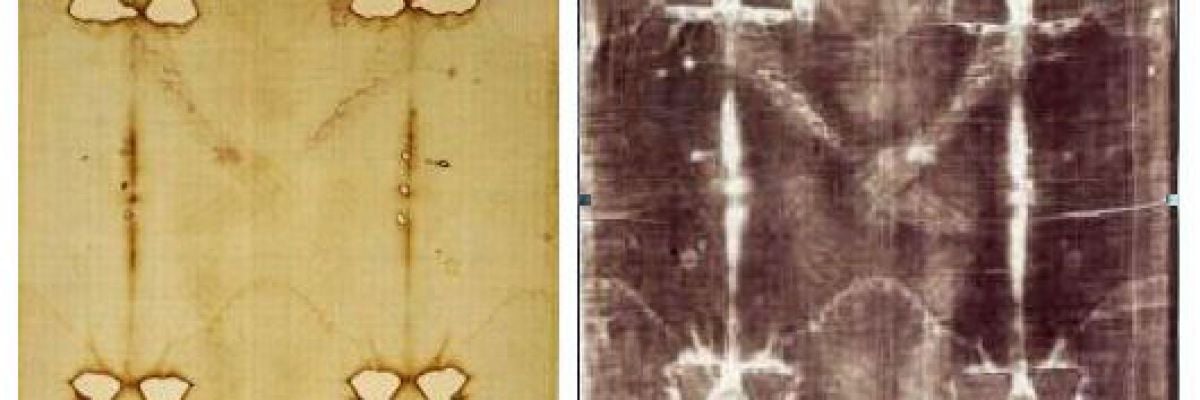
The Shroud of Turin: What's Your Opinion?

  • Thread starter Thread starter TheOldColonel
  • Start date Start date
Status
Not open for further replies.
My opinion is thats its a medieval man who looks a bit like Jesus
How, may I ask, do you have any idea what Jesus looked like?

St. Augustine wrote, "The physical face of the Lord is pictured with infinite variety by countless imaginations . "
 
Last edited:
Both shroud and Mandylion are listed separately in various lists of relics sent to France. Almost every ‘eye-witness’ description of the Mandylion is worded in a way that cannot apply to the Shroud.
The idea that the real Mandylion was sent to a French Museum where it languished and then was just forgotten about has been dismissed by sindonologists. The Holy Mandylion was the most valued relic in the Orthodox Church, and it could not have been treated in this manner by any Christian nation. What was sent to France was undoubtedly an icon of the Mandylion (and probably not a very good one.)

As for your second statement, that is patently untrue and, FYI, is why I made my earlier complaint about misrepresentations.
 
One has to remember that the Byzantine iconographers had only the positive image in the Shroud’s face to work from. A well known 11th century Mandylion icon bears a remarkable similarity to the Shroud’s face with long hair, a thin and long nose, a short beard, eyes wide open (as they appear to be on the positive image), etc. After the Mandylion was lost to the Orthodox Church, Mandylion icons became more stylized with the more oval face that you mention. Many of these icons were made in Russia, and they are still being made today without the presence of the Mandylion’s image for guidance.
Either Byzantine painters copied what they saw (or what someone else had seen) or they didn’t. I don’t immediately recognise the 11th image you refer to. It is monochrome or in full colour? Does it show the blood flows? Is the moustache full and bushy or thin and droopy?
 
What’s more John says that they had actually rowed three or four miles. Nevertheless, this information is still not enough to determine how far they were from shore or how far Jesus walked.
The question was if the disciple’s boat had been so close to the shore that Jesus’ walking on water could have been some kind of magician’s illusion. It was not about exactly how far from shore that boat was. Isn’t “three or four miles” good enough for you?
 
Does it show the blood flows?
When present day artists make a rendition of Jesus’ face from the Shroud, they often do not include the blood flows or the cheek bruises. For one to insist on these features on a Mandylion icon is not correct, in my opinion.
 
Last edited:
The idea that the real Mandylion was sent to a French Museum where it languished and then was just forgotten about has been dismissed by sindonologists. The Holy Mandylion was the most valued relic in the Orthodox Church, and it could not have been treated in this manner by any Christian nation. What was sent to France was undoubtedly an icon of the Mandylion (and probably not a very good one.)
Are you sure? Mark Guscin and Mark Oxley are sindonologists who have studied the Mandylion in some detail. It is fairly clear that its importance faded while it was in Constantinople, such that even the name Mandylion is largely replaced by a less ceremonial word like towel or sweat-cloth. Miraculous images from Edessa were less important than things which had actually touched the body of Christ, especially things which had been discovered by Byzantine queens, of which the cross and nails were much more important. Neither the Mandylion nor the burial cloths of Christ are given prominent mention in the lists of relics prepared by, say, Nicholas Mesarites or John Comnenos.
 
When present day artists make a rendition of Jesus’ face from the Shroud, they often do not include the blood flows or the cheek bruises. For one to insist on these features on a Mandylion icon is not correct, in my opinion.
No, that won’t do. I’m not talking of pictures of Jesus, but pictures of the Mandylion. The copies of the Mandylion were not “renditions of Jesus’ face”, they were copies of the Mandylion. If they were not copies of the Mandylion, then there is no way of knowing what it looked like, and no evidence to suggest it looked anything like the Shroud.
 
Prof. Guscin is among the most ardent supporters of the idea that the Shroud of Turin and the Image of Edessa are one and the same. Thank you for mentioning his name.
 
40.png
undead_rat:
When present day artists make a rendition of Jesus’ face from the Shroud, they often do not include the blood flows or the cheek bruises. For one to insist on these features on a Mandylion icon is not correct, in my opinion.
No, that won’t do. I’m not talking of pictures of Jesus, but pictures of the Mandylion. The copies of the Mandylion were not “renditions of Jesus’ face”, they were copies of the Mandylion. If they were not copies of the Mandylion, then there is no way of knowing what it looked like, and no evidence to suggest it looked anything like the Shroud.
Boy, you really lost me me there. The Image of Edessa is the face of Jesus “made without hands,” i.e. miraculous. Now if a painter makes a rendition of the Image of Edessa, he is essentially making a painting of Jesus’ face. This is exactly what I mean about “obfuscation.”
 
Prof. Guscin is among the most ardent supporters of the idea that the Shroud of Turin and the Image of Edessa are one and the same. Thank you for mentioning his name.
Eh? I know Guscin’s work quite well, and he explicitly refuses to make any such connection. Can you point out somewhere where he is an ‘ardent supporter’ of it?
Boy, you really lost me me there. The Image of Edessa is the face of Jesus “made without hands,” i.e. miraculous. Now if a painter makes a rendition of the Image of Edessa, he is essentially making a painting of Jesus’ face. This is exactly what I mean about “obfuscation.”
I’m sorry I confused you. Let’s try again. Some artists depict the person of Jesus. He is usually clothed. He may be sitting down or standing up. He may be holding a book and/or blessing people with his hands. What his face looks like is up to the artist, who may have derived, but not necessarily copied, it from other sources.
Other artists depict the Mandylion. It is usually shown as a cloth, with the disembodied face of Jesus on it. In this, they are not making something up, they are depicting an actual object, which was still extant and occasionally displayed. As such, their depiction of the face could not be drawn from imagination, or loosely derived, it had to be what the face actually looked like. If they painted a full colour face, everyone who knew the real thing would know that they had got it wrong. If they omitted the bloodstains, everyone would know that they were being dishonest in their portrayal of the Mandylion.

It’s not impossible that every single picture of the Mandylion was painted by a man who had not actually seen it, or who had been ordered to misrepresent it. But if it is misrepresented, then there is no way of knowing what it really looked like, and no basis for saying it was anything like the Shroud.

Is that clearer?
 
Eh? I know Guscin’s work quite well, and he explicitly refuses to make any such connection. Can you point out somewhere where he is an ‘ardent supporter’ of it?
Sir, you might know Prof. Guscin’s work, but you obviously do not known the man. Mark Guscin’s publications are scholarly works regarding the Image of Edessa, and, on the advice of his colleages, he refrains from injecting his strong personal opinions into his academic research.
 
I confess I have only met Mark Guscin once, at a Shroud conference last year, but he was concentrating on the sudarium of Oviedo at the time and we did not mention the Mandylion. If you know his opinions better, then I defer to your knowledge of them. However, I continue to disagree with them.
 
Other artists depict the Mandylion. It is usually shown as a cloth, with the disembodied face of Jesus on it. In this, they are not making something up, they are depicting an actual object, which was still extant and occasionally displayed. As such, their depiction of the face could not be drawn from imagination, or loosely derived, it had to be what the face actually looked like. If they painted a full colour face, everyone who knew the real thing would know that they had got it wrong. If they omitted the bloodstains, everyone would know that they were being dishonest in their portrayal of the Mandylion.
You forget that the artists who used the Image of Edessa (made without hands) may have known that Jesus had been an actual living human being with some kind of color in His face. Therefore they would add that color even though what they were observing was a monochome sepia. Furthermore, our present knowledge that the Image of Edessa was actually a bloody burial cloth was not known to the general public or, perhaps, even to the iconographers themselves.
Byzantine records indicate that the face on the Image of Edessa was difficult to make out and had a “watery” quality. This perfectly describes the facial image on the Shroud of Turin. Your arguement that the Image of Edessa must have been in color without blood stains because that is what its icons look like is facitious at best.
 
By agreeing that none of the reproductions of the image of Edessa are accurate, you necessarily agree that you don’t know if the image looked like the Shroud.
Your arguement that the Image of Edessa must have been in color without blood stains because that is what its icons look like is facitious at best.
No. My argument is that if the image of Edessa was the Shroud, then it was in monochrome and with bloodstains. There is no evidence to suggest that this was the case. Quite the opposite, in fact.
 
Last edited:
Two articles about the shroud: One a 2010 article by Mary Jo Anderson:


And another by Todd Aglialoro in 2013:

 
If it is a fake, it is a more advanced technique than what we can replicate today.
 
If it is a fake, it is a more advanced technique than what we can replicate today.
Maybe aliens from another planet created it. No, joking. I think it’s real, but it seems too good to be real.
 
Status
Not open for further replies.
Back
Top