The Vulgate

  • Thread starter Thread starter KatholikosMercy
  • Start date Start date
Status
Not open for further replies.
K

KatholikosMercy

Guest
Vulgate

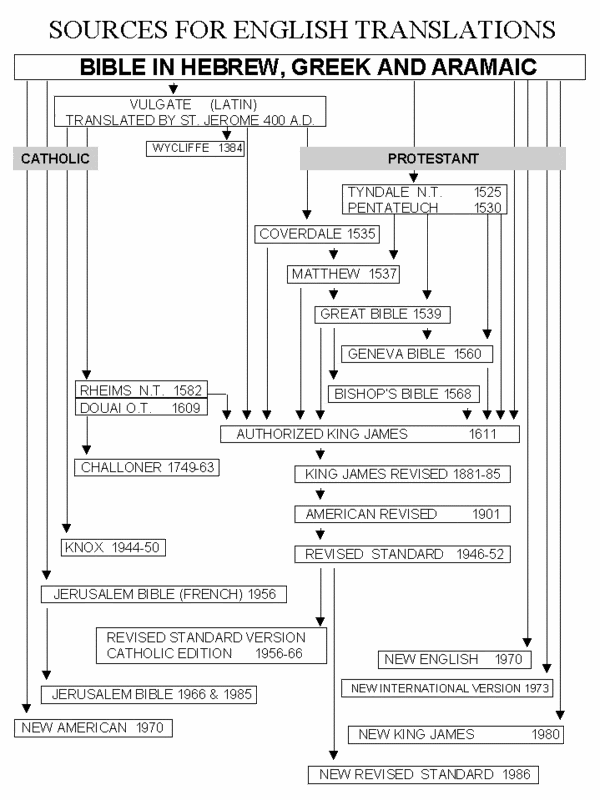
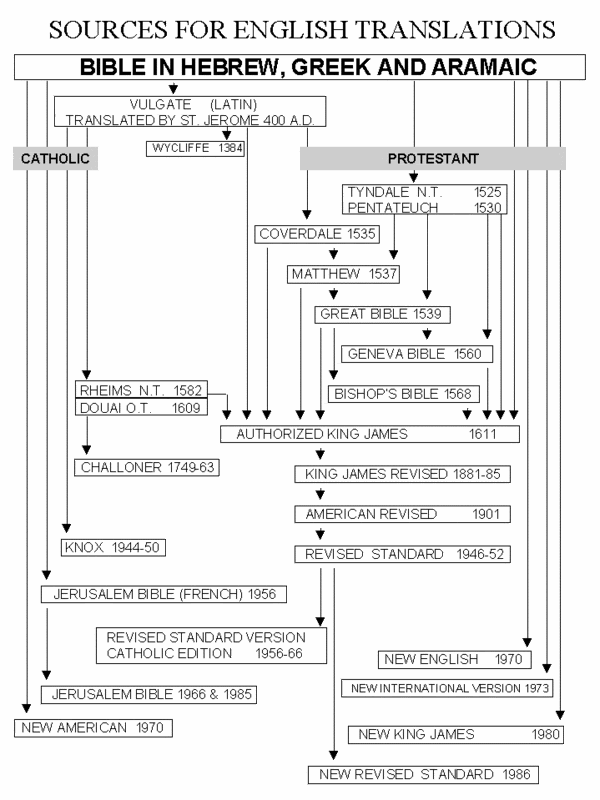
The Vulgate is the Latin version of the Bible prepared by St. Jerome (382-404), at the request of Pope St. Damasus I.

He translated the Old Testament directly from the original Hebrew, Aramaic and Greek, and revised the existing Latin text of the New Testament.

“Vulgate” means “common” or “popular”, since Latin was the popular language in Europe at the time. This translation was done in a language they could understand. Very few knew how to read.

The Vulgate was used through the centuries and was declared the official Latin text of the Bible for Catholics by the Council of Trent (1545-63).

It was from the Vulgate that almost all English Catholic translations were made until the middle of the 20th century, when scholars began to use original sources.

It remained the official Latin text of the Bible for the Catholic Church until Pope John Paul II replaced it with the New Vulgate in 1979.

Catholic Christians and non-Catholic Christians believe that the Bible is the inspired Word of God. This belief is based on their acceptance of the fact that the Catholic Church had the authority to declare which books were inspired and should be included in the list of sacred books or “Canon”, and which should not be included.

The Catholic Church knew it had this authority and guidance because:
  1. “And I will pray the Father, and He will give you another Helper, that He may abide with you forever - the Spirit of truth” (John 14:16-17)
  2. “However, when He, the Spirit of Truth, as come, He will guide you into all truth” (John 16:13)
  3. “… I am with you always, even to the end of the age” (Matthew 28:20)
  4. “Whatever you bind on earth will be bound in heaven, and whatever you loose on earth will be loosed in heaven” (Matthew 16:19)
  5. “… it has now been revealed by the Spirit to His holy apostles and prophets” (Ephesians 3:5)
  6. “… the church of the living God, the pillar and ground of the truth” (1 Timothy 3:15)
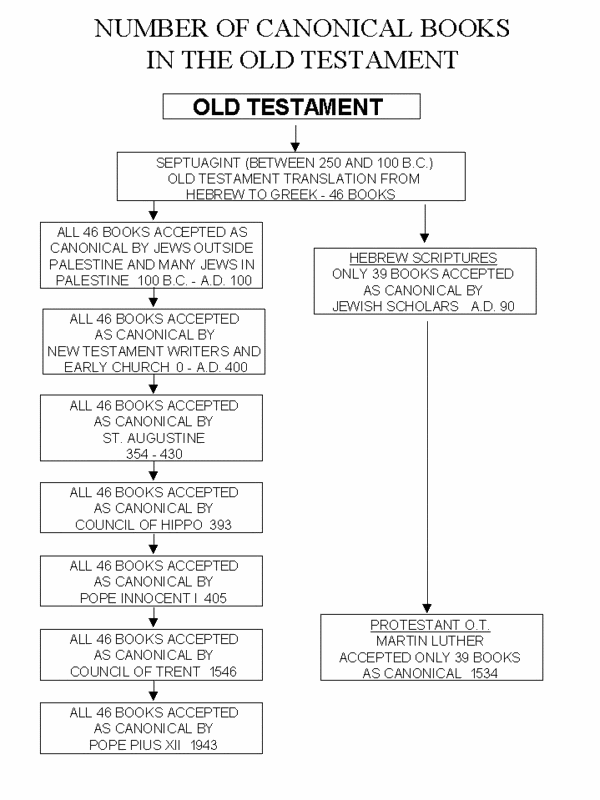
For more than 1500 years the Catholic Church has accepted and taught that these 73 books of the Bible are inspired and make up the list of sacred books.

Jesus gave His Apostles and Church the gift of the Holy Spirit when He said. “… ‘Receive the Holy Spirit.’” (John 20:22).

Jesus also said, “However, when He, the Spirit of truth, has come, He will guide you into all truth” (John 16:13).

It is impossible that the Holy Spirit, the Spirit of Truth, would lead the Church in an error for 1900 years. Such a promise was made to the Church alone.

Martin Luther decided to reject that and to accept the Hebrew Bible since it did not have the 2nd Book of Maccabees which says, “It is a holy and wholesome thought to pray for the dead that they may be loosed from their sin.” (2 Maccabees 12:46 NAB).

Luther did not agree with praying for the dead. He did not accept seven books of the Old Testament, and also did not accept these New Testament books: Hebrews, 2 John, 3 John, James, Jude, 2 Peter and Revelation. These books contained teachings which did not agree with his teaching.

By the year 1700, however, Lutheran scholars had restored these books to the New Testament. We must remember that Jesus promised that His Spirit would be with His Church (John 14:11-12) and that the Spirit of Truth would guide the Church into all truth (John 16:13). Paul said, “… which is the church of the living God, the pillar and ground of the truth” (1 Timothy 3:15).

So the Spirit of Truth guides the Church in all truth, not an individual person.


-Writings Which the Catholic Church decided to be the “Canon” of Scripture of the New Testament:

Bolded Writings which the Catholic Church decided to be the “Canon” of Scripture of the New Testament

+ Writings (existing today) which the Church decided would NOT be included in the “Canon”

***** Writings (no longer in existence) which the Church decided would NOT be included in the “Canon”

GOSPELS

*Andrew
*Apelles
*Twelve Apostles
*Barnabas
*Bartholomew
*Basilides
+Birth of Mary
*Cerinthus
*Eyptians
*Ebionites
*Encratites
*Eve
*Hebrews
*Hesychius
+Infancy of Jesus Christ
+Infancy (by Thomas)
John
*Jude
*Judas Iscariot
+Lost Gospel of Peter
Luke
*Marcion
Mark
Matthew
*Matthias
*Mernthus
*Nazarenes
+Nicodemus
*Perfection
*Peter
+Philip
+The Protevangelion
*Sythianus
*Titan
*Thaddaeus
+Thomas
+Truth
  • Valentinus
REVELATION

*Cerinthus
John
*Paul
*Peter
*Philip
*Stephen
*Thomas

EPISTLES

+Barnabas
*Christ (to Peter & Paul)
*Christ (produced by the Manichees)
+Clement to the Corinthians (1)
+Clement to the Corinthians (2)
Hebrews
+Herod and Pilate
+Igantius to the Ephesians
+Igantius to the Magnesians
+Igantius to the Trallians
+Igantius to the Romans
+Igantius to the Philadelphians
+Igantius to the Smyrnaeans
+Igantius to the Polycarp
James
+Jesus and Abgarus
**John (1) **
**John (2) **
**John (3) **
Jude
+Paul to the Laodicians
+Paul and the Seneca
Paul to Romans
**Paul to the Corinthians (1) **
**Paul to the Corinthians (2) **
Paul to the Galatians
Paul to the Ephesians
Paul to the Philippians
Paul to the Colossians

**Paul to the Thessalonians (1) **
**Paul to the Thessalonians (2) **
**Paul to Timothy (1) **
**Paul to Timothy (2) **
Paul to Titus
Paul to Philemon

**Peter (1) **
**Peter (2) **
+Polycarp to the Philippians
*Themison (the Montanist)

ACTS

*Andrew
*Apostles (by Leucius)
*Apostles (by Lentitus)
*Apostles (by Leontius)
*Apostles (by Leuthon)
**Apostles (by Luke) **
*Apostles (used by the Ebonites)
*Apostles (used by Manichees)
*Apostles (used by Seleucus)
*John
*Paul
*Paul and Thecla
*Peter
*Philip
*Pilate
*Thomas

BOOKS BY

*Andrew
*Christ
*The Helkesaites
+Hermas (His Visions 1)
+Hermas (His Commands 2)
+Hermas (His Similitudes 3)
*James
*John
*Lentitius
*Matthew
*Matthias
*Paul
*Thomas

OTHER

+Apostles’ Creed
+The Didache
*The Doctrine of Peter
*The Judgement of Peter
*The Preaching of Paul (and Peter)
*The Preaching of Peter
*The Traditions of Matthias
 
Thank you for these great images. I have saved them and will share them with others.

God bless you,
Paul
 
Wow I can’t believe all the “other” books that were out there
Thanks you for this post.
 
My mom has a copy of the Vulgate in her drawer, The Cover is ripped it reeks of anitquity. ONce and a while i was glance at it and compare it with other bibles. Its interesting how there are books in the Vulgate that are not included in other bibles. Is there anything lost in translation from the Vulgate to the current Standard american bible?
 
My mom has a copy of the Vulgate in her drawer, The Cover is ripped it reeks of anitquity. ONce and a while i was glance at it and compare it with other bibles. Its interesting how there are books in the Vulgate that are not included in other bibles.
Not included in protestant bibles? Unsurprising.

Or not included in other Catholic bibles? Which books did you have in mind?

:confused:
tee
 
It remained the official Latin text of the Bible for the Catholic Church until Pope John Paul II replaced it with the New Vulgate in 1979.
Of course the “it” being referred to is St. Jerome’s Latin Vugate. Please provide the offical statement from the Holy Father in which he formally announced that St. Jerome’s Latin Vulgate is no longer the official Latin text and is now replaced by the New Vulgate.
 
Of course the “it” being referred to is St. Jerome’s Latin Vugate. Please provide the offical statement from the Holy Father in which he formally announced that St. Jerome’s Latin Vulgate is no longer the official Latin text and is now replaced by the New Vulgate.
SCRIPTURARUM THESAURUS (for at least some definitions of “official”, viz editio “typica”)

tee
 
We’ve covered this before but it appears to be a matter of strong scholarly dispute as to whether Jerome actually translated the Deuteros or they were intercalated by later redactors using existing Old Latin texts.

The received story is that Jerome wanted to exclude them but the Pope prevailed upon him to add them.

There does not appear to be a thread of evidence for this submission to papal preference or even that Jerome translated the books at all.

When asked, all I have seen are fairly early references by Jerome to certain texts on the Deuteros.

The countering position is that as he got into the process of translating the Old Testament from Hebrew and Aramaic texts he became increasingly convinced that the Deuteros were apocryphal and excluded them.

Any evidence that he did in fact translate and include them would be appreciated.
 
On the face of it, it makes NO DIFFERENCE if Jerome did or did not translate the Duetros, or if he DID or DID NOT do so under duress, or if he did or did not agree they should be included in Scripture…the issue of including them as scripture WAS NOT UP TO St. Jerome…it was up to the various councils of the Church.
 
I am printing this off now. This will be very helpful to me for the next time someone asks me why my Catholic bible is not the same as a Protestant bible.

🙂
 
I am printing this off now. This will be very helpful to me for the next time someone asks me why my Catholic bible is not the same as a Protestant bible.

🙂
Except that it may rest on possibly dishonest but at least erroneous assumptions re: Jerome’s position on the Deuteros…

The best I think we can really say is that Jerome is not a very good or consistent or possibly even orthodox authority when it comes to the question of the canon of the Old Testament even though his translation (of whatever he did translate) was a masterpiece.
 
Except that it may rest on possibly dishonest but at least erroneous assumptions re: Jerome’s position on the Deuteros…

The best I think we can really say is that Jerome is not a very good or consistent or possibly even orthodox authority when it comes to the question of the canon of the Old Testament even though his translation (of whatever he did translate) was a masterpiece.
No, St. Jerome was NOT a COMPETENT authority to decide which books were and were not inspired…so it does much matter what he thought on the subject. THE BISHOPS…TOGETHER decided these issues…not just one or two of them.
 
Except that it may rest on possibly dishonest but at least erroneous assumptions re: Jerome’s position on the Deuteros…

The best I think we can really say is that Jerome is not a very good or consistent or possibly even orthodox authority when it comes to the question of the canon of the Old Testament even though his translation (of whatever he did translate) was a masterpiece.
Except: Unless Sagefrakrobatik wants to clarify his post, I don’t think anyone brought up the deuterocanon – Let alone Jerome’s feelings, if any, about it – Until you yourself did in post [post=2186949]#9[/post]. :hmmm:

The OP makes no mention of them at all.

:twocents:
tee
 
Not to hijack the thread, but here’s an interesting story:

Years ago, an old college roommate of mine was rummaging through a used bookstore in Arkansas and came across a 19th-century edition of the Vulgate – for which he paid something like $16!

Pretty good find, that!

Peace,
Dante
 
thank you for the information, i will make a copy too. i don’t think i can afford a vulgate version do:shrug: .May the Sacred Heart of Jesus be Adored, Glorified, Loved & Preserved throughout the world, now & forever. Sacred Heart of Jesus, please pray for me. Saint Jude, Worker of Miracles, please pray for me. Saint Jude, Helper of the Hopeless, please pray for me. Amen."😊
 
why some of those books were left behind?thank you for your help.hail mary full of grace…🙂
 
Except: Unless Sagefrakrobatik wants to clarify his post, I don’t think anyone brought up the deuterocanon – Let alone Jerome’s feelings, if any, about it – Until you yourself did in post [post=2186949]#9[/post]. :hmmm:

The OP makes no mention of them at all.

:twocents:
tee
40.png
KatholikosMercy:
For more than 1500 years the Catholic Church has accepted and taught that these 73 books of the Bible are inspired and make up the list of sacred books.
And the 7 books that make up the difference between the Catholic and the Protestant Canon are the books I am suggesting Jerome may not have translated, so this may not be true.

Also, when he says,
Martin Luther decided to reject that and to accept the Hebrew Bible since it did not have the 2nd Book of Maccabees which says, “It is a holy and wholesome thought to pray for the dead that they may be loosed from their sin.” (2 Maccabees 12:46 NAB).
This is pure conjecture.

And when he says,
He did not accept seven books of the Old Testament,
This is not strictly true, he included them in his translation of the Bible.
and also did not accept these New Testament books: Hebrews, 2 John, 3 John, James, Jude, 2 Peter and Revelation. These books contained teachings which did not agree with his teaching.
This is manifestly untrue as stated.
By the year 1700, however, Lutheran scholars had restored these books to the New Testament.
Also manifestly untrue. The books were never missing and therefore never in need of being restored.

The whole post is junk-history.
 
For more than 1500 years the Catholic Church has accepted and taught that these 73 books of the Bible are inspired and make up the list of sacred books.
And the 7 books that make up the difference between the Catholic and the Protestant Canon are the books I am suggesting Jerome may not have translated, so this may not be true.
Why are you equating “The Catholic Church” with “Jerome”? :confused:

tee
 
Status
Not open for further replies.
Back
Top