Tomb of St. Philip the Apostle Discovered in Turkey

  • Thread starter Thread starter Rolltide
  • Start date Start date
Status
Not open for further replies.
R

Rolltide

Guest
worldbulletin.net/?aType=haber&ArticleID=76705

Tomb of St. Philip the Apostle discovered in Turkey’s Denizli
D’Andria said the structure of the tomb and the writings on it proved that it belonged to St. Philip the Apostle, who is recognized as a martyr in the history of Christianity

The tomb of St. Philip the Apostle, one of the original 12 disciples of Christianity’s central figure Jesus Christ, has been discovered during the ongoing excavations in Turkey’s south-western province of Denizli.

Italian professor Francesco D’Andria, the head of the excavation team at the Hierapolis ancient city in Denizli, told reporters on Tuesday that experts had reached the tomb of St. Philip whose name is mentioned in the Bible as one of the 12 Apostles of Jesus.

Professor D’Andria said archeologists had been working for years to find the tomb of the Biblical figure, and finally, they had managed to reach the monument while working on the ruins of a newly-unearthed church in Hierapolis.

D’Andria said the structure of the tomb and the writings on it proved that it belonged to St. Philip the Apostle, who is recognized as a martyr in the history of Christianity.

Describing the discovery as a major development both for archeology and the Christian world, D’Andria said the tomb, which had not been opened yet, was expected to become an important Christian pilgrimage destination.

Hierapolis, whose name means “sacred city”, is an ancient city located next to the renowned Pamukkale, white Travertine terraces, in Denizli province. It is a UNESCO World Heritage Site.

The city, famous for its historical hot springs used as a spa since the 2nd century, is a mixture of Pagan, Roman, Jewish and early Christian influences.

Ancient tradition associates Hierapolis with St. Philip the Apostle, who is believed to have died in the city around 80 AD. The follower, who is known as the apostle who preached in Greece, Syria, and Phrygia, is said to have been martyred in Hierapolis. The legend is that St. Philip was crucified upside-down or martyred by beheading.

After the apostle’s death, an octagonal tomb named “The Martryium” was erected for him where he is believed to have been martyred.
 
What makes this even more cool is that I have actually been to this exact archeological site!
 
Thank you for posting this. It is so wonderful to hear and makes the case for the historical Jesus and his followers that much stronger. 👍

God bless
 
Here is a photo of part of the necropolis at the Hierapolis archeological site. It is famous for being a spa town. Many would come to the beautiful natural hot springs in an attempt to be healed. Many sick people also died there, which is why its necropolis (graveyard) is particularly famous.


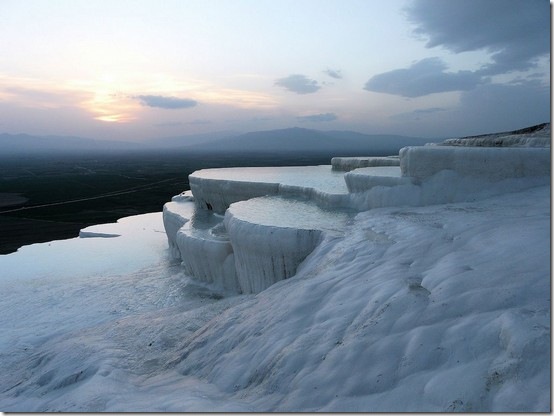
Here are a couple of photos of the famous “cotton castle” of Pammukale, which is the natural volcanic hot spring associated with Hieropolis.


http://www.travlang.com/blog/wp-content/uploads/2010/04/pamukkale-98.jpg

And here is where you can actually still come and bathe in the hot springs today. What is so fascinating about this natural pool is that the old spa collapsed into the pool, so when you are in the water, you’re walking among the ruins of the building, including Roman columns and statues.

(Please Note: This uploaded content is no longer available.)

http://farm4.static.flickr.com/3170/3100939358_7be9efa8dd.jpg
 
This is so cool. The pictures are fantastic. I have no doubt this is accurate, but how do they know for sure?
 
thanks for posting this information and the pictures. so interesting! i love archaeology.
i get so excited each time a new discovery is made! just think what has not been unearthed yet or is still undiscovered! they are like more pieces of a giant puzzle that
help us to understand the history of that time more clearly.
 
Awesome, and cool news.
Professor D’Andria said archeologists had been working for years to find the tomb of the Biblical figure, and finally, they had managed to reach the monument while working on the ruins of a newly-unearthed church in Hierapolis.
D’Andria said the structure of the tomb and the writings on it proved that it belonged to St. Philip the Apostle, who is recognized as a martyr in the history of Christianity.
Maybe when the enemies of the Church have to go back to the drawing board in attacking the Christ; they will have to claim all twelve apostles didnt’ exist either. 😛

They did it with King David, who came Before Christ who points to him. They probably with enough lack of reason, will go after the ones After Christ who also point to him.
 
Awesome, and cool news.

Maybe when the enemies of the Church have to go back to the drawing board in attacking the Christ; they will have to claim all twelve apostles didnt’ exist either. 😛

They did it with King David, who came Before Christ who points to him. They probably with enough lack of reason, will go after the ones After Christ who also point to him.
👍🙂
 
Wow.

I wonder if his skeleton is still there.

Apparently St. Peter’s skeleton has his feet missing, which goes along with the tradition that people had secretly pulled him off his cross, which he was nailed to upside down.
 
This discovery is wonderful news.
May Jesus Christ be Praised.

St. Philip, pray for us.
 
Wow this is very, very exciting!

What certain assurance do we have (in case the atheists ask) that this indeed belonged to St. Peter, i.e. some sort of inscriptions with his name on the site?
 
Wow this is very, very exciting!

What certain assurance do we have (in case the atheists ask) that this indeed belonged to St. Peter, i.e. some sort of inscriptions with his name on the site?
I’m sure you meant St. Phillip. I more or less asked the same question. The article refers to inscriptions but doesn’t really offer any sort of detailed descriptions. Maybe they’re saving it for the Discovery Channel Special. I asked because there seems to be some confusion between St. Phillip the Apostle and Phillip the Deacon or Evangelist. One article I read in New Advent said that there has been some confusion between the two people and indicated that they were either two seperate people with amazing similarities that worked in the very same city and had the same number of daughters that were also revered to some extent. Or, they are the same person and either the Deacon was conflated with the Apostle or the other way around. So, I was wondering what, if any, possibility there might be that the tomb is that of Phillip the Deacon and not St. Philip the Apostle. I’m not trying to be a wet blanket, its just intellectual curiosity.

I am assuming it is the tomb of St. Phillip. However, I doubt that there will be any remains in the tomb because I also read that the remains were removed to Rome sometime in the 1400’s, I believe. I think its amazing that there’s a temple to begin with. Consider that Phillip was probably martyred some time around the middle of the 1st Century. I looked at several Catholic and non-Catholic sources and there was almost a complete abscence of information as to a possible date for martyrdom. There was a date of around 80 A.D. on a wikipedia page but had no supporting citation, so I’m not putting any faith in it. And, if Phillip were fairly young, lets say between 15 and 20 years old at the time of Christ’s crucifixion, then he would have been almost 70 in 80 A.D. My limited understanding of this period tells me that a person would be very very lucky to live to this age. So, I figure it was probably a little earlier. In any case, the people of Heriopolis would have had to remember the exact location of his burial and keep it secret, due to persecution, for some 250 years. I’m assuming that Constantine lifted the persecution once and for all sometime around 320 A.D. My dating is rough to be sure but I think its still amazing.
 
I came across this blog by a Greek Orthodox guy --hey, we can learn something from everybody 😉 --and he has some interesting information, photos, and a video on the topic.
Interesting how relics get moved, and hidden away for safety. Part of St. Philip’s skull is now in Cyprus. It should be noted that in the quote below, it means* part *of the skull.

The Tomb of the Apostle Philip Discovered In Hierapolis

Holy Cross Monastery In Omodos, Cyprus
The skull of Apostle Philip is kept in a gold and silver-plated case that is shaped like a pyramid. The authenticity of the skull is witnessed by the seals of the Byzantine Emperors Theodosius the Great and Heraclius. The Holy Relic of Orthodoxy was kept in Constantinople until July 31st, 1204. After the city’s capture by the Franks it was transferred for safekeeping to the village Arsinoe of the Paphos district. A little after 1735 the case was stolen and in 1770 it was replaced by the one that is extant until today, at the expenditure of the then Metropolitan Bishop of Paphos, Panaretos. For greater safety the case with the Apostle’s skull was transferred to the Holy Temple of the Holy Cross in Omodos before 1788.
 
Status
Not open for further replies.
Back
Top