
What are the spiritual benefits of praying to the saints and Mary?

  • Thread starter Thread starter Tommy999
  • Start date Start date
Status
Not open for further replies.
To be consistent, Don’t ever pray to Jesus or ask anyone on earth EVER to pray for you.
About praying to Jesus; our God is a trinity, and so you can pray to the Father, or the Son or the Holy Spirit.
We can ask another person to pray for us because we can commune with him, and he can communicate to God via prayer. Take for example the person leading prayers in church will make a prayer on behalf of the others.
Except, Christ says the exact opposite of it being a symbol;

John 6;

Jesus said to them, “Amen, amen, I say to you, unless you eat the flesh of the Son of Man and drink his blood, you do not have life within you. 54 Whoever eats my flesh and drinks my blood has eternal life, and I will raise him on the last day. 55 ** For my flesh is true food, and my blood is true drink. **

St Paul also said it was more than just symbol in 1 Corinthians 11

Therefore whoever eats the bread or drinks the cup of the Lord unworthily will have to answer for the body and blood of the Lord.[l] 28 A person should examine himself,[m] and so eat the bread and drink the cup. 29 For anyone who eats and drinks without discerning the body, eats and drinks judgment[n] on himself.

Ignatius of Antioch around the year 100AD (He knew Polycarp and John, and was the second Bishop of Antioch where they were first called Christians) This would be like the second pastor of your church and the first pastor was an apostle.

“Consider how contrary to the mind of God are the heterodox in regard to the grace of God which has come to us. They have no regard for charity, none for the widow, the orphan, the oppressed, none for the man in prison, the hungry or the thirsty. They abstain from the Eucharist and from prayer, because they do not admit that the Eucharist is the flesh of our Savior Jesus Christ, the flesh which suffered for our sins and which the Father, in His graciousness, raised from the dead.”

“Letter to the Smyrnaeans”, paragraph 6. circa 80-110 A.D.

Then we have of course, the fact that 100% of Christian writings and practice prior to the 1500’s taught that Jesus was really present in the Eucharist.

Your idea is a novelty of modernity and came about because of a rejection of the priesthood. It is a cheap and phony way of looking at the Eucharist. You must completely reject Facts to hold your belief. Even the oldest protestant sects hold a similar or the same belief as us along with the Orthodox, Coptics, etc… Basically 90% of Christendom holds a belief in the real presence…why don’t you?

First, the issue of the Lords table is mentioned just a few times in the letters. The only detail which is given is in Corinthians by Apostle Paul. Lets look at his words:
1Cor 11:20 So then, when you come together, it is not the Lord’s Supper you eat, 21 for when you are eating, some of you go ahead with your own private suppers. As a result, one person remains hungry and another gets drunk. 22 Don’t you have homes to eat and drink in? Or do you despise the church of God by humiliating those who have nothing? What shall I say to you? Shall I praise you? Certainly not in this matter.
1Cor11:34: Anyone who is hungry should eat something at home, so that when you meet together it may not result in judgment.

It appears that Just as Jesus had supper with his disciples, the first church was having a communal meal in remembrance of the Lord. Why Apostle Paul does not commend the behavior of the Corinthian church is because they did not hold a solemn assembly with equitable sharing of the meal and drink they had. They made spot of the event by turning it into a rowdy gathering.
The idea of the real presence has elevated the bread and wine to a position of worship. Jesus said it was his body and blood to be eaten but not adored. The immediate apostles too did not hold that believe.
Its clear your history is lacking as the 3rd century refers to the 200’s and Christianity wasn’t legalized until the latter part of the 4th century. Your explanation is not grounded in history at all.
To proof the dates, we just peruse the annals of history. Today we have the internet, and its just a click and we get it.
But you are right that the difference is Tradition. Our Tradition dates to the Apostles. Your tradition dates to the Reformation at the earliest but more likely a pastor in the 19th or 20th century with a “new idea” to “grow a church” and put money in his own pocket.
We use the bible with the words & works of Christ and the immediate apostles and no controversy. We use the traditions which are the works & words of the latter 'church fathers" and we get controversy.

The pastors who are out to enrich themselves with the gospel are fulfilling a prophecy and they have their reward.
 
The pastors who are out to enrich themselves with the gospel are fulfilling a prophecy and they have their reward.
First of all, you should know this: No prophecy of Scripture comes from one’s own interpretation, 2 Peter 1:20

as he does in all his letters when he speaks in them of these matters. There are some things in them that are hard to understand, which the ignorant and unstable twist to their own destruction, as they do the other Scriptures. 2 Peter 3:16
 
And yet you ask people to pray for you or you for others. Why the hypocrisy?

YOU made it symbolic. Not Jesus. He tells us to eat his body, not once but a few times. In John 6:31 Jesus reminded the Jews that their fathers ate the manna in the wilderness. That was real food. He described it as his Father given them the true bread from heaven and not Moses. For the bread of God is that which comes down from heaven and give life to the world. John 6:32. In John 6:48-51 he reinforced the message the Jews murmured in John 6:41. There is nothing symbolic here. Their fathers ate the heavenly manna previously. Now Jesus is teaching them that he is the bread of life that has come down from heaven and that we must eat this living bread to live forever. John 6:52-58 says most clearly. For my flesh is food indeed. The manna wasn’t symbolic, it was real food too.

What is the ironic part about Jesus eating his own body? Are you putting him into a box what he can or can not do? He can rise from the dead. He can do heavenly things. You really need to restrain yourself from objecting to things you are not sure about. It is a hard saying. So are you going to go away also? John 6:60, 67. That why it is a mystery to us also how he does it at every mass.
Manna was food to sustain life just like any other food. No wonder when they crossed Jordan river, the provision of manna ceased. The bible tell us that Christ is the real bread from heaven. This bread is different from the manna in that it’s a person. Before the Lord’s table was instituted, we had many who had partaken of him as the bread from heaven.
Jesus is the bread of life, he’s the giver of living waters, Rock of ages, the true vine, the good shepherd etc
What catholic teachings in the 3rd century are you talking about that are not accepted by the protestants? Please list them. Protestantism started in the 15th century. What were you doing between 3rd and 15th century? Unless you are siding with the heresies. When the Catholic Church was fighting the heresies, where were you? Where were the Protestant voices?
Heresy is always with us as its the work of Satan. Even Jesus was said to be doing miracles by the powers of Belzebub. The ones in authority have a responsibility of maintaining sound doctrine. However, the prophecy must be fulfilled, just as Judas had to be with the 12 disciples for the prophecy to be fulfilled.
Please do your research on what the Emperor did and what the Church did. The Church is responsible for doctrine , not the Emperor. He helped no doubt in making the environment conducive for the Church. The Christian world benefited.
It was a symbiotic kind of a relationship.
Protestants think they have a relation to God while excluding Catholics. It is time to go out into the real world and see for yourself that a billion Catholics also have a personal relation with God. You really need to take off those blinders and stop talking like a Pharisee. Luke 18:11
As Christians, we endeavor to maintain our relationship with God.
Why are you arbitrarily selecting saints that are still on earth? The saints in heaven they are alive, don’t you agree? In the Transfiguration, Moses and Elijah were there and alive and talking. Aren’t they dead? Obviously not. Why do you limit yourself to only those on earth? You are self imposing limits that are not there. Who came out with the doctrine that communion of saints only involve saints who are alive on earth? Source please.
If you cite Moses and Elijah during the configuration, we don’t have St. Elijah, or st. Moses from the OT. Also in Rev 4, we see 24 elders in heaven of whom we are not told who they are.
Jesus is our perfect teacher, and His Words will abide forever. His gospel is an everlasting gospel. I chose his teaching as they are more infallible.
In Matt we read:
Mat24:30: And then shall appear the sign of the Son of man in heaven: and then shall all the tribes of the earth mourn, and they shall see the Son of man coming in the clouds of heaven with power and great glory. 31: And he shall send his angels with a great sound of a trumpet, and they shall gather together his elect from the four winds, from one end of heaven to the other.
In Thess, we read;
1Thes 4:13: But I would not have you to be ignorant, brethren, concerning them which are asleep, that ye sorrow not, even as others which have no hope. 14: For if we believe that Jesus died and rose again, even so them also which sleep in Jesus will God bring with him.17: Then we which are alive and remain shall be caught up together with them in the clouds, to meet the Lord in the air: and so shall we ever be with the Lord.

Jesus taught about those who died and that they will arise at his second coming. Apostle Paul taught the same and the churches were comforted. The view of saints in heaven was non-existent. But a believe of a place of peace called ‘Bosom of Abraham’ was existent.
You don’t know much about Catholicism don’t you. You only know about our canonized saints. From the Baltimore Cathecism:
  1. Q. What does the communion of saints mean?
    A. The communion of saints means the union which exists between the members of the Church on earth with one another, and with the blessed in heaven and with the suffering souls in purgatory.
If you base this with the 1st Nicene resolution, it was in 325AD. There-before, the believe was fragmented, and most likely communion of saints in heaven and purgatory was non-existent.
 
We agree; our God is a Trinity. Prayer to the Father, to Jesus or to the Holy Spirit is directed to the same God.
What I meant is that there’s no space for a prayer to be directed to another person.
Chong-

Thanks for sharing your personal opinions. However, I’d like a little more than that.

All I am asking for is a verse of scripture - from the NT and Jesus specifically, if possible - that forbids anyone Catholic, Orthodox or otherwise, from speaking to a friend or loved one who has already died.

Thanks.
 
If you base this with the 1st Nicene resolution, it was in 325AD. There-before, the believe was fragmented, and most likely communion of saints in heaven and purgatory was non-existent.


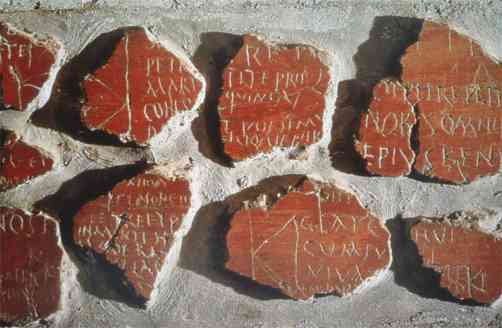
Catacomb of St. Sabastiano: Fragments of a wall plaster from the triclia with
numerous graffiti that ask for the prayers of the martyred apostles, Peter and Paul.
catholicbridge.com/catholic/saints.php
 
Jesus came to show us the way, so we should believe Jesus words more than anyone else.
He taught his disciples (and us too) how to pray. The immediate apostles taught the word of Jesus, and so should we.
The problem you need to realize is you are influenced by your teachers. Your pastor. Your commentaries. You are viewing Jesus through them instead of the historical Faith that was actually given 2000 years ago.

Every church with roots to the New Testament time, Orthodox, Catholic, Coptics, etc… We all hold the same beliefs

Why are yours different.

It’s really no different than Mormons…a modern invention.

I’d encourage you to remove the glasses covering your worldview and start fresh looking at the early church.
 
Manna was food to sustain life just like any other food. No wonder when they crossed Jordan river, the provision of manna ceased. The bible tell us that Christ is the real bread from heaven. This bread is different from the manna in that it’s a person. Before the Lord’s table was instituted, we had many who had partaken of him as the bread from heaven.
Jesus is the bread of life, he’s the giver of living waters, Rock of ages, the true vine, the good shepherd etc
I have provided to you chapter/verse that show Jesus Body is the bread from heaven. He says he is real food. So why do you say it is symbolic? Do you want to go away too?
Heresy is always with us as its the work of Satan. Even Jesus was said to be doing miracles by the powers of Belzebub. The ones in authority have a responsibility of maintaining sound doctrine. However, the prophecy must be fulfilled, just as Judas had to be with the 12 disciples for the prophecy to be fulfilled.
I see you are avoiding to substantiate your allegations that 3rd century catholic teachings are not accepted by Protestants. Not even an example? To put it bluntly, you can’t . There were no Protestants then. Protestantism started about 500 yrs ago. Your line of argument has been disproved many times. There is no substance there. Quite surprised to see you used an old ineffective tactic.
It was a symbiotic kind of a relationship.
Emperor was a pagan turned Christian. There is nothing symbiotic about that. Christianity prospered under his reign. God has his ways.
As Christians, we endeavor to maintain our relationship with God.
Same as many other Christians and Catholics. You don’t have a monopoly on that.
If you cite Moses and Elijah during the configuration, we don’t have St. Elijah, or st. Moses from the OT.
Not having a prefix of St doesn’t make them less of a saint. There are countless unnamed saints. We don’t canonized OT saints if you want to know.
Also in Rev 4, we see 24 elders in heaven of whom we are not told who they are.
Jesus is our perfect teacher, and His Words will abide forever. His gospel is an everlasting gospel. I chose his teaching as they are more infallible.
You can’t be serious! There is no such book which is “more” or “less” infallible. The whole book is the Word of God. You can’t just pick and choose and decide which book you think is “more” infallible. But I understand your need to do that though to support a certain view. After all , you already threw out a couple of books.
In Matt we read:
Mat24:30: And then shall appear the sign of the Son of man in heaven: and then shall all the tribes of the earth mourn, and they shall see the Son of man coming in the clouds of heaven with power and great glory. 31: And he shall send his angels with a great sound of a trumpet, and they shall gather together his elect from the four winds, from one end of heaven to the other.
In Thess, we read;
1Thes 4:13: But I would not have you to be ignorant, brethren, concerning them which are asleep, that ye sorrow not, even as others which have no hope. 14: For if we believe that Jesus died and rose again, even so them also which sleep in Jesus will God bring with him.17: Then we which are alive and remain shall be caught up together with them in the clouds, to meet the Lord in the air: and so shall we ever be with the Lord.
You put together a verse from here and there yet nothing support your
(a) communion of saints or
(b) that it involve only saints on earth
Those verses may refer to bodily resurrection at the final Judgement. You missed the point completely.
Jesus taught about those who died and that they will arise at his second coming. Apostle Paul taught the same and the churches were comforted. The view of saints in heaven was non-existent. But a believe of a place of peace called ‘Bosom of Abraham’ was existent.
Saints in heaven non-existent? Only if you don’t read Revelation or Revelation is not in your Bible.
If you base this with the 1st Nicene resolution, it was in 325AD. There-before, the believe was fragmented, and most likely communion of saints in heaven and purgatory was non-existent.
Prior to that date the Church Fathers have been quoting communion of saints in their letters. Samples:

Clement of Alexandria
“In this way is he [the true Christian] always pure for prayer. He also prays in the society of angels, as being already of angelic rank, and he is never out of their holy keeping; and though he pray alone, he has the choir of the saints standing with him [in prayer]” (
Miscellanies 7:12 [A.D. 208]).

Origen
“But not the high priest [Christ] alone prays for those who pray sincerely, but also the angels . . .as also the souls of the saints who have already fallen asleep” (Prayer
11 [A.D. 233]).

Cyprian of Carthage
“Let us remember one another in concord and unanimity. Let us on both sides [of death] always pray for one another. Let us relieve burdens and afflictions by mutual love , that if one of us, by the swiftness of divine condescension, shall go hence first, our love may continue in the presence of the Lord, and our prayers for our brethren and sisters not cease in the presence of the Father’s mercy” (Letters56[60]:5 [A.D. 253]).

And finally ,

Romans 8:35-39 - death cannot separate us from Christ
Romans 12:5 - we are one body in Christ, individual parts of one another
1 Corinthians 12:12-27 – If one part is hurt (suffers), all the parts share its pain. And if one part is honored, all the parts share its joy
 
Tommy - I don’t typically keep bulletin’s, but I did indeed keep this one as it was so troubling.

It was from Nov 24th, 2013 and during a parish wide consecration to our Blessed Mother (first issue…shouldn’t it be consecration to Christ through Mary?) according to Fr. Gaitley ‘33 Days’ formula. I’m happy to transcribe the entire letter if anyone wants it…,but here is the part where I had issues…

*…The primary question that has come up is something like this, “Why do we go exclusively to Mary with everything? Can’t we also go straight to God or rely upon the intercession of other saints too?” The simple answer is “no” and “yes”. No, we really can’t just go straight to God with our prayers, but, yes, we still can and should rely upon the intercession and mediation of the other saints and angels… *

This note in the bulletin reinforced multiple homilies where Father stated that you can not go to God, but must instead go to Mary. He also said that whenever we pray to other saints, that the prayers are delivered to Mary and she brings them to God and that any grace that results comes back through Mary. All of this was communicated as the exclusive way by which we can interact with God. I had never heard of such a thing until then. Subsequently, I have heard a half dozen priests state the same thing all related to Marian consecration and all in the Rockford diocese and all in parishes closely attached to Franciscan U at Steubenville where Mark Miravalle’s influence is felt most strongly.

I think the proper thing to do is talk directly with the priest and then if not resolved you go to the deanery… Any else know how to handle something like this?
You might also want to take it up with the Bishop.
 
Chong-

Thanks for sharing your personal opinions. However, I’d like a little more than that.

All I am asking for is a verse of scripture - from the NT and Jesus specifically, if possible - that forbids anyone Catholic, Orthodox or otherwise, from speaking to a friend or loved one who has already died.

Thanks.
In Matt. 6:6: Jesus on the positive said; But thou, when thou prayest, enter into thy closet, and when thou hast shut thy door, pray to thy Father which is in secret
In Matt 6:7: He cited a negative; “But when ye pray, use not vain repetitions, as the heathen do…”

So, Jesus made it very clear on how prayer should be made.
The contrast that Jesus used of vain repetitions of the heathens seems to have been taken from OT, c/f 1Kin18:26: … and called on the name of Baal from morning even until noon, saying, O Baal, hear us. It seems that the concept of praying to people who had died was not in the domain of the people during that time. If it was, people would have quoted it from the OT writings or traditions. The Sadducee believed that there is no resurrection while the pharisees believed there was. Jesus confirmed that there will be.
 
In Matt. 6:6: Jesus on the positive said; But thou, when thou prayest, enter into thy closet, and when thou hast shut thy door, pray to thy Father which is in secret
In Matt 6:7: He cited a negative; “But when ye pray, use not vain repetitions, as the heathen do…”

So, Jesus made it very clear on how prayer should be made.
The contrast that Jesus used of vain repetitions of the heathens seems to have been taken from OT, c/f 1Kin18:26: … and called on the name of Baal from morning even until noon, saying, O Baal, hear us. It seems that the concept of praying to people who had died was not in the domain of the people during that time. If it was, people would have quoted it from the OT writings or traditions. The Sadducee believed that there is no resurrection while the pharisees believed there was. Jesus confirmed that there will be.
This has nothing to do with Randy’s question…🤷

You can’t answer him I guess…

But regarding this post…

Do you only pray in a closet with the door closed?
 
The problem you need to realize is you are influenced by your teachers. Your pastor. Your commentaries. You are viewing Jesus through them instead of the historical Faith that was actually given 2000 years ago.
Every church with roots to the New Testament time, Orthodox, Catholic, Coptics, etc… We all hold the same beliefs

Why are yours different.

It’s really no different than Mormons…a modern invention.

I’d encourage you to remove the glasses covering your worldview and start fresh looking at the early church.
I have not quoted any pastor and I’ll never quote, (you may check all my posts). I’ll use the Words of Jesus primarily, and the immediate apostles as documented in the NT which both Catholics & Protestants ascribe to.

In Acts 15, its recorded of a dispute that arose regarding doctrine among gentiles. In response, the missionaries had to seek full clarifications that culminated to a council in JERUSALEM. The conclusion was based on the OT scripture, then they gave instructions on morals and practices.
If we assume that the subject we are discussing was taken to the Jerusalem council, how would they have responded.
The apostles used to follow the example is Jesus:
Luk 4:3: And the devil said unto him, If thou be the Son of God, command this stone that it be made bread. 4: And Jesus answered him, saying, It is written, That man shall not live by bread alone, but by every word of God.

Peter on the day of Pentecost quoted the OT, Acts 2:16: But this is that which was spoken by the prophet Joel; 17: And it shall come to pass in the last days, saith God, I will pour out of my Spirit upon all flesh:

The difference is on the usage of Scripture to support a teaching.
 
I have provided to you chapter/verse that show Jesus Body is the bread from heaven. He says he is real food. So why do you say it is symbolic? Do you want to go away too?
Jesus is symbolized in many ways: Lion of Judah, Lamb of God, Rock of ages, the true vine etc. He is not a Lion by all means, He’s not a lamb neither is he a rock. These are words to express his character.
Jesus met a Samaritan woman at the well in John 4:14 But whosoever drinketh of the water that I shall give him shall never thirst; but the water that I shall give him shall be in him a well of water springing up into everlasting life.
For sure Jesus did not give the woman physical water.
I see you are avoiding to substantiate your allegations that 3rd century catholic teachings are not accepted by Protestants. Not even an example? To put it bluntly, you can’t . There were no Protestants then. Protestantism started about 500 yrs ago. Your line of argument has been disproved many times. There is no substance there. Quite surprised to see you used an old ineffective tactic.
The Edict of Thessaloniki by the Emperor of Rome required that all subjects of the Roman Empire to profess the faith of the Bishop of Rome & Alexandria. They obliged and so the Roman Empire was united by one faith only. Heresy was punishable and so no major differences arose. Scriptures were limited from ordinary men.
Let me say that had the reformers not risen at that time, they would have arisen at a latter time.
Example of the teachings is what we are now debating. Its not supported by the canonized scriptures.
Emperor was a pagan turned Christian. There is nothing symbiotic about that. Christianity prospered under his reign. God has his ways.
History shows that Emperor Constantine was never a christian until at the time of his death when he called a bishop to baptize him.
Same as many other Christians and Catholics. You don’t have a monopoly on that.
All Christians are called to fellowship with the Lord.
Not having a prefix of St doesn’t make them less of a saint. There are countless unnamed saints. We don’t canonized OT saints if you want to know.
Jesus says he’ll come again; as the lighting shines so shall his coming be accompanied with angels with trumpets. The dead shall arise at the sound of the trumpet and appear before Jesus.
You can’t be serious! There is no such book which is “more” or “less” infallible. The whole book is the Word of God. You can’t just pick and choose and decide which book you think is “more” infallible. But I understand your need to do that though to support a certain view. After all , you already threw out a couple of books.
Jesus was God-man, and so he could not have erred like other men. Man including the apostles had the usual weakness of a man. If we do a character exposition of the Apostles, we find others like Thomas was doubting the resurrection of Jesus.
You put together a verse from here and there yet nothing support your
(a) communion of saints or
(b) that it involve only saints on earth
The scriptures says the dead are waiting for the day of resurrection and so, we cannot commune with them. The saints are not with Christ in heaven as this is not shown anywhere in the scriptures. The souls of the saints in Rev 6:9 are under the altar and are not praying. They are told to wait for their brethren on earth
The Creed which mentions the communion of saints was promulgated during the Nicene council. Its not part of scripture.
Those verses may refer to bodily resurrection at the final Judgement. You missed the point completely.
1Thes 4:15: For this we say unto you by the word of the Lord, that we which are alive and remain unto the coming of the Lord shall not prevent them which are asleep (dead) 16: For the Lord himself shall descend from heaven with a shout, with the voice of the archangel, and with the trump of God: and the dead in Christ shall rise first:
17: Then we which are alive and remain shall be caught up together with them (who rose from the dead) in the clouds, to meet the Lord in the air: and so shall we ever be with the Lord. The writer did not mean at the last judgement.
Saints in heaven non-existent? Only if you don’t read Revelation or Revelation is not in your Bible.
Where in revelation?
Prior to that date the Church Fathers have been quoting communion of saints in their letters. Samples:

Clement of Alexandria
“In this way is he [the true Christian] always pure for prayer. He also prays in the society of angels, as being already of angelic rank, and he is never out of their holy keeping; and though he pray alone, he has the choir of the saints standing with him [in prayer]” (
Miscellanies 7:12 [A.D. 208]).

And finally ,
Romans 8:35-39 - death cannot separate us from Christ
Romans 12:5 - we are one body in Christ, individual parts of one another
1 Corinthians 12:12-27 – If one part is hurt (suffers), all the parts share its pain. And if one part is honored, all the parts share its joy
I wish to stick to the canonized scripture.

The scripture you have quoted are sure;
Rom 8: 35-39 sure, death is not the end, we shall live with Christ
Rom 12:5 & 1Cor 12: 12-27 Yes, on solving divisions in the church.
If the foot shall say, because I am not the hand, I am not of the body; is it therefore not of the body?
 
I have not quoted any pastor and I’ll never quote, (you may check all my posts). I’ll use the Words of Jesus primarily, and the immediate apostles as documented in the NT which both Catholics & Protestants ascribe to.

In Acts 15, its recorded of a dispute that arose regarding doctrine among gentiles. In response, the missionaries had to seek full clarifications that culminated to a council in JERUSALEM. The conclusion was based on the OT scripture, then they gave instructions on morals and practices.
If we assume that the subject we are discussing was taken to the Jerusalem council, how would they have responded.
The apostles used to follow the example is Jesus:
Luk 4:3: And the devil said unto him, If thou be the Son of God, command this stone that it be made bread. 4: And Jesus answered him, saying, It is written, That man shall not live by bread alone, but by every word of God.

Peter on the day of Pentecost quoted the OT, Acts 2:16: But this is that which was spoken by the prophet Joel; 17: And it shall come to pass in the last days, saith God, I will pour out of my Spirit upon all flesh:

The difference is on the usage of Scripture to support a teaching.
Yes every time you quote a verse to support an erroneous doctrine you are essentially quoting a pastors view of the Bible.

You need to read the Bible through the sacred tradition the apostles gave us. Not through your opinion or your pastors.
 
Jesus is symbolized in many ways: Lion of Judah, Lamb of God, Rock of ages, the true vine etc. He is not a Lion by all means, He’s not a lamb neither is he a rock.
I am not disputing that Jesus can not be a symbol. I am disputing that your take on John 6:48-56 is symbolic. You are imposing a symbolic reading when plain language does not support it.
The Edict of Thessaloniki by the Emperor of Rome required that all subjects of the Roman Empire to profess the faith of the Bishop of Rome & Alexandria. They obliged and so the Roman Empire was united by one faith only. Heresy was punishable and so no major differences arose. Scriptures were limited from ordinary men.
Let me say that had the reformers not risen at that time, they would have arisen at a latter time. Example of the teachings is what we are now debating. Its not supported by the canonized scriptures.
History shows that Emperor Constantine was never a christian until at the time of his death when he called a bishop to baptize him.
You stated Constantine received baptism on his deathbed. His edict is his prerogative. That is not doctrine. You claim the Emperor issued many decrees on behalf of the Church. The Church doesn’t rule him and he can’t determine Church doctrine. Where are the examples of 3rd century doctrines which you claim Protestant objected to? But there were no Reformers then. So at best you are making a hypothetical statement.
Jesus was God-man, and so he could not have erred like other men. Man including the apostles had the usual weakness of a man. If we do a character exposition of the Apostles, we find others like Thomas was doubting the resurrection of Jesus.
**I can’t believe that you are advocating that certain books in the Bible are more infallible than other books. ** This is the latest novel interpretation I have come across. All books are God inspired. You don’t have the authority to grade them.
The scriptures says the dead are waiting for the day of resurrection and so, we cannot commune with them. The saints are not with Christ in heaven as this is not shown anywhere in the scriptures. The souls of the saints in Rev 6:9 are under the altar and are not praying. They are told to wait for their brethren on earth
The Creed which mentions the communion of saints was promulgated during the Nicene council. Its not part of scripture.
1Thes 4:15: For this we say unto you by the word of the Lord, that we which are alive and remain unto the coming of the Lord shall not prevent them which are asleep (dead) 16: For the Lord himself shall descend from heaven with a shout, with the voice of the archangel, and with the trump of God: and the dead in Christ shall rise first:
17: Then we which are alive and remain shall be caught up together with them (who rose from the dead) in the clouds, to meet the Lord in the air: and so shall we ever be with the Lord. The writer did not mean at the last judgement.
Where in revelation?
Yes, they are waiting for bodily resurrection. Spiritually they are alive in heaven. Didn’t you read that God of Abraham is God of the Living and not the dead. You can kill the body but not the spirit. In Revelation, we know it is happening in heaven. In Rev 4:1, it says: After this I looked and behold, in heaven an open door! And the first voice which I had heard speaking to me like a trumpet, said “Come up here, and I will show you what must take place after this”.

Rev 6:9-10 When he opened the fifth seal, I saw under the altar the souls of those who had been slain for the word of God and for the witness they had borne; they cried out with a loud voice, …

If they are dead, they would not be shouting.

Rev 7:9 … a great multitude which no man could number, from every nation, from all tribes and peoples and tongues, standing before the throne and before the Lamb, clothed in white robes, with palm branches in their hands, and crying out with a loud voice, “Salvation belongs to our God who sits upon the throne, and to the Lamb!”

Again, very alive saints.

Rev 7:14. You can see these saints serve God day and night.
Rev 8:3-4. Prayers of the saints from the altar and prayers from the saints from the hand of the angel rose with the smoke of the incense before God.

The evidence is so clear that the saints in heaven are alive and they pray.

I think you are confused about the bodies of dead saints which remain in the ground till Judgement Day. We are referring to the spiritual bodies of saints who have gone to heaven while awaiting Judgement Day. These saints are alive in heaven and praying and serving God. We are in communion with them. You can not deny them. Your pastor is wrong to deny them.
I wish to stick to the canonized scripture.
The scripture you have quoted are sure;
Rom 8: 35-39 sure, death is not the end, we shall live with Christ
Rom 12:5 & 1Cor 12: 12-27 Yes, on solving divisions in the church.
If the foot shall say, because I am not the hand, I am not of the body; is it therefore not of the body?
Don’t you profess the Apostles Creed? If you do, then you shouldn’t object to me quoting it. I brought up history to educate you that the Communion of Saints was an earlier development than the date of the Apostle Creed you provided. It wasn’t a theological point I was trying to make. It was a history lesson.

If you don’t profess the Apostles Creed, then what creed do you profess to? The Apostles Creed is a summary of our beliefs. A summary of the scripture teachings. The scripture teachings are Biblical. Why are you objecting? Don’t you agree to the communion of saints? It is in the Bible. You are not able to furnish proof that Communion of Saints only refer to Saints on earth and exclude saints in heaven. It is not in the Scripture. You should stick to canonized Scripture.
 
Yes every time you quote a verse to support an erroneous doctrine you are essentially quoting a pastors view of the Bible.

You need to read the Bible through the sacred tradition the apostles gave us. Not through your opinion or your pastors.
Jesus quoted the scripture. The apostles too quoted the scripture. They are our perfect examples on usage of scripture to support a doctrine.
Jesus quoted a scripture in Mar 12:10: And have ye not read this scripture; The stone which the builders rejected is become the head of the corner
Apostle Paul also quoted the scripture in 1Tim 5:18: For the scripture saith, Thou shalt not muzzle the ox that treadeth out the grain.

The apostles followed Jesus. Jesus is our focal point; Heb 12:2 says Looking unto Jesus the author and finisher of our faith; who for the joy that was set before him endured the cross, despising the shame, and is sited down at the right hand of the throne of God.

This is not a pastor’s view but the apostle’s view.
 
I am not disputing that Jesus can not be a symbol. I am disputing that your take on John 6:48-56 is symbolic. You are imposing a symbolic reading when plain language does not support it.
For sure Jesus is the Bread of life that came from heaven. The dispute is how we should eat ‘Jesus’ as the bread.
Jesus used parables to teach which were symbolic. Here are examples.
John 2:19: Jesus answered and said unto them, Destroy this temple, and in three days I will raise it up.
John 3:3: Jesus answered and said unto him, Verily, verily, I say unto thee, Except a man be born again, he cannot see the kingdom of God. 4: Nicodemus said unto him, How can a man be born when he is old? can he enter the second time into his mother’s womb, and be born?
John15:5: I am the vine, ye are the branches:
You stated Constantine received baptism on his deathbed. His edict is his prerogative. That is not doctrine. You claim the Emperor issued many decrees on behalf of the Church. The Church doesn’t rule him and he can’t determine Church doctrine. Where are the examples of 3rd century doctrines which you claim Protestant objected to? But there were no Reformers then. So at best you are making a hypothetical statement.
The Emperors were not Christians by conversion, but needed a uniform faith in their territory for ease of governance. The result was everybody became a ‘Christian’ not by conversion but by law. They were to profess the faith of the bishops of Rome and Alexandria. The doctrine came from the bishops and was enforced by the Emperors.
**I can’t believe that you are advocating that certain books in the Bible are more infallible than other books. ** This is the latest novel interpretation I have come across. All books are God inspired. You don’t have the authority to grade them.
The whole bible is infallible; its the word of God.
Yes, they are waiting for bodily resurrection. Spiritually they are alive in heaven. Didn’t you read that God of Abraham is God of the Living and not the dead. You can kill the body but not the spirit. In Revelation, we know it is happening in heaven. In Rev 4:1, it says: After this I looked and behold, in heaven an open door! And the first voice which I had heard speaking to me like a trumpet, said “Come up here, and I will show you what must take place after this”.

Rev 6:9-10 When he opened the fifth seal, I saw under the altar the souls of those who had been slain for the word of God and for the witness they had borne; they cried out with a loud voice, …

If they are dead, they would not be shouting.

Rev 7:9 … a great multitude which no man could number, from every nation, from all tribes and peoples and tongues, standing before the throne and before the Lamb, clothed in white robes, with palm branches in their hands, and crying out with a loud voice, “Salvation belongs to our God who sits upon the throne, and to the Lamb!”

Again, very alive saints.

Rev 7:14. You can see these saints serve God day and night.
Rev 8:3-4. Prayers of the saints from the altar and prayers from the saints from the hand of the angel rose with the smoke of the incense before God.

The evidence is so clear that the saints in heaven are alive and they pray.

I think you are confused about the bodies of dead saints which remain in the ground till Judgement Day. We are referring to the spiritual bodies of saints who have gone to heaven while awaiting Judgement Day. These saints are alive in heaven and praying and serving God. We are in communion with them. You can not deny them. Your pastor is wrong to deny them.
The only thing we’ll do is to wait for our turn.
Don’t you profess the Apostles Creed? If you do, then you shouldn’t object to me quoting it. I brought up history to educate you that the Communion of Saints was an earlier development than the date of the Apostle Creed you provided. It wasn’t a theological point I was trying to make. It was a history lesson.

If you don’t profess the Apostles Creed, then what creed do you profess to? The Apostles Creed is a summary of our beliefs. A summary of the scripture teachings. The scripture teachings are Biblical. Why are you objecting? Don’t you agree to the communion of saints? It is in the Bible. You are not able to furnish proof that Communion of Saints only refer to Saints on earth and exclude saints in heaven. It is not in the Scripture. You should stick to canonized Scripture.
Why was the apostles creed drafted. First it was the Emperor who called the council so that there could be uniformity in the faith.
The creed is acceptable except the part that says “the holy catholic Church, and the communion of saints”.
The term ‘Holy Catholic Church’ have been used to equate salvation with being in catholic church. The word catholic is Latin meaning universal, or for all. Since its the Emperor who called the council, the implication was within the Roman Empire. Today, for one to in Christ, he/she must not be in catholic.
The ‘communion of saints’ is acceptable to the extent of the body of believers worldwide. The difference is when its construed as to imply communion with the departed. The citation to support the doctrine is in the book of Revelation which is apocalyptic and may mean different things. The praying to saints in heaven was not a teaching of Jesus and the 1st apostles.
 
For sure Jesus is the Bread of life that came from heaven. The dispute is how we should eat ‘Jesus’ as the bread.
John 6:54 He who eats(trogon) my flesh, and drinks my blood, has eternal life; and I will raise him up at the last day.
Jn 6:56 He who eats(trogon) my flesh and drinks my blood abides in me, and I in him

“trogon” in Greek which mean to ngaw, chew, munch. That’s how Jesus asked you to eat his body.
The Emperors were not Christians by conversion, but needed a uniform faith in their territory for ease of governance.
That can’t be true because previous pagan emperors did not have difficulty with uniformity of faith because the state religion of the time was paganism. Christianity was a very small segment of the population.
The result was everybody became a ‘Christian’ not by conversion but by law. They were to profess the faith of the bishops of Rome and Alexandria.
BBC, not a very fond friend of the CC, has this to say: bbc.co.uk/history/ancient/romans/christianityromanempire_article_01.shtml

"Constantine’s ‘conversion’ poses problems for the historian. Although he immediately declared that Christians and pagans should be allowed to worship freely, and restored property confiscated during persecutions and other lost privileges to the Christians, these measures did not mark a complete shift to a Christian style of rule.

Many of his actions seemed resolutely pagan. Constantine founded a new city named after himself: Constantinople. Christian writers played up the idea that this was to be a ‘new Rome’, a fitting Christian capital for a newly Christian empire.

But they had to find ways to explain the embarrassing fact that in this new, supposedly Christian city, Constantine had erected pagan temples and statues."

"Christianity did increase in numbers gradually over the next two centuries, and among Constantine’s successors only one, the emperor Julian in the 360s AD, mounted concerted action to re-instate paganism as the dominant religion in the empire. But there was no ‘triumph’, no one moment where Christians had visibly ‘won’ some battle against pagans. Progress was bitty, hesitant, geographically patchy. "

This is nothing like what you painted, everyone converted to Christianity by law. Please disclose your historical sources. Obviously your source and BBC has a major disagreement.
The doctrine came from the bishops and was enforced by the Emperors.
This must have come from your historical source. Show me this evidence. Which books gave you this information? Who taught this history? What doctrine?
The whole bible is infallible; its the word of God.
But you claim other books were more infallible than others. Who decides that? Did the Bible says that? Or someone else?
The only thing we’ll do is to wait for our turn.
But you are running away from the Bible. You asked for the evidence and I gave them to you . This response is rather disappointing. Anyway I made my point and you have learnt something new and that’s good.
 
Why was the apostles creed drafted. First it was the Emperor who called the council so that there could be uniformity in the faith.
The Emperor is a strong supporter of Christianity, there is no doubt. But the Council was not called because it need to come up with the Apostle Creed. It was called to resolve the Arian heresy. Look at what National Geographic had to say about the Council of Nicea:

"Constantine convened and took part in the first meeting of Christian churches, the Council of Nicea, held in 325 in what is today Iznik, Turkey. He hoped to help church leaders find common ground on some contentious aspects of Christian doctrine. Chief among these issues was the relationship and relative divinity of God the Son (Jesus) and God the Father. Arianism was popular during this period. This Christian belief championed by Arius, a priest of Alexandria, Egypt, held that Jesus, though the Son of God, was inferior to God the Father.

The Council of Nicea established the equality of Father and Son and documented this in a creed, or universal statement of faith, to which all but two attending bishops agreed. The dissenting bishops were exiled, as was Arius himself. After this council, orthodox Christians agreed on the critical point that Jesus and God were equally divine and created of the same substance. "

“Ancient Christian historians enthusiastically portrayed Constantine as a pious Christian convert. In later years some scholars suggested that the emperor simply used the faith to his political advantage. The truth may lie somewhere in between, but Constantine’s importance to his adopted religion is beyond doubt.”

Constantin financed the travel expenses of the bishops for the Council and though his ability to group these bishops together, he helped to remove the Arian heresy! Without his financial support, the Council won’t have taken place, the Arian heresy would have continued to grow. The contents of the Apostle creed are all in the Bible. There is no new doctrine in it. I have shown previously to you, writings from early Christians regarding communion of saints even before this Council happened.
The creed is acceptable except the part that says “the holy catholic Church, and the communion of saints”.
You see I have an issue with that. You, on whose authority decide that it is not acceptable? Many other Protestant churches profess the whole creed. You can pick and choose which line you like and don’t like?
The term ‘Holy Catholic Church’ have been used to equate salvation with being in catholic church. The word catholic is Latin meaning universal, or for all. Since its the Emperor who called the council, the implication was within the Roman Empire. Today, for one to in Christ, he/she must not be in catholic.
The word catholic was used to denote 1 universal Church. The word catholic was used in the Letter to the Smyrnaeans that Ignatius of Antioch wrote in about 107 to Christians in Smyrna. Exhorting Christians to remain closely united with their bishop, he wrote: “Wherever the bishop shall appear, there let the multitude [of the people] also be; even as, wherever Jesus Christ is, there is the Catholic Church.” Ignatius is a student of John the Apostle and was an Apostolic Father. It wasn’t a new invention by the Council of Nicea. There were no Protestant Churches then and the only church then is the Catholic Church. The same Church that you still see today. The Emperor facilitated the Council. The Council decisions were by the Bishops. Last time I checked, Constantine wasn’t a Bishop. In fact he got baptized just prior to his death. He is influential but not that influential. So don’t give him credit unnecessarily. Check your facts.

To be one in Christ, you must belong to the Church he founded. You can not escape that fact. The Catholic Church has the apostolic succession history. If you are Protestant, you don’t have apostolic succession. When was your church founded? List your succession history and you will find a very very short history with no apostles on your genealogy chart.
The ‘communion of saints’ is acceptable to the extent of the body of believers worldwide. The difference is when its construed as to imply communion with the departed. The citation to support the doctrine is in the book of Revelation which is apocalyptic and may mean different things.
I have shown you where to find the living saints in heaven which you originally claimed can not be found in Revelations. Now you come back and tell me it mean different things. I really feel sorry for you when backed into a corner Biblically, when the verses are staring in your face, you have to hide under such language. “Oh, it mean different thing.”
The praying to saints in heaven was not a teaching of Jesus and the 1st apostles
Then you don’t accept that we are all part of the Mystical Body of Christ. With baptism, we all became one and of the same family. You have to stop thinking the departed vs living. The flesh is of no avail, that is of the flesh , is flesh. Do not fear what can kill the body but cannot kill the soul. We are all living members of Christ. We are surrounded by a great cloud of witnesses (Heb 12:1).If one member suffers, all suffer together; if one member is honored, all rejoice together 1Cor 12:26. If there is a physical body, there is also a spiritual body 1Cor 15:44. Our spiritual body doesn’t die when the physical body die. it is already joined to Christ body upon baptism.
 
In Matt. 6:6: Jesus on the positive said; But thou, when thou prayest, enter into thy closet, and when thou hast shut thy door, pray to thy Father which is in secret
And this is clearly NOT a prohibition against talking to anyone else in heaven, is it?
In Matt 6:7: He cited a negative; “But when ye pray, use not vain repetitions, as the heathen do…”;
And this is clearly NOT a prohibition against talking to anyone else in heaven, either.
So, Jesus made it very clear on how prayer should be made.
So, you don’t pray in church with other members of your congregation? 🤷

Because Jesus taught that you are ONLY to pray in your closet when you are alone…

And you have never said the Lord’s prayer more than one have you?

Because Jesus taught that vain repetition is bad…
 
Jesus quoted the scripture. The apostles too quoted the scripture. They are our perfect examples on usage of scripture to support a doctrine.
Jesus quoted a scripture in Mar 12:10: And have ye not read this scripture; The stone which the builders rejected is become the head of the corner
Apostle Paul also quoted the scripture in 1Tim 5:18: For the scripture saith, Thou shalt not muzzle the ox that treadeth out the grain.

The apostles followed Jesus. Jesus is our focal point; Heb 12:2 says Looking unto Jesus the author and finisher of our faith; who for the joy that was set before him endured the cross, despising the shame, and is sited down at the right hand of the throne of God.

This is not a pastor’s view but the apostle’s view.
You just don’t get it.

You ever wonder why Mormons quote those same verses?

They read it through the wrong world view. You do the same.
 
Status
Not open for further replies.
Back
Top