
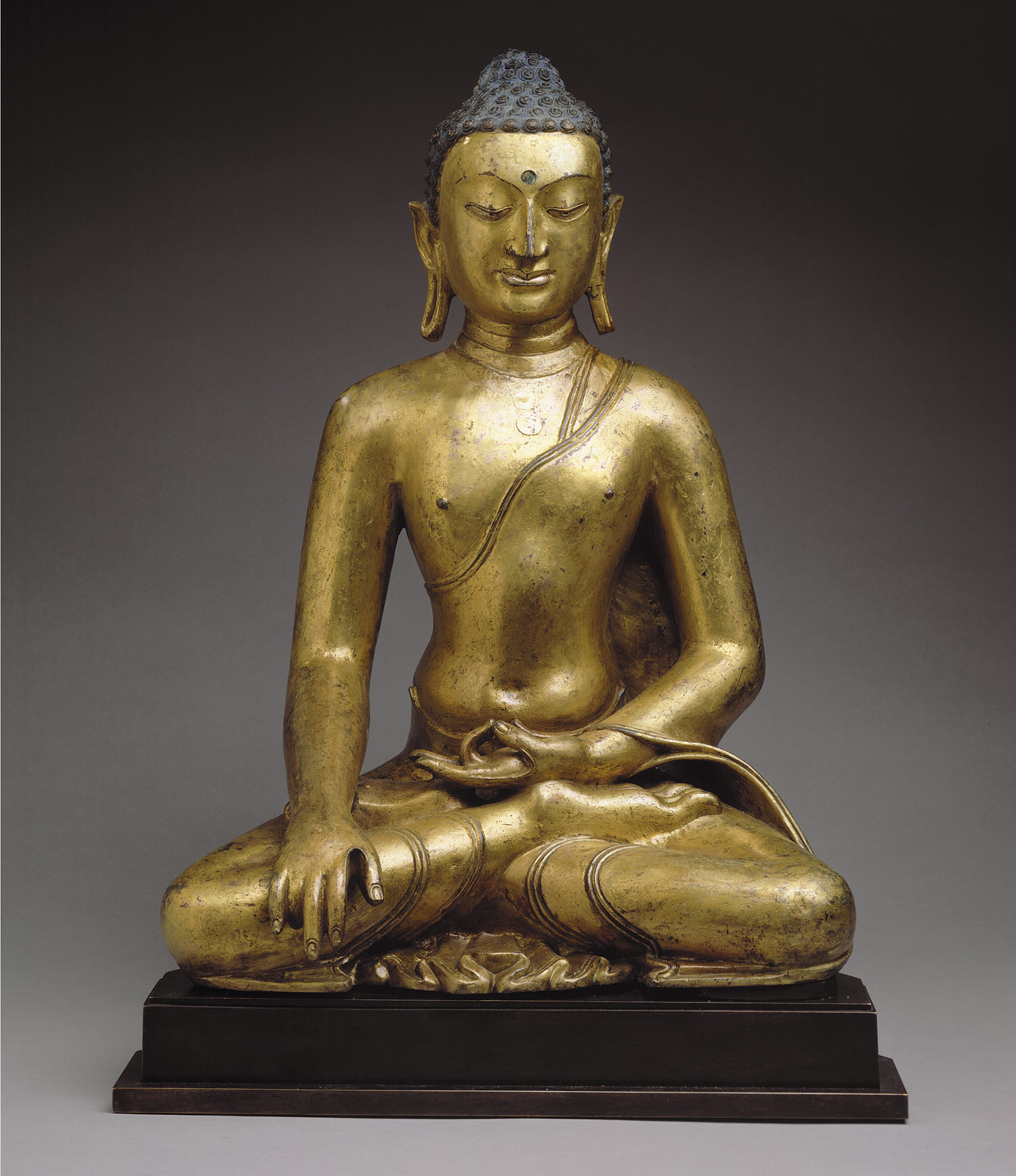
What do I do with a statue of Buddha?

  • Thread starter Thread starter blaskoman
  • Start date Start date
Status
Not open for further replies.
Edwin,

Your argument seems to be of a relativistic nature
Again, you like big resounding terms which you don’t bother to define. I assure you that I do believe some things are always true and good and others are always bad and false. Your misuse of language and your willingness to make uninformed and unjust remarks about other religions is the kind of behavior that is always bad and false. So no, I’m not a relativist and you’re just starting one more false trail to distract from the indefensibility of your position.
as is obvious with your objections to terms such as “objective Truth” “false religions” etc.
It has nothing to do with relativism. It has to do with precise use of language.
Concerning the latter there is no point in putting more meaning into the term than is necessary which only illustrates a certain level of misunderstanding or possibly bad will. Had I wanted to express the idea of a completely false religion I would have said so by use of the terms “utterly false religion” or “completely false”.
Sorry, but that doesn’t work in the context of this discussion. Let me refresh your memory. You advocated the destruction of an image of the Buddha, and defended this by appealing to the actions of ancient saints who destroyed the images of European deities. Furthermore, in post 89 you compared the statue of Buddha to “a statue of the devil,” arguing that if one should be destroyed then the other should as well. The only reasonable conclusion to draw is that for you there is no significant difference among Buddhism, ancient European paganism, and Satan worship with regard to the level of falsehood and evil found among them. That is the context in which I was interpreting your use of the term “false religion.” If you do not think that Buddhism as as false as Satanism or various forms of ancient European paganism (not that those two are by any means the same thing), then it is only your fault that I didn’t get the message.

This is what we are arguing about: your explicit comparison of the veneration of Buddha to
a) the worship of ancient pagan deities and
b) the explicit and deliberate worship of Satan.
I thought my apple anaolgy would get the point across but evidently that is not possible if you cannot tell the difference between a fruit that is “going bad” and one that is bad. The former consists of an advanced degree of ripening which some may not find suitable to their liking but nevertheless completely edible. The latter consists of an advanced stage of decay, inedible without bodily harm. My example was of the latter.
But what you have not done is make the case that Buddhism is analogous to a fruit in “an advanced stage of decay, inedible without bodily harm” rather than one that has some bad bits.
The implication of your arguments would induce someone to believe that buddhism expresses enough truth that one should leave it alone; they’re well on their way.
Again, you are using vague language. What do you mean by “leave it alone”? I certainly don’t think that Christians should refrain from talking about their faith to Buddhists. I don’t think human beings should ever “leave each other alone” in the sense of refraining from interacting with other human beings in a way that conduces to our mutual pursuit of truth, beauty, and goodness. And what Christians have to bring to that mutual pursuit is the message of the Gospel. Of course we should share it.

And of course one can’t say that all Buddhists are “well on their way” to final union with God. Some may be treading the path of destruction. So may many Christians.

If “leave it alone” means that we shouldn’t go around destroying statues of Buddha (which is, after all, the subject of this thread), then yes, I think we should leave Buddhism alone. I don’t think we can say with confidence that the veneration of Buddha is a wicked thing analogous or equivalent to the worship of Satan. In fact, I think I can say with some degree of confidence that it isn’t.
 
This is not a Christian attitude and we’re called to make believers of all men.
You are flirting with heresy again: Pelagianism this time. We can’t make believers of anyone. (Matt. 28 doesn’t say “make believers”; it says “make disciples.”) We are called to witness the Gospel to all nations and invite them to join us on the path of Christian discipleship.
This naturally begs the question of whether or not emphasizing the elements of truth in whatever religion actually does more harm than good.
Wrong question. We should ask whether something *is *good, not whether it does good. What is good naturally does good, although it can be perverted (which is not the fault of the good). What is not good may be used by divine Providence to bring forth good, but we can’t presume on that.

The question to ask is: is it intrinsically better to contemplate good or to contemplate evil? The answer should be obvious. Evil is not even a thing in itself. Focus on it is neither good nor healthy. We have to address evil, of course. But only so that we can more clearly articulate and promote the good.
If it breeds a spirit of complacency then it should be rejected
And I can say that focusing on the errors of other religions breeds a spirit of hatred. We can go round like that all day and get nowhere. That’s why we should focus on intrinsic and not pragmatic good, and let pragmatic good take care of itself. You do what’s good and let God worry about the results.
because Christ desires that all men should come to the knowledge of the Truth [yes, objective Truth]. You are correct when you quote the Church in saying that She does not reject the elements of truth in each religion - how can she? However, that should not be interpreted as the need to emphasize it to the point of hyper-exaggeration.
Again, you’re using vague language that doesn’t really mean anything. What is “hyper-exaggeration”? How would you go about showing that I’m guilty of it? You aren’t really saying anything at all.

All I’m saying is that we should say what is true and not what is false. Equating a statue of the Buddha with a statue of the devil is clearly saying what is false. Therefore it is bad, regardless of your allegedly noble intentions (how you think comparing Buddha to the devil is going to persuade Buddhists to become Christians is beyond me, but that’s not really the issue I care about anyway for the reasons I’ve given). And you call me a relativist! You are the one saying something false in order to bring about a good result.
Because something contains a sliver of truth does not make it acceptable to openly embrace nor to adopt an attitude of indifference towards it. satanism contains at least a fiber of truth as it acknowledges the existence of the soul, spiritual beings etc.
I’m really not even sure what you are talking about when you talk about “Satanism.” If you’re talking about LaVeyan Satanism–the only kind that as far as I know can be proven to exist as an organized entity–then I think you’re wrong (I don’t believe that LaVeyan Satanists believe in spiritual beings–they use “Satan” as a metaphor). But furthermore, you’re missing the connection I’m drawing (in connection with the entire Christian tradition) between truth and goodness. Of course a deliberate, literal worshiper of Satan (if such a thing exists) would by definition believe something true. And of course we would have to agree with him or her about that. But the moral and religious teaching of the Satanist would be the reverse of the truth. The Satanist (in the literal sense) worships what is evil and seeks to become like it.

On the other hand, the Buddhist believes some things which we as Christians understand to be false (such as that there is no Creator). And insofar as Buddhists believe error, we should of course reject that error (with due humility about the limits of our understanding both of the infinite reality of God and of the nuances of Buddhist teaching). Error is bad and keeps people from God. But the things Buddhists venerate as good and holy and noble are in fact good and holy and noble. That is the specific kind of truth that is most relevant when answering the question “What do I do with a statue of Buddha?”
This whole topic is getting way off
I’m not getting way off. Everything I’m saying is relevant to the OP’s question. I’ll let you speak for yourself. I think I’ve answered your closing question above.

Edwin
 
On the other hand, the Buddhist believes some things which we as Christians understand to be false (such as that there is no Creator)…
…which is not exactly true. Obviously, Buddhists believe the universe exists, and they also believe that the universe is ‘created’ in some sense, and thus has a ‘creator’. On one level, the karma, or action, of sentient beings, creates the ‘universe’ that they experience. On another level, the physics of Theravada posits that each material entity arises into existence, exists, and passes out of existence, many thousands or millions of times per second. Such is a type of ‘creatio ex nihilo’, but without a conscious being controlling it.
 
If you like Asian art, you can hang up these beautiful pictures. In the meantime, I’d stash that buddha in the garage.
upload.wikimedia.org/wikipedia/commons/thumb/3/36/Maria_Kannon.jpg/400px-Maria_Kannon.jpg

During the Tokugawa shogunate period in Japan, when Christianity was banned and punishable by death, some underground Christian groups venerated the Virgin Mary disguised as a statue of the Bodhisattva Avalokiteshvara/Kuan Yin/Kannon; such statues are known as Maria Kannon.

rossum
 
Edwin,

To put things back into perspective: this is about a Christian with a statue of buddha. This isn’t about how to “persuade Buddhists to become Christians” [speak about semi-pelagianism].

It would be scandalous, in the least, for a Christian to have a statue of Buddha in their home in any area of prominence or in a manner suggesting reverence or religious usage. The OP is within his rightful duty to dispose of said statue in the manner I suggested (or any other manner) as long as he was not intending to use such an occasion as a public (or private) act of hatred towards individuals – which no one suggested - which would make the act offensive to God.

As Christians, we love the Buddhist but not their religion. There being only one True religion [Christianity – specifically Catholicism] all others are false despite what little truth may be found in them which is what is meant by the term “false religion.” False religions may vary in their quantity of truth but this is the common usage of the word among Catholics and protestants who are not of a liberal persuasion - the latter finding the term, and concept, offensive.

It would probably be more appropriate to continue in a new thread if you would like to further discuss the other issues.
 
If you like Asian art, you can hang up these beautiful pictures. In the meantime, I’d stash that buddha in the garage.

http://mattstone.blogs.com/photos/asian_icons/christmas2004_our_lady_of_china_with_chi.jpg

An image of Hathor would be better:​

(Please Note: This uploaded content is no longer available.)

http://www.geocities.com/lilith1969_my_t_fine/bastet.jpg

And, just to be ecumenical:


And finally:

(Please Note: This uploaded content is no longer available.)

🙂
 
A common mistake that non-Buddhists make when talking about Buddhism is to refer to the “extinction of self”. You can no more extinguish your self than you can kill a unicorn. Neither your ‘self’ nor unicorns exist. What can be extinguished is the mistaken belief that you do have a ‘self’. Things are not always what they appear to be, and the appearance of self is one of those misleading things.

The Buddha classified other religions as useful and not useful. Most versions of Christianity fall into the useful category. I would make an exception for the extreme forms of Calvinism where our actions have no consequences. A useful religion links our actions to the consequences of those actions.

rossum

Is nirvana:​

  • freedom from egotism
  • freedom from ego
  • freedom from control by the passions
  • freedom from the passions
alone or else in combination ? Pardon my ignorance :o 🙂

It sounds a bit like the virtue called “detachment”, but also like Stoic apatheia, “indifference” - which is something very different. Both of which are different from control by the passions, but in different ways.
 

Is nirvana:​

  • freedom from egotism
  • freedom from ego
  • freedom from control by the passions
  • freedom from the passions
alone or else in combination ? Pardon my ignorance :o 🙂

It sounds a bit like the virtue called “detachment”, but also like Stoic apatheia, “indifference” - which is something very different. Both of which are different from control by the passions, but in different ways.
THe best description of nirvana from a Christian perspective I have seen is by Thomas Merton:[At Polonnaruwa] I am able to approach the Buddhas barefoot and undisturbed, my feet in wet grass, wet sand. Then the silence of the extraordinary faces. The great smiles. Huge and yet subtle. Filled with every possibility, questioning nothing, knowing everything, rejecting nothing, the peace not of emotional resignation but of sunyata, that has seen through every question without trying to discredit anyone or anything - without refutation – without establishing some argument. For the doctrinaire, the mind that needs well established positions, such peace, such silence, can be frightening.

I was knocked over with a rush of relief and thankfulness at the obvious clarity of the figures, the clarity and fluidity of shape and line, the design of the monumental bodies composed into the rock shape and landscape, figure rock and tree. And the sweep of bare rock slopping away on the other side of the hollow, where you can go back and see different aspects of the figures. Looking at these figures I was suddenly, almost forcibly, jerked clean out of the habitual, half-tied vision of things, and an inner clearness, clarity, as if exploding from the rocks themselves, became evident and obvious. The queer evidence of the reclining figure, the smile, the sad smile of Ananda standing with arms folded (much more “imperative” than Da Vinci’s Mona Lisa because completely simple and straightforward).

The thing about all this is that there is no puzzle, no problem and really no “mystery.” All problems are resolved and everything is clear, simply because what matters is clear. The rock, all matter, all life is charged with dharmakaya… everything is emptiness and everything is compassion. I don’t know when in my life I have ever had such a sense of beauty and spiritual validity running together in one aesthetic illumination. … I mean, I know and have seen what I was obscurely looking for. I don’t know what else remains, but I have now seen and have pierced through the surface and have got beyond the shadow and the disguise. …

It says everything, it needs nothing. And because it needs nothing it can afford to be silent, unnoticed, undiscovered. It does not need to be discovered. It is we who need to discover it.

From: The Asian Journal of Thomas Merton
alternatively, though not from a Christian perspective:There is, monks, an unborn, an unbecome, an unmade, an unconditioned. If there were not that unborn, unbecome, unmade, unconditioned, no escape would be possible from the born, become, made, conditioned. But precisely because there is an unborn, unbecome, unmade, unconditioned, escape from the born, become, made, conditioned is possible.

Udana 8.3

rossum
 
…which is not exactly true. Obviously, Buddhists believe the universe exists, and they also believe that the universe is ‘created’ in some sense, and thus has a ‘creator’. On one level, the karma, or action, of sentient beings, creates the ‘universe’ that they experience. On another level, the physics of Theravada posits that each material entity arises into existence, exists, and passes out of existence, many thousands or millions of times per second. Such is a type of ‘creatio ex nihilo’, but without a conscious being controlling it.
And that’s what I meant by saying that Buddhists do not believe in a “Creator.”
The classical Christian understanding of creation is actually not about time, so the idea of an eternal universe isn’t really the main question (not that you said it was). The question is whether there is an eternal being whose act causes all other beings to exist. As I understand it, Buddhists deny this. Am I wrong?

The website to which you linked describes two “postulates” of Western monotheistic religions with regard to creation. Only the first is central to the Judaeo-Christian-Islamic concept of creation. The second is more complex than the website indicates. I’m not sure what they mean by “relatively recently.” Are they trying to suggest that Christians, Jews, and Muslims generally or unanimously take Biblical chronology literally? Because I certainly don’t, and even conservative opponents of evolution in the 19th century generally accepted an old earth. That the universe was created at a point in time is traditionally regarded by Christians as a matter of faith. However, St. Thomas Aquinas (probably the greatest Christian philosopher) insisted that the doctrine of creation was quite possible even with an eternal universe. In other words, God could have chosen to create a universe with no beginning and no end, eternally dependent on God’s creative activity. He thought that the Bible ruled out this possibility. But when Thomists at least speak of “creation” they aren’t speaking of something that essentially involves a beginning in time.

Edwin
 
Edwin,

To put things back into perspective: this is about a Christian with a statue of buddha. This isn’t about how to “persuade Buddhists to become Christians” [speak about semi-pelagianism].
I was paraphrasing what you seemed to be saying when you spoke of the Church desiring all people to come to the knowledge of the truth and of the need not to be “complacent” about this. I apologize if I paraphrased you incorrectly. However, you are the one who introduced evangelistic concerns into the thread, so it’s odd for you to “remind” me to “put things back into perspective.” I am focused on the question of how a Christian ought to treat a statue of a person who as far as we know was virtuous and a sincere seeker of truth, and who is venerated by members of the religious he founded for these qualities. You made the outrageous suggestion that our attitude to an image of such a person should be analogous to the attitude of early Christians toward pagan deities (whom they regarded as demonic largely because of their at best ambiguous moral character) or the attitude we would take toward a (hypothetical–no such thing exists as far as I know) statue of Satan. So yes, please let’s keep things in perspective. Don’t accuse me of “relativism” or of fostering evangelistic “complacency” because I think that we should distinguish between what is virtuous, what is morally ambiguous, and what is clearly evil.
It would be scandalous, in the least, for a Christian to have a statue of Buddha in their home in any area of prominence or in a manner suggesting reverence or religious usage.
I am sensitive to that concern, and I would not feel comfortable displaying such an image in such a way myself. I would either display it in a manner that suggested it was an object of art, or I would dispose of it respectfully (perhaps offer to donate it to a Buddhist monastery or a museum). What I’m objecting to is your claim that it should be destroyed because early Christians destroyed the statues of Indo-European deities and because we would all destroy a statue of Satan.
As Christians, we love the Buddhist but not their religion.
It’s not that simple. We must love truth and virtue wherever we find it. The pursuit of virtue, the restraint of the passions, the practice of compassion, harmony with that which is ineffably beyond the world of becoming and craving–these things are central to Buddhism (well, the last point is tricky and perhaps truer of Mahayana than Theravada–but I’ll let the Buddhists comment if I misspoke). If we do not love these things, we are worse Christians, not better ones.
There being only one True religion [Christianity – specifically Catholicism] all others are false despite what little truth may be found in them
How do you define “little”? I don’t think that the things that I have described are “little.” Nor do I find *Lumen Gentium *or the Catechism speaking in such a dismissive way.
which is what is meant by the term “false religion.” False religions may vary in their quantity of truth
“may”? I think that the official teachings of your Church leave no doubt about the matter.
but this is the common usage of the word among Catholics
then perhaps you could point me to an official Catholic document of the past forty years which uses that term.
It would probably be more appropriate to continue in a new thread if you would like to further discuss the other issues.
I think that the issues we are discussing are extremely relevant to the question of whether a Christian ought to destroy a statue of Buddha in a manner calculated to express a lack of respect for Buddhism.

If the moderators disagree, I will bow to their decision.

In Christ,

Edwin
 
My wife is a Roman Catholic originally from Asia. She has a statue of Buddha in her flower garden. She does not worship this statue. It is for good luck only. No different than a horeshoe, or a rabbit’s foot, or a four leaf clover. I see no harm.
 
Edwin,

Do you think buddhism is contrary to the first commandment?
 
My wife is a Roman Catholic originally from Asia. She has a statue of Buddha in her flower garden. She does not worship this statue. It is for good luck only. No different than a horeshoe, or a rabbit’s foot, or a four leaf clover. I see no harm.
You don’t see any harm or superstition in charms?
 
As long as you don’t go overboard with it. Think of it like this… I have nothing against a basketball player that has a lucky pair of socks or a football player that has a lucky head band.
 
Edwin,

Do you think buddhism is contrary to the first commandment?
If someone who knew Yahweh the God of Israel turned to Buddhism as an alternative because it was more comforting to look at one’s own navel than to worship the living God, then that would be contrary to the first commandment. But of course I can’t judge that any individual–even a Christian or other monotheist who became Buddhist–is actually doing that. To say that Buddhism as a whole is contrary to the first commandment makes no sense. In fact, I would say that insofar as Buddhism called people away from the worship of the Hindu devas and away from the idea of offering sacrifices in order to get power in this world or the next, its basic message was an approximation of the First Commandment.

To a lesser degree, one could even make this argument about the Bhagavad-Gita’s message of devotion to the Supreme Deity, or the Katha Upanishad’s condemnation of Nagasena’s father’s selfish attitude toward his relationship with the gods. Note that I say “to a lesser degree”–and I’m not claiming that any of the Indian traditions teach the First Commandment, only that to one degree or another there are elements that point people away from the selfish adoration of limited beings and toward something, however vaguely understood, that is purer and more transcendent.

Edwin
 
Re: What do I do with a statue of Buddha?

Do with it what you will. I have seen Mahayana temples with thousands of wall relief images of Buddha. This is to remind followers that Buddha nature is everywhere. Veneration of Buddhist statues is completely empty of merit.

Namaste
 
As long as you don’t go overboard with it. Think of it like this… I have nothing against a basketball player that has a lucky pair of socks or a football player that has a lucky head band.
Attributing any power to it is to engage in superstition.
 
Question: Do you think buddhism is contrary to the first commandment?
If someone who knew Yahweh the God of Israel turned to Buddhism as an alternative because it was more comforting to look at one’s own navel than to worship the living God, then that would be contrary to the first commandment. But of course I can’t judge that any individual–even a Christian or other monotheist who became Buddhist–is actually doing that. To say that Buddhism as a whole is contrary to the first commandment makes no sense. In fact, I would say that insofar as Buddhism called people away from the worship of the Hindu devas and away from the idea of offering sacrifices in order to get power in this world or the next, its basic message was an approximation of the First Commandment.

To a lesser degree, one could even make this argument about the Bhagavad-Gita’s message of devotion to the Supreme Deity, or the Katha Upanishad’s condemnation of Nagasena’s father’s selfish attitude toward his relationship with the gods. Note that I say “to a lesser degree”–and I’m not claiming that any of the Indian traditions teach the First Commandment, only that to one degree or another there are elements that point people away from the selfish adoration of limited beings and toward something, however vaguely understood, that is purer and more transcendent.

Edwin
Your answer settles the matter. Thanks for your honest reply.
 
Status
Not open for further replies.
Back
Top