I would approach this from a different angle.
Ancient Israelite religion, aside from a few distinctive characteristics, was not really different from that of other West Semitic religions in general. In Exodus for instance, God commands Moses to construct altars for the Tabernacle: the golden altar of incense and the brazen altar of sacrifice. Curiously, these altars have horns in them. The dig is, horned altars are not unique to the Israelites. In many archeological digs in the Holy Land, a number horned altars have been found, many of them unrelated to Israel.
http://img503.imageshack.us/img503/1504/ekronironiihornedaltars.jpg
Horned altars from Iron Age-II (10th-6th centuries BC) Ekron, modern-day Tel Miqne.
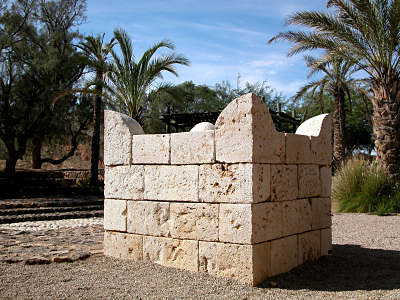
An altar at Beersheba, probably connected to a temple or cult center in the city. When Tel Be’er-Sheva was first excavated, archeologists discovered sandstone blocks in the walls of storehouses - most of the blocks used in the ancient city was made of limestone. They eventually took these blocks and reconstructed the altar, as shown here. It is thought that the altar was dismantled during the reforms of King Hezekiah in circa 8th century BC.
Plus, sacrifice of animals and incense ain’t really a unique custom to the sons of Israel. Also, we have the Ark of the Covenant, functioning both as the receptacle of the Law and God’s portable throne-chair: well, we do have gods and Pharaohs in Ancient Egypt who are
carried around in box-like litters or shrines too. Some find a parallel between the cherubim on the
kapporet - loosely paraphrased as ‘mercy-seat’ - and the winged humans/human-animal hybrids/animals
usually seen flanking or overshadowing
the thrones of kings and gods in the Ancient Near East and
Ancient Egypt as well (sometimes they are seen
riding on them as well).
The Temple of Solomon sports many features which are also present in other Ancient Near Eastern temples, in part due to the Tyrian workers and craftsmen who helped built it: say, that ‘cherubim-palm tree-flower’
motif that decorated the interior walls, or the idea of having two big pillars in front of the entrance themselves. In layout, appearance and iconography, it would not have looked that much different from any other temple you can see in other areas. The Temple has for example the private, innermost sanctuary usually dubbed in scholarly parlance the
adyton (Hebrew:
debir) usually containing the cult image of the deity being worshipped inside the edifice (in the case of the Israelites, the one contained inside the the ‘
Holy of Holies’ is the box which also served as the throne of their unseen God), a rectangular room called the
cella (Hebrew:
heikal), and a
pronaos (aka
ulam) or an outer hallway. A courtyard surrounding the god’s house, marked with stones, is also one common feature.
All of the elements I have mentioned also exist among other, ‘pagan’ ANE cultures, but they are not in itself ‘evil’ or ‘satanic’ just because they were used by these peoples. The lesson is: ‘pagan’ usually does not automatically equal ‘evil’. Ultimately I don’t care whether the symbol of the eye or the image of a mother and child or cross-like geometric shapes were used in other pre-Christian cultures. I think G.K. Chesterton summed it best.
It is often said by the critics of Christian origins that certain ritual feasts, processions or dances are really of pagan origin. They might as well say that our legs are of pagan origin. Nobody ever disputed that humanity was human before it was Christian; and no Church manufactured the legs with which men walked or danced, either in a pilgrimage or a ballet. What can really be maintained, so as to carry not a little conviction, is this: that where such a Church has existed it has preserved not only the processions but the dances; not only the cathedral but the carnival. One of the chief claims of Christian civilisation is to have preserved things of pagan origin. In short, in the old religious countries men continue to dance; while in the new scientific cities they are often content to drudge.
But when this saner view of history is realised, there does remain something more mystical and difficult to define. Even heathen things are Christian when they have been preserved by Christianity. Chivalry is something recognisably different even from the virtus of Virgil. Charity is something exceedingly different from the plain pity of Homer. Even our patriotism is something more subtle than the undivided love of the city; and the change is felt in the most permanent things, such as the love of landscape or the love of woman. To define the differentiation in all these things will always be hopelessly difficult. But I would here suggest one element in the change which is perhaps too much neglected; which at any rate ought not to be neglected; the nature of a vow. I might express it by saying that pagan antiquity was the age of status; that Christian mediaevalism was the age of vows; and that sceptical modernity has been the age of contracts; or rather has tried to be, and has failed.



