T
TimothyH
Guest
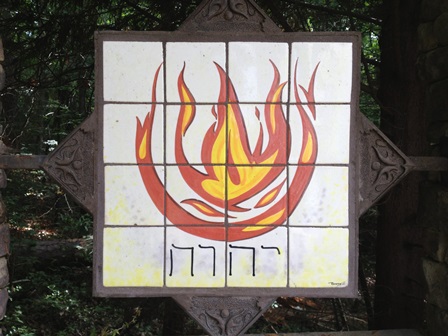
It is an image of the burning bush so I’m sure it has something to do with Moses or “I AM” or YHWH or similar.
-Tim-

-Tim-

It is “yiroh” in Hebrew, which means awe or reverence.It is an image of the burning bush so I’m sure it has something to do with Moses or “I AM” or YHWH or similar.
http://timhollingworth.webs.com/img/IMG_3242.JPG
-Tim-
I hate to disagree with you (Especially since you probably speak the language and I don’t) but that is the Tetragramaton. Read from right to left, the letters are: Yodh He Waw He.It is “yiroh” in Hebrew, which means awe or reverence.
P.S. I have to get back to you, Tim, on another post…
It’s not the best Vav in the world, but clearly given the context of the burning bush account, you are correct.I hate to disagree with you (Especially since you probably speak the language and I don’t) but that is the Tetragramaton. Read from right to left, the letters are: Yodh He Waw He.
The vowel points were added by the Masorites to make it easier to read, but that has no bearing on how it was actually pronounced in ancient Hebrew.This is the word Jehovah in Hebrew read from right to left, actually Yehovah. However, Jews never pronounce it that way and say Adonai, in its place. Adonai is God. There are several other Hebrew renditions of God’s name which are always spoken as Adonai even though they are spelled completely differently . Readers just know what to say.
No Yahovah/Jehovah in the Bible.This is the word Jehovah in Hebrew read from right to left, actually Yehovah. However, Jews never pronounce it that way and say Adonai, in its place. Adonai is God. There are several other Hebrew renditions of God’s name which are always spoken as Adonai even though they are spelled completely differently . Readers just know what to say.
No Yahovah/Jehovah in the Bible.

The word Jehovah/Yehovah/Yahovah is a mis-reading of Yahweh, mistakenly combing the consonants of Yahweh with the vowel pointing of Adonai. It’s an error. With the name of God, no less.
The word Jehovah/Yehovah/Yahovah is a mis-reading of Yahweh, mistakenly combing the consonants of Yahweh with the vowel pointing of Adonai. It’s an error. With the name of God, no less.
 That makes much more sense.
you are correct about this common error.The word Jehovah/Yehovah/Yahovah is a mis-reading of Yahweh, mistakenly combing the consonants of Yahweh with the vowel pointing of Adonai. It’s an error. With the name of God, no less.
You’re absolutely correct! Sorry, Tim. Next time I’ll put on my eyeglasses.Being that my native tongue is Ladino/Hebrew, I must concur with the others that the word in question is indeed the Tetragrammaton, YHWH.
Only in liturgical settings is Adonai generally substituted. Many Ashkenazi Jews say “HaShem” (Hebrew for “The Name”) in common conversation when speaking of G-d by name. And while Judeo-Spanish Ladino doesn’t have this convention, the Spanish word for G-d “Dios” is generally said without the “s” at the end (“Dio”) when YHWH is specifically meant.
“Yirah” is spelled יִרְאָה. The word here in the photo is יהוה.
While “Jehovah” does not represent the way “HaShem” was originally pronounced, it does occur in some Bibles, especially in some languages where the pronunciation of YHWH was developed on the basis of that mispronunciation.
