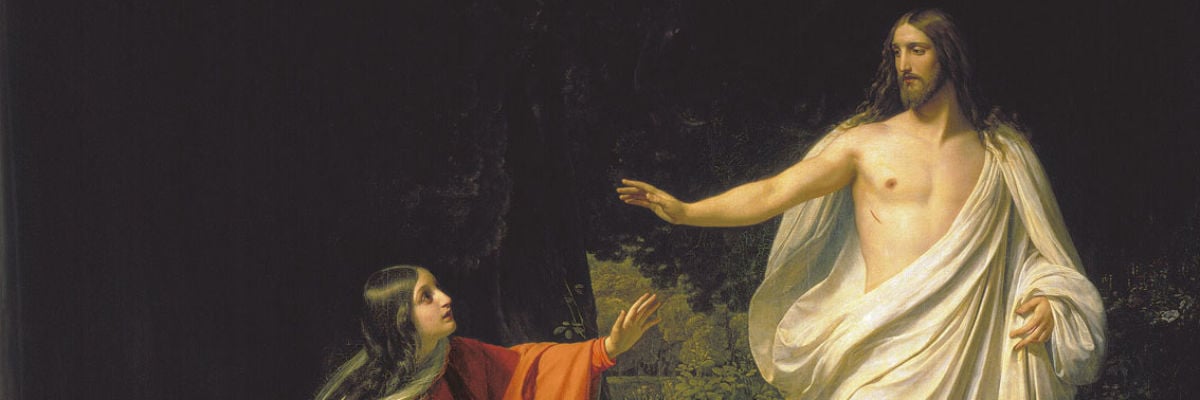
Why couldn't Mary Magdalene hold onto Jesus?

  • Thread starter Thread starter Prodigal1984
  • Start date Start date
Status
Not open for further replies.
P

Prodigal1984

Guest
Jesus said to her, “Stop holding on to me, for I have not yet ascended to the Father. But go to my brothers and tell them, ‘I am going to my Father and your Father, to my God and your God.’” Mary Magdalene went and announced to the disciples, “I have seen the Lord,” and then reported what he told her.

Why exactly couldn’t Mary hold him before he ascended? Would it tarnish him or something? Would it prevent him from being able to ascend? I never understood this.
 
I’m perplexed too, since Christianity revolves on union, this makes me wonder if there is contradiction or not.
 
Last edited:
But you have things like Jesus “Come to me…” Matthew 11:28.
 
It was never Jesus’ plan to stay in this world always, and His resurrection was not to be seen as His promised return. That is why He tells Mary of the ascension. His plan was to ascend to the Father and then send the Holy Spirit ([John 16:7] Fellowship with Jesus would continue, but it would be a spiritual communion, not a physical presence.

In loosening Mary’s hold on Him, Jesus was, in effect, saying this: “I know you desire to keep Me here, always present with you. I know you want everything to be just the same as before I died. But our relationship is about to change. I’m going to heaven, and you will have the Comforter in My place. You need to start walking by faith, Mary, not by sight.”
 
I have heard a few things, none having to do with cleanliness or being tarnished.

One is that we’re to understand that we couldn’t just cling to Jesus’ body. He had to go an ascend to the Father. Mary Magdalena had to learn to let go in that sense.

Haydock’s commentary focuses on the opposite point.
Ver. 16. Jesus saith to her, Mary. Magdalene, now in grief and tears, knew not Jesus, till he called upon her by her name, and with his usual voice: then with joy, she cried out, Rabboni, Master. And Jesus saith to her, touch me not, &c. The meaning of which words seems to be: I am not yet leaving thee, nor ascending to the Father, so that thou mayest have time enough to embrace my feet afterwards; now go to my disciples, &c. Wi. — Magdalene, having inquired where he had placed him, appears to have turned towards the angels, to inquire the cause of the awe and reverence she had observed in them. Upon this, Jesus calls upon her by name, and she, turning again towards him, discovers him by his voice. S. Chrys. hom. lxxxv. in Joan
Interestingly, both points are true.
 
Last edited:
Also, Thomas Aquinas collected some early Patristic commentary in the Catena Aurea.
GREGORY. (Hom. xxv.) The Evangelist does not add what she did upon recognising Him, but we know from what our Lord said to her: Jesus saith unto her, Touch Me not. Mary then had tried to embrace His feet, but was not allowed. Why not? The reason follows: For I am not yet ascended to My Father.

AUGUSTINE. (Tr. cxxi. 3) But if standing upon the earth, He is not touched, how shall He be touched sitting in heaven? And did He not before His ascension offer Himself to the touch of the disciples: Handle Me and see, for a spirit hath not flesh and bones? (Luke 24:39) Who can be so absurd as to suppose that He was willing that disciples should touch Him before He ascended to His Father, and unwilling that women should till after? Nay, we read of women after the resurrection, and before He ascended to His Father, touching Him, one of whom was Mary Magdalene herself, according to Matthew. Either then Mary here is a type of the Gentile Church, which did not believe in Christ till after His ascension: or the meaning is that Jesus is to be believed in, i. e. spiritually touched, in no other way, but as being one with the Father. He ascends to the Father mystically, as it were, in the mind of him who hath so far advanced as to acknowledge that He is equal to the Father. But how could Mary believe in Him otherwise than carnally, when she wept for Him as a man?

AUGUSTINE. (i. de Trin) Touch is as it were the end of knowledge1; and He was unwilling that a soul intent upon Him should have its end, in thinking Him only what He seemed to be.

CHRYSOSTOM. (Hom. lxxxvi. 2) Mary wished to be as familiar with Christ now, as she was before His Passion; forgetting, in her joy, that His body was made much more holy by its resurrection. So, Touch Me not, He says, to remind her of this, and make her feel awe in talking with Him. For which reason too He no longer keeps company with His disciples, viz. that they might look upon Him with the greater awe. Again, by saying I have not yet ascended, He shews that He is hastening there. And He who was going to depart and live no more with men, ought not to be regarded with the same feeling that He was before: But go to My brethren, and say unto them, I ascend unto My Father, and your Father; and to My God, and your God.

 
Last edited:
Like many Biblical passages, it has a myriad of possible interpretations.

I always went for the basic common sense one: “Mary, I’m not yet ascended, there will be time for all that later, quit hugging on me as I have to go do something else now, and run and tell the others.”
 
@Prodigal1984, you have asked an interesting question and I apologize for shooting off at a tangent. I wasn’t aware of this translation, “Stop holding on to me.” I don’t know which translation you’re quoting from, but very many modern translations choose an expression of this kind, such as “Don’t hold on to me” or “Stop clinging to me.” This arouses my curiosity. The Greek verb haptomai, which Matthew uses here, is found 36 times in the NT and is nearly always translated as “touch” (link below). In older English Bibles, such as the KJV, the Douay Rheims, and the RV, Jesus’ words to Mary Magdalene here in John 20:17 always appeared as “Do not touch me” or “Touch me not.” Why has this changed? Where does the idea of “clinging” come from, instead of “touching”? Does anyone know?

https://biblehub.com/greek/strongs_680.htm
 
To me, the interpretation that makes most sense is that Jesus said this for Mary Magdalene’s benefit. Because she still saw Him as more human than divine. And so by this command He made her understood He was now in a glorified body not a human body.
 
I somehow don’t think a person in grief who goes to the graveyard and suddenly finds their newly dead friend’s tomb open and empty and the dead friend walking around looking nothing like himself, is going to grasp the finer points of glorified bodies and theology right at that moment.
 
Yes grief can make a person irrational so maybe this is why she needed to be told this. God is wiser than us humans.
 
As was said there are many interpretations to Bible passages. Much interpretation is as much or more art than science. In Matthew Jesus also tells the apostles he met after the resurrection to go and tell the brethren. Some interpretations say the word used in John is better translated as “cling” than “hold”. Jesus had business to attend and he requested for Mary to fulfill her duty. He would be back in spirit and in the Sacraments.
 
I’m not sure. I copy pasted the translation the Universalis app uses.
 
Found this article from Catholic Answers for some guidance on this

 
The two disciples on the road to Emmaus. Mary of Magdala. The twelve in the upper room. Thomas by himself. All had spent three years with Him - yet not one recognized Him by either appearance or voice until He chose to reveal Himself.

He was resurrected in His glorified Body, and it not only had a different physical appearance (i.e. at the Transfiguration), but was of a different substance, having defeated death.

Perhaps He was then the living, breathing Eucharist, and was to be received, rather than taken - which applies to this day. The resurrection was a sea change in all of human history, and something about the “firstborn of the dead” is simply beyond all human comprehension.
 
Can you explain a bit what you mean by glorified not human body? I am under the impression that Christ’s resurrection was of his human body.
 
Still 100% human in His Body. But, having defeated death, He can no longer suffer or die. That Body is both impassable and immortal.
 
Yeah that’s what I thought, was just confused at the not human part of that post.
 
Status
Not open for further replies.
Back
Top