Why do we celebrate Christmas in December?

  • Thread starter Thread starter Polak
  • Start date Start date
Status
Not open for further replies.
More info on early date for Christmas

Shortly thereafter in the second century, Saint Hippolytus (A.D. 170-240) wrote in passing that the birth of Christ occurred on December 25:

The First Advent of our Lord in the flesh occurred when He was born in Bethlehem, was December 25th, a Wednesday, while Augustus was in his forty-second year, which is five thousand and five hundred years from Adam. He suffered in the thirty-third year, March 25th, Friday, the eighteenth year of Tiberius Caesar, while Rufus and Roubellion were Consuls.[vii]

[vii] Saint Hippolytus of Rome, Commentary on Daniel.

Also Hippolytus (ca. 165 – 235 A.D.), in his commentary on Daniel 4:23 wrote: “The first coming of our Lord, that is in the flesh, in which he was born at Bethlehem, took place eight days before the Kalends of January …” (Eight days before the calends of January is December 25)

merriam-webster.com/dictionary/ides

The calends is the first day of the month. The Ides is the middle of the month, or specifically: : the 15th day of March, May, July, or October or the 13th day of any other month in the ancient Roman calendar.

A specific day was referred to as a number of days counting back from either the Calends or the Ides with the Calends or the Ides included as part of that number ( I belive).

Part of Dr Taylor Marshall book can be read here

scribd.com/doc/193812676/Taylor-Marshall-God-s-Birthday

Dr. Marshall defends Dionysius Exiguus as getting the dates right in the 500’s

Read more on Dionysius Exiguus here

WHY DO WE CALL SPRING “SPRING” ?

**This interesting article shows how to demonstrate in ordinary conversation the fact that all human life begins at conception. Without mentioning abortion or other hot button issues you can promote concepts that are inherently pro-life and help rebuild a culture that respects the beauty of life. **

John
 
Also Hippolytus …
“The first coming of our Lord, that is in the flesh, in which he was born at Bethlehem, took place eight days before the Kalends of January …”
(Eight days before the calends of January is December 25) …"
A specific day was referred to as a number of days counting back from either the Calends or the Ides with the Calends or the Ides included as part of that number ( I belive).
Hi,

Just to verifying how the Romans counted the days.
And to counter one misinterpretation which misunderstood
“ante diem VIII Kalendas Ianuarius” [eight days before the Kalends of January]
And mistakenly thought that meant December 24

http://www.timeanddate.com/calendar/roman-calendar.html
The Roman calendar
Calends, Nones, and Ides


Unlike the Julian and Gregorian calendars, the Roman calendar had a different system for numbering the days of the month. The months were divided into day markers that fell at the start of the month, the fifth or seventh day, and in the middle of the month. These 3 markers were called Calends, Nones and Ides.

Calends (Kalendae, Kalends) signify the start of the new moon cycle and was always the first day of the month. It is derived from the Greek word καλειν, “to announce” the days of the full and new moon.
*
Nones* (Nonae) were known to be the days of the half moon which usually occur 8 days before the Ides.
*
Ides* occurred on the 15th day of March, May, July, and October, and the 13th day of the other months. They are thought to have been the days of the full moon.

Each day was referred to by how many days it fell before the Calends, Nones or Ides. For example, March 11 would be known as “Five Ides” to the Romans because it is four days before the Ides of March (March 15).

en.wikipedia.org/wiki/Roman_calendar

… counting back from a named reference day. The reference day itself counted as the first, so that two days before was denoted the third day. …

e.g., a.d. III Kal. Nov. = on the third day before the November Kalends = 30 October.

John
 
The “no sheep outside in the winter” argument was first propagated by an old Scottish killjoy, the Rev. Alexander Hislop, in a turgid little classic of anti-Catholic craziness he first published in 1853, “The Two Babylons: Or: The Papal Worship Proved to be the Worship of Nimrod and his Wife”, a screed filled with hate for all things associated with Catholicism and the source for most of those crazy “The Pope secretly worships Ba’al” things you find nowadays on websites full of typos and blurry photos. Hislop, a Free Church of Scotland Minister who had only a nodding acquaintance with history, anthropology, or, apparently, sanity, may have been thinking about the viciously cold Scottish winters of his homeland when writing that. Jerusalem can get cold, but not Scottish cold. In addition to that kind of provincialism, Hislop filled his book with voluminous footnotes (many misquotes, out of context, or simply made-up) that convinced many of the credulous by sheer volume, but even Ralph Woodrow, who traffics in this sort of thing now, has disavowed Hislop’s poor scholarship.

I will note several things:

I live on about the same latitude line as Bethlehem, and the weather is about the same, at least nowadays. The coldest month of the year in Jerusalem, January, barely gets below freezing. It might have been a little chilly for the shepherds, but guess what? They had access to lots of WOOL, nature’s best insulator, which insulates even when wet. As did the sheep.

If you’d be okay with going out in a thick wool sweater on a cold night, so would the sheep.

The Navajo sheepherders, who face the same approximate weather as the sheepherders in 1st Century Palestine, do, in fact, keep their sheep out in the winter, and the shepherds stay with the sheep at night to prevent coyote attacks…which often come at dark. (And yes, I have actually asked real Navajo shepherds about this.) Like Navajo shepherds, I would presume the shepherds around Bethlehem would have some shelters they could throw up quickly, or that might have been set up permanently, like lean-tos or rock walls, to herd the sheep into if the winds got bad. In temperate climes, like the middle east, sheep are often kept outside year-around.

Sheep do quite well outside, and don’t like the dust that can build up inside standing barns. Keeping sheep inside in temperate coastal climes like Bethlehem is bad for the sheep’s feet, for their metabolic adjustment and it aids in the spread of disease. If you pen the sheep, you will also have to supply them with hay (which would have been in short supply and an additional cost for the owners of the herd in 1st century Palestine, who were probably poor men), it would have been more economical to leave them outside and let them graze. Like the shepherds, the sheep of 2000 years ago were presumably of tougher stock than modern breeds and more able to survive the cold.

You can still see Shepherds outside at night in winter in the Bethlehem area at Christmas time. Most of the time, they’re in short sleeves. Here’s a picture of sheep grazing outside on Christmas day in Jerusalem:
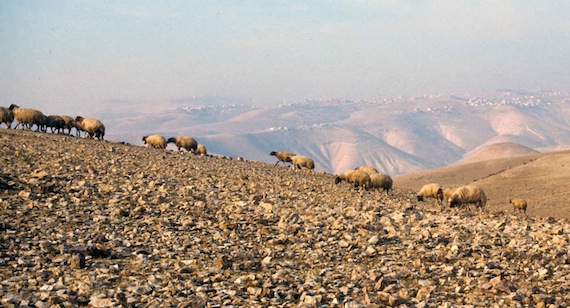


We also don’t know if the shepherds were Jews. They could have been Bedouins, who were nomadic and didn’t (and still don’t) keep their livestock penned, even in winter.

So there is no reasonable objection to the notion that Jesus could have been born on or about December 25. It’s certainly possible, despite what an old Scottish anti-Catholic crank said.

Every Internet expert (atheist or Puritan) who thinks they know about livestock loves to bring this up to try to disparage the the traditional Catholic celebration of Christmas. I think it’s something every Catholic should be able to defend.

 
I would also note that celebrating the date of our holiday on the same date as a minor pagan celebration (if it even existed prior to Christianity, which is doubtful) would not be likely to be a big deal-maker for conversion to the Faith. Why would a proud Roman pagan convert to what would have been seen as a disparaged “Jewish,” sect, whose members were often suppressed and executed by the state, sect just for the chance to have a holiday on the same date?

(And, what pagan holiday were they supposed to have supplanted? Saturnalia was over and done by December 25. The Winter Solstice, which is a floating holiday and does not fall on the same day each year, was not celebrated as a religious holiday by pagans, it was simply observed as an important date in the agricultural calendar to help decide later planting dates. We have no evidence that the Feast of Sol Invictus, was anything more than a minor date in the late Roman political/liturgical calendar, and no evidence that it existed before the Christian celebration of Christmas - the main celebration was in the summer. The creation by the state of Sol Invictus was an attempt to combine multiple solar deity devotions under a neoplatonist umbrella to attempt to unify an empire that was under great internal stress - you will not find any reference to “Sol Invictus” in classical pagan writings, unlike Apollo - and was likely created to try to draw back pagans who were converting to Christianity, as with many of the changes adopted by the neoplatonists to traditional pagan beliefs and practices. )

What actually led to pagan conversions were the following: 1) A worldview that resonated with the human spirit; 2) a religion that valued the marginalized - slaves, women, the poor; 3) Christian witness by martyrdom; 4) Christian witness in a successive wave of epidemics, in which Christians stayed behind in the infected cities to tend to the sick and dying pagans, even as the wealthy fled; and most importantly 5) the miracles accomplished in Jesus’s name through the apostles; 6) the truth of the message that was spread.
 
Status
Not open for further replies.
Back
Top